
 Worksheets
Honors Phys Sci - Solutions, Acids, and Bases Review
Total questions: 110
Worksheet time: 5hrs 4mins
Mia and Michael are making lemonade. They mix sugar into water, creating a physical combination where one substance is dissolved in another. What is this called?
solvent
solute
solubility
solution
Lily, Rohan, and Abigail are having a contest to see who can dissolve sugar the fastest! Lily uses sugar cubes in cold water, Rohan uses powdered sugar in hot water, and Abigail tries sugar cubes in hot water. Who will win the contest by dissolving their sugar the fastest?
Lily with sugar cubes in cold water
Rohan with powdered sugar in hot water
Abigail with sugar cubes in hot water
Powdered sugar in cold water
Rohan and Hannah are conducting a science experiment to see how quickly different substances dissolve. Can you help them by selecting the statements that are true about what affects the rate of dissolution?
Stirring will make a substance dissolve slower
Grinding up a substance will make it dissolve faster
Heating up a substance will make it dissolve faster
Grinding slows down the rate at which something can dissolve because it gives it more surface area
Charlotte, Hannah, and Henry are trying to dissolve sugar in water for their science experiment. Which of the following does NOT affect how quickly the sugar dissolves?
agitation
temperature
pressure
surface area
Scarlett and Michael are working together in the science lab. They want to speed up the process of dissolving sugar in water. Which of these actions would be classified as agitation?
turning up the temperature
stirring
grinding the substance up
melting the substance

Noah and Sophia are conducting a science experiment. They decide to add 40g of KBr to 100g of water at 20 degrees Celsius. What kind of solution do they create?
supersaturated
unsaturated
saturated
complete solution

Samuel and Evelyn are conducting a science experiment! They decide to add 150g of NaClO3 to 100g of water at 60°C. What kind of solution do they create?
saturated
supersaturated
unsaturated
over saturated
Michael and Mason are conducting a science experiment. They decide to add 150g of NaClO3 to 100g of water at 60°C. What kind of solution did they create?
saturated
supersaturated
unsaturated
over saturated

Aria and Noah are conducting a science experiment! They decide to add 60g of KNO3 to 100g of water at 20°C. What kind of solution do they end up with?
over saturated
supersaturated
saturated
unsaturated

Charlotte and Zoe are in the science lab, trying to impress Harper with their chemistry skills! They add 40g of KBr to 100g of water at 80 degrees Celsius. What kind of solution did they create?
unsaturated
over saturated
supersaturated
saturated

Benjamin, Isla, and Lily are testing different liquids in science class using pH strips. If their pH readings are between 1 and 6, what type of solution have they found?
basic
acidic
neutral
soluble

James, Evelyn, and Anika are testing different solutions in science class. If their solution has a pH level between 8 and 14, what type of solution have they discovered?
acidic
soluble
basic
neutral

Ethan and Lily are testing the pH of water in science class. They discover the pH level is 7.0. Can you help them figure out what this means?
basic
acidic
soluble
neutral

Michael and Liam are doing a science experiment! They dip a red litmus paper into a mysterious solution, and it magically turns blue. What does this tell them about the pH of the solution?
acidic
neutral
basic
soluble

Maya, Aria, and Grace are having a contest to find the strongest base in their homes. Which household item would win as the strongest base?
drain cleaner
milk
water
bleach

Kai, Noah, and Avery are having a contest to find the strongest acid in their kitchen! Which household item would win as the most powerful acid?
coffee
blood
battery acid
lemon
Grace and William are baking cookies and discover that baking soda has a pH of 9. Can you help them figure out if baking soda is:
basic
acidic
neutral
soluble
Lily is making lemonade and adds sugar to water. What term describes the sugar that is being dissolved in her solution?
Solute
Solvent
Conductivity
Concentration
William and Harper are making lemonade. They want to know what term describes the amount of solute (like sugar) present in a given amount of solvent (like water). Can you help them out?
Solvent
Concentration
Solute
Conductivity

Arjun, Aria, and Evelyn are having a science experiment to see which solution can light up a bulb the brightest! They have a sugar solution and a NaCl (salt) solution. Which solution will have the highest conductivity and help them win the experiment?
Sugar solution, because sugar molecules dissociate into ions when dissolved in water.
NaCl solution, because NaCl dissociates into ions, which allow the solution to conduct electricity.
NaCl solution, because sugar solutions do not conduct electricity.
Sugar solution, because sugar is a better conductor than NaCl.

David, Lily, and Evelyn are watching a cool science experiment! In the picture, you see a flask with a supersaturated solution of sodium acetate. As they cheer, crystals start forming inside the flask. Once the sodium acetate stops forming crystals, what do you think is left in the flask for our curious trio?
The remaining liquid is a supersaturated solution of sodium acetate in water.
The remaining liquid will be a saturated solution of sodium acetate in water.
The remaining liquid is an unsaturated solution of sodium acetate in water.
The remaining liquid contains only water because the sodium acetate formed crystals.
Daniel and Anika are conducting an experiment to see how quickly sugar dissolves in water at different temperatures. What effect does temperature have on the rate at which solutes dissolve in a specific solvent?
Temperature decreases the rate
Higher temperature increases the rate
Lower temperature increases the rate
Temperature has no effect
Henry and Abigail are racing to see who can dissolve sugar cubes in water the fastest. Henry crushes his sugar into tiny pieces, while Abigail keeps hers whole. Based on what you know, how does surface area affect the rate at which solutes dissolve in a specific solvent?
Larger surface area increases the rate
Smaller surface area increases the rate
Surface area has no effect
Surface area decreases the rate
Aria and James are making lemonade. They notice that when they stir the sugar into the water, it dissolves faster. Based on their experiment, how does agitation affect the rate at which solutes dissolve in a specific solvent?
Agitation decreases the rate
Agitation increases the rate
Agitation causes separation
Agitation has no effect
Sophia and James are curious about how different factors affect dissolving things in water. What does a solubility curve actually show them?
The effect of temperature on solubility
The effect of pressure on solubility
The effect of concentration on solubility
The effect of agitation on solubility
Aria and Arjun are conducting a science experiment to see how temperature affects the solubility of solid solutes. If they heat up their solution, what do you think will happen to the solubility?
Temperature decreases solubility
Temperature has no effect
Higher temperature increases solubility
Lower temperature increases solubility
Avery and Aiden are conducting a science experiment with fizzy soda. They notice that the soda loses its fizz faster when left out in the sun. Based on their observation, how does temperature affect the solubility of most gaseous solutes?
Higher temperature decreases solubility
Temperature has no effect
Lower temperature increases solubility
Higher temperature increases solubility
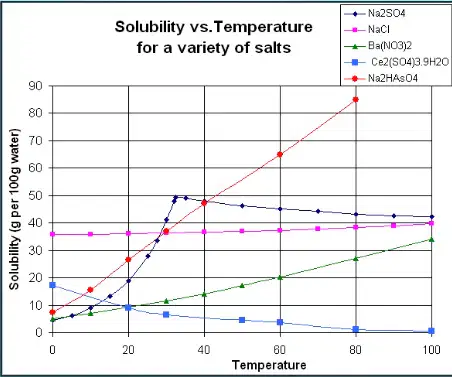
Lily, Priya, and Grace are conducting a science experiment to see how the solubility of different salts changes as the temperature rises. Which salt do they discover has its solubility increase the most as the temperature goes up?
Ba(NO3)2
Ce2(SO4)
Na2HAsO4
NaCl
Mia and Olivia are doing a science experiment and want to know: What ion is always present in acids?
H+
OH-
Na+
Cl-
Aria and Harper are in a science quiz! They need your help: Which ion is always found in bases?
Cl-
Na+
OH-
H+
Lily and Mia are in the science lab, and they’re excited to see what happens when they bubble HCl (hydrochloric acid) gas through water. As the gas dissolves, it dissociates according to the formula: HCl → H+ + Cl-.
Lily grabs some Litmus paper and wonders what will happen if she dips it into the solution. What should she expect to see?
The Litmus paper will turn red because the solution has more H+ ions than OH– ions, and its pH is low.
The Litmus paper will turn red because the solution has more OH– ions than H+ ions, and its pH is high.
The Litmus paper will turn blue because the solution has more OH- ions than Cl– ions, and its pH is high.
The Litmus paper will not change color because the solution has an equal amount of H+ ions and Cl– ions, and its pH is neutral.
Liam, Lily, and Abigail are curious about the liquids in their kitchen. How can they figure out if these household substances are acidic, basic, or neutral?
By testing their conductivity
By using pH indicators
By measuring their temperature
By observing their color
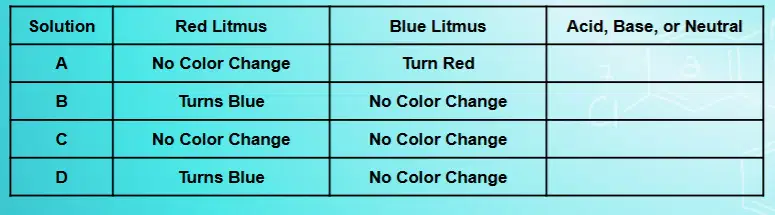
Grace, Daniel, and Avery are in the science lab, testing four mysterious solutions with red and blue litmus paper. Their results are shown below. Can you help them figure out what type each solution is?
A = _____
B = _____
C = _____
A = Acid
B = Neutral
C = Base
A = Base
B = Acid
C = Neutral
A = Base
B = Base
C = Acid
A = Acid
B = Base
C = Neutral
Mason accidentally spills a strong acid in the science lab! What should Arjun and Evelyn use to safely neutralize it?
Weak Base
Strong Base
Weak Acid
More strong acid
Ethan is mixing sugar into his lemonade. At what point does his solution become one where no more sugar can dissolve?
saturated
unsaturated
super saturated
solubility

Ava and William are conducting a science experiment. They dissolve sugar in water and reach the point marked 'A' on the graph above. What type of solution have they created?
Unsaturated
Supersaturated
Saturated
Undefined

Michael, Aria, and William are investigating solutions in their science class. They come across the graph below and notice point C. Can you help them out? Point C represents a(n) ___ solution.
saturated
supersaturated
unsaturated
undefined
Elijah, Michael, and Abigail are making Kool-Aid together! They mix powder, sugar, and water
Can you help them identify the solvent in their tasty drink?
water
powder
sugar
powder and sugar

Rohan, Emma, and Maya are making a party snack mix with pretzels, peanuts, and colorful candies. They can easily spot each ingredient in the bowl! What type of mixture have they created, where the substances are visibly distinguishable?
homogeneous
heterogeneous
solution
colloid
Hannah and Luna are in the science lab, testing different substances. They want to know which set of properties belongs to acids. Can you help them choose the correct answer?
sour taste, corrosive, change litmus from red to blue
sour taste, corrosive, change litmus from blue to red
sweet taste, slippery, change litmus from blue to red
sour taste, slippery, change litmus from blue to red

William, Abigail, and Evelyn are having a picnic! They brought vinegar, fruit juice, and cola. Can you guess what type of substances these are?
salts
neutral substances
bases
acids
Kai and Abigail are helping Benjamin clean up a messy kitchen, and they find a bottle labeled NaOH. They remember it's used in drain cleaners and soaps. Can you help them figure out: Is NaOH an acid or a base?
Acid
Base
Neither (Neutral)
David, Arjun, and Samuel are having a science quiz! They want to know: The pH scale is a range from:
1-7
0-14
1-5
1-14
Sophia and Elijah are in science class, and they discover a mysterious solution with a pH of 8.6. They wonder: is this solution an acid, a base, neutral, or somehow both? What do you think?
Acid
Base
Neutral
Acid and Base
Aria and James are in a science quiz! They want to know: which ion gives acids their special properties?
Sodium ion
Hydrogen ion
Hydroxide ion
Oxide ion
Samuel and Hannah are in a science quiz! They want to know: which ion is responsible for the properties of bases?
Sodium ion
Hydrogen ion
Hydroxide ion
Oxide ion
Aria and Jackson are in science class, and their teacher hands them a mysterious liquid. They wonder: What does the pH scale help them discover about this liquid?
Tells if a substance is an acid or base
Measures the strength and weakness of acids and bases
Both statements are correct
Grace and Jackson are mixing up a science experiment in class. Can you help them figure out what solutions are composed of?
salts and solutes
solvents and salts
solutes and alloys
solutes and solvents
Jackson and Maya are conducting a science experiment with salt water. In their mixture, NaCl would be considered the ______.
Solution
Solute
Solvent
Solvation
Abigail and Noah are mixing different materials in their science class. When materials combine to form a mixture, they
A. keep their original properties.
B. react to form a new substance with new properties.
C. combine in a specific ratio.
D. always change their physical state.
Stirring the solution increases the rate of dissolution (rate of dissolving).
True
False
The smaller the particle size the faster the rate of dissolution (rate of dissolving).
True
False
What combination would dissolve a solid solute the fastest?
high temperature, no stirring
no heat, no stirring
sugar cube, no heat
high temperature, stirring
How does cold water affect the speed of dissolving?
Cold water slows down dissolving.
Cold water speeds up dissolving.
Cold water has no effect on dissolving.
Cold water has no effect on dissolving.
A soft drink that is more concentration is _____ in color and _______ in taste
lighter, stronger
darker, weaker
lighter, weaker
darker, stronger
Which pitcher is the most diluted?
100 mL water
125 g of mix
100 mL water
100 g of mix
100 mL water
50g of mix
100 mL water
25g of mix
If a mixture is NOT uniform throughout, it is ______________.
heterogeneous
homozygous
homogeneous
a compound


You are given a small beaker of solution at room temp. You add a bit of solute to the solution and it dissolves. The solution was:
saturated
unsaturated
concentrated
warm
What type of solution will conduct electricity?

What is this image representing?
Saturated
Unsaturated
Supersaturated
Insoluble

How much Ce2(SO4)3 solute is saturated at 80 degrees?
20
15
30
2
How much NaBr solute is saturated at 70 degrees?
110
120
130
140
NaOH may be found in drain cleaners and as a component of soaps. Is NaOH an acid or a base?
Acid
Base
Neither (Neutral)

HCl is found in household products, including some toilet bowl cleaners. Is HCl an acid or a base?
Acid
Base
Neither (Neutral)

Is laundry detergent an acid or a base?
Acid
Base
Neither (Neutral)
_______ are corrosive substances characterized as having a strong smell, a sour taste, and a _______.

When 42 grams of potassium chloride ( KCl), is dissolved in 100 grams of water at 50 ºC, the solution can be correctly described as:
supersaturated
saturated
unsaturated

Which solution is more concentrated?
Solution 1:
500 mL of water
100 g of salt
Solution 2:
500 mL of water
90 g of salt
Solution 1
Solution 2
They have the same concentration
Which solution is more diluted?
Solution 1:
1000 mL of water
60g of salt
Solution 2:
500 mL of water
60 g of salt
Solution 1
Solution 2
They are equally diluted
A solute whose water solution conducts electricity is called a(n)
Two examples of nonelectrolyte solutions are:
sugar (C6H12O6) water
salt (NaCl) water
Carbonated (CO2) Water
Potassium chloride (KCl) water
Choose the correct methods if you want to prepare a cup of coffee in a short time.
Use cold water
Use hot water
Use crystal cube sugar
Stirring the drink faster
Use powdered sugar
As temperature decreases, the solubility of gases:
acidic or basic.
The substance in the beaker
William collected a rain sample and measured its pH to be 5.6. What does this mean?
An organic compound that changes color in acids and bases
The best subject to study ... EVER ... is
Science, of course!
ELA
Math
Art

