
Font size
 Worksheets
Unit 4A-Matter
Total questions: 38
Worksheet time: 20mins
Glucose, C6H12O6, is considered to be a(n) ____
element
compound
heterogeneous mixture
homogeneous mixture
Uranium, U , is considered to be a(n) _____
element
compound
heterogeneous mixture
homogenous mixture
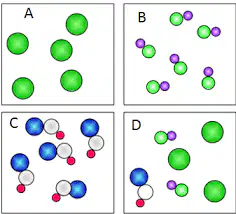
Which particle model represents an element?
A
B
C
D

What type(s) of mixture is shown in the picture?
homogeneous mixture
heterogeneous mixture
colloid
suspension

Table salt, NaCl, is a _____.
mixture
pure substance
suspension
colloid
Which of the following statements describes a difference between a mixture and a pure substance?
The density of a mixture can change with temperature, but the density of a pure substance cannot change.
The composition of a mixture can vary from sample to sample, but the composition of a pure substance is always the same.
A mixture has a specific melting point, while the melting point of a pure substance can vary.
A mixture tends to be homogeneous, while a pure substance tends to be heterogeneous.
Which procedure correctly describes materials combining into a homogeneous mixture?
Sand and water are shaken in a container and left to separate into two substances
Olive oil is added to water
Salt is sprinkled on popcorn
Sugar is add to water
Which phase change absorbs heat energy (endothermic)?
freezing
condensation
sublimation
deposition
Which is a phase change that releases heat (exothermic)?
vaporization
condensation
melting
sublimation
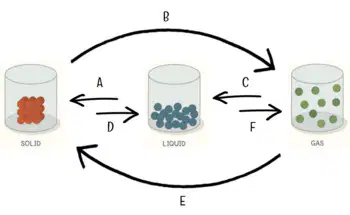
What phase change is represented by letter C?
condensing
freezing
vaporization
sublimation
You have a glass of water. Which of the following would cause the molecules of water to move faster?
Putting salt in the glass of water.
Pouring the water into a heated pot.
Placing the water in the freezer.
Emptying the water into a larger glass with water of the same temperature.

One of these statements does not describe what is happening in the picture. Which one is it?
Temperature is increasing.
Kinetic energy is increasing.
The space between the particle stays the same.
The attractive force between the particles is decreasing.
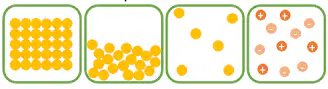
In the 4 states of matter above, what is the correct order of their kinetic energy (energy of movement) from least to greatest ?
solid, liquid, gas, plasma
gas, liquid, plasma, solid
liquid, solid, plasma, gas
plasma, gas, liquid, solid
STEEL WATER CARBON DIOXIDE GAS
What would be the order of the 3 items above from the MOST to the LEAST ordered particle arrangement?
STEEL, WATER , CARBON DIOXIDE GAS
WATER, CARBON DIOXIDE GAS, STEEL
CARBON DIOXIDE GAS, STEEL, WATER
STEEL, CARBON DIOXIDE GAS, WATER

This is a cooling curve. As the temperature changes from a gas, to a liquid, then a solid, what else is true?
There is a decrease in kinetic energy and the molecules get closer together.
There is a decrease in molecular attraction and kinetic energy.
Kinetic energy increases while potential energy decreases during the phase changes.
Although the molecules get closer together, there is no real change in the energy of the molecules.
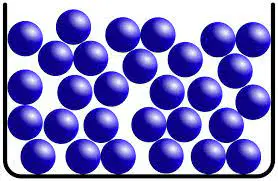
How should the model be changed to show the particles of a liquid at a lower temperature?
The particles should have positive and negative charges, and increase the space between the particles.
Separate the particles into positive and negative charges, but maintain the same space between the particles.
Decrease the velocities of the particles but maintain the space between the particles.
Increase the velocities of the particles, but increase the same space between the particles.
If heat is absorbed by water, what phase change will occur?
gas to solid
gas to liquid
liquid to gas
liquid to solid
If heat is released by water, what phase change will occur?
liquid to solid
solid to gas
liquid to gas
none of these

Which model above represents the structure and movement of a solid?
first picture
middle picture
last picture
the picture isn't represented

Where would you place the following properties in the diagram:
combustibility
oxidation
A
B
C
D
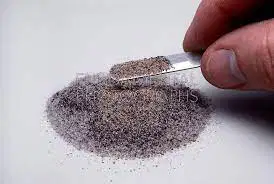
This is a mixture of sand and iron filings. How could you use physical properties of matter to separate the two substances?
Add water to the mix to dissolve the sand.
Pick out the sand particles one by one.
Pour the mix through filter paper to separate them.
Use a magnet to pull out the iron filings.

The Statue of Liberty is made of copper and the first image in 1886 has been enhanced to show what it looked like after being built. The second image is 132 years later in 2018. The green color is copper oxide caused by oxidation from oxygen in the air.
What would be a chemical property of copper?
Copper is malleable. (you can flatten copper into a sheet)
Copper has reactivity with oxygen causing the color change.
Copper is a strong metal.
Copper is a good conductor.
You have been given several unknown substances to identify. Select ALL the PHYSICAL properties that could help you tell the difference between the unknown substances.
color
reaction with an acid
flammability
texture
melting point

While studying chemical and physical changes, students added salt to a glass of water. They stirred the salt until it dissolved and could no longer be seen. "That's a chemical change," a student stated. Do you agree? Explain.
Yes, it is a chemical change because something new is formed.
No, it is a physical change. It is salt and water and you can get the salt back by boiling off the water.
Yes, it is a chemical change because there was a change in the appearance of one of the components, the salt.
No, it is a physical change. A chemical change cannot occur when you mix two compounds together like salt, NaCl, and water, H2O, without adding heat.

First-Aid cold packs work by crushing a small vial inside the pack that releases the substance inside and the pack gets cold. What kind of reaction happens in the cold pack?
Physical change; the evidence is by a drop in temperature.
Chemical change; two different chemicals are mixed together.
Chemical change; heat energy is released and the pack gets colder.
Physical change; the substance in the vial dissolved in the pack's liquid.
Which of the following is NOT a sign of a chemical change?
Calcium chloride combined with sodium bicarbonate to produce bubbles.
Sodium metal reacts with chlorine gas to produce sodium chloride.
Magnesium iodide dissolves in water.
Hydrogen sulfide gas (H2S) is bubbled into a lead acetate solution and a precipitate forms.
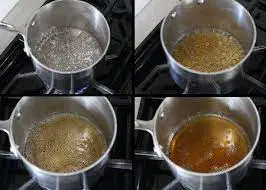
A teacher got out the hot plate and put some sugar cubes in a pan. She began heating the sugar cubes the process is seen above. What can be said about this process?
Heating the sugar did not affect the solid sugar cubes.
Heating the solid sugar cubes caused evaporation and the sugar disappeared.
Heating the sugar caused something new to form and a chemical change to occur.
Heating the solid sugar cubes caused melting and a physical change to occur.
melting butter
evaporating perfume
freezing fruit juice for popsicles
These are all examples of ____
nuclear changes
chemical changes
physical changes
evaporation
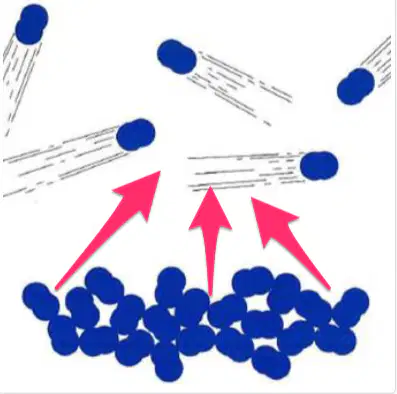
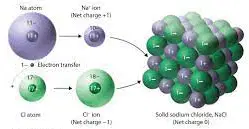
Which one of these models would show a physical change?



What are pieces of evidence that a chemical change is occurring?
color change
gas production
temperature change
light production
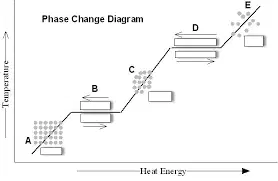
Is this a heating or cooling curve?
What phase of matter is letter B in?
heating; gas & solid
cooling; liquid & gas
heating; liquid & solid
cooling; gas & liquid
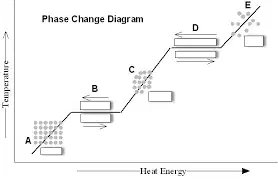
In sections B and D on the heating curve, what do you notice about the temperature?
The temperature increases.
The temperature decreases.
The temperature remains the same.
Cannot determine an answer.
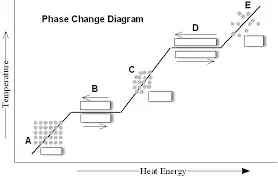
Why is there never a temperature change during phase changes even though heat energy is added or can be taken away?
The heat energy added or removed is used to create or break bonds to form the next phase.
There is a temperature change during phases changes. It's just too subtle to detect with a thermometer.
Heat energy cannot be added or removed because that would violate the Law of Conservation of Mass.
What is the difference between a mixture and a pure substance?
The density of a mixture can change with temperature, but the density of a pure substance cannot change.
The composition of a mixture can vary from sample to sample, but the composition of a pure substance is always the same.
A mixture has a specific melting point, while the melting point of a pure substance can vary.
A mixture tends to be homogeneous, while a pure substance tends to be heterogeneous.
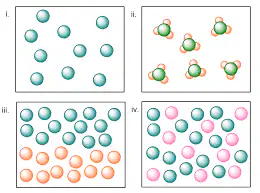
Which one(s) represents a pure substance?
i only
i and iii only
ii and iv only
i and ii only
iii only
Which of these processes is NOT exothermic (releases heat energy)?
vaporization
sublimation
deposition
melting
Which of these is NOT a chemical property?
combustibility
oxidation
reactivity
viscosity
Which of the following is NOT a chemical property?
combustibility
oxidation
reactivity
density

