
 Worksheets
Waves Review
Total questions: 38
Worksheet time: 25mins
Definition of Wave
The distance between similar points on a wave.
A disturbance that travels in a pattern and carries energy.
Allowing all light to pass through.
A coding system using 0 and 1 or black and white to transmit information.
Definition of Baseline
The top point of a transverse wave.
The greatest height of a wave in its resting position.
The bottom point of a transverse wave.
The line that goes through the wave to show the middle.
Definition of amplitude
The greatest height of a wave in its resting position.
The distance between similar points on a wave.
The line that goes through the wave to show the middle.
The top point of a transverse wave.
Definition of Frequency
The greatest height of a wave in its resting position.
The number of times a wave repeats itself in a certain amount of time.
A form of energy we can see.
A disturbance that travels in a pattern and carries energy.
Definition of Crest
The greatest height of a wave in its resting position.
A form of energy we can see.
The top point of a transverse wave.
Process of sending out information in a certain way from one person to another.
Definition of Trough
The top point of a transverse wave.
The distance between similar points on a wave.
To bend when passing through an object.
The bottom point of a transverse wave.
Definition of Light
A form of energy we can see.
The line that goes through the wave to show the middle.
Waves that are caused by a disturbance at a single point.
A wave that moves and carries energy perpendicular to the particles it travels through.
Definition of Reflection
A disturbance that travels in a pattern and carries energy.
To bounce off an object.
A form of energy we can see.
To bend when passing through an object.
Definition of Refraction
To bend when passing through an object.
Not able to see through.
To bounce off an object.
Allowing all light to pass through.
Definition of Transparent
Allowing all light to pass through.
Allowing some light through.
Not able to see through.
A form of energy we can see.
Definition of Translucent
Allowing all light to pass through.
Allowing some light through.
Not able to see through.
A form of energy we can see.
Definition of Opaque
Allowing all light to pass through.
Allowing some light through.
Not able to see through.
A form of energy we can see.
Definition of Transmit
The bottom point of a transverse wave.
A wave that moves and carries energy perpendicular to the particles it travels through.
The number of times a wave repeats itself in a certain amount of time.
Process of sending out information in a certain way from one person to another.
Definition of Binary Code
A coding system using 0 and 1 or black and white to transmit information.
The number of times a wave repeats itself in a certain amount of time.
Process of sending out information in a certain way from one person to another.
The distance between similar points on a wave.
Definition of Transverse
A disturbance that travels in a pattern and carries energy.
Waves that are caused by a disturbance at a single point.
A wave that moves and carries energy perpendicular to the particles it travels through.
The number of times a wave repeats itself in a certain amount of time.
Definition of Circular Waves
A wave that moves and carries energy perpendicular to the particles it travels through.
A disturbance that travels in a pattern and carries energy.
Waves that are caused by a disturbance at a single point.
To bend when passing through an object

What is A?
Trough
Wavelength
Crest
Amplitude
What is B?
Trough
Wavelength
Crest
Amplitude
What is C?
Baseline
Wavelength
Crest
Amplitude
What is D?
Baseline
Wavelength
Crest
Amplitude
What is E?
Baseline
Wavelength
Crest
Amplitude
What can you change about a transverse wave to show it has more energy?
crest
baseline
amplitude
trough
Which image shows how the light allows you to see the object?
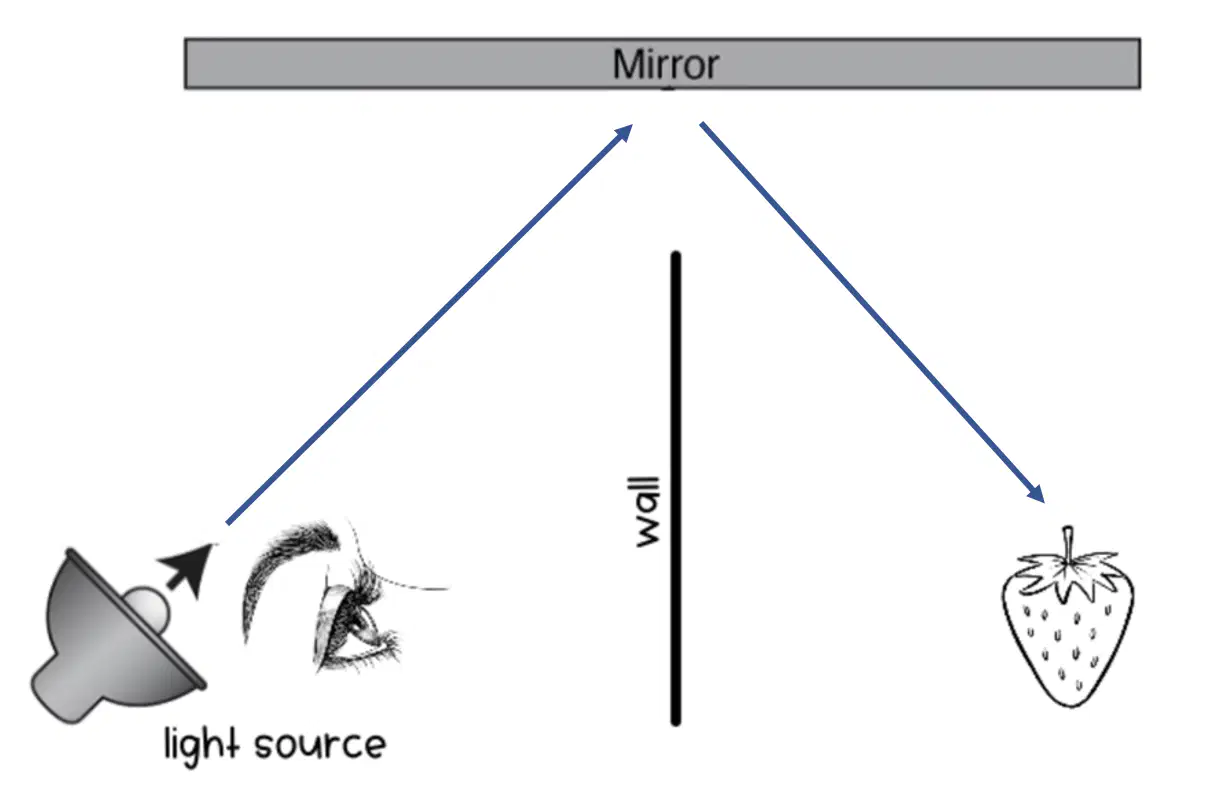


What color is being reflected into the eye?
Red
Every color but red
Orange
Blue
What does transparent mean?
Allows all light through.
Allows some light through.
Allows no light through.
What are some examples of transparent objects?
wax paper, tissue
windows, glass
books, wall
What does translucent mean?
Allows all light through.
Allows some light through.
Allows no light through.
What are some examples of translucent objects?
wax paper, tissue
windows, glass
books, wall
What does opaque mean?
Allows all light through.
Allows some light through.
Allows no light through.
What are some examples of opaque objects?
wax paper, tissue
windows, glass
books, wall
What is a device that receives and transmits digital signals?
refridgerator
lamp
radio
bicycle

What will happen to the size of the wave as they spread out in the bowl?
The waves will get bigger
The waves will get smaller
The waves will stay the same size
There will be no waves

What type of wave does this make?
transverse
radio
microwaves
circular

Which medium has the slowest speed of sound?
Air
Oxygen
Aluminum
Iron
Which medium has the fastest speed of sound?
Air
Oxygen
Aluminum
Iron

From X wave to Y wave, the frequency...
Increased
Decreased
Stayed the same
What is something visual and sound transmissions of energy have in common?
you can see both of them
both communicate information
both are better when it's dark
both use binary code
What is something visual and sound transmissions of energy have different?
one you can see, one you can hear
both communicate information
one works better in the dark, one works better when far away
one can be used with deaf people, one can be used with blind people

