wayground logo

Free Printable Worksheets

Font size

S
M
L
XL
Worksheets

Chapter 1 Review: Graded & Extra Credit

Total questions: 119

Worksheet time: 4hrs 58mins
Name
Class
Date
1.
 Jermaine runs exactly 2 laps around a 400 meter track. What is the displacement?
a)
800
b)
400
c)
0
d)
200
2.
Bill runs 400 meters to Andy's house, turns around, and runs 400 meters back home.  What is Bill's distance?
a)
0 meters
b)
400 meters
c)
800 meters
d)
1600 meters
3.
Bill runs 400 meters to Andy's house, turns around, and runs 400 meters back home.  What is Bill's displacement?
a)
0 meters
b)
400 meters
c)
800 meters
d)
1600 meters
4.

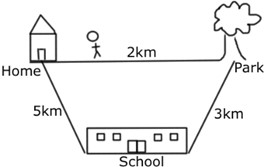
Jerry walked from home to school, then from the school to the park. What is his total distance?

a)

2 km

b)

5 km

c)

8 km

d)

10 km

5.

Jerry walked from home to school, then from the school to the park. What is his total displacement?

a)

2 km

b)

5 km

c)

8 km

d)

10 km

6.
A car drives 84 meters forward.  It's displacement and distance would be the same.
a)
True
b)
False
7.
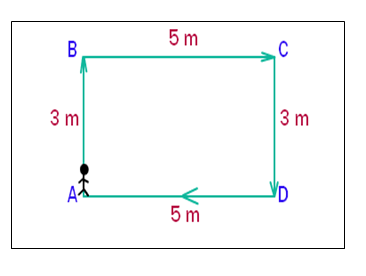
Sara walks from Point A to Point B. Which is true?
a)
Distance and displacement are EQUAL
b)
Distance is less than displacement
8.
Find the distance Sara walks from A to B,  B to C then C to D?
a)
11m
b)
3m
c)
5m
9.
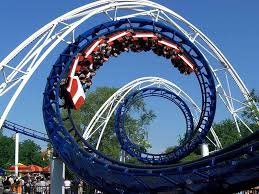
After completing one trip on a roller coaster, the roller coaster's ________ is zero.
a)
displacement
b)
reference point
c)
length
d)
distance
10.

The shortest distance between 2 points is a straight line.

a)

true

b)

false

11.

Billy runs 400 meters to Andy's house, turns around, and runs 400 meters back home. What is Billy's distance?

a)

0 meters

b)

400 meters

c)

800 meters

d)

1600 meters

12.

Billy runs 400 meters to Andy's house, turns around, and runs 400 meters back home. What is Billy's displacement?

a)

0 meters

b)

400 meters

c)

800 meters

d)

1600 meters

13.

Jerry walked from home to school, then from the school to the park. What is his total displacement?

a)

2 km

b)

5 km

c)

8 km

d)

10 km

14.

Jerry walked from home to school, then from the school to the park. What is his total distance?

a)

2 km

b)

5 km

c)

8 km

d)

10 km

15.

From the figure, what is the displacement?

a)

20 meters

b)

25 meters

c)

15 meters

d)

25 meters NE

16.

The change in an objects position from the final position to initial position.

a)

displacement

b)

distance

c)

motion

d)

reference point

17.

Two people walk across a parking lot. Their paths are shown in the image. Who traveled with a larger displacement?

a)

Person A

b)

Person B

c)

They both had the same displacement.

18.
David walks 3 km north, and then turns east and walks 4 km. What is the distance?
a)
7 km
b)
3 km
c)
4 km
d)
1 km
19.
Ronaldo runs across a soccer field, moving 10 meters north, then 8 meters west. His displacement would be:
a)
10.2 m, NW
b)
12.8 m, NW
c)
15.4 m, NW
d)
18.0 m, NW
20.
Because displacement has a magnitude and direction it is called a ______. 
a)
distance
b)
vector
c)
arrow
d)
length
21.
A person walks 50 meters directly north, stops, and then travels 32 meters directly south.  What is their displacement?
a)
82 meters
b)
18 meters
c)
28 meters
22.

Which of the following is correct?

a)

Initial Position = -5 m

Final Position = -5 m

Distance = 22 m

Displacement = 0 m

b)

Initial Position = -5 m

Final Position = -5 m

Distance = 0 m

Displacement = 22 m

c)

Initial Position = -5 m

Final Position = 6 m

Distance = 22 m

Displacement = 0 m

d)

Initial Position = -5 m

Final Position = 6 m

Distance = 0 m

Displacement = 22 m

23.

Which of the following is correct?

a)

Initial Position = -2 m

Final Position = 0 m

Distance = 14 m

Displacement = 2 m

b)

Initial Position = 0 m

Final Position = -2 m

Distance = 14 m

Displacement = -2 m

c)

Initial Position = -2 m

Final Position = 0 m

Distance = -2 m

Displacement = -2 m

d)

Initial Position = -2 m

Final Position = 0 m

Distance = 14 m

Displacement = 14 m

e)

None are correct.

24.

David walks 3 km north, and then turns east and walks 4 km. What is the displacement?

a)

1 km

b)

3 km

c)

4 km

d)

5 km

25.

What distance did the creature travel?

a)

23 m

b)

9 m

c)

-9 m

d)

-23 m

26.

What is the creature's final displacement?

a)

23 m

b)

9 m

c)

-9 m

d)

-23 m

27.
Object C had an initial position of 2 m and a final position of 10 m. The displacement of object C can be shown with this equation: Displacement = final position - initial position
What was the displacement of object C?
a)
+6 m
b)
+8 m
c)
-4 m
d)
-2 m
28.
Object B had an initial position of 12 m and a final position of 7 m. The displacement of object C can be shown with this equation: Displacement = final position - initial position
What was the displacement of object B?
a)
+5 m
b)
- 6 m
c)
-5 m
d)
+6 m
29.
What was the total distance traveled by object C?
a)
8 m
b)
10 m
c)
12 m
d)
14 m
30.

Which is the length of the path an object has traveled?

a)

displacement

b)

distance

c)

motion

d)

reference point

31.

Billy runs 400 meters to Andy's house, turns around, and runs 400 meters back home. What is Billy's distance?

a)

0 meters

b)

400 meters

c)

800 meters

d)

1600 meters

32.

Billy runs 400 meters to Andy's house, turns around, and runs 400 meters back home. What is Billy's displacement?

a)

0 meters

b)

400 meters

c)

800 meters

d)

1600 meters

33.

Jerry walked from home to school, then from the school to the park. What is his total displacement?

a)

2 km

b)

5 km

c)

8 km

d)

10 km

34.

Jerry walked from home to school, then from the school to the park. What is his total distance?

a)

2 km

b)

5 km

c)

8 km

d)

10 km

35.

From the figure, what is the displacement?

a)

20 meters

b)

25 meters

c)

15 meters

d)

25 meters NE

36.

The change in an objects position from the final position to initial position.

a)

displacement

b)

distance

c)

motion

d)

reference point

37.

Two people walk across a parking lot. Their paths are shown in the image. Who traveled with a larger displacement?

a)

Person A

b)

Person B

c)

They both had the same displacement.

38.
David walks 3 km north, and then turns east and walks 4 km. What is the distance?
a)
7 km
b)
3 km
c)
4 km
d)
1 km
39.
Ronaldo runs across a soccer field, moving 10 meters north, then 8 meters west. His displacement would be:
a)
10.2 m, NW
b)
12.8 m, NW
c)
15.4 m, NW
d)
18.0 m, NW
40.
Because displacement has a magnitude and direction it is called a ______. 
a)
distance
b)
vector
c)
arrow
d)
length
41.
A person walks 50 meters directly north, stops, and then travels 32 meters directly south.  What is their displacement?
a)
82 meters
b)
18 meters
c)
28 meters
42.

Which of the following is correct?

a)

Initial Position = -5 m

Final Position = -5 m

Distance = 22 m

Displacement = 0 m

b)

Initial Position = -5 m

Final Position = -5 m

Distance = 0 m

Displacement = 22 m

c)

Initial Position = -5 m

Final Position = 6 m

Distance = 22 m

Displacement = 0 m

d)

Initial Position = -5 m

Final Position = 6 m

Distance = 0 m

Displacement = 22 m

43.

Which of the following is correct?

a)

Initial Position = -2 m

Final Position = 0 m

Distance = 14 m

Displacement = 2 m

b)

Initial Position = 0 m

Final Position = -2 m

Distance = 14 m

Displacement = -2 m

c)

Initial Position = -2 m

Final Position = 0 m

Distance = -2 m

Displacement = -2 m

d)

Initial Position = -2 m

Final Position = 0 m

Distance = 14 m

Displacement = 14 m

e)

None are correct.

44.

David walks 3 km north, and then turns east and walks 4 km. What is the displacement?

a)

1 km

b)

3 km

c)

4 km

d)

5 km

45.

What distance did the creature travel?

a)

23 m

b)

9 m

c)

-9 m

d)

-23 m

46.

What is the creature's final displacement?

a)

23 m

b)

9 m

c)

-9 m

d)

-23 m

47.
Object C had an initial position of 2 m and a final position of 10 m. The displacement of object C can be shown with this equation: Displacement = final position - initial position
What was the displacement of object C?
a)
+6 m
b)
+8 m
c)
-4 m
d)
-2 m
48.
Object B had an initial position of 12 m and a final position of 7 m. The displacement of object C can be shown with this equation: Displacement = final position - initial position
What was the displacement of object B?
a)
+5 m
b)
- 6 m
c)
-5 m
d)
+6 m
49.
What was the total distance traveled by object C?
a)
8 m
b)
10 m
c)
12 m
d)
14 m
50.

Which is the length of the path an object has traveled?

a)

displacement

b)

distance

c)

motion

d)

reference point

51.
What is the formula to calculate speed?
a)
S = t/d
b)
S = d/t
c)
S = d x t
d)
S = t x d
52.
What is speed?
a)
how far you go
b)
how much distance is covered over a period of time
c)
how fast you accelerate
d)
the change in the location of a object
53.
A runner races in the 100 meter dash.  It takes her 10 seconds to finish.  What is her average speed?
a)
10 m/s
b)
1000 m/s
c)
100 seconds
d)
10 seconds
54.
What is the speed of an object that travels 60 meters in 4 seconds?
a)
240 m/s
b)
15 m/s
c)
0.067 m/s
d)
15 mph
55.
Which runner won the race?
a)
A
b)
B
c)
C
d)
It was a tie
56.
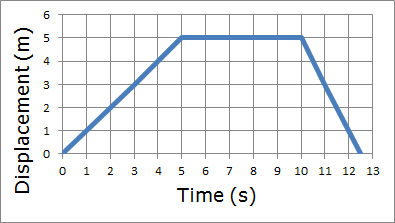
According to the graph how far does the person travel in the first 5 seconds?
a)
2 m
b)
10 m
c)
0 m
d)
5 m
57.
What is the person doing from 5 seconds to 10 seconds?
a)
Walking 
b)
Running
c)
Standing Still 
d)
Walking Fast
58.
Velocity is both ____ and _____. 
a)
speed , direction 
b)
direction, mass
c)
volume, density 
d)
direction, magnitude 
59.
You walk 10 meters to math class in 20 seconds. Your average speed is
a)
2 m/s
b)
0.5 m/s
c)
200 m/s
d)
5 m/s
60.
Find the velocity of a plane that traveled 3000 miles west in 5 hours.
a)
65 mph west
b)
6 mph west
c)
600 mph west
d)
6000 mph west 
61.
Which of the following represents a velocity?
a)
40 m
b)
40 m north
c)
40 m/s
d)
40 m/s north
62.
David walks 3 km north, and then turns east and walks 4 km. What is the distance?
a)
7 km
b)
3 km
c)
4 km
d)
1 km
63.
What is the speed of a cheetah that travels 112.0 m in 4.0 s?
a)
0.0357 m/s
b)
28 m/s
c)
0.036 m/s
d)
28.0 m/s
64.
A dog runs on the sidewalk 9 mi/hr.
a)
Speed
b)
Acceleration
c)
Velocity
65.
Describe the speed of the object from
2-5 seconds using the speed vs. time graph.
a)
Increasing speed
b)
Not moving
c)
Decreasing speed
d)
Constant speed
66.
A bicyclist takes a curved, scenic ride through the park going 4.5 m/s.
a)
Speed
b)
Acceleration
c)
Velocity
67.
Calculate the speed of a train that traveled 400 miles in 5 hours.
a)
20 mph
b)
20 m/s
c)
80 mph
d)
80 m/s
68.

Pick all of the following that are velocities.

a)

4 km/s west

b)

5 cm/h south

c)

2 mph

d)

8 cm/year

e)

5 m/s up

69.
mph is a unit for ... 
a)
Speed
b)
Distance
c)
Time
d)
Direction
70.
What is speed?
a)
how far you go
b)
how much distance is covered over a period of time
c)
how fast you accelerate
d)
the change in the location of a object
71.
A runner races in the 100 meter dash.  It takes her 10 seconds to finish.  What is her average speed?
a)
10 m/s
b)
1000 m/s
c)
100 seconds
d)
10 seconds
72.
Total distance divided by total time is
a)
average speed
b)
constant speed
c)
instantaneous speed
d)
acceleration
73.
What does this graph represent?
a)
Constant Speed
b)
Acceleration
c)
Not moving
74.
Which runner won the race?
a)
A
b)
B
c)
C
d)
It was a tie
75.
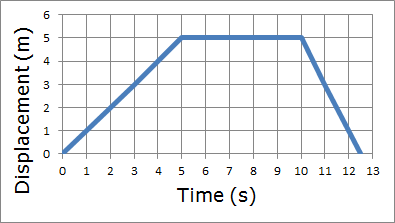
According to the graph how far does the person travel in the first 5 seconds?
a)
2 m
b)
10 m
c)
0 m
d)
5 m
76.
What is the person doing from 5 seconds to 10 seconds?
a)
Walking 
b)
Running
c)
Standing Still 
d)
Walking Fast
77.
Velocity is both ____ and _____. 
a)
speed , direction 
b)
direction, mass
c)
volume, density 
d)
direction, magnitude 
78.
Which of the following represents a velocity?
a)
40 m
b)
40 m north
c)
40 m/s
d)
40 m/s north
79.
When you look at the speedometer of your car, it tells you your....
a)
Average speed
b)
Instantaneous speed
80.

What is the speed of a cheetah that travels 112.0 m in 4.0 s?

a)

0.0357 m/s

b)

30 m/s

c)

0.036 m/s

d)

28.0 m/s

81.
Two horses are running in a field.  The gray horse runs 12 m/s north.  The black horse runs 12 m/s east.  
Which is true about their motions?
a)
Equal speeds.
b)
Equal velocities.
c)
Equal distances.
d)
Equal displacements.
82.

Which statement is true about velocity?

a)

Must have measurement of speed.

b)

Must have a measurement of speed and direction.

c)

Must have only direction.

d)

Has neither a measurement of speed or direction.

83.
How do you calculate velocity?
a)
Distance divided by time.
b)
Displacement divided by time.
c)
Speed multiplied by time.
d)
Displacement divided by velocity.
84.
How do you calculate distance?
a)
Distance divided by time.
b)
Displacement divided by time.
c)
Speed multiplied by time.
d)
Displacement divided by velocity.
85.
A car moves a distance of 1000 m with an average speed of 28 m/s.   Calculate the time.
a)
36 seconds
b)
28,000 seconds
c)
28 seconds
d)
972 seconds
86.
A cheetah runs with an average speed of 32 m/s for 30 seconds.  How far did the cheetah run?
a)
960 m
b)
1.07 m
c)
0.94 m
d)
62 m
87.
In which of the following graphs (click the image) are both runners moving at the same speed (note that graph c is the bottom right graph, and graph d is the bottom left graph)? 
a)
Graph A
b)
Graph B
c)
Graph C
d)
Graph D
88.
What does this graph represent?
a)
Constant speed
b)
Acceleration
c)
Not moving
89.
What is the speed of the red line?  
a)
4 m/s 
b)
16 m/s 
c)
32 m/s 
d)
2 m/s 
90.
Acceleration: is the rate of change in ___________.
a)
speed
b)
distance
c)
velocity 
d)
displacement 
91.

A roller coasters accelerates from an initial speed of 6.0 m/s to a final speed of 70 m/s over 4 seconds. What's the acceleration?

a)

24 m/s2

b)

18 m/s2

c)

16 m/s2

d)

16 m/s

92.
A car accelerates from a standstill to 70 m/s in 10 seconds.  What is the acceleration?
a)
0.7m/s2
b)
7m/s2
c)
14m/s2
d)
none of the above
93.
The SI unit for acceleration is
a)
mph
b)
ft/sec2
c)
m/s2
94.
Why does a car accelerate as it round a corner at a constant speed?
a)
Its direction changes
b)
It doesn't
c)
It slows down
d)
Its speeds up  
95.
Velocity is both ____ and _____. 
a)
speed , direction 
b)
direction, mass
c)
volume, density 
d)
direction, magnitude 
96.
In each of the following cases, determine where the car has no acceleration ?
a)
A car shortly after a stoplight turns green.
b)
A car approaching a red light
c)
A car with the cruise control set at 80 km/h
d)
A car turning a curve at a constant speed
97.
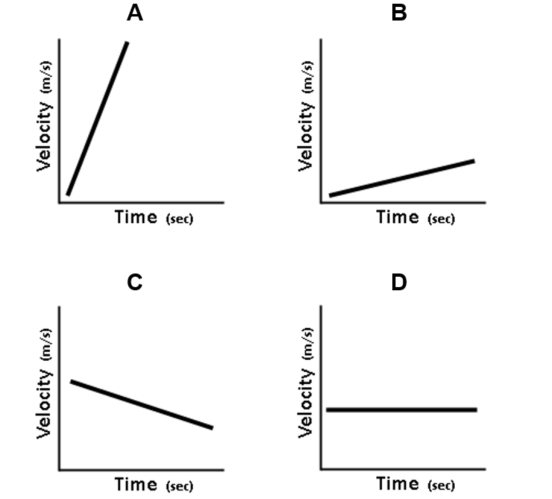
Which graph represents the greatest acceleration?
a)
A
b)
B
c)
C
d)
D
98.
Which graph represents zero acceleration (constant velocity)?
a)
A
b)
B
c)
C
d)
D
99.
A dog runs with an initial speed of 7.5 m/s on a waxed floor.  It slides to a stop in 15 seconds.  What is the acceleration?
a)
-7.5 m/s
b)
-7.5 m/s2
c)
-0.5 m/s2
d)
7.5 mi//hr
100.
A golf ball accelerates off a tee at 15m/s2, changing its velocity from 0m/s to 50 m/s down the fairway. How long did it take the golf ball to accelerate?
a)
750 seconds
b)
35 seconds
c)
0.3 seconds
d)
3.3 seconds
101.
A ball of clay is thrown at a wall at a velocity of 28.0 m/s.  After it hits the wall, it takes 0.020 s to stop.  What is the acceleration of the clay when it hits the wall?
a)
1400 m/s2
b)
-1400 m/s2
c)
0.56 m/s2
d)
-0.56 m/s2
102.
A ball of clay is thrown at a wall at a velocity of 28.0 m/s.  After it hits the wall, it takes 0.020 s to stop.  What is the acceleration of the clay when it hits the wall?
a)
1400 m/s2
b)
-1400 m/s2
c)
0.56 m/s2
d)
-0.56 m/s2
103.
A box sliding down an inclined plane attains a velocity of 27 m/s in 3 seconds from rest.  Find the acceleration.
a)
30 m/s
b)
24 m/s2
c)
9 m/s2
d)
81 km/hr
104.
A roller coasters accelerates from an initial velocity of of 6.0 m/s to a final velocity of 70 m/s over 4 seconds.  What's the acceleration?
a)
24 m/s2
b)
18 m/s2
c)
16 m/s2
d)
16 m/s
105.
A dog runs with an initial speed of 7.5 m/s on a waxed floor.  It slides to a stop in 15 seconds.  What is the acceleration?
a)
-7.5 m/s
b)
-7.5 m/s2
c)
-0.5 m/s2
d)
7.5 mi//hr
106.
How fast is the car traveling at 30 seconds?
a)
5m/s
b)
10m/s
c)
20m/s
d)
30m/s
107.
A car starts from rest at a stop light and reaches 20 m/s in 3.5 s. Determine the acceleration of the car.
a)
2.2m/s2
b)
7.0m/s2
c)
5.7m/s2
d)
70m/s2
108.
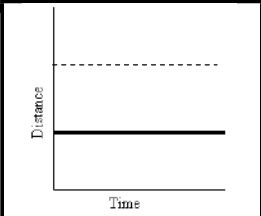
The picture of the position vs. time graph shows an object that is...
a)
accelerating/speeding up
b)
moving at a constant speed 
c)
not moving 
d)
accelerating/slowing down. 
109.
Acceleration is defined as the CHANGE in 
a)
time it takes for one place to move to another place. 
b)
velocity of an object.
c)
distance divided by the time interval 
d)
velocity divided by the time interval 
110.
Why does a car accelerate as it round a corner at a constant speed?
a)
Its direction changes
b)
It doesn't
c)
It slows down
d)
Its speeds up  
111.
Acceleration only takes place when things speed up. 
a)
True
b)
False
112.
In each of the following cases, determine where the car has no acceleration ?
a)
A car shortly after a stoplight turns green.
b)
A car approaching a red light
c)
A car with the cruise control set at 80 km/h
d)
A car turning a curve at a constant speed
113.
Determine the motion of the car.
a)
at rest 
b)
moving at constant speed
c)
speeding up
d)
slowing down
114.
Determine the motion of the car.
a)
at rest 
b)
constant velocity 
c)
speeding up
d)
slowing down
115.
A roller coasters accelerates from an initial velocity of of 6.0 m/s to a final velocity of 70 m/s over 4 seconds.  What's the acceleration?
a)
24 m/s2
b)
18 m/s2
c)
16 m/s2
d)
16 m/s
116.
Which graph shows the object standing still?
a)
A
b)
B
c)
C
d)
D
117.
Which graph demonstrates the greatest positive speed?
a)
A
b)
B
c)
C
d)
D
118.
Which graph represents zero acceleration (constant velocity)?
a)
A
b)
B
c)
C
d)
D
119.
Which graph represents the greatest acceleration?
a)
A
b)
B
c)
C
d)
D