Wayground logo

Free Printable Worksheets

Font size

S
M
L
XL
Worksheets

Cocktail

Total questions: 120

Worksheet time: 7hrs 22mins

Name
Class
Date
1.
What type of friction is not moving?
a)
static
b)
sliding
c)
fluid
d)
rolling
2.
Friction is a force that acts in an ___________ direction of movement.
a)
similar
b)
opposite
c)
parallel
d)
west
3.
If F is force, k is spring constant and x is extension, Hooke's Law tells us that:
a)
F=k/x
b)
x=Fk
c)
k=Fx
d)
F=kx
4.
When you stretch a rubber band, you are storing __________ energy. 
a)
kinetic 
b)
potential
c)
none of the above
d)
all of the above 
5.

Students examine a spring (A)at rest, and then hang different masses from the spring (B & C). How much elastic potential energy does Spring C have compared to the others?

a)

Zero Elastic Potential Energy

b)

More Elastic Potential Energy than both A and B

c)

More Elastic Potential Energy than A and less than B

d)

Less Elastic Potential Energy than both A and B, but it does have some elastic potential energy.

6.

Students examine a spring (A)at rest, and then hang different masses from the spring (B & C). How much elastic potential energy does Spring B have compared to the others?

a)

Zero Elastic Potential Energy

b)

More Elastic Potential Energy than both A and C

c)

More Elastic Potential Energy than A and less than C

d)

Less Elastic Potential Energy than both A and C, but it does have some elastic potential energy.

7.

Which of the following springs is the stiffest?

a)

A spring that requires a force of 2000 N to compress it by 5 m.

b)

A spring that requires a force of 4000 N to stretch it by 10.0 m.

c)

A spring that requires a force of 2400 N to compress it by 4m.

d)

A spring that requires a force of 4800 N to stretch it by 12 m.

8.

A net force of 1400 N acts to stretch an extension spring. How far will the spring stretch if its spring constant is 700 N/m?

a)

1.0

b)

0.5m

c)

1.5 m

d)

2.0 m

9.

A 24,000 N Car is supported by 4 springs. If each spring is deflected by 0.5 m what is the spring constant?

a)

12,000 N /m

b)

48,000 N/m

c)

630,000 N/m

d)

120,000 N/m

10.
A spring has a spring constant of 330 N/m.  How far is the spring compressed if 150 N of force are used?
a)
2.2 m
b)
0.0014 m
c)
5.0 m
d)
0.45 m
11.
A spring with k=73 N/m is compressed 70 cm.  An object of mass 4 kg is attached to one end of the compressed spring.  What is the acceleration of the object at the moment the spring is released?  
a)
.078 m/s/s
b)
0.17 m/s/s
c)
13 m/s/s
d)
1.3 X 10^5 m/s/s
12.
A force of 470 N is applied to stretch a spring which has a spring constant, k=1100 N/m.  How much does the spring stretch past its free length?
a)
0.214 m
b)
2.34 m
c)
0.427 m
d)
5.17 X 10^5 m
13.
A spring with a spring constant of k is cut into 4 equal length pieces.  What is the spring constant of each of the pieces?
a)
1/2 K
b)
2 K
c)
1/4K
d)
4K
14.
What force should be applied to compress a spring by 0.013 m if its spring constant is k = 1900 N/m?
a)
1880 N
b)
24.7 N
c)
1900 N
d)
0.127 N
15.
Which of the following springs is the stiffest?
a)
A spring that requires a froce of 2000 N to compress it by 6.8 m.
b)
A spring that requires a force of 4000 N to stretch it by 9.0 m. 
c)
A spring that requires a force of 8000 N to compress it by 45 m.  
d)
A spring that requires a force of 4800 N to stretch it by 14 m.
16.
Hooke's Law describes the behaviour of which kind of material under tension?
a)
plastic
b)
metals only
c)
elastic
d)
non-metals only
17.

A graph of force vs. distance for an elastic material is:

a)

A downward curve

b)

An upward curve

c)

A straight line from any point on the x and y axis

d)

A straight line from the origin

18.

What is the extension of spring D?

a)

1mm

b)

2mm

c)

3mm

d)

0mm

19.
A spring has a spring constant of 330 N/m.  How far is the spring compressed if 150 N of force are used?
a)
2.2 m
b)
0.0014 m
c)
5.0 m
d)
0.45 m
20.
Which statement most accurately represents Hooke's Law?
a)
a) Extension of a spring is proportional to the force applied.
b)
b) Extension of a spring is proportional to the number of coils.
c)
c) Extension of a spring is inversely proportional to the force applied.
d)
d) Thickness of a spring wire is proportional to the force applied.
21.

What type of force is shown inside of the picture?

a)

Tension

b)

Friction

c)

Elastic

d)

Gravitational

22.
A spring extends 1.5m under load 10N. What is its spring constant?
a)
0.15N/m
b)
10N/m
c)
6.7N/m
d)
15N/m
23.

If a spring which has a k constant cut into half ,what is the constant of the short spring.

a)

2k

b)

k

c)

k/2

d)

3k

24.

If a spring which has a k constant cut into three equal pieces ,what is the constant of one of the short springs.

a)

3k

b)

k/3

c)

k

d)

9k

25.

If a spring which has a k constant cut into five equal pieces ,what is the constant of one of the short springs.

a)

5k

b)

k

c)

k/2

d)

k/5

26.
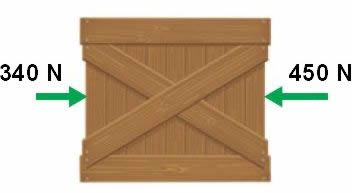
Calculate the net force of the object in the image shown.
a)
20N
b)
35N
c)
5N
d)
25N
27.
Is this a balanced or unbalance force?
a)
Balanced
b)
Unbalanced
c)
Neither one
d)
Both
28.
Which direction will the object move?
a)
Up
b)
Down
c)
Right
d)
Left
29.
Calculate the net force of the object.
a)
10N
b)
2N
c)
15N
d)
5N
30.
Is this a balanced or unbalanced force?
a)
Balanced
b)
Unbalanced
c)
Neither
d)
Both
31.
Which direction will the object move?
a)
Right
b)
Left
c)
Up
d)
Down
32.
What is the net force of this object?
a)
0N
b)
50N
c)
25N
d)
5N
33.
Is this a balanced or unbalanced force?
a)
Balanced
b)
Unbalanced
c)
Neither
d)
Both
34.
This model shows the forces applied to a box.  However, this model DOES NOT show ________________________.
a)
the forces acting in opposite directions
b)
that the forces are unequal
c)
that student B is pushing harder
d)
the actual amount of the forces
35.
If a force causes an object to move, it's considered a(n) __________________ force.
a)
Balanced
b)
Unbalanced
c)
Massive
d)
Strong
36.
Students are playing tug-of-war. If group B pulls the rope to the right with a force of 400 N and group A pulls the rope to the left with a force of 250 N, what will happen to the ribbon in the middle of the rope?
a)
The ribbon will move to the left and group A will win the tug-of-war.
b)
The ribbon will move to the left and group B will win the tug-of-war.
c)
The ribbon will move to the right and group B will win the tug-of-war.
d)
The ribbon will move to the right and group A will win the tug-of-war.
37.
A cyclist traveling at 25 km/hr turns sharply to the left while continuing to move 25 km/hr. This means the forces involved are_____________________.
a)
Balanced, because the cyclist's speed did not change.
b)
Balanced, because he was still moving forward.
c)
Unbalanced, because it's the same bicycle.
d)
Unbalanced, because his direction changed.
38.
If a force causes an object to start moving, stop moving, or change direction it's considered a(an)__________________force.
a)
Balanced
b)
Unbalanced
c)
Magnetic
d)
Gravitational
39.
The forces represented by the arrows in the diagrams are applied to the four objects that are at rest on a table. Which object is most likely to move to the right?
a)
Object W
b)
Object X
c)
Object Y
d)
Object Z
40.
Imagine a bat swinging with a force of 1200 N, hitting a ball pitched with a force of 400 N. At what net force does the ball move away from the bat?
a)
1600 N
b)
800 N
c)
400 N
d)
Net force of 0 N
41.
The roller coaster car begins at point W.  At what point along the track will the car have the greatest amount of kinetic energy?
a)
W
b)
X
c)
Y
d)
Z
42.
The sum of all forces acting on an object and direction
a)
Contact Force
b)
Balanced Force
c)
Unbalanced Force
d)
Net Force
43.
Are forces balanced or unbalanced when a car is moving at a constant speed in a straight line?
a)
Balanced
b)
Unbalanced
44.
Ted is trying to move a fridge through his house, he gets stuck on a carpet and even though he is pushing the fridge, it is not moving. What force is acting against him?
a)
gravity
b)
friction
c)
air
d)
mass
45.
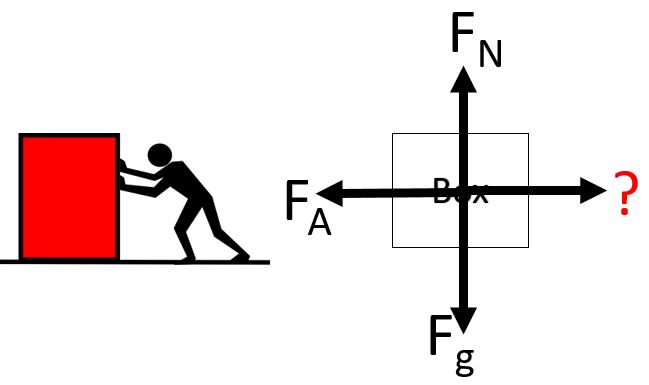
Name the missing force...
a)
frictional force
b)
weight force
c)
thrust
d)
buoyant force
46.
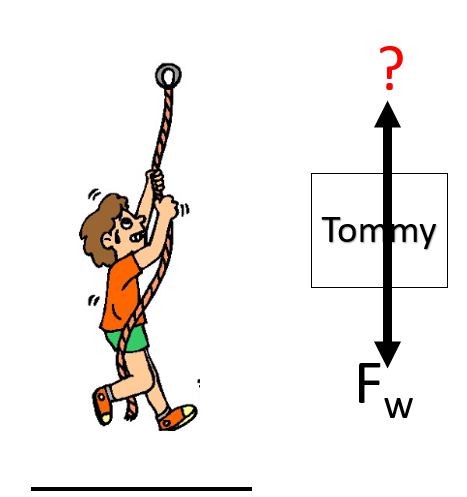
Name the missing force...
a)
tension force
b)
gravitational force
c)
normal force
d)
applied force
47.

A leftward force is applied to a crate to push it across the floor at a constant speed. Which is the correct force diagram?

a)
b)
c)
d)
48.

A rightward force is applied to a dresser to accelerate it to the right across the bedroom floor.

a)
b)
c)
d)
49.

A hockey puck glides to the right across the ice at a constant speed.

a)
b)
c)
d)
50.

A downward-moving skydiver who has just opened the parachute is slowing down.

a)
b)
c)
d)
51.

This diagram can be used to indicate which of the following? (TWO correct answers)

a)

a object at rest

b)

an object moving at a constant velocity (speed)

c)

an object accelerating

d)

(Trick question -- there is only one correct answer)

e)

an object decelerating

52.
A Newton is a unit of...
a)
force
b)
inertia
c)
acceleration
d)
velocity
53.
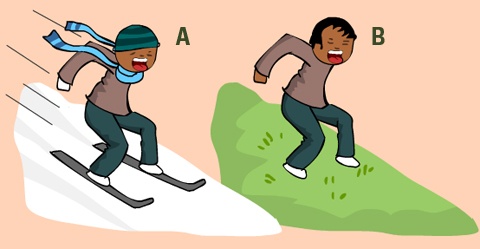
Why is it harder for the boy in Image B to get down the hill?
a)
Motion
b)
Friction
c)
Work
d)
Displacement
54.
How much force is needed to accelerate a 2 kg physics book to an acceleration of 6 m/s/s?
a)
36 N
b)
12 N
c)
3 N
d)
0.33 N
55.
A tennis ball and a solid steel ball the same size are dropped at the same time. In the absence of air resistance, which ball has the greater acceleration?
a)
The tennis ball
b)
The steel ball
c)
Nonsense! They both have the same acceleration
56.
You pull horizontally on a 50-kg crate with a force of 500 N, and the friction force on the crate is 250 N. The acceleration of the crate is (find net force, use formula)
a)
zero
b)
2 m/s/s
c)
4 m/s/s
d)
5 m/s/s
57.
A jumbo jet cruises at a constant velocity when the force from the engines on the jet is 40000 N. How much air resistance acts on the jet?
a)
80000
b)
60000
c)
40000 N
d)
20000
58.

An object with a mass of 2.0 kg accelerates 2.0 m/s2 when an unknown force is applied to it. What is the amount of the force?

a)

4 N

b)

0.4 N

c)

1 N

d)

0.1 N

59.
An object with a mass of 5.0 kg accelerates 8.0 m/s2 when an unknown force is applied to it. What is the amount of the force?
a)
40 N
b)
4 N
c)
10 N
d)
0.1 N
60.
An object with a mass of 6.0 kg accelerates 4.0 m/s2 when an unknown force is applied to it. What is the amount of the force?
a)
240 N
b)
24 N
c)
2.4 N
d)
0.24 N
61.
An object accelerates 3.0 m/s2 when a force of 6.0 newtons is applied to it. What is the mass of the object?
a)
2 N
b)
18 N
c)
0.5 N
d)
0.05 N
62.
An object accelerates 12 m/s2 when a force of 6.0 newtons is applied to it. What is the mass of the object?
a)
2 N
b)
18 N
c)
0.5 N
d)
0.05 N
63.
An object accelerates 5 m/s2 when a force of 20 newtons is applied to it. What is the mass of the object?
a)
4 N
b)
20 N
c)
0.5 N
d)
2 N
64.
An object accelerates 2 m/s2 when a force of 12 newtons is applied to it. What is the mass of the object?
a)
24 N
b)
20 N
c)
5 N
d)
6 N
65.
An object with a mass of 2.0 kg has a force of 4.0 newtons applied to it. What is the resulting acceleration of the object?
a)
2 N
b)
8 N
c)
0.5 N
d)
6 N
66.
F=MA
An object of mass 10 kg is accelerated upward at 2 m/s2.  What force is required? 
a)
20 N
b)
2 N
c)
5 N
d)
0 N
67.
A box weighing 46 newtons rests on an incline that makes an angle of 25° with the horizontal. What is the magnitude of the component of the box’s weight perpendicular to the incline?
a)
19N
b)
21N
c)
42N
d)
26N
68.
An 8.0-newton block is accelerating down a frictionless ramp inclined at 15° to the horizontal. What is the magnitude of the net force causing the block’s acceleration?
a)
0N
b)
2.1N
c)
7.7N
d)
8.0N
69.
A 1.0 × 10⁵-newton truck at rest on a hill that makes an angle of 8.0° with the horizontal. What is the component of the truck’s weight parallel to the hill?
a)
1.4E3N
b)
1E4N
c)
1.4E4N
d)
9.9E4N
70.
A cart rolls down an inclined plane with constant speed as shown in the diagram below. Which arrow represents the direction of frictional force?
a)
A
b)
B
c)
C
d)
D
71.
A 10.-newton block is sliding down a 30-degree incline at a constant speed. What is the force of friction?
a)
5N
b)
4.9N
c)
10N
d)
98N
72.
A 3.0-kg block slides on a frictionless 20° inclined plane. A force of 16 N acting parallel to the incline and up the incline is applied to the block. What is the acceleration of the block?
a)
2 m/s^2 down the incline
b)
5.3 m/s^2 up the incline
c)
2 m/s^2 up the incline
d)
3.9 m/s^2 down the incline
73.
A block of mass 5 kilograms lies on an inclined plane  at 37 degrees.  The horizontal and vertical supports for the plane have lengths of 4 meters and 3 meters, respectively. The coefficient of friction between the plane and the block is 0.3. The magnitude of the force F necessary to pull the block up the plane with constant speed is most nearly 
a)
30
b)
42
c)
49
d)
50
74.
A wooden box is first pulled across a horizontal steel plate. The box is then pulled across the same steel plate while the plate is inclined. How does the force required to overcome friction in the inclined case compare to the horizontal case ? 
a)
bigger
b)
smaller
c)
the same
d)
not enough info
75.
A block weighing 10.0 newtons is on a ramp inclined at 30.0° to the horizontal. A 3.0-newton force of friction, Ff , acts on the block as it is pulled up the ramp at constant velocity with force F, which is parallel to the ramp, as shown in the diagram below. What is the magnitude of force F?
a)
7N
b)
8N
c)
10N
d)
13N
76.
A block rests on a ramp, making angle θ with the horizontal. As theta is increased
a)
the blocks mass will decrease
b)
the blocks mass will increase
c)
the blocks component of weight parallel to the ramp will increase
d)
the blocks component of the weight parallel to the ramp will decrease
77.

Newton's 1st Law is also called the Law of ...

a)

Friction

b)

Inertia

c)

Unbalanced forces

d)

Newtons

78.
An object in motion tends to stay in motion unless an ___ force acts on it.
a)
unbalanced
b)
balanced
79.
The tendency of an object to resist a change in motion is...
a)
inertia
b)
kinetic energy
c)
vector
d)
net force
80.
Objects with greater _________ also have greater inertia.
a)
speed
b)
mass
c)
temperature
d)
friction
81.
The law of inertia (Newton’s First Law) applies
a)
to both moving and nonmoving objects
b)
only to moving objects
c)
only to objects that are not moving
82.

Because of inertia, a moving object will keep ________ unless acted on by an unbalanced force.

a)

at rest

b)

moving

c)

in one spot

d)

inertia

83.
Because of inertia, a resting object will remain at ________.
a)
rest
b)
a constant speed
c)
school
d)
inertia 
84.
What kind(s) of objects have inertia?
a)
all objects with mass
b)
only objects at rest
c)
only objects in motion
d)
only objects whose motion is being changed
85.
You push on a car and it does not move.  What is true about the inertia?
a)
The inertia is changing
b)
The inertia of the car is too great 
c)
The inertia of the person is equal to the car
d)
There is not inertia because of no movement
86.
An object following a straight-line path at a constant speed 
a)
has zero acceleration
b)
has no forces acting on it
c)
has a net force acting in the direction of motion
d)
none of these
87.
One object has twice as much mass as another object. The first object also has also twice as much...
a)
velocity
b)
gracitational acceleration
c)
inertia
d)
all of these
88.
Why is the net force 0 in the image?
a)
Because the elephants are the same size
b)
Because they are both pulling the same amount of force in opposite directions
c)
Because they are elephants
d)
Because they are pulling away from each other.
89.
If an object has a kinetic energy, it must be _____.
a)
at rest
b)
in motion
90.
If an external force is applied, the velocity will change because of the force.
a)
True
b)
False
91.
Objects with more mass or heavier have LESS inertia.
a)
True
b)
False
92.
____ is the distance traveled divided by the time of travel.
a)
Velocity
b)
Speed
c)
Mass
d)
Volume
93.
What happens when unbalanced forces act on an object at rest?
a)
the object remains at rest
b)
the object begins moving in an unpredictable direction
c)
the object begins moving in the direction of the net force
d)
the object begins moving opposite to the direction of net force
94.
How much force is needed to accelerate a 2 kg physics book to an acceleration of 6 m/s/s?
a)
36 N
b)
12 N
c)
3 N
d)
0.33 N
95.
Newton's second law of motion describes acceleration as force divided by __________.
a)
mass
b)
inertia
c)
speed
d)
direction
96.
Newton's _____ Law of Motion means that for every force there is a reaction force that is equal in size, but opposite in direction.
a)
First
b)
Second
c)
Third
d)
Fourth
97.
If a force of 26 N is exerted on two balls, one with a mass of 0.52 kg and the other with a mass of 0.78 kg, which ball will have the greater acceleration?  (F=ma)
a)
The one with a mass of .78 kg will have the greatest acceleration.
b)
The one with a mass of .52 kg will have the greatest acceleration.
c)
They will both accelerate at the same rate.
98.

If you apply MORE force to the ground what happens to the ground pushing on you?

a)

The force remains the same

b)

The force increases

c)

The force decreases

99.

A lamp sitting on a table is demonstrating Newton's ___ Law.

a)

1st

b)

2nd

c)

3rd

d)

4th

100.

How much force is going to be needed to push a Wagon that weighs 95kg while accelerating at 20 m/s^2? *

a)

1,900 N

b)

1.9 N

c)

1960 N

d)

1,705 N

101.
Joanna drives for 400km at an average speed of 80km/h. How long was her journey?
a)
Joanna's journey was 5hrs long
b)
Joanna's journey was 10hrs long
c)
Joanna's journey was 20hrs long
d)
Joanna's journey was 15hrs long
102.

Which graph presents an object moving with a constant positive velocity?

a)
b)
c)
d)
103.

Which graph presents an object at rest?

a)
b)
c)
d)
104.

A bus travels from El Paso, Texas, to Chihuahua, Mexico, in 5.2h with an average velocity of 73km/h to the south. What's the bus's displacement?

a)

73 km to the south

b)

370 km to the south

c)

380 km to the south

d)

14 km/h to the south

105.

What is the squirrel's displacement at time t=3.0 s?

a)

-6.0 m

b)

-2.0 m

c)

+0.8 m

d)

+2.0 m

106.

A ball initially at rest rolls down a hill and has an acceleration of 3.3 m/s2. If it accelerates for 7.5 s, how far will it move during this time?

a)

12 m

b)

93 m

c)

120 m

d)

190 m

107.
Two objects are connected by a rope over a pulley.  According to Newton's Second Law of Motion, the masses will start to move if the
a)
acceleration of object 1 is greater than acceleration of object 2
b)
acceleration of object 2 is greater than acceleration of object 1
c)
mass of object 1 is greater than the mass of object 2
d)
mass object 2 is greater than the mass of object 1
108.
 267.5 N unbalanced force applied to push a stuffed chair across the room, causing an acceleration of 4.2 m/s2. What is the mass of the chair?
a)
26.75 kg
b)
63.69 kg 
c)
263.3 kg 
d)
1123.5 kg
109.
A box weighing 46 newtons rests on an incline that makes an angle of 25° with the horizontal. What is the magnitude of the component of the box’s weight perpendicular to the incline?
a)
19N
b)
21N
c)
42N
d)
26N
110.
An 8.0-newton block is accelerating down a frictionless ramp inclined at 15° to the horizontal. What is the magnitude of the net force causing the block’s acceleration?
a)
0N
b)
2.1N
c)
7.7N
d)
8.0N
111.
A 1.0 × 10⁵-newton truck at rest on a hill that makes an angle of 8.0° with the horizontal. What is the component of the truck’s weight parallel to the hill?
a)
1.4E3N
b)
1E4N
c)
1.4E4N
d)
9.9E4N
112.
A 10.0-kilogram mass held at rest on a frictionless 30.0º incline by force F. What is the magnitude of force F?
a)
49.1N
b)
98.1N
c)
85N
d)
9.81N
113.
A 3.0-kg block slides on a frictionless 20° inclined plane. A force of 16 N acting parallel to the incline and up the incline is applied to the block. What is the acceleration of the block?
a)
2 m/s^2 down the incline
b)
5.3 m/s^2 up the incline
c)
2 m/s^2 up the incline
d)
3.9 m/s^2 down the incline
114.
The diagram represents an object being held at rest on a frictionless incline. The net force is equal to
a)
zero
b)
normal force
c)
weight
d)
friction
115.
A block of mass 5 kilograms lies on an inclined plane  at 37 degrees.  The horizontal and vertical supports for the plane have lengths of 4 meters and 3 meters, respectively. The coefficient of friction between the plane and the block is 0.3. The magnitude of the force F necessary to pull the block up the plane with constant speed is most nearly 
a)
30
b)
42
c)
49
d)
50
116.
A block weighing 10.0 newtons is on a ramp inclined at 30.0° to the horizontal. A 3.0-newton force of friction, Ff , acts on the block as it is pulled up the ramp at constant velocity with force F, which is parallel to the ramp, as shown in the diagram below. What is the magnitude of force F?
a)
7N
b)
8N
c)
10N
d)
13N
117.
A block rests on a ramp, making angle θ with the horizontal. As theta is increased
a)
the blocks mass will decrease
b)
the blocks mass will increase
c)
the blocks component of weight parallel to the ramp will increase
d)
the blocks component of the weight parallel to the ramp will decrease
118.
A wooden box is first pulled across a horizontal steel plate. The box is then pulled across the same steel plate while the plate is inclined. How does the force required to overcome friction in the inclined case compare to the horizontal case ? 
a)
bigger
b)
smaller
c)
the same
d)
not enough info
119.
Are forces balanced or unbalanced when a marble speeds up rolling down a ramp?
a)
Balanced
b)
Unbalanced
120.
Balanced or unbalanced?
a)
balanced
b)
unbalanced