
 Worksheets
Polynomial Function Checkpoint Review
Total questions: 25
Worksheet time: 37mins
What is the degree of the polynomial
10x3−7x2+9x5−x8+7
3
2
5
8

What is the domain of the graph?
(−∞, ∞)
(∞, 1)
(1, ∞)
Cannot be determined.
What is the leading coefficient of the polynomial?
f(x) = 3x3−6x5−2x2−5 ?
3
−6
−2
-5
Check all the even degree polynomials:


What is the domain and range of the polynomial?
f(x) = 3x7 − 2x4 − 3x +1D(−∞, ∞) R(1, ∞)
D(−∞, ∞) R(2, ∞)
D(1, ∞) R(−∞, ∞)
D(−∞, ∞) R(−∞, ∞)


Which of the following correctly identifies the End Behavior?


Which of the following correctly identifies the End Behavior?


Which root has a multiplicity of 2?
-1
2
4
-4
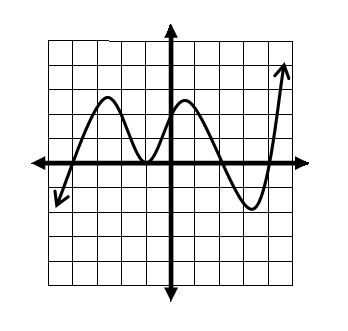
What are the decreasing intervals?
(- ∞, -1.5) & (0, 1.5)
(-1.5, 0) & (1.5, ∞)
(- ∞, -1.5) & (-1.5, 0)
(-1.5, 0) & (0, 1.5)

What are the increasing intervals?
(- ∞, 0) & (2, ∞ )
(-1, 0) & (2,4)
(0,2) & (-3, -7)
(-8, -3) & (-7, 8)

What are the increasing intervals?
(- ∞, -1) & (-1, 0) & (0, 1) & (1, ∞)
(3, 4) & (3, 8)
(- ∞, -1) & (1, ∞)
(-1, 0) & (1, ∞)
Which of the following is a 5th degree trinomial with a leading coefficient of -2?
−2x5+3x−1
5x−2+3x−1
−2x5+3x14+2x3+x2−10
−2x+5

How many real zeros are shown in the graph?
1
2
3
4

Find the correct statement about the zeros.
−5 is a zero with multiplicity 1
−5 is a zero with multiplicity 2
−2 is a zero with multiplicity 1
2 is a zero with multiplicity 2

The graph of f(x) is shown here. Which TWO statements correctly identify the end behavior? You are selecting TWO choices for this one!
as x→∞, f(x)→∞
as x→∞, f(x)→−∞
as x→−∞, f(x)→∞
as x→−∞, f(x)→−∞

The graph of a polynomial function is shown. How many turning points does this graph have?
2
3
4
5

The graph of f(x) is shown here. Which statement best describes the function?
The function has an odd degree and a negative leading coefficient.
The function has an odd degree and a positive leading coefficient.
The function has an even degree and a negative leading coefficient.
The function has an even degree and a positive leading coefficient.

The graph of f(x) is shown here. Which statement best describes the function?
The function has an odd degree and a negative leading coefficient.
The function has an odd degree and a positive leading coefficient.
The function has an even degree and a negative leading coefficient.
The function has an even degree and a positive leading coefficient.

Describe the graph correctly.
1 absolute min, 3 relative max and 3 relative min
4 relative min and 4 relative max
1 absolute max, 3 relative max and 2 relative min
1 absolute min, 1 absolute max, 2 relative max

Points B, D and F represent
Relative Minimums
Relative Maximums
Absolute minimums
Absolute maximums

What are the Relative Maximums on this graph?
Point A, B and E
Point A, C, and E
Point B, D, and F
Point A, C, D, and F

