
 Worksheets
mockboard pt.3
Total questions: 100
Worksheet time: 50mins
Name
Class
Date
1.
At very high temperatures the extrinsic semiconductors become intrinsic because
a)
drive in diffusion of dopants and carriers
b)
band to band transition dominants over impurity ionization
c)
impurity ionization dominants over band to band transition
d)
band to band transition is balanced by impurity ionization
2.
To forward-bias a diode,
a)
the anode voltage must be positive with respect to its cathode.
b)
the anode voltage must be negative with respect to its cathode.
c)
the cathode voltage must be positive with respect to its anode.
d)
Either A or B.
3.
When a voltage is applied to a semiconductor crystal then the free electrons will flow.
a)
towards positive terminal
b)
towards negative terminal
c)
either towards positive terminal or negative terminal
d)
towards positive terminal for 1 μs and towards negative terminal for next 1 μs
4.
A diode is a
a)
unidirectional device.
b)
linear device
c)
nonlinear device
d)
Both A and C.
5.
Avalanche voltage is routinely exceeded when a P-N junction acts as a:
a)
Current rectifier
b)
Variable resistor
c)
Variable capacitor
d)
Voltage regulator
6.
Of the following, which material allows the lowest forward voltage drop in a diode?
a)
Selenium
b)
Silicon
c)
Copper
d)
Germanium
7.
A semiconductor, such as silicon, has an electron valence of
a)
±4.
b)
– 7.
c)
+ 1.
d)
0.
8.
Assertion (A): The reverse saturation current in a semiconductor diode is 4nA at 20°C and 32 nA at 50°C.
Reason (R): The reverse saturation current in a semiconductor diode doubles for every 10°C rise in temperature.
a)
Both A and R are true and R is correct explanation of A
b)
Both A and R are true but R is not a correct explanation of A
c)
A is true but R is false
d)
A is false but R is true
9.
Determine the diode current at 20 oC for a silicon diode with reverse saturation current of 50 nA and an applied forward bias of 0.6 V.
a)
9.17 mA
b)
7.19 mA
c)
1.79 mA
d)
9.7 mA
10.
A disadvantage of gallium-arsenide devices is that:
a)
The charge carriers move fast
b)
The material does not react to ionizing radiation.
c)
It is expensive to produce
d)
It must be used at high frequencies
11.
At room temperature the current in an intrinsic semiconductor is due to
a)
holes
b)
electrons
c)
ions
d)
holes and electrons
12.
An unimportant factor concerning the frequency at which a P-N junction will work effectively is:
a)
The type of semiconductor material
b)
The cross-sectional area of the junction
c)
The reverse current
d)
The capacitance with reverse bias
13.
Assertion (A): The conductivity of p-type semiconductor is higher than that of intrinsic semiconductor.
Reason (R): The addition of donor impurity creates additional energy levels below conduction band.
a)
Both A and R are true and R is correct explanation of A
b)
Both A and R are true but R is not a correct explanation of A
c)
A is true but R is false
d)
A is false but R is true
14.
If the reverse bias exceeds the avalanche voltage in a P-N junction:
a)
The junction will be destroyed
b)
The junction will insulate; no current will flow
c)
The junction will conduct current
d)
The capacitance will become extremely high
15.
When a P-N junction does not conduct, it is:
a)
Reverse biased
b)
Forward biased
c)
Biased past the break over voltage
d)
In a state of avalanche effect
16.
When a diode is forward-biased, the anode:
a)
Is negative relative to the cathode
b)
Is positive relative to the cathode
c)
Is at the same voltage as the cathode
d)
None of the above
17.
The sharing of valence electrons in a silicon crystal is called
a)
doping.
b)
the avalanche effect.
c)
covalent bonding.
d)
coupling.
18.
The purpose of the I layer in a PIN diode is to:
a)
Minimize the diode capacitance
b)
Optimize the avalanche voltage
c)
Reduce the forward break over voltage
d)
Increase the current through the diode
19.
When a silicon diode is conducting at a temperature of 27 °C, reverse saturation current is 35 nA, what is the new reverse current at 50 °C?
a)
175 nA
b)
77 nA
c)
88 nA
d)
23 nA
20.
To a first approximation, a forward-biased diode is treated like a (n)
a)
open switch with infinite resistance.
b)
closed switch with a voltage drop of 0 V.
c)
closed switch in series with a battery voltage of 0.7 V.
d)
closed switch in series with a small resistance and a battery.
21.
The capacitance of a varactor varies with:
a)
Forward voltage
b)
Reverse voltage
c)
Avalanche voltage
d)
Forward break over voltage
22.
A photodiode, when not used as a photovoltaic cell, has:
a)
Reverse bias
b)
No bias
c)
Forward bias
d)
Negative resistance
23.
Zener voltage is also known as:
a)
Forward break over voltage
b)
Peak forward voltage
c)
Avalanche voltage
d)
Reverse bias
24.
An n-type semiconductor is a semiconductor that has been doped with
a)
trivalent impurity atoms.
b)
impurity atoms whose electron valence is + 4.
c)
pentavalent impurity atoms.
d)
None of the above.
25.
The purpose of doping is to:
a)
Make the charge carriers move faster
b)
Cause holes to flow
c)
Give a semiconductor material certain properties
d)
Protect devices from damage in case of transients
26.
Which of the following does not result from adding an acceptor impurity?
a)
The material becomes P type
b)
Current flows mainly in the form of holes
c)
Most of the carriers have positive electric charge
d)
The substance has an electron surplus
27.
A pure semiconductor is often referred to as a (n)
a)
extrinsic semiconductor.
b)
intrinsic semiconductor.
c)
doped semiconductor.
d)
None of the above.
28.
If ac is applied to a diode, and the peak ac voltage never exceeds the avalanche voltage, then the output is:
a)
AC with half the frequency of the input
b)
AC with the same frequency as the input
c)
AC with twice the frequency of the input
d)
None of the above
29.
When a P-N junction is reverse-biased, the capacitance depends on all of the following except:
a)
The frequency
b)
The width of the depletion region.
c)
The cross-sectional area of the junction
d)
The type of semiconductor material
30.
If an electron has a charge of -1 unit, a hole has:
a)
A charge of -1 unit
b)
No charge
c)
A charge of +1 unit
d)
A charge that depends on the semiconductor type
31.
Holes flow the opposite way from electrons because:
a)
Charge carriers flow continuously
b)
Charge carriers are passed from atom to atom
c)
They have the same polarity
d)
Holes flow in the same direction as electrons
32.
In an n-type semiconductor, the minority current carriers are
a)
free electrons.
b)
protons.
c)
valence electrons.
d)
holes.
33.
When used as a voltage regulator, a zener diode is normally
a)
forward-biased.
b)
reverse-biased.
c)
not biased.
d)
None of the above.
34.
The most commonly used semiconductor material is
a)
silicon
b)
germanium
c)
mixture of silicon and germanium
d)
none of the above
35.
A crystal set:
a)
Can be used to transmit radio signals
b)
Requires a battery with long life
c)
Requires no battery
d)
Is useful for rectifying 60-Hz ac
36.
The forward break over voltage of a silicon diode is:
a)
About 0.3 V
b)
About 0.6 V
c)
About 1.0 V
d)
Dependent on the method of
e)
manufacture
37.
Which of the following is not an advantage of semiconductor devices over vacuum tubes?
a)
Smaller size.
b)
Lower working voltage.
c)
Lighter weight.
d)
Ability to withstand high voltages.
38.
A neutral atom with an atomic number of three has how many electrons?
a)
1
b)
3
c)
none
d)
depends on the type of atom
39.
Which of these diode types might be found in the oscillator circuit of a microwave radio transmitter?
a)
A rectifier diode
b)
A cat whisker
c)
An IMPATT diode
d)
None of the above
40.
A p-type semiconductor is a semiconductor doped with
a)
trivalent impurity atoms.
b)
impurity atoms whose electron valence is _ 4.
c)
pentavalent impurity atoms.
d)
None of the above.
41.
A diode detector:
a)
Is used in power supplies
b)
Is employed in some radio receivers
c)
Is used commonly in high-power radio transmitters
d)
Changes dc into ac
42.
Selenium works especially well in:
a)
Photocells
b)
High-frequency detectors
c)
Radio-frequency power amplifiers
d)
Voltage regulators
43.
A semiconductor material is made into N type by:
a)
Adding an acceptor impurity
b)
Adding a donor impurity
c)
Injecting electrons
d)
Taking electrons away
44.
The charge on a single electron is
a)
6.25 x 10⁻¹⁸ C
b)
1.6 x 10⁻¹⁹ C
c)
1.6 x 10⁻²¹ C
d)
3.14 x 10⁻⁶ C
45.
Holes flow from:
a)
Minus to plus
b)
Plus to minus
c)
P-type to N-type material
d)
N-type to P-type material
46.
A diode audio limiter circuit:
a)
Is useful for voltage regulation
b)
Always uses Zener diodes
c)
Rectifies the audio to reduce distortion
d)
Can cause objectionable signal distortion
47.
In a p-type semiconductor, the majority current carriers are
a)
free electrons.
b)
valence electrons.
c)
protons.
d)
holes.
48.
A diode audio limiter circuit:
a)
Is useful for voltage regulation
b)
Always uses Zener diodes
c)
Rectifies the audio to reduce distortion
d)
Can cause objectionable signal distortion
49.
Determine the temperature coefficient of a 5 V zener diode (rated 25 ̊C value) if the nominal voltage drops to 4.8 V at a temperature of 100 ̊C.
a)
0.048 %/ ̊C
b)
0.053 %/ ̊C
c)
0.064 %/ ̊C
d)
0.07 %/ ̊C
50.
The term “semiconductor” arises from:
a)
Resistor-like properties of metal oxides.
b)
Variable conductive properties of some materials.
c)
The fact that there’s nothing better D.
d)
Insulating properties of silicon and GaAs.
51.
Transient disturbance is produced in a circuit whenever
a)
it is suddenly connected or disconnected from the supply
b)
it is shorted
c)
its applied voltage is changed suddenly
d)
all of the above
52.
To double the resonant frequency of an LC circuit with a fixed value of L, the capacitance, C, must be
a)
doubled.
b)
quadrupled.
c)
reduced by one-half.
d)
reduced by one-quarter.
53.
After two-time constants, the capacitor in an RC circuit is charged to what percentage of the supply
voltage?
a)
36.8 %
b)
86.5 %
c)
63.2 %
d)
95 %
54.
In an R-L circuit connected to an alternating sinusoidal voltage, size of transient current primarily depends on
a)
the instant in the voltage cycle at which circuit is closed
b)
the peak value of steady-state current
c)
the circuit impedance
d)
the voltage frequency
55.
The resonant frequency of an LC circuit is the frequency where
a)
XL = 0 Ω and XC = 0 Ω
b)
XL = XC
c)
XL and rs of the coil are equal.
d)
XL and Xc are in phase.
56.
An uncharged capacitor of 0.2 μF is connected to a 100 V, d.c. supply through a resistor of 100 kΩ . Determine the capacitor voltage 10ms after the voltage has been applied.
a)
39.35 V
b)
35.39 V
c)
33.95 V
d)
39.53 V
57.
What is the term for the time required for the capacitor in an RC circuit to be charged to 63.2% of the supply voltage?
a)
An exponential rate of one.
b)
One time constant.
c)
One exponential period.
d)
A time factor of one.
58.
A higher Q for a resonant circuit provides a
a)
dampened response curve.
b)
wider bandwidth.
c)
narrower bandwidth.
d)
None of the above.
59.
In a low Q parallel resonant circuit, when XL = Xc.
a)
IL = IC.
b)
IL is less than IC.
c)
IC is less than IL.
d)
IL is more than IC.
60.
What will happen to a parallel ac-circuit if its line frequency is more than the resonant frequency?
a)
Becomes purely resistive
b)
Becomes purely capacitive
c)
Becomes inductive
d)
Becomes capacitive
61.
Below resonance, a series LC circuit appears
a)
inductive.
b)
resistive.
c)
capacitive.
d)
None of the above
62.
A circuit consists of an uncharged capacitor connected in series with a 50k Ω resistor and has a time constant of 15 ms. Determine the capacitance of the capacitor.
a)
0.309 μF
b)
3.09 μF
c)
0.039 μF
d)
309 μF
63.
Which of the following can provide a higher Q?
a)
a higher L/C ratio.
b)
a lower L/C ratio.
c)
more resistance in series with the coil.
d)
Either B or C.
64.
The phase angle of an LC circuit at resonance is
a)
0°
b)
180°
c)
+90°
d)
- 90°
65.
Characteristics of the current in a series R-L-C circuit at resonance.
a)
It is dc
b)
It is a minimum
c)
It is zero
d)
It is at maximum
66.
A parallel circuit at resonance would mean, the circuit is
a)
resistive
b)
inductive
c)
reactive
d)
capacitive
67.
Double-energy transients are produced in circuits consisting of
a)
two or more resistors
b)
resistance and inductance
c)
resistance and capacitance
d)
resistance, inductance and capacitance
68.
The impedance of a series LC circuit at resonance is
a)
maximum.
b)
nearly infinite.
c)
minimum.
d)
Both A and B.
69.
A coil and capacitor are in series. The inductance is 88 mH and the capacitance is 1000 pF. What is the resonant frequency?
a)
17 kHz
b)
17 MHz
c)
540 Hz
d)
540 kHz
70.
A series LC circuit has a Q of 100 at resonance. If Vin = 5 mV p-p, how much is the voltage across C?
a)
50 μV p-p.
b)
5 mV p-p.
c)
50 mVp-p.
d)
500 mVp-p.
71.
There are no transients in pure resistive circuits because they
a)
offer high resistance
b)
obey Ohm’s law
c)
have no stored energy
d)
are linear circuits
72.
Above resonance, a parallel LC circuit appears
a)
inductive.
b)
resistive.
c)
capacitive.
d)
None of the above.
73.
What is the meaning of the term“time constant of an RL circuit”? The time required for the:
a)
Current in the circuit to build up to 36.8% of the maximum value.
b)
Voltage in the circuit to build up to 63.2% of the maximum value.
c)
Current in the circuit to build up to 63.2% of the maximum value.
d)
Voltage in the circuit to build up to 36.8% of the maximum value.
74.
A 10 μF capacitor is charged to 120V and then discharged through a 1.5MΩ resistor. Find how long it takes for the voltage to fall to 25 V.
a)
25.33 s
b)
22.53 s
c)
23.53 s
d)
21.53 s
75.
The transient current in a loss-free L-C circuit when excited from an ac source is a/an _______ sine wave.
a)
Overdamped
b)
Undamped
c)
Under damped
d)
Critically damped
76.
When either L or C is increased, the resonant frequency of an LC circuit
a)
decrease.
b)
increases.
c)
doesn’t change.
d)
it cannot be determined.
77.
The current at the resonant frequency of a series LC circuit is 10 mAp-p. What is the value of current at the half-power points?
a)
7.07 mAp-p
b)
14.14 mAp-p.
c)
5 mAp-p.
d)
10 mAp-p.
78.
Transient currents in electrical circuit are associated with
a)
Inductors
b)
Capacitors
c)
Resistors
d)
Both A and B
79.
A series circuit at resonance would mean, the circuit is
a)
resistive
b)
capacitive
c)
inductive
d)
reactive
80.
The impedance of a parallel LC circuit at resonance is
a)
zero.
b)
maximum.
c)
minimum.
d)
equal to the rs of the coil.
81.
In a series ac-circuit, if the line frequency is more than the resonant frequency, the circuit behaves as
a)
resistive
b)
reactive
c)
inductive
d)
capacitive
82.
A capacitor is connected in series with a voltmeter of resistance 750 k Ω and a battery. When the voltmeter reading is steady the battery is replaced with a shorting link. If it takes 17s for the voltmeter reading to fall to two-thirds of its original value, determine the capacitance of the capacitor.
a)
55.90 μF
b)
55.80 μF
c)
55.10 μF
d)
55.60 μF
83.
What is the meaning of the term “time constant of an RC circuit”? The time required to charge the capacitor in the circuit to:
a)
23.7% of the supply voltage.
b)
36.8% of the supply voltage.
c)
57.3% of the supply voltage.
d)
63.2% of the supply voltage.
84.
The total line current, IT, of a parallel LC circuit at resonance is
a)
minimum.
b)
maximum.
c)
equal to IL and Ic.
d)
Q times larger than IL or IC.
85.
A series-resonant circuit is to be made for 14.1 MHz. A coil of 13.5μH is available. What capacitor size is needed?
a)
0.945 μF
b)
94.5 pF
c)
9.45 pF
d)
945 pF
86.
After two-time constants, the capacitor in an RC circuit is discharged to what percentage of the starting voltage?
a)
86.5 %
b)
63.2 %
c)
13.5 %
d)
36.8 %
87.
A capacitor of 470 pF is in parallel with an inductor of 4.44 μH. What is the resonant frequency?
a)
3.49 MHz
b)
13.0 MHz
c)
3.49 kHz
d)
13.0 GHz
88.
If an ac-series circuit is supplied with a source whose frequency is less than that of fr, the circuit becomes
a)
resistive
b)
reactive
c)
inductive
d)
capacitive
89.
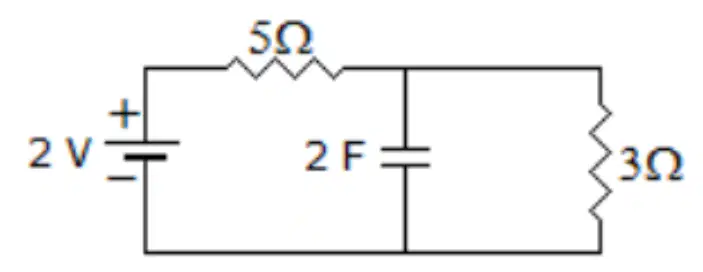
The time constant of the circuit in figure is
a)
6 sec
b)
15/4 sec
c)
10 sec
d)
16 sec
90.
An inductor and a capacitor are connected in parallel. At the resonant frequency the resulting impedance is:
a)
maximum
b)
minimum
c)
totally reactive
d)
totally inductive
91.
A "high Q" resonant circuit is one which:
a)
carries a high quiescent current
b)
is highly selective
c)
has a wide bandwidth
d)
uses a high value inductance
92.
What is the cause of a minimum Q on a single-tuned LC circuit?
a)
Decreased series resistor
b)
Decreased shunt resistor
c)
Increased shunt resistor
d)
Decreased capacitance
93.
The Q of a parallel resonant circuit can be lowered by
a)
placing resistor in parallel with the tank.
b)
adding more resistance in series with the coil.
c)
decreasing the value of L or C
d)
Both A and B.
94.
What is the term for the time required for the current in an RL circuit to build up to 63.2% of the maximum value?
a)
One time constant.
b)
An exponential period of one.
c)
A time factor of one.
d)
One exponential rate.
95.
The current at resonance in a series LC circuit is
a)
zero.
b)
minimum.
c)
different in each component.
d)
maximum.
96.
An inductor and a capacitor form a resonant circuit. The capacitor value is increased by four times. The resonant frequency will:
a)
increase by four times
b)
double
c)
decrease to half
d)
decrease to one quarter
97.
The ability of an LC circuit to supply complete sine waves when the input to the tank is only a pulse is called
a)
tuning.
b)
the flywheel effect.
c)
antiresonance.
d)
its Q.
98.
An inductor and a capacitor form a resonant circuit. If the value of the inductor is decreased by a factor of four, the resonant frequency will:
a)
increase by a factor of four
b)
increase by a factor of two
c)
decrease by a factor of two
d)
decrease by a factor of four
99.
An inductor and a capacitor are connected in series. At the resonant frequency the resulting impedance is:
a)
maximum
b)
minimum
c)
totally reactive
d)
totally inductive
100.
The transients which are produced due to sudden but energetic changes from one steady state of a circuit to another are called ________ transients.
a)
initiation
b)
transition
c)
relaxation
d)
subsidence
100 %

