wayground logo

Free Printable Worksheets

Font size

S
M
L
XL
Worksheets

DNA Review

Total questions: 48

Worksheet time: 1hrs 8mins

Name
Class
Date
1.
The backbone of the DNA structure is composed of:
a)
Sugar and Phosphate
b)
Sugar
c)
Phosphate
d)
Nitrogenous Base
2.
The bond that holds the nitrogenous bases together are WEAK bonds called:
a)
Hydrogen Bonds
b)
Nitrogen Bonds
c)
Carbon Bonds
d)
Phosphodiester Bonds
3.
Which statement about DNA structure is correct?
a)
The two strands are identical and run in the same direction. 
b)
The two sides are identical and run in opposite direction. 
c)
The two sides are complementary and run in the same direction.
d)
The two sides are complementary and run in opposite direction.  
4.
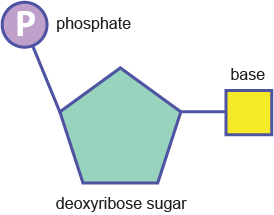
A nucleotide is made of 
a)
A nitrogen,a ribose sugar, and protein. 
b)
A phosphate, a deoxyribose sugar, and a carbon base.
c)
Adenine, guanine, cytosine, and  thymine.
d)
A phosphate, deoxyribose sugar, and a nitrogen base.
5.
There are _________ bonds between Adenine and Thymine and ________ bonds between Guanine and Cytosine . 
a)
Two;Three
b)
Two;Four
c)
Three;Two
d)
Four;Two 
6.
Which nitrogen base pairs with Cytosine?
a)
Arganine
b)
Thymine
c)
Guanine
d)
Adenine 
7.
Which nitrogen base pairs with Adenine?
a)
Arganine
b)
Cytosine
c)
Guanine
d)
Thymine 
8.
Which nitrogen base pairs with Guanine?
a)
Adenine
b)
Cytosine
c)
Thymine
d)
Arganine 
9.
Which nitrogen base pairs with Thymine?
a)
Adenine
b)
Guanine
c)
Cytosine
d)
Arganine 
10.
Which sequence of DNA bases would pair with this partial strand
ATG TGA CAG
a)
ATG TGA CAG
b)
TAC ACT GTC
c)
GTA AGT GAC
d)
CAT TCA CTG
11.
Which of the following best describes a DNA molecule?
a)
double helix
b)
contains ribose
c)
made of amino acids
d)
contains Uracil
12.
Which of the following units are repeatedly joined together to form a strand of DNA?
a)
amino acids
b)
nucleotides
c)
fatty acids
d)
polysaccharides
13.
In a molecule of double-stranded DNA, the amount of Adenine present is always equal to the amount of
a)
cytosine
b)
guanine
c)
thymine
d)
uracil
14.
Why is DNA important?
a)
it is very small and very complicated
b)
it's in everything
c)
it serves as the blueprint for traits of all living things
d)
because we eat it every day for energy
15.
What determines the code, or information, of a DNA molecule?
a)
the shape (structure) of the nitrogen bases
b)
the order (sequence) of the nitrogen bases
c)
the color of the nitrogen bases
d)
the frequency (number) of nitrogen bases
16.
Which organelle is DNA usually found in?
a)
cell membrane
b)
vacuole
c)
chloroplast
d)
nucleus
17.
Replicate the following strand of DNA: 
AATCATGGA
a)
AATCATGGA
b)
TTAGTACCT
c)
UUAGUACCU
d)
GGATAUCUA
18.

What is the correct complimentary strand for the following DNA? ATCGAG

a)

TACGAG

b)

ATCGAG

c)

TAGCTG

d)

TAGCTC

19.
The drawing shows the structure of what molecule?
a)
A DNA molecule
b)
A lipid molecule
c)
A carbohydrate molecule
d)
A protein molecule
20.
What are the three components of a nucleotide?
a)
sugar, hydrogen, nitrogen base
b)
sugar, oxygen, nitrogen base
c)
sugar, phosphate, nitrogen base
d)
sugar, phosphate, protein
21.
What does DNA stand for?
a)
Deoxyribonucleic acid
b)
Denitrogenous acid
c)
Deribonucleic acid
d)
Diribonucleic acid
22.
Which of the following units are repeatedly joined together to form a strand of DNA? (This is the MONOMER of DNA.) 
a)
amino acids
b)
nucleotides
c)
fatty acids
d)
polysaccharides
23.
The traits of an organism are passed to its offspring on small coded strands of DNA material called
a)
meiosis
b)
recessive traits
c)
genes
d)
heredity
24.

Which of the following is the first step of DNA replication?

a)

Two identical daughter DNA molecules form.

b)

Free nitrogen bases pair up with the bases on parent molecule.

c)

The parent DNA molecule unwinds and unzips.

d)

Enzymes "glue" together Okazaki fragments.

25.

What is the final product of DNA replication?

a)

one identical DNA molecule

b)

two identical DNA molceules

c)

two unique DNA molecules

d)

four identical DNA molecules

26.

The complementary DNA strand for ACTGGCA would be _.

(a)  

27.

If you are given 22 % Adenine, then you will have what percentage of thymine?

(a)  

28.

If you have 22% thymine and 22% adenine what will the percentage for cytosine and guanine be?

a)

56% cytosine

56% guanine

b)

28% cytosine

28% guanine

c)

56% cytoside

28% guanine

d)

22% cytosine

22% guanine

29.

A student compares the DNA sequence of three unrelated organisms. What similarity will the student find in the DNA sequences?

a)

The DNA sequences of all three organisms are made up of four nucleotides: A, T, C, and G.

b)

The DNA sequences of all three organisms have the same orders of base pairs.

c)

The DNA sequences of all three organisms are made up of five nucleotides: A, T, U, C, and G

d)

The DNA sequences of all three organisms have very little in common.

30.

What are the four DNA base pairs?

a)

1, 2, 3, 4

b)

X, Y, Z, W

c)

A, T, C, G

d)

A, B, C, D

31.

In the nucleus of most human body cells, there are

a)

23 pairs of chromosomes

b)

46 pairs of chromosomes

c)

92 chromosomes

d)

None of these choices

32.
What has DNA?
a)
animals
b)
plants
c)
bacteria
d)
all of the above
33.

Which direction do you "read" a DNA strand?

a)

5' to 3'

b)

3' to 5'

c)

Doesn't matter

34.
Which organelle is DNA usually found in?
a)
cell membrane
b)
vacuole
c)
ribosome
d)
nucleus
35.
A monomer of DNA is called a(n)
a)
Monosaccharide
b)
Amino Acid
c)
Triglyceride
d)
Nucleotide
36.
Nucleotides are made up of a sugar, phosphate, and..?
a)
nitrogenous base
b)
nucleic acid
c)
cholesterol
d)
fatty acid
37.
What are the 4 nitrogen bases?
a)
adenine, thymine, cytoplasm, and guanine
b)
adenine, thymine cytosine, and guanine
c)
adenine, thymine, cytosine, and gylcerol
d)
adenine, thymine, cytosine, and glucose
38.
Which shows the correct complementary base pairing for DNA?
a)
C-A, T-G
b)
A-G, C-T
c)
C-G, U-A
d)
T-A, G-C
39.
Which sequence of DNA bases would pair with this partial strand?
ATG TGA CAG
a)
ATG TGA CAG
b)
TAC ACT GTC
c)
GTA AGT GAC
d)
CAT TCA CTG
40.
Which two scientists are accredited with correctly deducing the double helix model of DNA?
a)
Watson and Crick
b)
Wilkins and Franklin
c)
Wilkins and Crick
d)
Watson and Franklin
41.

DNA's structure is called:

a)

double helix

b)

nucleic acide

c)

twisty ladder

d)

spaghetti blob

42.

How many pairs of chromosomes are found in a human body cell?

a)

23

b)

46

c)

0

d)

81

43.

What molecules are used to assist in cell cycle checkpoints?

a)

Nucleotides

b)

Enzymes

c)

Bacteria

d)

Mrs. Hamory

44.

Which biomolecule is responsible for storing and transmitting genetic information?

a)

Carbohydrates

b)

Lipids

c)

Proteins

d)

Nucleic Acids

45.

What is a gene?

a)

A section of DNA

b)

Tightly coiled DNA

c)

DNA and protein

d)

A nucleotide

46.

What do amino acids come together to make?

a)

Protein

b)

DNA

c)

Chromosomes

d)

Carbohydrates

47.

What is a mutation?

a)

When DNA changes to RNA

b)

Any change in DNA

c)

When a gene changes shape

d)

When a trait changes

48.

When is your DNA in the form of chromosomes?

a)

When a cell is growing

b)

When a cell is reproducing

c)

When the DNA is leaving the nucleus

d)

When a cell is changing