
 Worksheets
CHS universal1
Total questions: 103
Worksheet time: 52mins
Never fill a refillable refrigerant cylinder beyond ________.
A) 70% of its capacity by weight
B) 70% of its capacity by volume
C) 80% of its capacity by weight
C) 80% of its capacity by volume
What makes HFC refrigerants damaging to the environment?
A) They contain fluorine, which damages the ozone layer.
B) They contain chlorine, which damages the ozone layer.
C) They have a high ozone depletion potential (ODP).
D) They can have very high global warming potentials.
When transferring liquid in service hoses, you should guard against trapping ________.
A) oil in the service hose
B) oil in the manifold gauge set
C) liquid refrigerant in the service hose between closed service valves
D) refrigerant vapor in the service hoses between closed service valves
When a system using POE oil has been opened, what is the minimum evacuation level that should be achieved and held before charging the system?
A) 28 in Hg
B) 2000 microns
C) 500 microns
D) 500 in Hg
The Montreal Protocol is ________.
A) An international treaty that addresses ozone-depleting substances and their alternatives
B) A test procedure or protocol to use when measuring GWP
C) A test procedure or protocol to use when measuring ODP
D) An international treaty that certified technicians and recovery equipment
________ make(s) HFO refrigerants less flammable than HC refrigerants.
A) Chlorine
B) Fhosgene
C) Fluorine
D) Fractured oxygen (FO)
Before shipping any recovered refrigerant, you must ________.
A) properly label the refrigerant container
B) fill the cylinder to capacity
C) verify the recipient is Section 608 certified to reclaim refrigerant
D) check the pressure of the refrigerant
When a system is operating, the ________ changes a low-pressure vapor to a high-pressure vapor.
A) expansion valve
B) evaporator
C) accumulator
D) compressor
A "self-contained" recovery device ________.
A) cannot be used anymore
B) removes refrigerant with the assistance of components in the appliance
C) must have the recovery tank inside the recovery unit
D) can only be used on a system with 5 pounds or less of refrigerant
A flammable refrigerant can only burn or explode if the refrigerant concentration is ________.
A) above the lower flammability limit
B) below the upper flammability limit
C) either below the lower flammability limit or above the upper flammability limit
D) both above the lower flammability limit and below the upper flammability limit
Under normal conditions, refrigerant enters the compressor of a refrigeration system as a ________.
A) low-pressure liquid
B) low-pressure vapor
C) high-pressure liquid
D) high-pressure vapor
Under the EPA's new regulations, when can disposable cylinders be used to recover refrigerant?
A) In an emergency to avoid venting.
B) When there is no visible rust or corrosion on the cylinder or valve.
C) When disposing of the refrigerant.
D) Never.
________ is the removal of refrigerant from a system and storing it in a container without testing or processing it in any way.
A) Recovering
B) Recycling
C) Reclaiming
D) Restoring
The center port on a three-port manifold used to ________.
A) obtain gauge readings
B) pump air into system
C) provide a by-pass from low to high side
D) connecting to recovery devices, vacuum pumps, and refrigerant charging cylinders
________ is the only EPA SNAP approved "drop-in" replacement for R-22.
A) R-407C
B) R-1234yf
C) Propane (R-290)
D) There are no direct drop-in refrigerant substitutes.
Ozone depletion is caused by ________ in HCFC refrigerants.
A) fluorine
C) carbon
B) chlorine
D) hydrogen
________, only containers designated "refillable" by DOT can be used for transporting recovered pressurized refrigerant.
A) To reduce shipping logistics
B) To reduce cost
C) To meet safety requirements
D) All of the above
Which additional safety precaution should be followed when using flammable refrigerants?
A) Always make certain the recovery tank and recovery unit are grounded before being used.
B) Do not cut or weld any refrigerant line when refrigerant is in the unit.
C) Never let the refrigerant hoses touch the ground.
D) Both A and B
Technicians who violate Clean Air Act provisions ________.
A) can lose their certification
B) will have their equipment confiscated
C) will be required to take mandatory training
D) may be required to pass an online test
Approved refrigerant recovery cylinders have ________.
A) gray tops and yellow bodies
B) gray tops and red bodies if they have flammable refrigerants in them
C) Yellow tops and gray bodies
D) Red tops and yellow bodies
What refrigerant servicing does NOT require Section 608 certification?
A) carbon dioxide refrigerant
B) R-410A
C) R-1234yf
D) R-134a
The low-pressure gauge on a typical gauge manifold set is colored ________.
A) green
B) yellow
C) blue
D) red
What happens when EPA regulations change after a technician is certified?
A) The technician has 18 months to get recertified.
B) The technician has a responsibility to keep up with changes in EPA regulations.
C) If certified after 2002, the technician has 18 months to get recertified.
D) The technician must attend an 8-hour refresher class to become recertified.
Which refrigerant can be purchased if you don't have EPA's Section 608 certification?
A) Only ozone-depleting substances used in small appliances.
B) Only non-ozone-depleting substances used in industrial refrigeration.
C) Only reclaimed refrigerants.
D) Only refrigerants that are exempt from the venting prohibition.
The high-pressure gauge on a typical gauge manifold set is typically colored ________.
A) black
B) yellow
C) blue
D) red
Which refrigerant can fractionate?
A) R-407C
B) R-410A
C) R-600a
D) R-290
End of Core
yes
no
________is an approved refrigerant for new household refrigerators, freezers, and combination refrigeration/freezers.
A) R-600a
B) R-1234yf
C) R-1234zd
D) R-1234ze(E)
Recovered R-410A ________.
A) can be recovered into a recovery tank containing R-32 or R-125 because R-410A is a mixture of those two refrigerants
B) can only be recovered into a tank containing R-407C
C) can only be recovered into a tank containing R-22 and not R-407C
D) can only be recovered into an evacuated tank or a tank containing R-410A
For a system with an operating compressor and a restricted capillary tube, what is the minimum number of access valves needed and where would you place them?
A) Only one access valve on the low side of the system
B) Only one access valve on the high side of the system
C) Two valves, one on the high side and one on the low side of the compressor
D) Three valves, one on the high side and one on the low side of the compressor and the third at the condenser outlet
A small appliance is defined as a system that is ________.
A) manufactured, fully charged, and hermetically sealed in a factory with a charge of 5 pounds or less
B) manufactured, fully charged, and hermetically sealed in a factory with a charge of 15 pounds or less
C) an appliance with a compressor under one-third horsepower
D) any assembly of pre-charged components with a charge of less than 2 pounds per component
A process stub is a ________.
A) straight piece of tubing that is entered using a piercing access valve
B) line located at least 3 inches below the compressor
C) service valve installed at the factory
D) stub to allow additional compressors to be connected in parallel
Recovery of refrigerant cannot begin if the initial pressure in the system is ________.
A) above 800 psig
B) above 550 psig
C) above 30 psig
D) 0 psig
When installing an access fitting, ________.
A) it is not necessary to leak test the access fitting, because the recovery will be fast
B) the fitting should be verified as leak free before beginning any recovery to avoid drawing air into the recovery tank
C) the fitting should be leak tested before the system is recharged
D) the fitting should be leak tested after the system is recharged
When a tank of mixed refrigerant is sent to a reclaimer, they can ________.
A) refuse to accept the refrigerant
B) charge extra for processing it
C) vent the refrigerant
D) A & B
What is not a small appliance?
A) An MVAC-like system that holds three pounds of R-22
B) A water cooler that holds 2 pounds of R-22
C) A food freezer that holds 4 pounds of R-134a
D) A dehumidifier that holds seven ounces of R-600a
A passive system-dependent recovery process ________.
A) uses a pressurized container
B) must still use a pressurized container but no pressure relief device is needed
C) recovers refrigerant in a non-pressurized container
D) needs a system with an operating compressor
Nitrogen tanks should always be equipped with a ________.
A) pressure regulator
B) pressure relief valve downstream of the regulator
C) float switch
D) both A and B
Which refrigerant does not need to be recovered?
A) R-744
B) carbon dioxide
C) R-404A
D) both A and B
Low- and high-side access valves can be installed instead of a single access valve ________.
A) to speed-up recovery
B) to prevent contamination
C) to prevent oil recovery
D) to remove acids in the system
A passive recovery device can be used for a ________.
A) reciprocating liquid chiller with a charge of 100 pounds
B) small commercial walk-in freezer with a charge of 14 pounds
C) domestic refrigerator with a charge of 3 pounds
D) B and C
The 80% fill level in a recovery tank can be determined by ________
A) System superheat when a capillary tube is present or sub-cooling when a thermostatic expansion valve is used
B) a float switch in the recovery tank
C) measuring the temperature and pressure in the recovery tank
D) shaking the tank to feel if refrigerant liquid is sloshing around
CFC and HCFC refrigerants can decompose to form ________.
A) boric acid
B) sulfuric acid
C) hydrochloric and hydrofluoric acids
D) phosphoric acid
For small appliances, a standard vacuum pump ________.A) can be configured as an active recovery device
B) can only be used as a recovery device in combination with an unpressurized container
C) can only be used as a recovery device in combination with a pressurized container
D) can never be used as a recovery device
Always ________ when connecting or disconnection refrigeration hoses.
A) wear safety eyewear and butyl-lined gloves
B) verify the hoses are rated for the refrigerant being used
C) avoid trapping liquid refrigerant in the hoses
D) do all of the above
The hydrocarbon refrigerant approved for retrofit into existing household refrigerators is ________.
A) R-600a if charge is less than 1 ounce
B) R-290 if charge is less than 2 ounces
C) any hydrocarbon if the charge is less than 1 ounce
D) none. Hydrocarbons are not approved for any retrofit applications
Solderless piercing valves should never remain permanently installed because they ________.
A) violate EPA regulations
B) violate SNAP regulations
C) tend to leak over time
D) trap lubricant and cause compressor failure
________ can be vented.
A) Carbon dioxide
B) Ammonia because it is used in absorption and not vapor compression systems
C) Nitrogen
D) All of the above
Recovery equipment is certified by ________.
A) an ASHRAE-approved laboratory
B) an EPA-approved laboratory
C) a SNAP-approved laboratoryC) a SNAP-approved laboratory
D) any of the above three organizations can approve the testing laboratory
If a recovery cylinder is suspected to be contaminated, measure the ________.
A) pressure of the refrigerant in the cylinder
B) weight of the cylinder
C) weight of the cylinder and subtract the empty cylinder weight to get the refrigerant weight
D) both A and C
A ________ recovery device can be used for Type I small appliance applications or Type II applications if the total charge is below 15 pounds.
A) system-dependent
B) small-system
C) electronic-dependent
D) electro-mechanical
Small appliance servicing requires a ________ or Universal certification.
A) Type I
B) Type II
C) Type III
D) Type I or II
End of Type 1
yes
i don't know
If leaks in a system make the recovery to a required evacuation level unattainable or if reaching this level of evacuation would draw air into the recovered refrigerant, you are only required to recover down to a pressure of ________.
A) 10 psig
B) 5 psig
C) 0 psig
D) 5 inches of mercury
To avoid freezing the water in a water-cooled heat exchanger of an R-134a system, the unit should be initially charged with R-134a vapor to a pressure of at least about ________.
A) 500 microns
B) 5 psig
C) 30 psig
D) 100 psig
When beginning recovery, it is fastest to remove the refrigerant as a ________.
A) vapor
B) mixture
C) liquid
D) The state of the refrigerant does not affect the recovery rate
The ________ is plumbed just downstream of the condenser.
A) accumulator
B) evaporator
C) receiver
D) compressor
Before recovering refrigerant into an empty recovery tank, you must ________.
A) test the refrigerant for acid
B) purge the cylinder with nitrogen
C) heat the cylinder
D) evacuate the cylinder
An oversized vacuum pump can cause ________ during evacuation.
A) refrigerant to freeze
B) water in the system to freeze
C) damage to the compressor inlet valve
D) damage to both the inlet and outlet flapper valves of the compressor
EPA-approved recycling and recovery equipment must ________.
A) be tested by an EPA-approved third party and have a label verifying it meets EPA requirements
B) be equipped with low-loss fittings
C) be certified for use with the refrigerant being recovered or recycled
D) All of the above
________ appliances are defined by the EPA as refrigeration appliances used in the retail food and cold storage warehouse sectors.
A) Commercial refrigeration
B) Process refrigeration
C) Food refrigeration
D) Warehouse refrigeration
Always evacuate to at least ________ to assure all moisture has been removed from the system.
A) 50 microns for HFC and 200 microns for HFO refrigerants
B) 2000 mm Hg
C) 1000 microns
D) 500 microns
To charge a system that has both an air-cooled condenser and evaporator with a charge of 80 pounds, it is fastest to ________.
A) vapor charge through the suction service valve
B) vapor charge through the discharge service valve
C) vapor charge through the suction service valve
D) liquid charge through the liquid-line service valve
After all the liquid refrigerant has been recovered from a system, the remaining vapor ________.
A) must be purged to the atmosphere
B) can be vented or recovered
C) left in the system if it is being discarded
D) must be removed by the recovery system to the required evacuation level
Before recovering refrigerant from a compressor in a parallel compressor system, you must ________ as well as close both the compressor inlet and outlet connections.
A) drain the oil from both compressors
B) drain the oil from the compressor being evacuated
C) close the oil equalization connection
D) flush the oil equalization line with nitrogen
________ indicates low charge in a high-pressure system with a capillary tube.
A) Low superheat
B) Low subcooling
C) Excessive superheat
D) Excessive vibration
Compressor crankcase heaters are used to warm the compressor and ________.
A) reduce the amount of refrigerant dissolved in the oil
B) prevent refrigerant from condensing in the compressor
C) reduce oil foaming on compressor start-up when the crankcase pressure drops suddenly
D) all of the above
An HVAC company must keep records for each disposed appliance with a charge between 5 and 50 pounds for ________.
A) 30 days
B) 18 monthsC) 3 years
C) 3 years
D) 5 years
You have to open an R-410A system with a normal charge of 250 pounds, to replace a compressor, you must evacuate the system to ________.
A) 0 psig
B) 25 mm Hg absolute
C) 10 inches of Hg vacuum
D) 15 inches of Hg vacuum
According to the EPA, soap bubbles are best used to ________.
A) pin point refrigerant leaks
B) find oil leaks on the coil fin area
C) find leaks in chiller tube barrels
D) detect leaks on dirty coil fins
________ appliances are defined by the EPA as air-conditioning appliances used to provide cooling in order to control heat and/or humidity in occupied facilities.
A) Comfort heating
B) Critical cooling
C) Comfort cooling
D) Dehumidification cooling
If an owner of a system with a charge of 50 or more pounds decides to retire the unit and replace the unit with a new unit that uses an EXEMPT refrigerant, the appliance owner has ________ to retire the appliance.
A) 3 months
B) 6 months
C) 12 months
D) 18 months
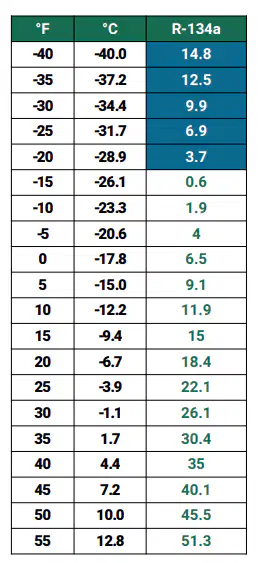
What is the evaporation temperature of R-134a at 30 psig?
A) 26 °F
B) 35 °F
C) 50 °F
D) 62 °F
The ________ is located downstream of the evaporator and before the compressor.
A) liquid receiver
B) liquid line filter drier
C) accumulator
D) condenser
Owners of a cold storage warehouse can't repair their R-22 refrigeration unit, so they are going to retire the unit. How long can they operate the leaking unit, before retrofitting or retiring the unit?
A) 3 months
B) 9 months
C) 12 months
D) 18 months
You have repaired a significant leak in an industrial process refrigeration system that contains 200 pounds of R-404A. How often is the owner required to perform a leak inspection to verify the system is no longer leaking?
A) Every 2 months
B) Every 3 months
C) Every 4 months
D) Every 12 months
When planning on using a refrigerant leak detector, an R-407C system should be leak checked with ________.
A) pressurized nitrogen and any HFC
B) pressurized nitrogen and R-22
C) pressurized nitrogen and a trace amount of R-407C
D) R-407C
To mothball a system with 60 pounds of refrigerant, you must ________.
A) shut down the appliance temporarily, and recover the refrigerant from the leaking isolated section or from the entire system to at least atmospheric pressure
B) remove the appliance and store it at an off-site facility
C) remove the compressor
D) immediately shut down the appliance and disconnect electrical power
End type 2
Yes
YES?
The owners and operators of any system that has 50 or more pounds of refrigerant charge must keep records of refrigerant added, leak inspections, initial verification tests, and follow-up verification tests for at least ________.
A) 2 years
B) 3 years
C) 5 years
D) 8 years or the life of the appliance, whichever is less
The best method to determine a chiller's normal charge for leak rate calculations is to ________.
A) measure the power consumption
B) use the power consumption and compressor horsepower
C) measure the chiller barrel dimensions
D) use the charge stated on the equipment nameplate
Pressure relief valves must NEVER be installed ________.
A) in series
B) in parallel
C) on a short tubing run
D) on a long tubing run
According to the EPA, when all the R-123 liquid has been removed from an average 350-ton R-123 chiller and the system vapor pressure is 0 psig, the system contains ________.
A) trace amounts of refrigerant, which does not need to be recovered
B) almost 10 pounds of refrigerant in the system
C) 100 pounds of refrigerant in the system
D) oil that must be recovered
Leak testing a low-pressure refrigeration system at pressures above 10 psig could damage the ________.
A) compressor
B) condenser
C) purge unit
D) rupture disc
What should be done to reduce refrigerant loss from a purge unit on a R-123 chiller?
A) install a new purge unit
B) repair the leak in the system
C) seal the purge unit
D) any of the above
To prevent freezing, when recharging an evacuated water-cooled chiller system with R-123, first charge with vapor to a pressure of at least ________.
A) 500 microns
B) 600 microns
C) 20 in Hg vacuum
D) 2 psig
A water-cooled recovery unit typically has a ________.
A) lower recovery tank pressure and therefore faster recovery rate
B) higher recovery tank pressure and therefore faster recovery rate
C) better chance of recovering all the oil in the system
D) slower recovery rate and is not recommended for use with large chillers
The typical design burst pressure for a rupture disk on a low-pressure centrifugal air-conditioning system is ________.
A) 2500 microns
B) 15 psig
C) 20 psig
D) 22 psig
The maximum test pressure for leak testing a low-pressure centrifugal chiller is ________.
A) 2000 microns
B) 2500 microns
C) 10 psig
D) 35 psig
When charging a low-pressure chiller with R-245ca, first introduce the refrigerant as a vapor until the pressure is greater than 18 inches Hg vacuum to prevent ________.
A) the purge unit from venting excess refrigerant into the air
B) the purge unit from overheating
C) the chiller water from freezing
D) over-pressurization of the system and burst disk failure
ASHRAE Standard 15 calls for the activation of an alarm and mechanical ventilation when the ________.
A) TLV-TWA is exceeded
B) UTL (upper threshold limit) is exceeded
C) oxygen level drops below 16%
D) EEL (emergency exposure limit) is exceeded by 10%
________ is responsible for keeping records of all leak inspections and any completed leak repair verification tests.
A) The most recent repair technician
B) The original technician who installed the unit
C) The owner and/or operator of the equipment
D) The SNAP program director
For a commercial refrigeration system with a charge of 50 pounds or more of refrigerant, a substantial (or threshold) leak rate will be reduced to ________ after January 1, 2019.
A) 5%
B) 10%
C) 20%
D) 30%
To raise the pressure of a low-pressure refrigeration system for leak checking, you can ________.
A) add nitrogen to increase the pressure
B) add a high-pressure refrigerant (trace gas) to increase the pressure and let the purge unit remove it later
C) heat the system by circulating hot water, raising the temperature of the room, or using heating blankets
D) seal the purge unit so the system pressurizes itself
If a chiller is suspected of having evaporator tube leaks, what should be done before recovering refrigerant?
A) Drain the water side of the evaporator.
B) Operate both circulating pumps.
C) Activate the purge unit.
D) Open all the condenser vents.
A company has achiller that uses 60% of the chiller cooling capacity for cooling an industrial process and 40% to cool the office spaces in the factory. Which leak rate category is this chiller in?
A) the all other category, because the use is split.
B) comfort cooling
C) air conditioning
D) industrial process refrigeration
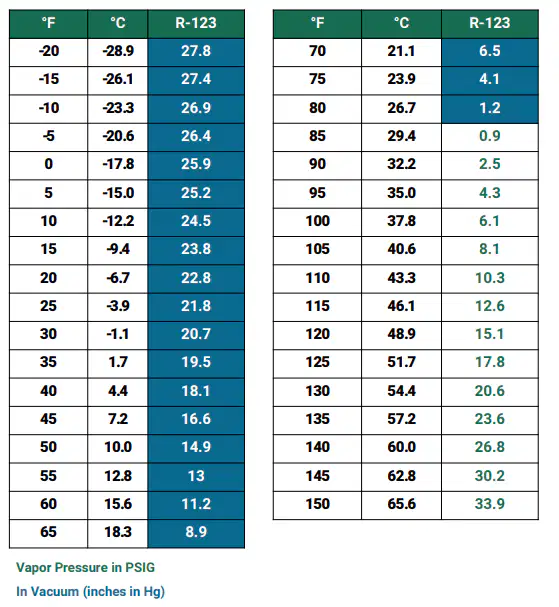
R-123 at a pressure of 13 inches Hg vacuum has a saturation temperature of ________.
A) 25 °F
B) 32 °F
C) 40 °F
D) 55 °F
ASHRAE Guideline 3 states the chiller should be checked for leaks if during a standard vacuum test the pressure in a system rises from 1 mm Hg to a level above ________.
A) 500 microns
B) 2.0 psig
C) 2.5 mm Hg
D) 600 microns
Water must be circulated through a chiller during refrigerant evacuation to avoid ________.
A) acid buildup
B) oil overheating
C) freezing of the water
D) system isothermalization
Which of the following statements about R-1233zd is TRUE?
A) It is a SNAP approved replacement for low-pressure centrifugal compressor systems.
B) It can be used in new equipment where R-123 might have been used.
C) It is flammable.
D) Both A and B are true.
According to the EPA, you should take an oil sample if ________.
A) the suction line is icing
B) the compressor has burned-out
C) cooling capacity has degraded
D) excess vibration is noted
After a leaking system that has been repaired has passed the initial verification leak test, when must the follow-up verification test be conducted?
A) within 5 days
B) within 10 days
C) within 30 days
D) No follow-up verification test is required.
During vapor recovery from a low-pressure chiller, ________.
A) only the recovery compressor should be on
B) the system water pumps and recovery compressor should be on, and the recovery condenser water flow should be off
C) the system water pumps, recovery compressor, and recovery condenser water flow should all be on
D) all pumps should be off to prevent damage to the pumps during recovery

