wayground logo

Free Printable Worksheets

NEW

Font size

S
M
L
XL
Worksheets

Biology Unit 5 Exam 5 Review

Total questions: 45

Worksheet time: 27mins

Name
Class
Date
1.
This scientist concluded that animals and, in fact, all living things are made of cells:
a)
Hooke
b)
Leeunwenhoek
c)
Schleiden
d)
Schwann
2.
This scientist was the first to identify cells and name them:
a)
Hooke
b)
Leeunwenhoek
c)
Schleiden
d)
Virchow
3.
This scientist proposed that all cells come from other cells:
a)
Leeunwenhoek
b)
Schleiden
c)
Schwann
d)
Virchow
4.
This scientist concluded that plants are made of cells:
a)
Virchow
b)
Schwann
c)
Schleiden
d)
Leeunwenhoek
5.
This scientist observed live cells and observed greater detail:
a)
Hooke
b)
Leeunwenhoek
c)
Virchow
d)
Schwann
6.
All organisms are made of:
a)
organelles
b)
cytoplasm
c)
DNA
d)
cells
7.
All existing cells are produced by other
a)
living cells
b)
dead cells
c)
atom cells
d)
animal cells
8.
This is the most basic unit of life
a)
atom
b)
cell
c)
nucleus
d)
DNA
9.
Cell theory is one of the great unifying theories of
a)
biology
b)
chemistry
c)
physics
d)
physical science
10.
Cells come only from what?
a)
existing cells
b)
nucleus
c)
fission
d)
budding
11.
Who looked at cork and named the cell?
a)
Robert Hooke
b)
Van Leeuwenhoek
c)
Robert Brown
d)
Francesco Redi
12.
The Cell Theory states...
a)
atoms create all matter
b)
living things evolve
c)
the cell is the backbone of all matter
d)
cells are the basic unit of structure and organization of organisms
13.
"All animals are made of cells". This fact was discovered by...
a)
Matthias Schleiden
b)
Theodor Schwann
c)
Robert Hooke
d)
Rudolf Virchow
14.
What does NOT happen during interphase?
a)
growth
b)
DNA replication 
c)
obtaining nutrients
d)
cell divison
15.
Cytokinesis is a phase of mitosis. 
a)
True
b)
False 
16.
Cells spend the majority of their lives in
a)
Interphase
b)
Mitosis
c)
Synthesis 
d)
Gap 2
17.

Cells of organisms must go through cell division for?

a)

growth

b)

repair of damaged cells

c)

replacement of dying cells.

d)

All of these

18.

DNA is replicated during ______ of the cell cycle.

a)

Gap 1

b)

Synthesis (S phase)

c)

Gap 2

d)

Gap 0

19.
What is cytokinesis?
a)
This is when two cells merge together to make one giant cell.
b)
The stage where chromosomes migrate to the opposite ends of the cell. 
c)
The stage of the cell cycle where the rest of the cell divides after mitosis is complete.
d)
The stage in which DNA condenses into chromosomes.
20.
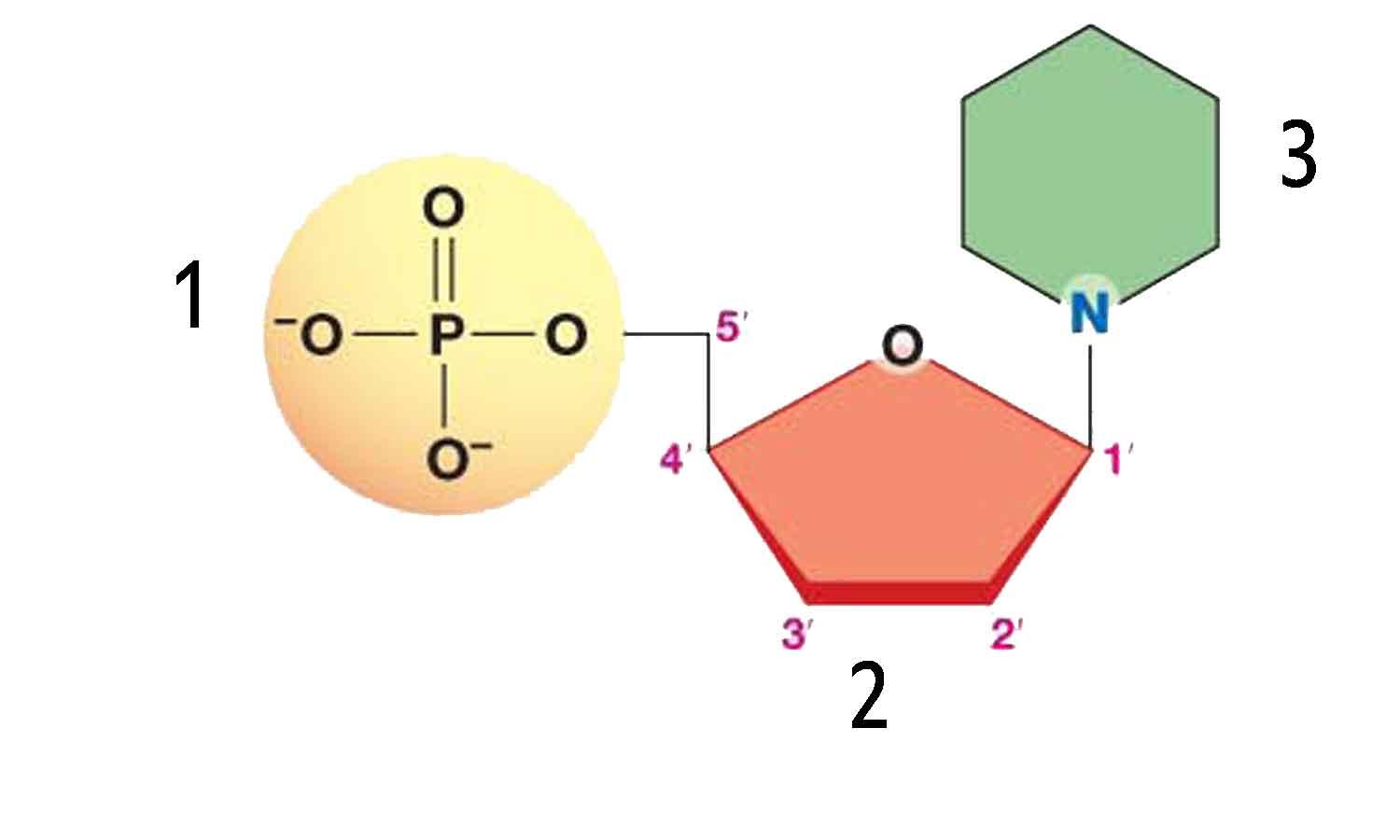
Identify the parts of the nucleotide shown:
a)
1) Ribose Sugar      2) Phosphate 
3)  Nitrogen Base
b)
1) Deoxyribose Sugar
2) Phosphate
3) Nitrogen Base
c)
1) Phosphate
2) Ribose Sugar
3) Nitrogen Base
d)
1)  Phosphate
2) Deoxyribose Sugar
3)  Nitrogen Base
21.
What occurs during G1?
a)
Checkpoint after S phase
b)
Chromosomes line up at the equator.
c)
The cell grows and develops.
d)
Spindle fibers separate chromosomes to opposite poles of the cell. 
22.
True or False:
Normal cells grow and divide continuously.
a)
True
b)
False
23.

During most of interphase, DNA is found in a relaxed form called

a)

chromosome

b)

centromere

c)

centriole

d)

chromatin

24.

During mitosis, DNA is found in the condensed form called a

a)

chromosome

b)

centromere

c)

centriole

d)

chromatin

25.

In prophase of mitosis, chromosomes

a)

form and the nuclear envelope disappears.

b)

are pulled toward opposite ends of the cell.

c)

chromosomes line up along the equator of the cell

d)

chromosomes begin to decondense and the two new nuclei begin to form.

26.

In metaphase of mitosis, chromosomes

a)

form and the nuclear envelope disappears.

b)

are pulled toward opposite ends of the cell.

c)

chromosomes line up along the equator of the cell

d)

chromosomes begin to decondense and the two new nuclei begin to form.

27.

In anaphase of mitosis, chromosomes

a)

form and the nuclear envelope disappears.

b)

are pulled toward opposite ends of the cell.

c)

chromosomes line up along the equator of the cell

d)

chromosomes begin to decondense and the two new nuclei begin to form.

28.

In telophase of mitosis, chromosomes

a)

form and the nuclear envelope disappears.

b)

are pulled toward opposite ends of the cell.

c)

chromosomes line up along the equator of the cell

d)

chromosomes begin to decondense and the two new nuclei begin to form.

29.

After mitosis, the cytoplasm and organelles are divided between the two new forming cells in a process called

a)

centriole

b)

chromatin

c)

cytokinesis

d)

centromere

30.

This process is the programmed death of a cell

a)

stem cell

b)

regulation

c)

apoptosis

d)

cytocide

31.

These undifferentiated cells can become specialized cells after receiving a chemical signal.

a)

stem cells

b)

generic cells

c)

blank cells

d)

empty cells

32.

The cell cycle is regulated by this

a)

cyclins

b)

stem cells

c)

cyclin-dependent kinases

d)

both cyclins and cyclin-dependent kinases

33.

When cells go through mitosis repeatedly without entering interphase, this results

a)

arthritis

b)

cancer

c)

mutation

d)

diabetes

34.
The organelle that helps in cell division and produces spindle fibers.
a)
Chromosome
b)
Centriole
c)
Cytoplasm
d)
Chloroplast
35.
Identify the stage of the cell cycle while looking at the picture.
a)
Interphase
b)
Prophase
c)
Metaphase
d)
Anaphase
36.
What phase of mitosis is shown in the picture?
a)
Prophase
b)
Anaphase
c)
Telophase
d)
Metaphase
37.
What phase of mitosis is shown in the picture?
a)
Prophase
b)
Anaphase
c)
Telophase
d)
Metaphase
38.
What phase of mitosis is shown in the picture?
a)
Prophase
b)
Anaphase
c)
Telophase
d)
Metaphase
39.
Structure B is pointing to the _____. 
a)
chromosome
b)
centromere
c)
DNA
d)
chromatid
40.
Which is Metaphase?
a)
A
b)
E
c)
C
d)
F
41.

Which is Prophase?

a)
A
b)
E
c)
C
d)
F
42.

Which is phase is cytokinesis?

a)
A
b)

B

c)
C
d)

D

43.

Identify letter "a" in the image.

a)

prophase

b)

G1

c)

interphase

d)

telophase

44.

Which of the following describes the result of mitosis?

a)

2 identical, haploid cells

b)

4 non-identical haploid cells

c)

2 identical, diploid cells

d)

4 non-identical, diploid cells

45.
Which structures are indicated by the green arrows?
a)
sister chromatids
b)
chromosomes
c)
spindle fibers
d)
centrioles