
 Worksheets
Unit 6 Exam Review
Total questions: 47
Worksheet time: 53mins
Besides stirring, which of the following should be done to make this powder dissolve faster in the liquid?
Add heat to the liquid
Cool the liquid in a freezer
Add more powder to the liquid
Store the mixture in a dark place
Which one of these is considered a SOLUTE?
Salt
Water
Salt Water
Factor(s) that affect solubility
Temperature
Agitation
Surface area
all of them
ionic compounds get separated into ions in solution through which process
solution
homogeneous solution
dissociation
dissolving
Which end of the water molecule would surround a Cl- ion in a solution
the Oxygen end
the Hydrogen end
neither end
they don't surround the ion
When water molecules completely surround ions or covalent molecules, they form what around them to keep them apart?
hydration shells
a polar bond
an invisible force field
a hydrogen bond
Which of the following would not be considered an agitation to increase dissolving?
shaking the solute/solvent mix
stirring the solute solvent mix
swirling the solute/solvent mix
cooling the solute/ solvent mix

In the image, what is the charge of the solute particle in the center of the hydration shell?
Positve
Negative
No Charge
Not enough information
The process of dissolving
dissolvability
Dissolution
Solution
Universal solvent
Contains more than the maximum amount of solute per solvent; any small particle or disturbance can cause crystalization.
Concentrated
Saturated
Supersaturated
Unsaturated
When a solution cannot hold anymore solute in a solvent at a given temperature and pressure
Concentration
Saturated
Supersaturated
Unsaturated
When a solution can hold more solute because it currently contains less than the maximum amount for the solvent available.
Concentration
Saturated
Supersaturated
Unsaturated
A measure of how much solute is dissolved in a solvent
Concentration
Dissolution
Solubility
Solution
Unable to be dissolved
dissolvability
Insoluble
Soluble
Unsaturated
Able to be dissolved
dissolvability
Insoluble
Soluble
Unsaturated
The part of the solution that is present in the greater amount and does the dissolving
Solute
Solvent
Solution
Solubility
The part of the solution that is present in the lesser amount and that is dissolved.
Solute
Solvent
Solution
Solubility

Which color pigment has the smallest mass?
Yellow
Orange
Blue
Green
Purple

Chromatography was done on several leaves of plant species. Which species is most similar to Species Y.
W
X
Z
None of these

Use the figure shown: Which has the greatest density of solute particles?
A
B
E
Use the figure shown: Which has a concentration of 0.25moles per 1 Liter of solution?
A
B
D
E
Use the figure shown: Which dilution can dissolve the most additional solute?
A
B
D
E
F
Use the figure shown: Which dilution represents a 0.5M solution. This is based on the kool aid lab we did.
A
B
C
D
E

What condition would KNO3 be at 85g and 45 degrees C in 100g of water?
Unsaturated
Saturated
Supersaturated
Dissolved
This is a type of mixture where one substance dissolves into another
Solution
Miscibility
Compound
Solubility
Molar mass of NaOH is ______________________
40 grams/mol
50 grams/mol
45 grams/mol
38 grams/nol
How many mols of HCl are in 3 liters of 2.0M HCl solution?
2.0
1.5
6.0
0.66
Molarity is defined as _________ divided by ___________
mol, liters
mol, kg
kg, liters
liters, kg
Molarity is measured in _____.
moles per g.
mols per L.
moles per mm.
moles per mL.
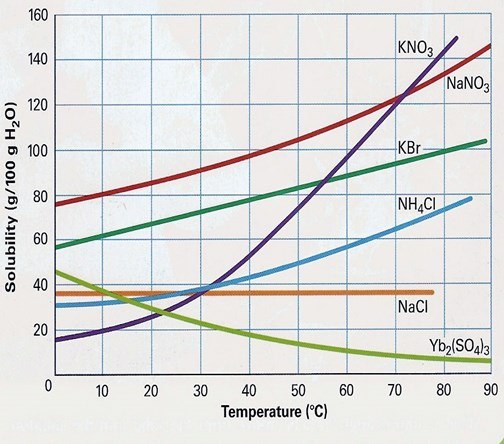
At 30'C, which substance has the lowest solubility?
KNO3
KBr
NaCl
Yb2(SO4)3

Which two solutions have the same concentration?
A & D
A & E
C & E
F & C
B & E

The drawings below represent beakers of aqueous solutions. Each o represents a dissolved solute particle.Which solution is least concentrated?
A
B
C
E
F
Kool-Aid - flavoring, coloring, sugar, and water. Identify the solvent.
water
powder
sugar
powder and sugar


Which diagram shows the MOST dense object?
left
center
right
A block of aluminum occupies a volume of 15.0 mL and weighs 45.0 g. What is its density?
3 g/mL
0.3333 g/mL
675 g/mL
I have no idea
How do we currently clean up an oil spill?
Remove all coral then burn the oil
Containment booms
Chemical dispersal
All of the above

When an oil slick reaches coastline ecosystems and washes up on beaches it poses a huge threat to biological organisms. The main removal / clean up method for this is... (Select TWO that apply)
Oil booms
Oil skimmers
Physical removal of sand / soil
Flushing with hoses, brushes and shovels
In-situ burning

