
 Worksheets
Anatomy Basics
Total questions: 60
Worksheet time: 15hrs 0mins
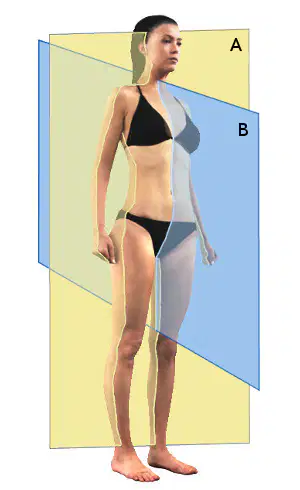
What does B indicate?
the Frontal plane
the Sagittal plane
the Transverse plane
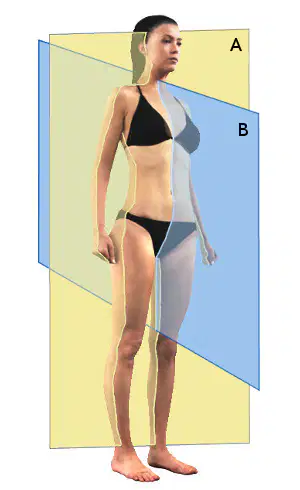
The Sagittal plane divides the body into:
anterior and posterior halves
left and right halves
superior and inferior sections
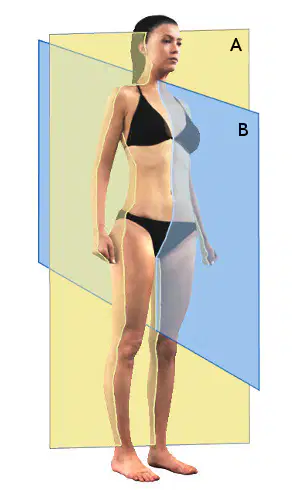
Plane A is the:
frontal plane
sagittal plane
transverse plane
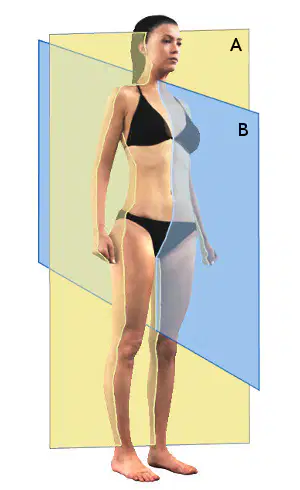
The frontal plane divides the body into which of the following?
anterior and posterior portions
superior and inferior portions
lateral and medial portions
Another name for frontal plane is:
parasagittal plane
transverse plane
coronal plane
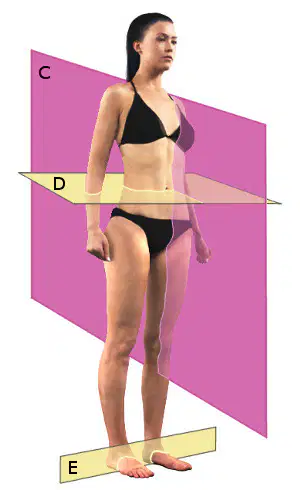
Which plane is indicated by letter C?
sagittal plane
frontal plane
transverse plane
Which plane is indicated by letter D?
sagittal plane
frontal plane
transverse plane
A transverse plane divides the body into:
distal and proximal portions
superior and inferior portions
anterior and posterior portions
When in the Anatomical Position, the feet are together and the palms of the hands face:
forward
backward
towards the body
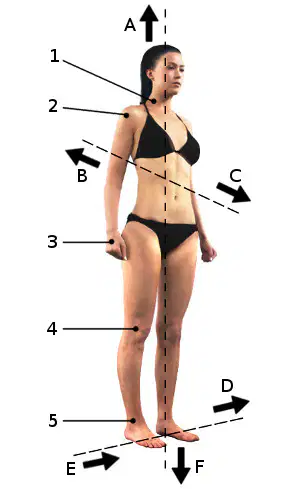
An area of the body nearer to the front (Letter C) is referred to as:
medial
lateral
anterior
posterior
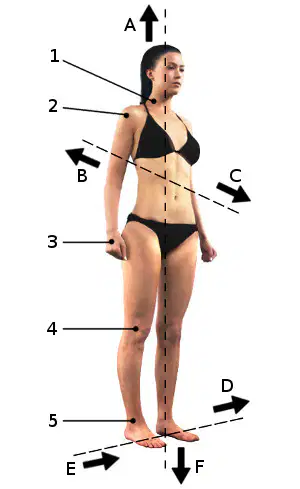
An area of the body further from the midline plane (Letter D) is referred to as:
superior
inferior
medial
lateral
An area of the body closer to the median plane (Letter E) is referred to as:
superior
inferior
medial
lateral
Something closer to the feet (Letter F) is referred to as:
superior
inferior
medial
lateral
The _______ is lateral to the eye.
nose
forehead
ear
chin
The ________ is inferior to the elbow.
shoulder
hand
chin
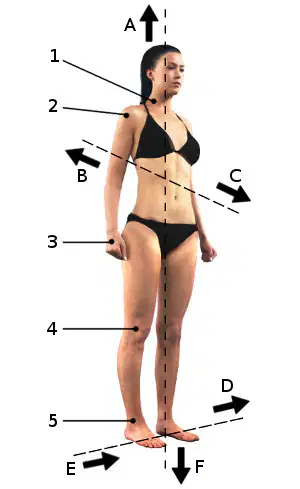
An area of the body nearer to the back (Letter B) is referred to as:
posterior
anterior
lateral
medial
The shoulder is ____________ to the sternum.
posterior
anterior
lateral
medial
Adduction:
turns a limb to face upwards
moves a limb towards the midline
moves a limb away from the midline
Flexion
decreases the angle at a joint
extends a limb
moves a limb towards the midline
rotates the limb away from the body
Movement of a limb away from the midline
adduction
abduction
extension
flexion
Increase the angle at a joint
adduction
extension
flexion
abduction
______________ leaves the palms facing forward in the anatomical position.
Adduction
Pronation
Supination
Abduction

Rotation of the forearm until the palm faces down is called ____________.
adduction
pronation
supination
abduction
Flexing the foot at the ankle to raise the toes
inversion
dorsiflexion
plantar flexion
eversion
Extending the foot at the ankle to lower the toes
inversion
dorsiflexion
plantar flexion
eversion
Movement of the foot so that the sole points away from the body's midline (laterally).
inversion
dorsiflexion
plantar flexion
eversion
Movement of the foot so that the sole points towards the body's midline (medially).
inversion
dorsiflexion
plantar flexion
eversion
Circumduction moves a limb:
anteriorly and posteriorly
medially and laterally
in circular movements
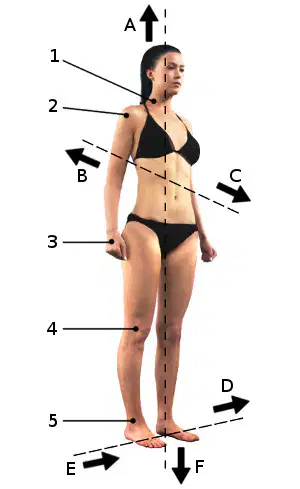
The neck (1) is _________ to the shoulder (2).
medial
lateral
anterior
posterior
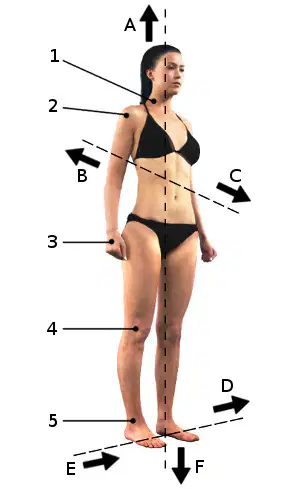
The hand (3) is __________ to the shoulder (2).
distal
proximal
lateral
medial
Something closer to the head
anterior
posterior
superior
inferior

The knee (4) is _________ to the ankle (5).
superior
inferior
medial
lateral
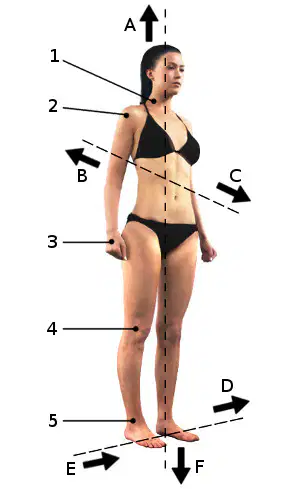
The ankle (5) is ________ to the knee (4).
proximal
distal
anterior
posterior
The toes are ___________ to the ankle.
lateral
medial
distal
proximal
Two areas located on the same side of the body are said to be:
ipsilateral
contralateral
rostral
caudal
Two areas located on the opposite side of the body are said to be:
ipsilateral
contralateral
rostral
caudal
The elbow is ___________ to the wrist.
proximal
distal
medial
lateral
In the anatomical position, the person:
is lying down
has arms placed above the head
is standing upright, facing the observer with the palms backward
is standing upright, facing the observer with the palms forward
A structure towards the head
superior
inferior
superficial
deep
Toward the front or belly
ventral
dorsal
superior
inferior
The navel is ___________ to the nose.
ventral
dorsal
superior
inferior
The armpit is _________ to the hip.
ventral
dorsal
superior
inferior
Toward the front or belly
ventral
dorsal
superior
inferior
Toward the back or spine
ventral
dorsal
superior
inferior
Another name for anterior is:
ventral
dorsal
caudal
rostral
A _____________ plane divides the body into upper and lower sections.
sagittal
frontal
transverse
coronal
A _____________ plane divides the body into left and right sides equally.
midsagittal
parasagittal
transverse
frontal
A _____________ plane divides the body into left and right sides unequally.
midsagittal
parasagittal
transverse
frontal
A _____________ plane divides the body into upper and lower sections.
midsagittal
parasagittal
transverse
frontal
A _____________ plane divides the body into anterior and posterior sections.
midsagittal
parasagittal
transverse
frontal
The skin is ___________ to the muscles.
deep
superficial
medial
lateral
The heart is ___________ to the ribs.
deep
superficial
medial
lateral
Away from the midline
lateral
medial
distal
proximal
Above another part or closer to the head
superficial
deep
superior
inferior
The hips are ______________ to the chest
superficial
deep
superior
inferior
On one side of the body
unilateral
bilateral
rostral
caudal
On both sides of the body
unilateral
bilateral
rostral
caudal
Between two structures
supine
prone
bilateral
intermediate
Facing up
supine
prone
bilateral
intermediate
Facing down
supine
prone
bilateral
intermediate

