
NEW
Font size
 Worksheets
PHYSICS IN EVERYDDAY LIFE REVISION QUIZ 4
Total questions: 25
Worksheet time: 32mins
If two objects are in two different temperatures, in what direction of heat will flow?
In all directions simultaneously
From lower temperature to higher temperature
From colder to warmer objects
From object at a lower temperature to object at a higher temperature
When does conduction continue until in the context of temperatures?
Until objects are at absolute zero
Until objects reach maximum temperature
Until object temperatures are equal
Until objects lose all their heat
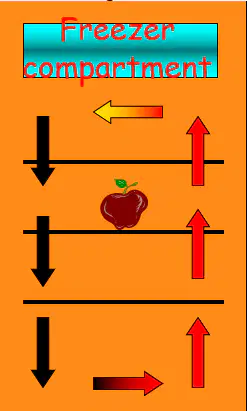
In the refrigerator shown, where does the warm air move?
Move upwards
Move left side
Move downwards
Move right side

In the refrigerator shown, where does the cool air move?
Move upwards
Move left side
Move downwards
Move right side
In the study of light, what does VIBGYOR represent?
A measure of light intensity.
Different types of light waves.
The spectrum of colours formed by sunlight.
Acronyms for light-related scientific principles.
Why does wood feel warmer than metal, when heated?
Wood retains heat
Wood conducts heat away better
Wood reflects heat
Wood absorbs heat
Wood generates more heat
What type of motion do atoms exhibit, even in solid objects?
Rotational motion
Vibrational motion
Circular motion
Linear motion
Random motion
What property of the liquid inside a thermometer is responsible for temperature measurement?
Density
Refractive index
Conductivity
Expansion or contraction
Viscosity
If the below mentioned containers are filled with hot water and placed in a room with air conditioner set to 20℃, which one would have the warmest water after ten minutes?
Shiny metal container
Transparent container
Opaque container
Black container
White container
What is the process described as moving energy from one object to another when they are physically touching?
Convection
Conduction
Transmission
Radiation
Insulation
On the Celsius scale, what is the freezing point of water?
0℃
100℃
273.15℃
32℃
212℃
In which of the following medium, light will move faster?
Air
Water
Diamond
Plexiglass
Glass
Which of these primary conditions must be satisfied for heat flow to occur?
Objects must have the same temperature
Objects must be at absolute zero
Objects must be in a vacuum
Objects must have different temperatures
Objects must be in direct sunlight
Which of the following is the fundamental building block of all matter?
Molecules
Elements
Compounds
Particles
Atoms
According to the concept of light absorption and reflection, why does an apple appear red?
It emits red light
It absorbs red light
It reflects red light and absorbs other colours
It refracts red light
It reflects all colours equally
When light enters a medium with a higher refractive index, how does it affect its speed?
The speed increases
The speed remains constant
The speed decreases
The speed becomes zero
The speed doubles
In which state of matter do particles flow freely?
Solid
Liquid
Gas
Bose-Einstein Condensate
Plasma
What is the primary material used in incandescent lights for producing light, and why is it chosen for this purpose?
Copper - High electrical conductivity
Tungsten - High melting point
Gold - Aesthetic appeal
Aluminum - Low melting point
Silver - Reflective properties
How is the temperature related to the average kinetic energy of particles in the object?
Inversely proportional
Directly proportional
Temperature only depends on speed
No relationship
Temperature only depends on mass
Provide an example from real life where total internal reflection is utilized.
Reflection in a car windshield
Flashlight beam projection
Dispersion of light through a prism
Fiber optics for communication
Absorption of light by a black surface
Why can't heat travel from the Sun to the Earth by conduction or convection?
Lack of particles between the Sun and Earth
Insufficient energy from the Sun
Earth's magnetic field blocks heat transfer
Conduction and convection only occur in liquids
Sun's energy is too intense
What does the cooling and movement of warmer air upward create?
A cycle of radiation
A cycle of conduction
A cycle of insulation
A cycle of compression
A cycle of convection
What is the primary phenomenon responsible for separating white light into its component colours when it passes through a prism?
Reflection
Refraction
Absorption
Diffraction
Transmission
Which of the following initiates heat transfer between a fire and hot pot?
Electromagnetic waves
Pressure differences
Kinetic energy differences
Density variations
Temperature differences
By which of the following principle of heat transfer, a refrigerator works?
Conduction
Convection
Radiation
Insulation
Compression

