
 Worksheets
Cell Structures & Cell Division.Revised 2026
Total questions: 44
Worksheet time: 51mins

During cell division, organisms must ensure that genetic material is accurately distributed to daughter cells. In meiosis, homologous chromosomes pair up and go through specific stages that differ from mitosis. One important stage is when these paired chromosomes align in the center of the cell before being separated. A student examines a diagram showing one of the stages of meiosis. Based on the diagram, which statement best explains what is occurring during Metaphase I of meiosis?
Sister chromatids are separating and moving toward opposite poles of the cell.
Homologous chromosome pairs are aligned along the equator of the cell.
Chromosomes are condensing and becoming visible inside the nucleus.
The nuclear membrane is reforming around two new nuclei.

Accurate separation of genetic material is essential for producing healthy gametes during meiosis. After meiosis I, cells enter meiosis II, where the separation process is similar to mitosis but involves haploid cells. What phase is shown here?
Prophase I

During meiosis, cells undergo a series of stages that increase genetic variation in organisms. Early in meiosis I, important events occur that do not happen in mitosis. A student examines the diagram shown on the left. Based on the diagram, which statement best explains what is occurring during Prophase I of meiosis?
Sister chromatids are separating and moving toward opposite poles of the cell.
Homologous chromosomes are pairing and exchanging genetic material through crossing over.
Chromosomes are aligning individually at the center of the cell.
The nuclear membrane is reforming around two haploid nuclei.
During meiosis, genetic variation is essential for the survival of populations in changing environments. One process that contributes to this variation occurs when homologous chromosomes exchange segments of DNA. This exchange results in new combinations of alleles that were not originally present in either parent. In what phase of meiosis does crossing over occurs?
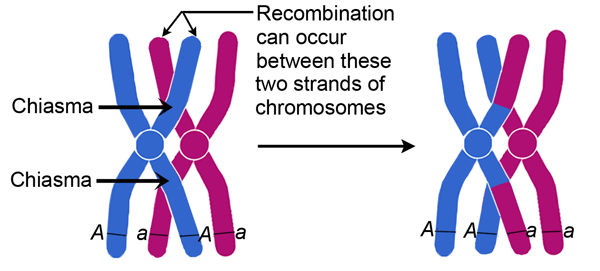
During meiosis, cells undergo processes that ensure genetic variation is passed from one generation to the next. In one stage, homologous chromosomes pair closely together and exchange segments of DNA, resulting in new combinations of genetic information. A student examines a diagram showing homologous chromosomes forming pairs with visible crossing over at certain points.
Explain how the process shown in the diagram during Prophase I contributes to genetic variation in sexually reproducing organisms.
It ensures that chromosomes are evenly divided between daughter cells.
It reduces the number of chromosomes in each daughter cell.
This process creates mutations in genes altering the organism's genome.
The process creates new combination of alleles. This increases genetic variation in offspring.
During meiosis, a diploid cell undergoes two divisions to produce haploid gametes. This reduction in chromosome number is essential for maintaining the correct chromosome number when fertilization occurs. If this process did not reduce the chromosome number, the number of chromosomes would double in each generation. A student is analyzing how chromosome numbers change after meiosis in a species.
During meiosis, if an organism has 10 chromosomes in its diploid body cells, how many chromosomes will each new daughter cell have after meiosis is completed?
10
8
5
2
During cell division, organisms use mitosis to produce new cells for growth, repair, and maintenance. Mitosis ensures that each new daughter cell receives an exact copy of the parent cell’s genetic material. Unlike meiosis, mitosis does not reduce the number of chromosomes in the cell. A student is analyzing how chromosome numbers remain the same after mitosis in a given organism.
During mitosis, if an organism has 10 chromosomes in its body cells, how many chromosomes will each new daughter cell have after cell division is completed?
10
8
5
2

Cells divide in different ways depending on the purpose of the division. Some divisions are used for growth and repair, while others are used to produce reproductive cells. These processes differ in how many times the cell divides, the number of daughter cells produced, and whether the genetic material remains identical or is reduced. A student compares two cell division processes occurring in different organisms.
Which statement best differentiates mitosis from meiosis?
Mitosis produces four genetically different haploid cells, while meiosis produces two identical diploid cells.
Mitosis produces two identical diploid cells, while meiosis produces four genetically different haploid cells.
Mitosis reduces chromosome number by half, while meiosis maintains the same chromosome number.
Mitosis only occurs in reproductive cells, while meiosis occurs in all body cells.
Scientists developed the cell theory after many observations of living organisms using microscopes. This theory explains the basic unit of structure and function in all living things and describes how new cells are formed. Modern biology continues to support and expand these ideas through ongoing research. A student is reviewing key ideas that make up the cell theory.
Which statement best supports a key principle of the cell theory?
All organisms are made of tissues and organ systems.
Cells can only be found in animals and plants.
All living organisms are made of one or more cells.
Cells form only in multicellular organisms during growth.

Cells regulate what enters and leaves through the cell membrane to maintain homeostasis. The movement of water across a selectively permeable membrane depends on solute concentrations inside and outside the cell. This process is essential for maintaining proper cell size and function. A student observes a cell placed in a solution with a higher solute concentration outside the cell.
What type of cellular transport is occurring when water moves out of the cell in this situation?
Active transport, because energy is used to move water against the concentration gradient.
Osmosis, because water moves from high water concentration to low water concentration across a membrane.
Diffusion, because solutes move into the cell to balance concentrations.
Facilitated diffusion, because proteins are required to move water into the cell.
Cells rely on the cell membrane to regulate the movement of substances in and out. Some molecules are too large or too polar to pass directly through the lipid bilayer and must use transport proteins embedded in the membrane. These proteins can move substances either with or against their concentration gradient, depending on the needs of the cell. A student observes a diagram showing ions moving through a membrane protein from an area of low concentration to an area of high concentration using energy.
Which statement best explains the type of transport occurring in the diagram and the role of the transport protein?
Facilitated diffusion is occurring because the protein helps move ions down their concentration gradient without energy.
Osmosis is occurring because water is moving through a protein channel into the cell.
Active transport is occurring because the protein uses energy to move ions against their concentration gradient.
Diffusion is occurring because ions are moving freely through the lipid bilayer without assistance.
Cells depend on a balance of fluids inside and outside the body to maintain proper function. In medical settings, IV (intravenous) solutions are carefully delivered into the bloodstream to avoid disrupting this balance. However, if an IV needle is not properly placed into a vein, the fluid can leak into the surrounding tissues. A patient receives an IV solution, but the needle is incorrectly positioned, causing the surrounding cells to be exposed to a fluid with a different solute concentration than normal blood plasma. The area around the injection site becomes swollen.
Which statement best explains the cellular transport process responsible for the swelling observed in the patient’s tissue?
Osmosis causes water to move into cells from the surrounding fluid, leading to cell swelling.
Active transport causes cells to pump excess water into the surrounding tissue using energy.
Diffusion causes solutes to move out of cells, increasing water inside the tissue.
Facilitated diffusion causes proteins to move water into cells through membrane channels.
The cell theory includes several key postulates that explain the structure and function of living organisms. These postulates state that all living things are made of cells, cells are the basic unit of structure and function, and all cells come from pre-existing cells. Scientists use observations and experiments to support these ideas in real-world situations. A student is analyzing different biological scenarios to determine which principle of the cell theory is being demonstrated.
A researcher observes a sample of bacteria under a microscope and records that each new bacterial cell forms by one cell dividing into two identical cells. Which postulate of the cell theory is best supported by this observation?
Cells contain genetic material that determines traits.
All cells come from pre-existing cells.
The cell is the basic unit of structure and function in living things.
All living organisms are made of one or more cells.
Cells have different structures depending on their function in the body. Some cells require large amounts of energy to perform their tasks, while others require less. Mitochondria are organelles responsible for producing ATP, the main source of energy for cellular activities. A student compares muscle cells to skin cells.
Which statement best explains why muscle cells are expected to have a large number of mitochondria
Muscle cells need to produce more proteins for communication, requiring additional mitochondria.
Muscle cells store genetic information, which requires more mitochondria for protection.
Muscle cells divide more rapidly than other cells, requiring more mitochondria for replication.
Muscle cells need more energy to contract and perform movement, so they require more ATP production.
Cells in the body grow and divide in a controlled manner through the cell cycle. Specialized proteins at checkpoints monitor whether a cell is ready to divide, ensuring that DNA is accurately copied and any damage is repaired. If these checkpoint proteins fail, cells may continue dividing even when errors are present. A student studies a group of cells in which the checkpoint proteins are not functioning properly and notices rapid, uncontrolled cell division.
Which statement best explains why some of these cells may develop into cancer?
The cells are unable to produce enough energy to complete normal functions.
The cells stop dividing completely due to the absence of checkpoint proteins.
The cells divide uncontrollably because damaged DNA is not repaired before cell division.
The cells lose the ability to exchange materials with their environment.
Plant cells rely on photosynthesis to convert light energy into chemical energy stored in glucose. This process occurs in the chloroplast and provides the energy needed for growth, repair, and cellular functions. In a lab experiment, a group of students places identical plant cells in two different environments: one exposed to continuous light and one kept in complete darkness for several days. The students observe changes in cell structure, growth rate, and overall health.
Based on the scenario, what is the most likely outcome for the plant cells kept in darkness, and why?
The cells will continue to grow normally because they can obtain glucose from water in the environment.
The cells will increase photosynthesis because darkness stimulates chloroplast activity.
The cells will divide more rapidly because the lack of light triggers faster cell division.
The cells will eventually weaken and die because they cannot produce enough glucose for energy.
Photosynthesis occurs in two main stages: the light-dependent reactions and the light-independent reactions (Calvin cycle). The light-dependent reactions take place in the thylakoid membranes and produce ATP and NADPH, while the Calvin cycle uses these products to build glucose in the stroma. In a lab experiment, students test a plant sample under normal light conditions but observe that oxygen is not being produced, even though carbon dioxide is still being absorbed. The plant is still taking in water and showing normal chloroplast structure.
Based on the scenario, which conclusion best explains which part of photosynthesis is not functioning properly?
The light-independent reactions are not working because carbon dioxide is not being used to produce glucose.
The light-dependent reactions are not working because oxygen production has stopped due to failure in energy capture.
Both stages are working normally because carbon dioxide uptake shows photosynthesis is occurring.
The Calvin cycle is overactive because excess glucose is being broken down into oxygen.
Photosynthesis occurs in two main stages: the light-dependent reactions and the light-independent reactions (Calvin cycle). The light-dependent reactions produce ATP and NADPH in the thylakoid membranes, while the Calvin cycle uses ATP and NADPH to help build glucose in the stroma. In a lab experiment, students analyze chloroplast activity under normal light conditions but observe that no ATP or NADPH molecules are being produced. However, carbon dioxide is still being absorbed by the plant cells.
Based on the scenario, which conclusion best explains which part of photosynthesis is not functioning properly?
The light-dependent reactions are not working because ATP and NADPH are not being produced.
The light-independent reactions are not working because carbon dioxide is not being absorbed.
Both stages are working normally because carbon dioxide absorption shows photosynthesis is occurring.
The Calvin cycle is overactive because glucose is being produced without energy input.
Scientists use microscopes to compare different types of cells in order to understand how structure relates to function. Plant and animal cells share many organelles, but they also have important differences that help them carry out specialized roles. In a lab investigation, a student observes two unknown cell samples under a microscope. One sample shows a rigid outer boundary and structures that appear green, while the other sample lacks a rigid outer boundary and has a more irregular shape.
Based on the observations in the scenario, which conclusion best explains what the scientist is seeing and how it relates to cell structure?
The first sample is an animal cell because it has a rigid structure, while the second is a plant cell because it is irregular in shape.
Both samples are plant cells because all cells contain chloroplasts and cell walls.
Both samples are animal cells because only animal cells contain chloroplasts for energy production.
The first sample is a plant cell because it has a cell wall and chloroplasts, while the second is an animal cell because it lacks these structures.
Scientists often use microscopes and recorded observations to classify organisms based on their cellular structures. In a lab investigation, a student examines four unknown multicellular organisms using high-power microscopy. The student’s notes show that one organism has cells with a rigid cell wall, no visible chloroplasts, and is made of many specialized cells. The other organisms show different combinations of these features, including some with chloroplasts or without cell walls.
Based on the scientist’s observations, which conclusion best identifies the organism and supports its classification?
he organism is an animal because it is multicellular, lacks chloroplasts, and does not have a cell wall.
The organism is a plant because it is multicellular and has a cell wall but lacks chloroplasts.
The organism is a fungus because it is multicellular and has a cell wall but lacks chloroplasts.
The organism is a bacteria because it is multicellular and lacks a nucleus.
Scientists use different types of microscopes to study cells and their internal structures. A transmission electron microscope (TEM) allows scientists to view thin sections of a cell and see internal organelles in great detail, while a scanning electron microscope (SEM) provides detailed images of the cell’s surface structure in three dimensions. In a lab investigation, a student is analyzing data from two different imaging techniques to study organelles such as mitochondria, chloroplasts, and the nucleus in a newly discovered organism.
Based on the scenario, which microscope would be most appropriate for obtaining detailed information about the internal structure of the cell’s organelles, and why?
SEM, because it provides a 3D image of the cell surface and shows internal organelles clearly.
TEM, because it allows scientists to view thin slices of the cell and see internal organelles in detail.
Light microscope, because it provides the highest magnification of living cells without staining.
SEM, because it is best for observing movement of organelles inside living cells.
Scientists often classify organisms by examining their cellular structures under a microscope. In a lab investigation, a student analyzes data collected from two unknown cell samples. Sample A shows cells with a clearly defined nucleus and membrane-bound organelles. Sample B shows much smaller cells that lack a nucleus and do not contain membrane-bound organelles. The student also notes that Sample B cells are structurally simpler and appear to be unicellular.
Based on the data collected, which statement best identifies how the scientist can distinguish between prokaryotic and eukaryotic cells?
Sample A is prokaryotic because it has a nucleus, while Sample B is eukaryotic because it is smaller in size.
Sample A is eukaryotic because it contains a nucleus and membrane-bound organelles, while Sample B is prokaryotic because it lacks these structures.
Both samples are prokaryotic because they are microscopic and unicellular.
Both samples are eukaryotic because all living cells contain a nucleus and organelles.

In a rapidly growing tissue in the human body, cells are constantly dividing to replace damaged or worn-out cells. A biology student observes that before each cell divides, the genetic material must be accurately copied. The student learns that this process ensures that each new cell receives a complete set of genetic instructions. However, the student also considers what might happen if this step did not occur properly or was skipped during cell division.
Why is it most important for DNA to be replicated before a cell undergoes mitosis or meiosis?
To reduce the number of chromosomes in each new cell so that genetic diversity increases in all body cells.
To ensure that each daughter cell receives an identical and complete set of genetic information needed for proper function.
To allow cells to produce more energy during division by increasing the number of mitochondria in the nucleus.
To prevent cells from growing too large before division by removing unnecessary genetic material.
In a biology laboratory, students are investigating how changes in cell membrane structure affect cell function. They place identical plant cells in a solution and chemically alter some of the cell membranes so that they become less permeable to water and ions such as sodium and potassium. After several hours, the students observe differences between normal cells and the altered cells in terms of size, internal pressure, and overall activity. The students begin to analyze how the movement of water and ions across the membrane is essential for maintaining homeostasis in the cell.
What would most likely happen to a cell if its membrane became significantly less permeable to water and ions?
. The cell would be unable to regulate internal conditions, leading to disrupted homeostasis and possible cell dysfunction or death.
The cell would immediately increase the rate of protein synthesis to compensate for the reduced permeability of the membrane.
The cell would automatically stop all metabolic activity and enter a permanent resting state to conserve energy.
The cell would begin producing a thicker cell wall to replace the need for membrane transport processes.
In a biology class, students are modeling how cell membranes control the movement of substances into and out of a cell. They compare two artificial membranes: one with a high proportion of phospholipids and embedded transport proteins, and another with a reduced number of transport proteins and more tightly packed lipid molecules. Both membranes are placed in identical environments containing glucose, ions, and water molecules. After several observations, students note differences in how quickly and efficiently substances move across each membrane.
How does the composition of a cell membrane most directly influence the transport of substances across it?
A higher number of transport proteins increases selective movement of ions and molecules, while lipid composition helps regulate diffusion of nonpolar substances.
A decrease in phospholipids allows all substances to freely pass through the membrane without restriction or energy use.
The presence of carbohydrates in the membrane determines the size of molecules that can be produced inside the cell.
Cholesterol completely blocks all movement of water and ions, preventing any form of transport across the membrane.


In a controlled laboratory investigation, a scientist studies how acidity affects the growth of a certain plant species. Four groups of identical plants are used. Three experimental groups are treated with solutions of different acidic pH levels (pH 4, pH 5, and pH 6), while a control group is treated with a neutral solution at pH 7. Over several weeks, the scientist measures plant height, leaf color, and overall health. The data show that plants exposed to lower pH levels exhibit slower growth and signs of stress compared to the control group
Which is the most valid conclusion based on the results of this experiment?
Plants grow best in all pH conditions, since each group received equal amounts of solution and light.
Neutral pH has no effect on plant growth because it was only used as a comparison group
Acidic solutions improve plant health because they provide more nutrients than neutral solutions
Increasing acidity negatively affects plant health, as plants exposed to lower pH levels showed reduced growth and stress compared to the control.
In a classroom experiment, students are investigating how different liquids affect plant growth. Three groups of identical plants are set up under the same conditions of light, temperature, and soil type. Each group receives a different liquid: one group is given water, another is given apple juice, and the third is given milk. The students want to determine which liquid best supports healthy plant growth by comparing results to a baseline condition.
Which group serves as the control in this experiment, and why?
The group receiving water, because it represents the normal condition for plant growth without added variables.
The group receiving apple juice, because it contains natural sugars that plants can use for energy
.The group receiving milk, because it has nutrients that may enhance plant growth.
All groups serve as controls because they are all being tested under the same environmental conditions
scanning electron microscope

In a biology lab, students are analyzing a highly magnified image of a mitochondrion. The image reveals detailed internal structures, including the folded inner membrane (cristae) and internal compartments of the organelle. The students note that the image shows a thin, two-dimensional cross-section rather than a three-dimensional surface view. They are asked to determine which type of microscope would be capable of producing such a detailed image of internal cell structures.
Which microscope most likely produced this image of the mitochondrion, and why?
Dissecting microscope, because it is designed to view internal structures of microscopic organelles.
Light microscope, because it can magnify organelles to show internal membrane structures clearly.
Transmission electron microscope, because it allows detailed visualization of internal structures in thin sections
Scanning electron microscope, because it produces high-resolution three-dimensional images of internal organelles.

In a biology laboratory, students are examining highly detailed images of a fly’s head to study its external structures, including compound eyes and sensory hairs. One image shows a three-dimensional view with surface texture and depth, allowing students to clearly observe the outer features. The students compare this image to others that show internal structures in thin slices without depth. They are asked to determine which type of microscope was most likely used to produce the detailed 3D surface image.
Which type of microscope most likely produced the three-dimensional image of the fly’s head, and why?
Transmission electron microscope, because it produces 3D images of internal cell structures.
Light microscope, because it allows visualization of surface features at the highest resolution.
Scanning electron microscope, because it provides detailed 3D images of surface structures.
Compound microscope, because it creates 3D images by combining multiple focal planes.

An osmosis investigation was conducted using chicken eggs to represent cells with semipermeable membranes. The eggs were first soaked in vinegar to dissolve the shell. Each egg was then placed in one of three different solutions for 24 hours. The mass of each egg was measured to determine how much water diffused into or out of the eggs. The table below shows the results of the investigation.
Based on this experiment, which of the following should be inferred about cells with semipermeable membranes?
Substances other than water may also cross the cell membrane.
Substances other than water may block pores in the cell membrane
Water enters the cell when placed in environments of higher water concentration
Water leaves the cell when placed in environments with a low concentration of solutes

Milan is a scientist studying the geometry of different types of viruses. She uses a particular type of microscope to generate the three-dimensional image of the surface shape of adenoviruses shown below. The image is magnified 125,000x.
What type of microscope must have Milan used to generate this image of adenoviruses?
Compound light microscope
Simple (single-lens) light microscope
Scanning electron microscope (SEM)
Transmission electron microscope (TEM)

Which microscope(s) would he use to complete the examination? Nicholas went to the community pond and collected samples. He wants to examine the internal structures of the organisms found in his sample.
Use the table to help you determine your answer.
Which microscope(s) would he use to complete the examination?
Scanning Electron
Compound Light
Transmission Electron
Scanning Electron or Transmission Electron
The prefix "micro" refers to tiny, and the suffix "scope" refers to view or look at. Microscopes are tools used to enlarge images of small objects so they can be studied more effectively. There are various types of microscopes, depending on the type of image that the scientist wants to view.
Therefore if a scientist is attempting to view the external surface of a bacterial cell with an emphasis on surface detail, what statement BEST explains what type of microscope to select in this scenario, with a rationale for using that particular kind of microscope?
A Scanning Electron Microscope (SEM) because it produces images by scanning specimens with a focused beam of electrons in order to provide a surface image of the organism.
A Transmission Electron Microscope (SEM) because it produces images by scanning speciements with a focused beam of electrons in order to provide a surface image of the organism.
A Compound Light Microscope because it produces imaged by scanning specimens with a focused beam of electrons in order to provide a surface image of the organism.
A Scanning Electron Microscope (SEM) because it produces images by scanning specimens with a focused beam of electrons in order to provide magnified detailed internal images of organelles.

Match the following
Stores water
Vacuole
Produces glucose through photosynthesis
Chloroplast
Releases energy
Mitochondria
Controls what enters and leaves
Cell membrane
Stores genetic material(DNA)
Nucleus

A
Cell Membrane
B
Cell Wall
E
Nucleus
J
Chloroplast
L
Central Vacuole

Match the following biological terms with their definitions.
Cell
The basic unit of all forms of life
Nucleus
The control center of a cell
Prokaryote
A unicellular organism without a nucleus
Eukaryote
An organism whose cells contain a nucleus

Match the following terms to its function.
cell membrane
protective layer
cytoplasm
fluid and all of the organelles
organelles
perform specific functions
DNA
genetic material /provide instructions
nucleus
in the DNA

The leaf inside the POTASH solution (KOH) did not turn purple because KOH does prevent the accumulation of _________.
Water
Oxygen
CO2
ATP

n a biology lab, students are analyzing a graph that compares two reaction pathways: one with an enzyme present and one without an enzyme. Both reactions begin with the same amount of reactants, but the curves on the graph show different rates of product formation over time. The line representing the reaction with the enzyme rises more quickly and levels off sooner than the reaction without the enzyme. Students are asked to interpret how enzymes affect the energy requirements and speed of biochemical reactions.
Based on the graph, which statement best describes the role of the enzyme in the reaction?
The enzyme prevents the reaction from occurring unless additional heat energy is added to the system
The enzyme increases the total amount of energy released in the reaction, resulting in more final product.
The enzyme lowers the activation energy, allowing the reaction to reach the product state faster than the reaction without the enzyme.
The enzyme permanently changes the reactants so they cannot return to their original form after the reaction
Simple Diffusion
When molecules passively cross the plasma membrane through the phospholipid bilayer
Facilitated Diffusion
When molecules passively cross the plasma membrane through a channel protein
Osmosis
The movement of water across the cell membrane
Endocytosis
Bringing in large materials through the cell membrane into a vacuole.
Exocytosis
Moving larger amounts or large quantities of materials through the cell membrane
In a biology investigation, a student performs an experiment to test whether carbon dioxide (CO₂) is necessary for photosynthesis. A healthy potted plant is first kept in darkness for 48 hours to remove stored starch from its leaves (de-starching). A bottle containing a strong solution of caustic potash (which absorbs carbon dioxide) is partially filled and sealed with a cork. A leaf is carefully inserted so that only part of it is inside the bottle while the rest remains outside. The plant is then placed in sunlight for several hours. Afterward, a starch test is performed on the leaf. The portion of the leaf inside the bottle shows no color change, while the exposed portion turns blue-black, indicating starch presence.
Based on the results of the experiment, what is the most valid scientific conclusion about the role of carbon dioxide in photosynthesis?
Photosynthesis occurs independently of environmental conditions, but starch production varies due to differences in water availability.
The absence of starch inside the bottle proves that oxygen, not carbon dioxide, is the primary reactant in photosynthesis.
Carbon dioxide is only needed for plant respiration, while sunlight alone is sufficient for starch production in all parts of the leaf.
Carbon dioxide is required for photosynthesis because only the part of the leaf with access to CO₂ produced starch.

