
 Worksheets
Unit 7-Genetics Review
Total questions: 51
Worksheet time: 36mins
In a Punnett square, a lower case letter stands for a ____________ allele.
dominant
recessive
homozygous
heterozygous
Hair color, height, eye color and freckles are examples of human traits. What do we call the physical expression of the genetic material of an organism?
genetics
heredity
genotype
phenotype

In animals, shaggy fur is dominant to short fur. The Punnett Square shows the genotypes of the offspring of a shaggy fur animal and a short fur animal. What were the genotypes of the parents?
FF and FF
Ff and ff
ff and ff
Ff and Ff

In animals, shaggy fur is dominant to short fur. According to the genotypes shown, what percent of offspring will have short fur?
0
25
50
75
100
Heterozygous is when...
the alleles are the same.
the alleles are different.
the alleles are absent.
the alleles are present.

T = tall and t = short
In the punnett square shown, what belongs in the missing square
tt
Tt
Bb
TT
In a heterozygous genotype, the ___________ allele takes over in the phenotype.
recessive
dominant
The genotype for a yellow plant is...

In plants, tall (T) is dominant to short (t). Perform the following cross: Tt x Tt. What is the probability of producing a short plant?
0%
25%
50%
75%
The genotypes AA and Aa always show up as the __________ phenotype.
dominant
recessive
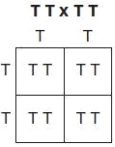
Which of the following genotypes is homozygous dominant?
A
Aa
AA
aa
Which of the following genotypes is heterozygous?
Bb
BB
bb
B
A recessive allele is represented by a ______ letter.
lower-case
capital
A dominant allele is represented by a ______ letter.
lower-case
capital
Blue-eyed is a ______.
genotype
phenotype
Bb is a ______.
genotype
phenotype
If a black guinea pig (BB) and a white guinea pig (bb) mate, there is a ______ chance that a white guinea pig will be born.
0%
25%
50%
75%
100%

A version of a gene is called a(n)
allele
characteristic
specific gene
trait

A trait that is expressed if one copy of the allele is present is a(n)
characteristic
dominant trait
gene
recessive trait

An organism’s genetic makeup; the pair of alleles for a trait is called a(n)
dominant trait
genotype
phenotype
recessive trait

An organism’s physical expression of a trait is called a(n)
dominant trait
genotype
phenotype
recessive trait

What is it called when both alleles in a genotype are the same?
Dominance
Heterozygous
Homozygous
Recessiveness

What is it called when the alleles in a genotype are different?
Dominance
Heterozygous
Homozygous
Recessiveness

Which pair of alleles is an example of homozygous recessive?
bb
BB
Bb

Which pair of alleles is an example of homozygous dominant?
tt
TT
Tt

Which pair of alleles is an example of heterozygous alleles?
ll
LL
Ll
What are physical characteristics of an organism?
Alleles
Genotypes
Genes
Traits
How many alleles does a child get from each parent for a trait?
1
2
3
4
How many alleles does a person carry for a trait?
1
2
3
4
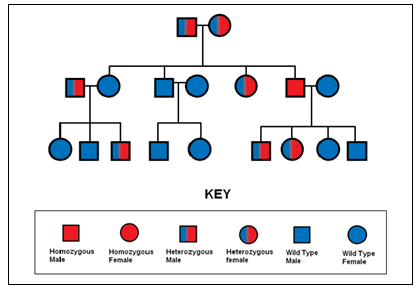
In a pedigree, which shape represents a male?
circle
square
Which gender has an X and a Y chromosome?
male
female

On this pedigree, the allele for curly hair is dominant. The couple labeled 2 both have curly hair, but have a daughter who does not have curly hair. Therefore, we can tell from the chart that for the couple labeled 2 -
the male is heterozygous and the female is heterozygous.
the male is homozygous recessive and the female is homozygous dominant.

What is the process of cell division called?
Mitochondria/Meiosis
Mitosis/Melanin
Mitosis/Meiosis
Mitosis/Mitchondria

What are the "x" particles lined up in the middle called?
DNA
Genes
RNA
Chromosomes
2 cell divisions
MITOSIS
MEIOSIS
1 cell division
MITOSIS
MEIOSIS
A single cell produces 4 new cells
MITOSIS
MEIOSIS
Used to reproduce an organism
MITOSIS
MEIOSIS
A single cell produces 2 new cells
MITOSIS
MEIOSIS
New cells only have 1/2 (half) the DNA of the original cell
MITOSIS
MEIOSIS

The purpose of mitosis is________
growth & healing
healing & gametes
growth & gametes
only gametes
Daughter cells made at the end of mitosis are:
genetically identical to the parent
genetically different from the parent
n/a
n/a
Cells made at the end of meiosis are:
genetically identical to the parent
genetically different from the parent
n/a
n/a
If I were to cross a heterozygous with another heterozygous, regardless of the trait, what is the chance of the offspring expressing the recessive trait?
0%
25%
50%
75%

