
 Worksheets
PSP Unit 1 Review
Total questions: 51
Worksheet time: 51mins
How does the direction of the acceleration and the direction of the velocity affect how an object speeds up or slows down?
If the velocity and acceleration are in the same direction the object slows down
If the velocity and acceleration are in the same direction the object speeds up
If the velocity and acceleration are in the opposite direction the object slows down
If the velocity and acceleration are in the opposite direction the object speeds up
How does the distance traveled per second affect the speed of an object?
The more distance traveled per second the faster the object is moving
If the object travels less distance per second the faster the object is traveling faster
The distance traveled per second has no impact on the speed of the object
The less distance traveled per second the faster the object is moving
The change in an object's position from the initial position to final position.
displacement
distance
Between distance and displacement, which one requires a direction?
Distance
Displacement
This is a measure of how far an object has traveled.
Distance
Displacement
In ____________ only the initial and final positions matters.
Distance
Displacement
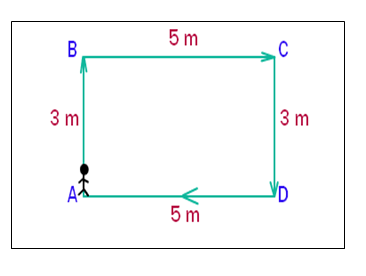
Sara walks from Point A to Point B. Which is true about Sara's distance and displacement?
Distance and Displacement are equal
Distance is less than displacement
Displacement is less than distance

Find the distance Sara walks from A to B, B to C then C to D?
11m
3m
5m
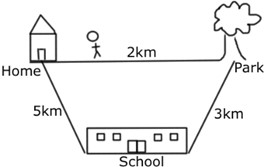
Jerry walked from home to school, then from the school to the park. What is his total distance?
2 km
5 km
8 km
10 km

The ball below moved from position 1, to position 2, and then finally to position 3. What is the ball's displacement?
4 meters, left
10 meters, left
4 meters, right
10 meters, right
Choose all ways an object can accelerate.
speed up
slow down
change direction
stay at a constant speed and never change direction

Which of the following motion diagrams represents an object that is at rest?
A
B
C
D
none of these

Which motion dot diagram represents an object that is moving at a constant velocity?
A
B
C
D
none of these

Which diagram represents an object that is, at first, moving at a constant velocity and then accelerating to the right? (assume that all motions are going to the right)
B
C
D
E
none of these

Which diagram represents constant ZERO acceleration?
A
B
C
D
none of these

In which diagram is the object decelerating?
A
B
C
D
none of these
A man walks 3 meters north, 4 meters south and then 8 meters north has a displacement of
6 meters north
6 meters south
7 meters north
7 meters
none of the above
If you walk 4 meters north and then walk 3 meters east, the magnitude of your displacement is
7 meters
6 meters
5 meters
2 meters
1 meter
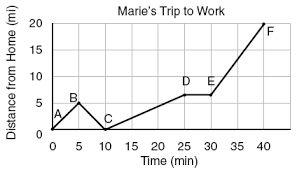
When was Marie driving the fastest?
C to D
D to E
E to F
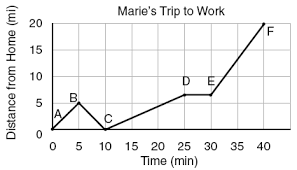
During what period of time was Marie stopped?
0-5 minutes
5-10 minutes
10-25 minutes
25-30 minutes
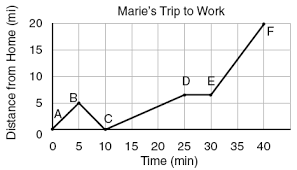
What could account for Marie’s motion at 27 minutes?
She was late so she broke the speed limit
She forgot something at home and ran back to get it
She was stopped at a red light
She was driving across the top of a hill

Which object is moving the fastest?
A
B
C
D

What is the object's starting position?
20 m to the right
20 m to the left
60 m to the right
60 m to the left
What is the object's ending position?
20 m to the right
20 m to the left
60 m to the right
60 m to the left
What is the object's motion between 0-1 seconds?
not moving
medium speed to the right
medium speed to the left

When is the object stopped?
0-10 seconds
10-15 seconds
15-40 seconds
40-60 seconds

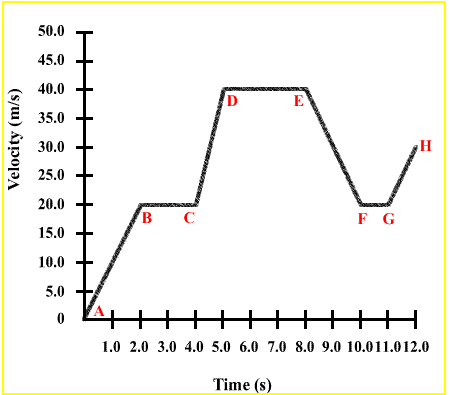
What is happening during point A to B?
not moving
increasing speed at a constant rate
moving at a constant speed
moving at 10 m/s2 acceleration

What is happening during point C to D?
not moving
increasing speed at a constant rate
moving at a constant speed
moving at 0 m/s2 acceleration
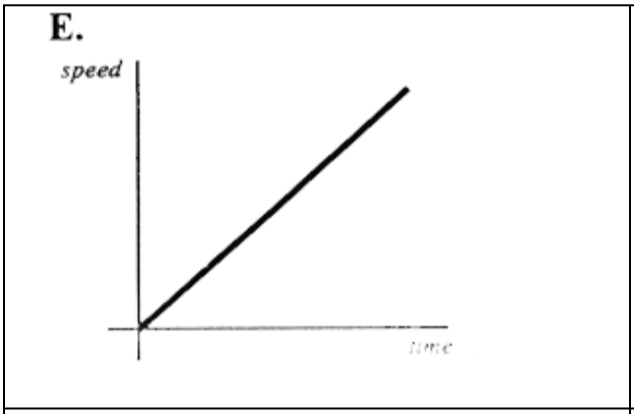
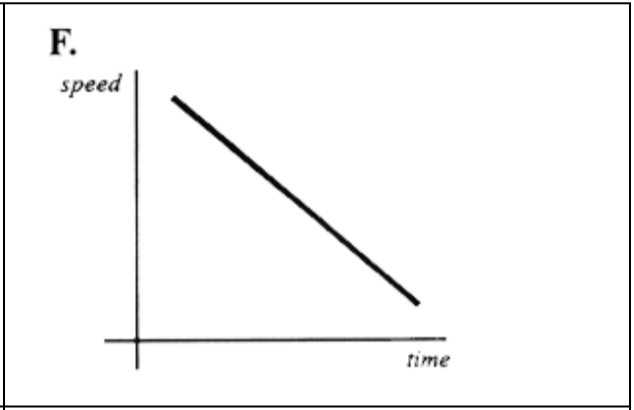
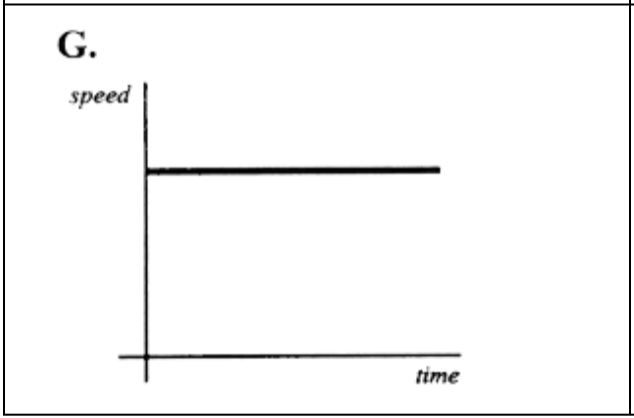
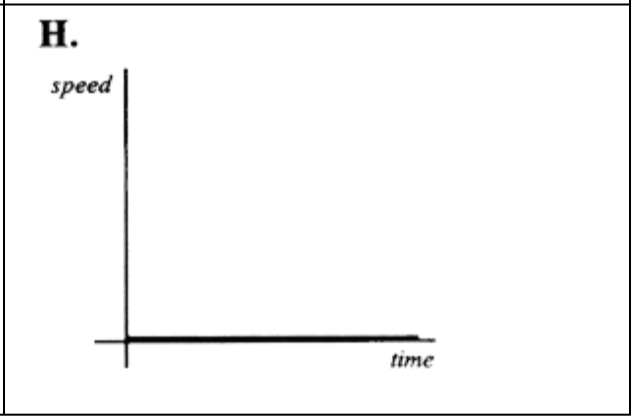
Match the graph to the description:
"The car is traveling at a constant speed."

What is happening to the car between 3-8 seconds?
The car is stopped
The car is traveling at a constant velocity of 0.5 m/s.
The car has an acceleration of 0.5 m/s2.
The car is going in the other direction.

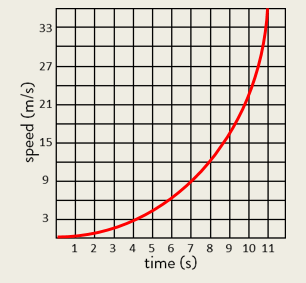
What is this graph showing?
At rest
Acceleration
Constant speed of 1 m/s
Gradually speeding up
What is this graph showing?
Gradually slowing down
Gradually speeding up
Constant speed
Stopped



How fast is this object going at 1 second?
20 cm/s
30 cm/s
-40 cm/s

Select the two correct statements that describe the object's motion.
The object is moving in the positive direction.
The object is moving in the negative direction.
The object is moving at a constant speed.
The object is speeding up.
The object is slowing down.

Select the two correct statements that describe the object's motion.
The object is moving in the positive direction.
The object is moving in the negative direction.
The object is moving at a constant speed.
The object is speeding up.
The object is slowing down.

