
 Worksheets
Review Weather/Climate Unit
Total questions: 102
Worksheet time: 2hrs 39mins
What provides energy in the water cycle?
Moon tides
The sun
The gravitational pull on the north pole
How much of Earth's surface is water?
25%
55%
75%
Which list includes four forms of precipitation?
rain, sleet, snow, water vapor
rain, snow, sleet, hail
lakes, ice, mists, run-ff
When water is heated in the ocean by the sun and turns into water vapor
condensation
evaporation
transpiration
Precipitation occurs because
the droplets evaporate in the air
the droplets are too light for the air to hold
the droplets are too heavy for the air to hold
More evaporation occurs
at night time
during the day time
The ____ is the driving force of the Earth's weather.
sun
moon
stars
The water cycle has NO start or end.
True
False
Most of the Earth's water is found
underground in aquifers
in rivers and lakes
in the oceans
The sun drives the water cycle by
heating the oceans
rotating on its axis
giving lights to plants
Heat is part of the water cycle.
True
False

What is the energy source that drives the water cycle?
the moon
The heat from our home in the winter all around the world
The sun
he heat generated solely from the core of the earth

The act of turning from a gas into a liquid. ________________________
Condensation
Evaporation
Transpiration
Precipitation

The act of turning from a liquid into a gas. ___________________
Transpiration
Condensation
Evaporation
Precipitation

The fall of water, ice, or snow deposited on the surface of the Earth from the atmosphere. __________
Condensation
Evaporation
Precipitation
Transpiration
On which kind of day would you expect the most evaporation from the surface of a pond?
warm, sunny
cold, rainy
cold, sunny
rainy, warm
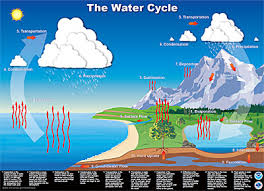
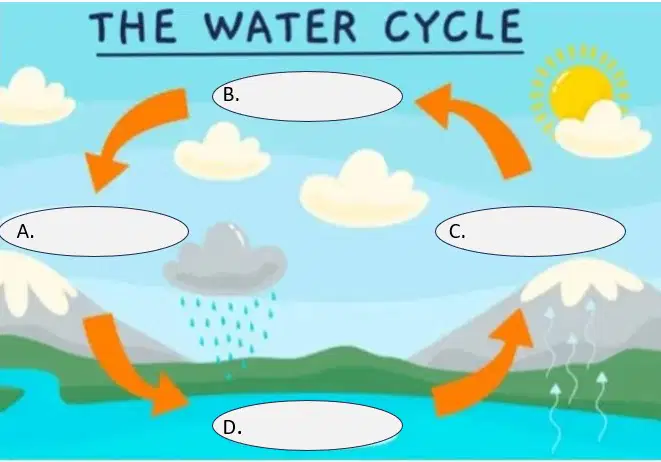


Water in its gas form is called ____________________,
water vapor
precipitation
ice
air
low pressure area
warm, less dense air rises
cool, dense air sinks
large, circular patterns of moving air
movement of air caused by differences in air pressure
Low air pressure systems cause _____.
clear, dry weather
cloudy, wet weather
cold, dry weather
hot, dry weather
High pressure systems cause _____.
clear, dry weather
cloudy, wet weather
cold, wet weather
hot and humid weather
What would cause a certain area to have rain that can last for days?
a high-pressure system
a stationary front
low humidity
a warm front
What kind of weather does a warm front cause?
cold and rainy
warm and sunny
cold and dry
warm and rainy
How does the ocean affect the climate?
Rushing water from tides cools the land.
Ocean winds can carry moisture with them and can bring rain and fog over inland areas.
Cool ocean air causes a cool climate.
Warm ocean air causes a dry climate.
weather
the average weather conditions in an area over a long period of time
the day to day state of the atmosphere, including temperature, humidity, precipitation and wind
the distance north or south from the equator, expressed in degrees
winds that blow mainly from 1 direction
climate
the average weather conditions in an area over a long period of time
the day to day state of the atmosphere, including temperature, humidity, precipitation, and wind
the distance north or south from the equator, expressed in degrees
winds that blow mainly from 1 direction
_________ monitor, investigate, and forecast the weather.
Atmospheric Scientists
Oceanographer
Meteorologist
Climatologist
Fronts occur when air masses of different temperature, humidity and (a) collide.
Which is a true statement?
Humans depend on oxygen, plants depend on carbon dioxide
Plants produce carbon dioxide
Humans depend on carbon dioxide, plants depend on oxygen
Humans don't depend on plants for the air they need
How does the Earth keep itself warm?
Sunlight keeps the Earth warm.
There are heat lamps orbitting above the Earth's atmosphere.
The greenhouse gases trap the warm air and send it back to the Earth's surface.

The highest gaseous pollutant is
methane
nitrous oxide
carbon dioxide
fluorinated gases
What is the atmosphere?
layer of dirt below the ground
layer of water at the bottom of the ocean
layer of air around the Earth
layer of air inside a greenhouse
Which of these IS a step in the water cycle.
evaporation
condensation
transpiration
precipitation
salination


What is the relationship between a barometer reading and the weather?
A rise in barometer readings indicates stormy weather.
A drop in barometer readings indicates stormy weather.
A drop in barometer readings indicates cold weather.
A rise in barometer readings indicates warm weather.
On a summer day, a barometer reading shows an increase in air pressure (it's getting higher). What type of weather should be expected?
Clear and sunny
Cloudy and rainy
Rainy and windy
Cloudy and cold
Is riding a bicycle to work instead of driving a car a positive or negative impact?
Positive
Negative
Is leaving the lights on in your house when you're not home a positive or negative impact?
Positive
Negative
Is leaving the water on while you brush your teeth a positive or negative impact?
Positive
Negative
Is planting trees a positive or negative impact?
Positive
Negative
Is littering a positive or negative impact?
Positive
Negative
Temperature effects solid, liquid and gases most by
state of water
state of atmosphere
state of gas
state of elements
When cold air moves in and warm air rises, we can conclude what? (check all that apply)
warm air rises due to green house gases
warm air rises because it weighs more
that is how a convection current is produced
the warm air is less dense


Which city just had a warm front move through?
Washington D. C.
Detroit
Chicago
Atlanta

Which city on the map will have an increase in temperature over the next 24 hours?
Atlanta
Denver
St. Louis
Billings

According to the map, which city will be experiencing a cold front in the next 24 hours?
Denver
Atlanta
St. Louis
Billings

What is the weather like in Los Angeles?
fair and dry
Sunny
rainy and storms
Cold
A High Pressure system bring what kind of weather?
Fair and sunny
cold and rainy
thunderstorms
hot and humid
In order for wind the be created,
(Hint: abcdefg H ijk L mnop
High Pressure moves to Higher Pressure areas
Low Pressure moves to High Pressure areas
High Pressure moves to Low Pressure areas
Low Pressure areas disappear

On the weather map, which area just had a cold front move through?
Little Rock
Chicago
New York
Miami

According to the weather map, which city is experiencing many days of rain?
Little Rock
New York
Seattle
Orlando
Where do Hurricanes typically form?
On land
In Warm Ocean Water
In cold Ocean Water
Near the Equator

According to the map, which city will most likely be having a cold front enter the area in the next few days?
Little Rock
Miami
Seattle
New Orleans
According to the map, which city will be experiencing a cold front in the next 24 hours?
Denver
Atlanta
St. Louis
Billings
Which city on the map will have an increase in temperature over the next 24 hours?
Atlanta
Denver
St. Louis
Billings

According to the map which city just had a cold front move through the area?
Los Angeles
Salt Lake City
San Francisco
Billings
Which city just had a warm front move through?
Washington D. C.
Detroit
Chicago
Atlanta

On the map, what do the arrows represent?
Warm Air Rising
Cold Air Sinking


Which is the correct symbol for a stationary front?


Which is the correct symbol for a warm front?


Which is the correct symbol for a cold front?
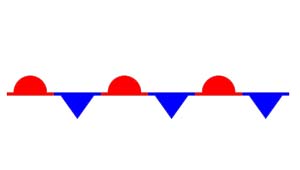



What type of front poses the greatest risk of flooding?
Cold front
Warm front
Occluded front
Stationary front
What kind of front produces thunderstorms followed by colder weather?
warm front
cold front
stationary front
occluded front
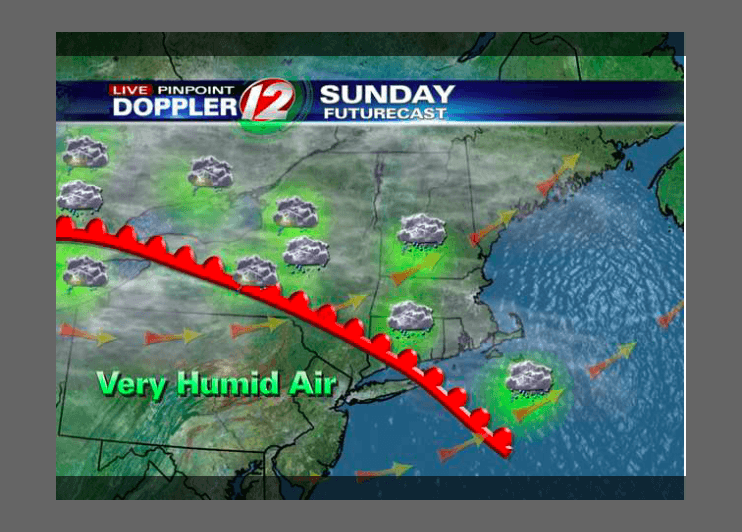
Name that symbol.
Cold Front
Warm Front
Stationary Front
Occluded Front
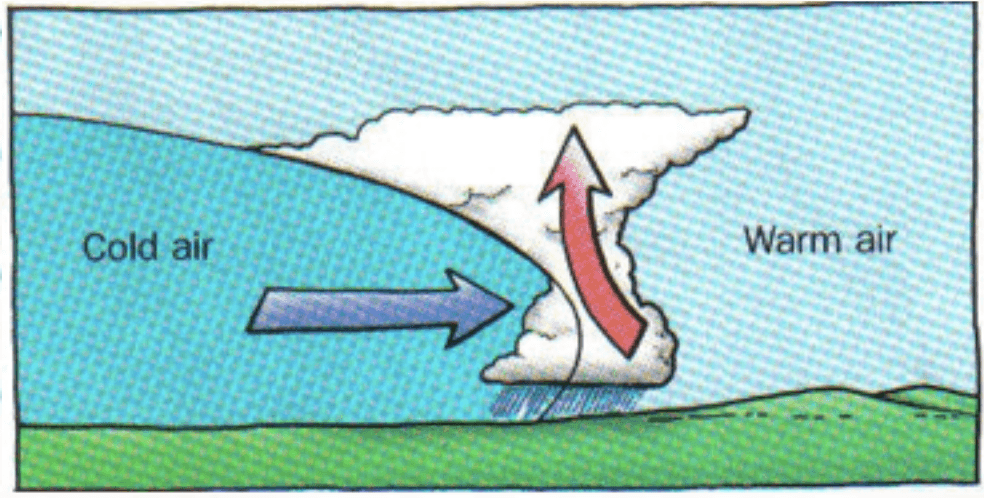
Name that front.
Cold Front
Warm Front
Stationary Front
Occluded Front
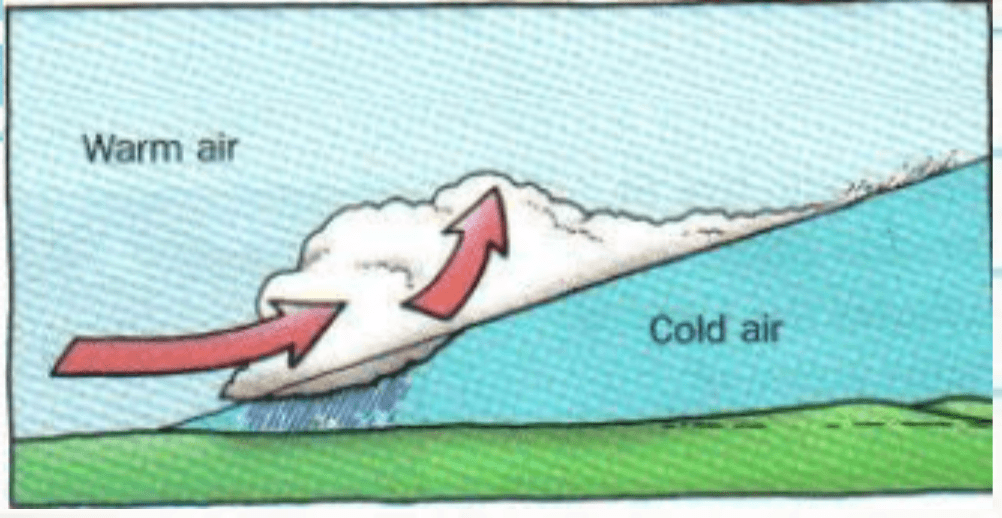
Name that front.
Cold Front
Warm Front
Stationary Front
Occluded Front
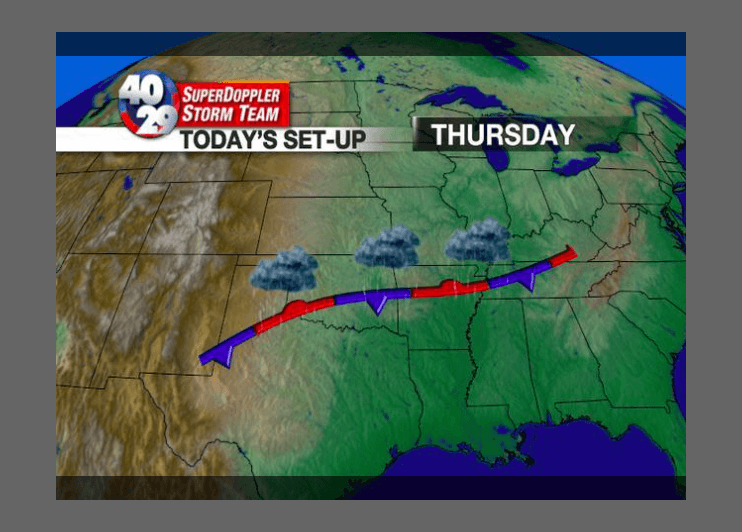
Name that symbol.
Cold Front
Warm Front
Stationary Front
Occluded Front
Name that symbol.
Cold Front
Warm Front
Stationary Front
Occluded Front
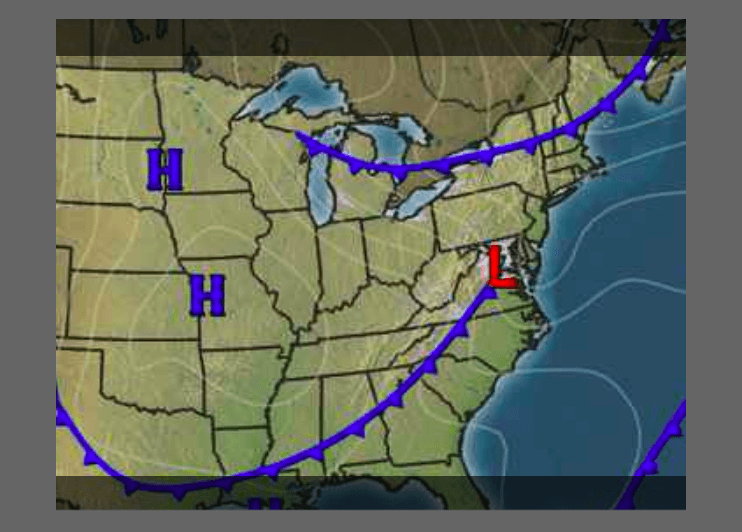
Name that symbol.
Cold Front
Warm Front
Stationary Front
Occluded Front

Temperature drops quickly. Strong winds, heavy precipitation.
Cold Front
Warm Front
Stationary Front
Occluded Front
What direction does heat transfer?
Hot to cold
Cold to hot
Heat doesn't transfer!
From lower temperature to higher temperature
Heat transfer through direct contact
Conduction
Convection
Radiation
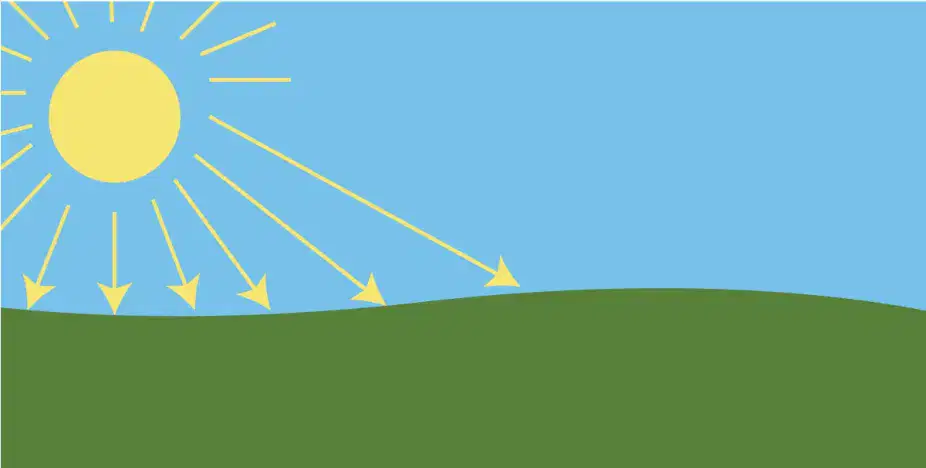
The sun heating the Earth
Conduction
Convection
Radiation
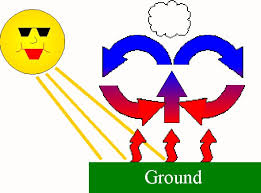
Climate is what we
(a)
Weather is what we
(a)

