wayground logo

Free Printable Worksheets

NEW

Font size

S
M
L
XL
Worksheets

Biochem CIA Review

Total questions: 54

Worksheet time: 1hrs 7mins

Name
Class
Date
1.

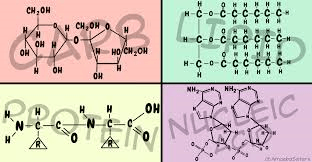
5. Which biomolecules provide quick energy for the cell and also provide materials to build the cell membrane/wall?

a)

Carbohydrates

b)

Proteins

c)

Lipids

d)

Nucleic Acids

2.

2. Which biomolecules contains your genetic information?

a)

Proteins

b)

Lipids

c)

Carbohydrates

d)

Nucleic Acids

3.

9. Amino Acids are the monomers of __________.

a)

Nucleic Acids

b)

Proteins

c)

Carbohydrates

d)

Lipids

4.

Just under an orca's skin lies a thick layer of blubber. Blubber helps insulate a whale from heat loss. Based on this information, which biomolecule is blubber primarily made of?

a)

Lipids

b)

Nucleic Acids

c)

Proteins

d)

Carbohydrates

5.

7. Glycerol and fatty acids are the monomers of _________.

a)

Lipids

b)

Carbohydrates

c)

Proteins

d)

Nucleic Acids

6.

8. The monomer of Nucleic Acids is known as _________.

a)

Amino Acid

b)

Fatty Acid

c)

Nucleotide

d)

Saccharide

7.

Which biomolecule helps form muscles?

a)

Nucleic Acid

b)

Carbohydrate

c)

Protein

d)

Lipids

8.
Which biomolecule has sugars and starches?
a)
Lipids
b)
Proteins
c)
Carbohydrates
d)
Nucleic Acid
9.
What elements are common to all 4 biomolecules?
a)
Carbon, hydrogen, nitrogen
b)
Carbon, Nitrogen, Phosphorus
c)
Carbon, Hydrogen, Oxygen
d)
Carbon, Hydrogen, Phosphorus
10.
Enzymes are considered to be 
a)
Lipids
b)
Carbohydrate
c)
Protein
d)
Nucleic Acid
11.

Letter D represents the ..

a)
active site
b)
enzyme
c)
substrate
d)
products
12.

Letter C represents the ...

a)
active site
b)
enzyme
c)
substrate
d)
products
13.

Letter B represents the ...

a)
active site
b)
enzyme
c)
substrate
d)
products
14.

Letter E represents the ...

a)
active site
b)
enzyme
c)
substrate
d)
products
15.
What 3 letters do enzymes typically end in?
a)
-ose
b)
-ase
c)
-ese
d)
-tic
16.
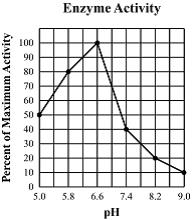
Which of the following conclusions can be drawn from this graph?
a)
The optimum pH of the enzyme is 6.6.
b)
The optimum pH of the enzyme is 5.8
c)
The enzyme’s activity increases as pH increases 5.0 to 9.0
d)
The enzyme’s activity is greater around pH of 8.0 .
17.

The ____________________ mechanism describes how each substrate must fit into the enzyme.

a)

lock and key

b)

hammer and nail

c)

jigsaw puzzle

d)

seesaw

18.
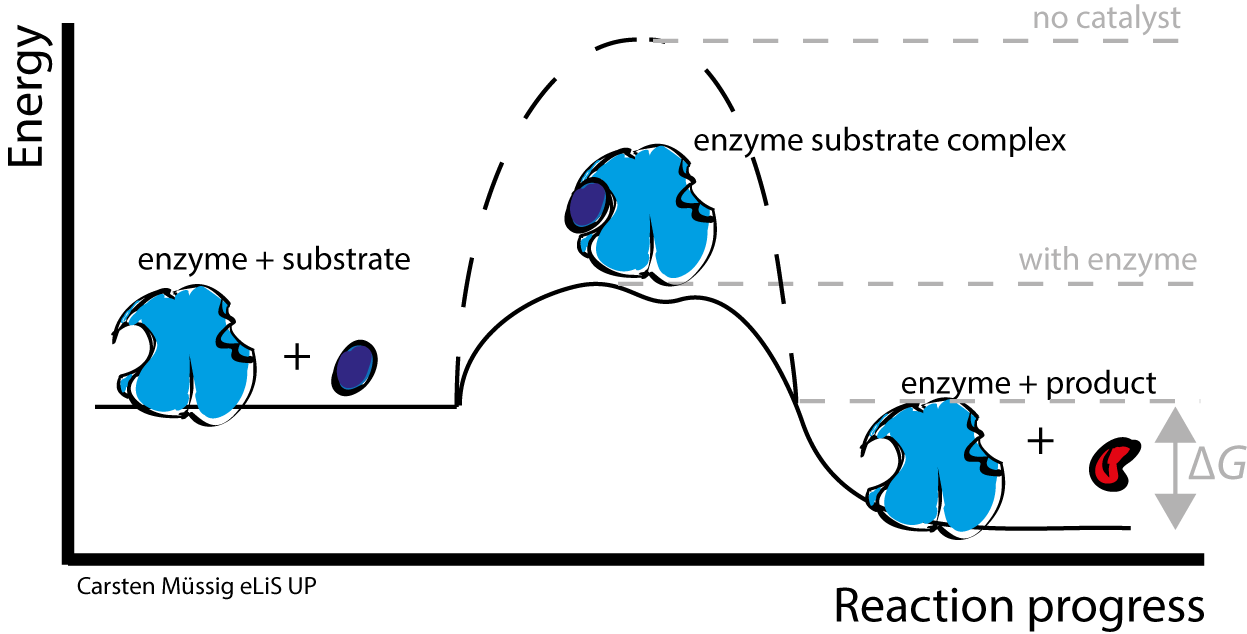
An enzyme speeds up a reaction by
a)
lowering the activation energy.
b)
raising the activation energy.
c)
releasing energy.
d)
absorbing energy.
19.
Which of these is NOT true?
a)
Enzymes can denature (change shape) when the temperature gets too high.
b)
Enzymes can only be used once in a chemical reaction. 
c)
Extreme pH can denature enzymes.
d)
Enzymes speed up chemical reactions. 
20.
What happens to an enzyme when it is denatured?
a)
Activation energy is lowered.
b)
It becomes stronger.
c)
It loses its shape.
d)
Activation energy is raised.
21.
Which factors can change the shape of an enzyme and thus denatures a enzyme?
a)
Excessive heat and changes in pH
b)
Nothing can
c)
Exposure to light and sound
d)
Exposure to bacteria and Amoebas
22.
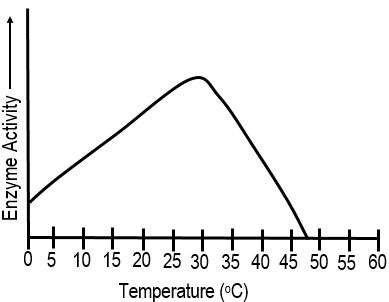
Based on the graph, what temperature does this enzyme work best? 
a)
15 C
b)
40 C
c)
30 C
23.
The maintenance of an organism’s internal environment is called:
a)
compensating
b)
homeostasis
c)
balancing
d)
routine
24.
If the environment gets cold, we will often shiver in order to:
a)
keep body temperature the same as the external temperature
b)
decrease body temperature
c)
increase body temperature
d)
regulate blood pressure
25.
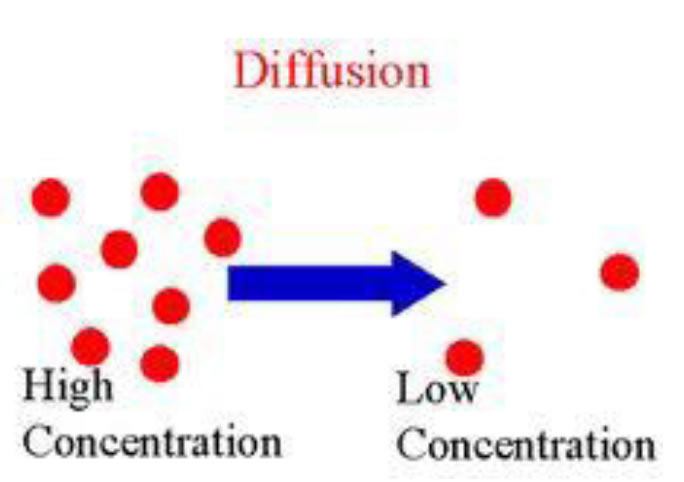
Movement of particles from high to low concentration. 
a)
Passive Transport
b)
Active Transport
26.
The diffusion of WATER across a semi-permeable membrane is
a)
osmosis
b)
diffusion
c)
endocytosis
d)
exocytosis
27.
Active transport requires
a)
energy
b)
the nucleus
c)
chloroplasts
d)
lysosomes
28.
How does a cell maintain homeostasis?
a)
Regulates what enters and leaves the cell
b)
Flexibility
c)
Protective barrier
d)
Structure and support
29.
The cell membrane is selectively permeable, which means...
a)
All materials can enter and leave the cell
b)
Certain things can enter while others cannot
c)
The cell manually sorts through all materials
d)
Only certain cells can interact with the cell.
30.
The movement of molecules against a concentration gradient
a)
simple diffusion
b)
facilitated diffusion
c)
active transport
d)
osmosis
31.
This picture represents what type of cell transport?
a)
endocytosis
b)
exocytosis
c)
osmosis
d)
passive transport
32.
A cell will _____________________ in a hypertonic solution.
a)
swell
b)
shrink
c)
will not change
d)
will explode
33.
A cell will __________________ in a hypotonic solution.
a)
swell and perhaps burst (lyse)
b)
shrink
c)
the size of the cell will not change
d)
the size of the cell will change from large to small and from small to large
34.

This picture is a representation of what type of transport?

a)

Osmosis because it is diffusing through a protein from an area of high concentration to low concentration.

b)

Facilitated diffusion because it is diffusing through a protein from an area of high concentration to low concentration.

c)

Facilitated diffusion because it is diffusing through a protein from an area of low concentration to high concentration.

d)

Simple diffusion because it is diffusing through a protein from an area of high concentration to low concentration.

35.

Which of these is NOT an example of active transport

a)

Endocytosis

b)

Exocytosis

c)

Osmosis

d)

Protein Pumps

36.

Some cells move large particles out of the cell through the process of:

a)

Protein Synthesis

b)

Endocytosis

c)

Exocytosis

d)

Cytoplasmic Streaming

37.

The sodium potassium pump is an example of

a)

Passive Transport

b)

Active Transport

c)

Facilitated Diffusion

d)

Endocytosis

38.

Which illustration shows a representation of diffusion?

a)
A
b)
B
c)
C
d)
D
39.

What is "A"?

a)

Nucleotide

b)

Deoxyribose Sugar

c)

Nitrogenous base

d)

Phosphate

40.

What is "B"?

a)

Nucleotide

b)

Deoxyribose Sugar

c)

Nitrogenous base

d)

Phosphate

41.

What is "C"?

a)

Nucleotide

b)

Deoxyribose Sugar

c)

Nitrogenous base

d)

Phosphate

42.

What is the molecule in the image?

a)

Nucleotide

b)

Deoxyribose Sugar

c)

Nitrogenous base

d)

Phosphate

43.

What is the complimentary sequence of the following sequence:

GATCAG

a)

TGACAT

b)

GACATG

c)

CTAGTC

d)

CGACTA

44.

What do the dotted lines between the nitrogenous bases (A,T,C,G) represent in the image provided?

a)

Covalent bonds

b)

Ionic bonds

c)

Peptide bonds

d)

Hydrogen bonds

45.

Adenine pairs with

a)

Thymine

b)

Thyme

c)

Guanine

d)

Glutamine

46.

The first step in DNA replication is

a)

to unwind and unzip the two strands

b)

to break the backbone in half so the sequence can be copies

c)

to attach new nucleotides

d)

to proof read the sequence

47.
Guanine bonds with ______________.
a)
Adenine
b)
Guanine
c)
Cytosine
d)
Thymine
48.
Which organelle is DNA usually found in?
a)
cell membrane
b)
vacuole
c)
chloroplast
d)
nucleus
49.
The enzyme that unzips the DNA to prepare for replication
a)
helicase
b)
replicase
c)
polymerase
d)
synthase
50.
DNA replication results in two DNA molecules,
a)
each one with two original strands
b)
each one with two new strands
c)
each one with one new strand and one original strand
d)
one with two new strands and the other with two original strands
51.

The two strands of DNA are

a)

Parallel

b)

Antiparallel

c)

Perpendicular

d)

At Right Angles

52.
Which enzyme is responsible for adding nucleotides ("The Builder")?
a)
Topoisomerase
b)
DNA Polymerase
c)
Ligase
d)
Primase
53.
In what phase of the cell cycle does DNA replication take place?
a)
G1
b)
S
c)
G2
d)
M
54.
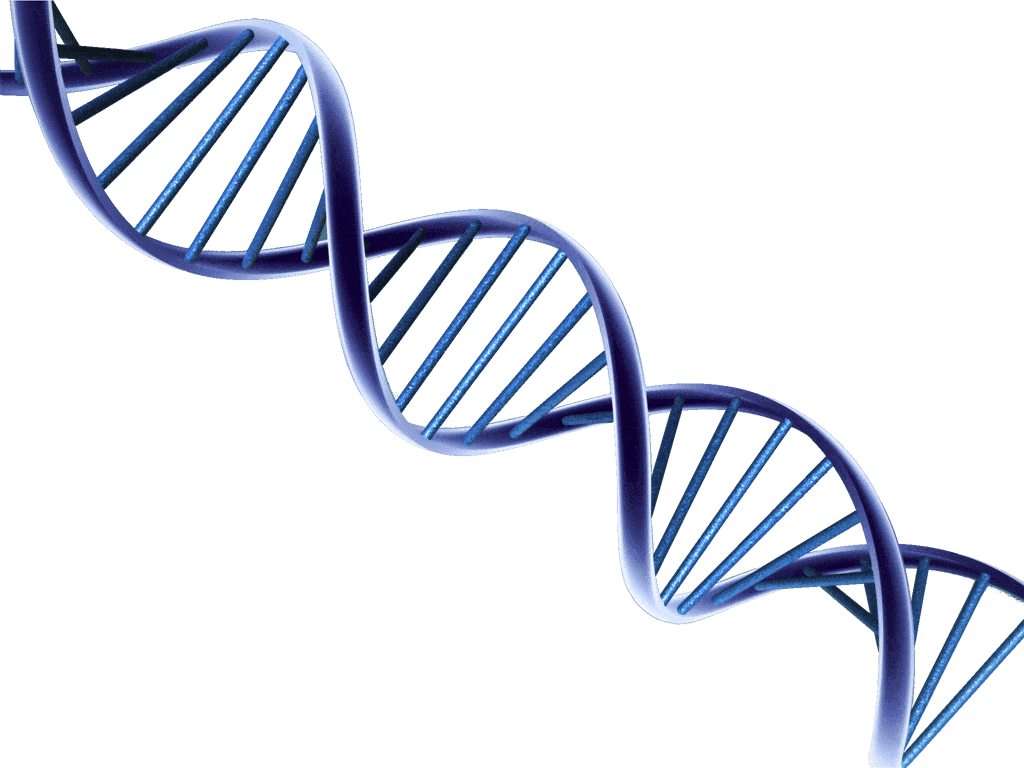
The drawing shows the structure of what molecule?
a)
A DNA molecule
b)
A lipid molecule
c)
A carbohydrate molecule
d)
A protein molecule