
 Worksheets
KMT, Heat, & Energy
Total questions: 158
Worksheet time: 4hrs 36mins

A liquid that evaporates readily is a __________ liquid.
condensed
frozen
volatile
molar

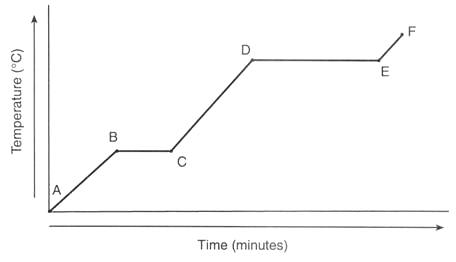




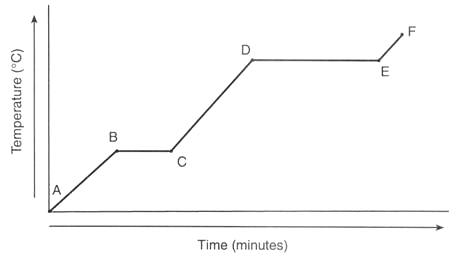
Are the particles moving faster or slower as time goes on?
Faster
Slower
What state/phase is the object likely from points A to B?
Solid
Liquid
Gas
Plasma
What is happening to the particles in the substance between points A and B?
Melting
Freezing
Speeding Up
Slowing Down
What is happening to the particles in the substance between points D and E?
Melting
Freezing
Vaporizing
Sublimating

Is the substance gaining or losing energy?
Gaining
Losing

Where on the graph are phase changes taking place?
1
2
3
4
5


At Point A, the beginning of observations, the substance exists in a solid state. Material in this phase has a ____________ volume and ___________ shape.
(a)
With each passing minute, (a) is added to the substance.
This causes the molecules of the substance to (a) more rapidly.
We detect this by the (a) change (rising) in the substance

At POINT B, the temperature is (a) degrees C.

The solid begins to (a) .

At POINT C, the substance is completely _____________, or in a ____________ state.
(a)
Material in this phase has a __________ volume and an _______________ shape.
(a)
The energy put to the substance between minutes 5 and 9 was used to convert the substance from a ___________ state to a __________ state.
(a)
Between minute 9 and 13, the added energy increases the (a) of the substance

During the time from POINT D to POINT E, the liquid is (a) .

By POINT E, the substance is completely in the (a) phase.

Material in this phase has _________ volume and ____________ shape.
(a)

The energy put into the substance between minutes 13 and 18 converted the substance from ___________ to ____________ state.
(a)

Beyond POINT E, the substance is still in the __________ phase, but the molecules are moving _________ as indicated by the increasing temperature.
(a)
According to the Kinetic Molecular Theory, gas particles have a force of attraction between one another.
True
False
According to the Kinetic Molecular Theory, gases are in (a) motion and thus, have a large amount of (b) energy.
According to the Kinetic Molecular Theory, when compared to their surroundings, gas particles are (a) and thus (b) .

Consider the following image. Match the following images to their names.

Limiting Reagent

Excess Reagent

Product
MgCO3 → MgO + CO2
A decomposition reaction occurs following the formula above. 15.9 g of MgO is recovered at the end of the reaction. If the theoretical yield was calculated to be 17.3 g, what is the percent yield?
108.8%
43.2%
79.3%
91.9%
MgCO3 → MgO + CO2
A decomposition reaction occurs following the formula above. If 25.4 grams of MgCO3 decomposes, how many grams of CO2 are made?
14.67 g
43.50 g
13.26 g
8.4 g
MgCO3 → MgO + CO2
A decomposition reaction occurs following the formula above. According to the reaction above, 25.4 grams of MgCO3 decomposes. If 10.43 grams of CO2 are collected at the end, what is the percent yield? (Hint: Using your answer from the last question, 13.26 grams, calculate the percent yield.)
78.67%
56.34%
92.11%
127.11%
The first postulate of the KMT is that all matter is made up of
tiny particles
molecules
cells
mass
According the KMT, the particles are in
different states
organized patterns
constant motion
various containers
According to the KMT, increasing the temperature of particles will
give off energy
increase motion
decrease volume
increase pressure
According to the KMT, the particles of the different states of matter differ in what two key aspects?
volume and mass
density and extention of interactions
temperature and freedom of motion
freedom of motion and extent of interactions
In a solid, what keeps each particle trapped in the same small volume and with the same surrounding particles.
strong attractions between particles
ionic bonds
lack of particle motion
low temperatures
What does increasing the temperatureof a solid lead to?
increased mass of particles
decreased space between particles
decreased velocity of particles
increased velocity of particles
What is happening when a solid is becoming a liquid?
The particles decrease in motion, collapsing the organized structure.
The increased movement of particles pushes them completely out of position, collapsing the organized structure.
The particles increase in motion, causing the organized structure to flatten into a smaller shape.
A particle party!
How doe the particles in a liquid behave?
Neatly organized without any movement.
Move around trapped in a small volume and with the same surrounding particles.
Move fast enough to break attractions and pushing other particles out of the way.
Move freely in a straight line until they collide with another particle.
How doe the particles in a gas behave?
Neatly organized without any movement.
Move around trapped in a small volume and with the same surrounding particles.
Move fast enough to break attractions and pushing other particles out of the way.
Move freely in a straight line until they collide with another particle.
If the particles are moving fast enough to complete break the attraction pulling it back towards other particles, what process is occuring?
sublimation
melting
freezing
evaporation
When particles in a gas collide, they change
direction and velocity
velocity and temperature
direction and volume
volume and temperature
In which state of matter are the particles the farthest apart?
gas
liquid
solid

Which will heat up faster?
copper
granite
iron
basalt

Which will heat up slower?
water
lead
granite
iron
Which of the following best explains why the sand at the beach is hotter than the water?
Sand has a higher specific heat than water.
Sand has a lower specific heat than water.
There is more water than sand at the beach.
There is more sand than water at the beach.
The amount of energy required to raise the temperature 1ºC for every gram is called____?
Thermal Energy
Specific Heat
Temperature
Kinetic Energy


What letter is used to represent specific heat capacity?
H
P
C
T
Which will heat up slower?
water
lead
granite
iron
Which will heat up faster?
copper
granite
iron
basalt
Which of the following best explains why the sand at the beach is hotter than the water?
Sand has a higher specific heat than water.
Sand has a lower specific heat than water.
There is more water than sand at the beach.
There is more sand than water at the beach.
The amount of energy required to raise the temperature 1ºC for every gram is called____?
Thermal Energy
Specific Heat
Temperature
Kinetic Energy

Which material heats up quickest?
Aluminium
Concrete
Diamond
Glass
Water

Which material heats up slowest?
Aluminium
Concrete
Diamond
Glass
Water


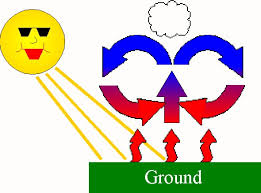
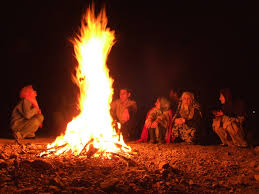

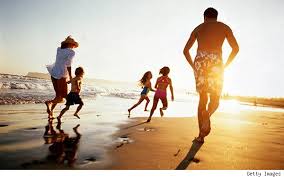
A snowball in your hand is what heat transfer?
Convection
Conduction
Law of Conservation of Energy
Radiation
In which direction does heat transfer?
Freezing to HOT
Hot to Warm
Hot to Cold
Cold to Hot
This is when heat is absorbed, it is an
Exothermic reaction
endothermic reaction
both
none
When heat is released it is an
exothermic reaction
endothermic reaction
both
none
The temperature increases outside of this reaction
exothermic
endothermic
both
none
The temperature decreases outside of this reaction
exothermic
endothermic
both
none

Evidence of a chemical reaction is when 2 substances react, they
stay the same
form a new substance
both
none

Your hands get cold outside from not wearing gloves
exothermic
endothermic
both
none

Fire is an example of
exothermic reaction
endothermic reaction
none
both

Fireworks are an example of
exothermic
endothermic
both
none

A melting ice cube is an example of
exothermic
endothermic
none
both

An ice pack in an example of
exothermic
endothermic
both
none

photosynthesis is an example of
Exothermic reaction
Endothermic reaction
both
none

Frying an egg is an example of
exothermic reaction
endothermic reaction
both
none
The phase of matter with a definite volume but no definite shape is a
The phase of matter with a definite shape and definite volume is a
solid
liquid
gas
Gases have ...
a definite shape and definite volume
no definite shape and no definite volume
a definite shape and no definite volume
The phase of matter in which the atoms are moving freely and are very far apart
solid
liquid
gas
What best describes the motion of molecules in a liquid?
flowing past each other
moving freely in all directions
Removing energy (cooling) causes the atoms to
spread apart
move closer together
get larger
get smaller


The water droplets on the outside of this glass of water is showing the following phase change


What phase change is represented by the dry ice in this picture- which changes from a solid to a gas?
evaporation
condensation
sublimation
melting
What phase change occurs due to losing heat energy?
freezing

Three containers with the same amount of the same material are shown below. Which container has the substance with the highest amount of energy?
The container on the left
The middle container
The container on the right
All have an equal amount of energy
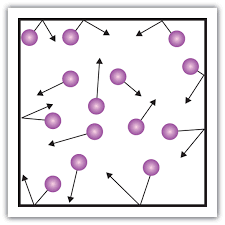
What state of matter?
Solid
Liquid
Gas
What is the phase change of a solid to a liquid?
freezing
melting
boiling
condensation
Change from Liquid to Solid is called ...
fusion
Freezing
sublimation
evaporation
Three containers with the same amount of the same material are shown below. Which container has the substance with the lowest amount of energy?
The container on the left
The middle container
The container on the right
All have an equal amount of energy
Q= m c ∆T
The units for specific heat are:

[Specific latent heat of vaporization of water = 2.26 × 10⁶ J kg−1, specific heat capacity of water = 4.2 × 10³ J kg−1°C−1]


________________

The specific latent heat released at stages?

What is the temperature of the metal cube when thermal equilibrium is achieved between the cube and the liquid?

