
 Worksheets
GEOS 410- Introduction
Total questions: 40
Worksheet time: 10hrs 0mins
______ _______: planetary-scale changes in the
Earth system. In more detail, it is planetary scale changes to atmospheric
circulation, ocean circulation, climate, the carbon cycle, the
nitrogen cycle, the water cycle and other cycles, sea-ice
changes, sea-level changes, food webs, biological
diversity, pollution, health, fish stocks, and more.
(a)
(a) is now a large driver of global change which include the changes in population, the economy, resource use, energy, development, transport, communication, land use
and land cover, urbanization, globalization.
The term ANTHROPOCENE can come in play in this description.
Earth system is.....
an integrated system(connected/linked)
refers to the interaction of Earth's physical, chemical, and biological processes.
system includes: land, oceans, atmosphere and poles. It includes the planet's natural cycles — the carbon, water, nitrogen, phosphorus, sulphur and other cycles — and deep Earth processes
Because the Earth is an integrated system, everyone and everything is impacted around the world if something is changed. Now that ever, anthropogenic changes are changing the chemical, physical, and biological processed of the earth, which relating to the feedbacks, it is affecting both for the earth and humans. (FALSE/TRUE)
(a)
-Book that contributed to the environmental issues
Book 'Silent Spring (1962) is about humanity's misguided attempts to control nature through the use of chemical pesticides. Talks about negative effects of it. It talked about how DDT(Dichlorodiphenyltrichloroethane (DDT)), an insecticide used in agriculture, killed a lot of birds.
Fact: The United States banned the use of DDT in 1972. Some countries outside the United States still use DDT to control of mosquitoes that spread malaria.
-Message: Pesticides not only destroy the target but also other ecosystems even humans because DDT pesticide->animals eat those crops-->humans eat those-->we have ddt-->bad for humans.
(TRUE/FALSE)
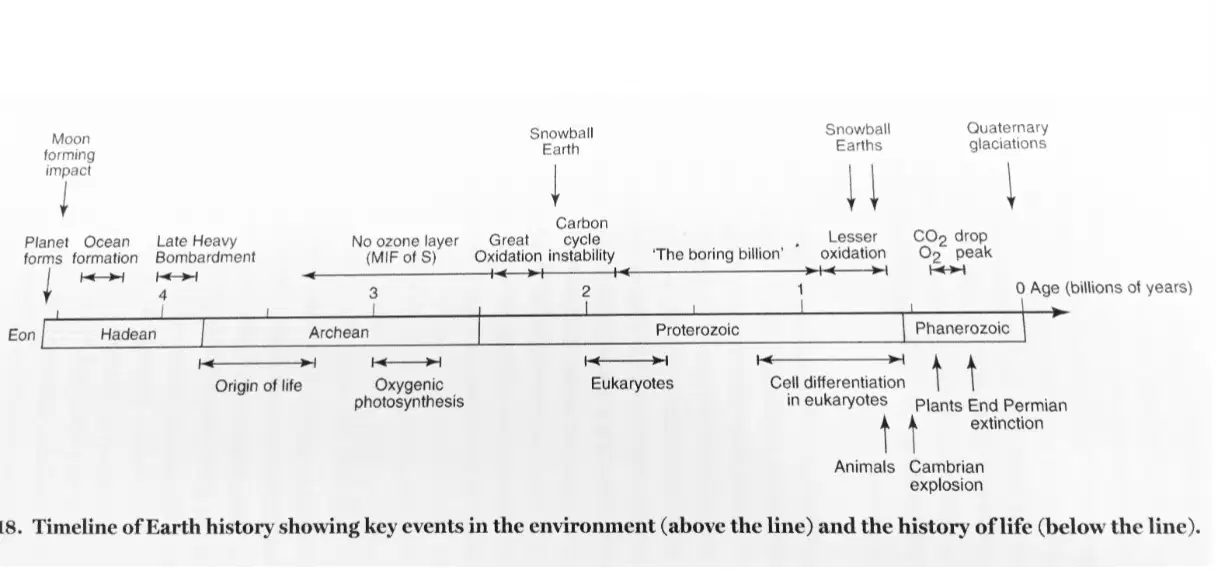
Earth is an integrated system that is always changing.(TRUE/FALSE)
(a)
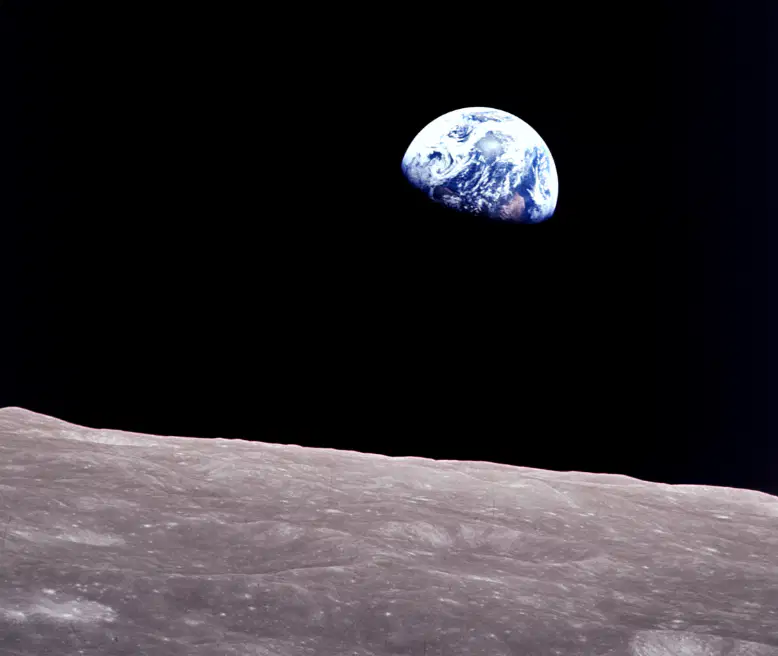
Earthrise’ taken by Bill Anders on 24 December 1968 during the
Apollo 8 mission to the Moon
-first humans to orbit the Moon, and the first to witness the magnificent sight called "Earthrise." Astronauts first saw the Earth rising above the Moon's barren horizon.
"Brand was one of a group of environmental activists who felt that an image of “Spaceship Earth” would bring us all together in watchfulness and care for our planetary craft and its precious payload. “Earthrise”, though, did more than just corroborate this gathering mood. With its incontestable beauty, a beauty that had needed no eye of a beholder for billions of years, it caught the human heart by surprise."
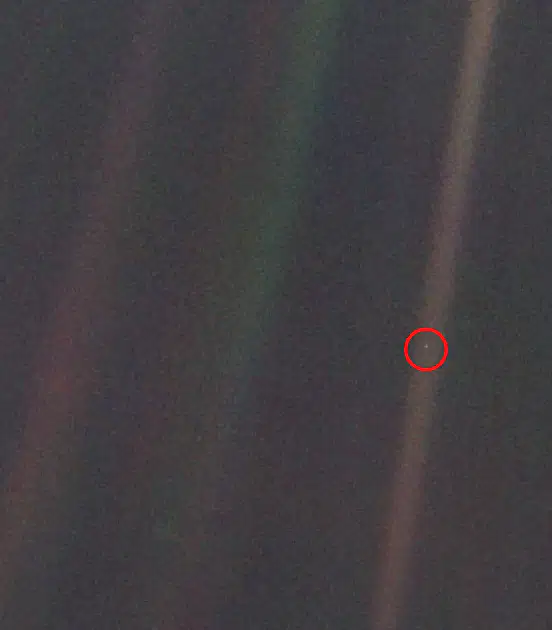
'Pale Blue Dot’ image of
Earth taken by Voyager
1 on 14 February 1990
Earth is a pale blue dot, rather than dark blue, because white light reflected by clouds combines with the scattered blue light. Earth's reflectance spectrum from the far-ultraviolet to the near-infrared is unlike that of any other observed planet and is partially due to the presence of life on Earth
-Something that looks so small and insignificant hold a lot for us humans. For this reason, we need to protect it. It gives us life.
"A single spec in space; a single pixel on your screen; our entire history is contained therein. If your mind is not already blown, then consider this: we now know that there are hundreds of billions of planets in our galaxy. Some may be just like ours and contain life. But it does not end there. There are hundreds of billions of galaxies in the universe, each with hundreds of billions of planets!
The idea that a single blue dot in the vastness of the cosmos is the only planet with life is just…nonsensical"
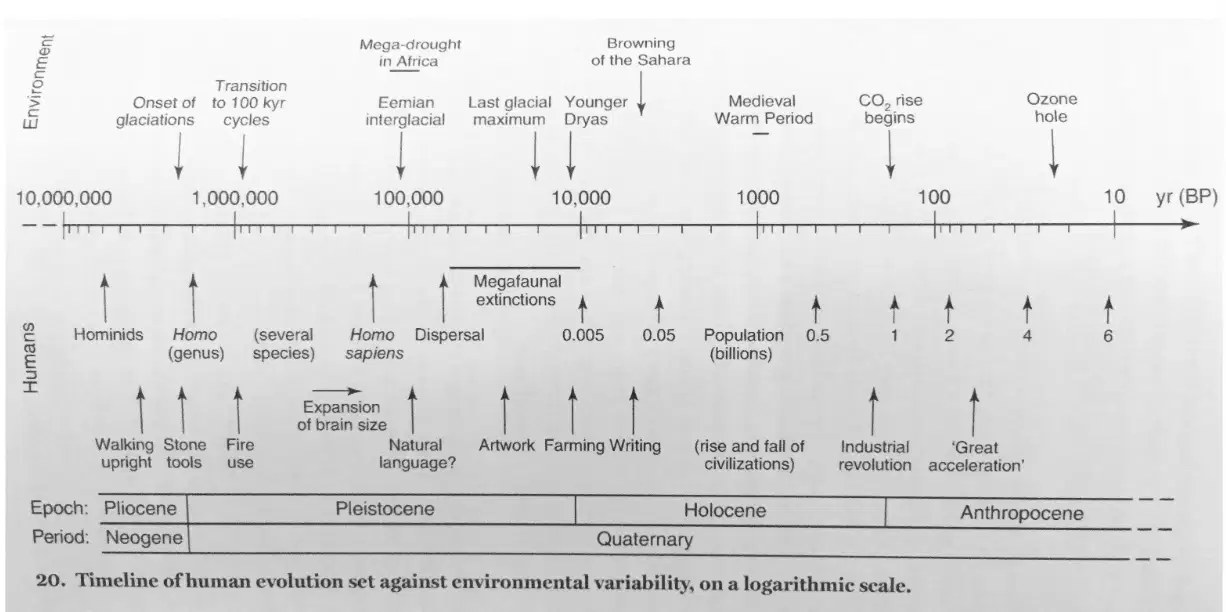
Environment vs human timeline
(Put True)
(a)
We live on a human dominated planet so......
Changes are pervasive and global. -> because changes are constantly going on and there is humans around the world
Global change is complex and multifaceted.--->bc earth is not just one thing but is a integrated system and has many aspects of sides
Two-way interactions between humans and the rest of
the natural world -->relate to feedbacks
Feedbacks on a planetary scale --> example: ice cores melt, albedo and sunlight, temperature
Fundamental shifts in the functioning of the Earth-->earth has different systems that work differrently to make what is earth
(a) is an important period because " corresponds with the rapid proliferation, growth, and impacts of the human species worldwide, including all of its written history, technological revolutions, development of major civilizations, and overall significant transition towards urban living in the present."
It is when industrial revolution happened that led to the CO2 increase and the dramatic changed on Earth.

Earth is an integrated system. Everything is connected.
(True/False). One thing changes everything.
(This is a model. Modeling of earth's systems is important because it allows us to view the bigger picture and potential consequences of CO2 emissions and the effects of global change.
True
False
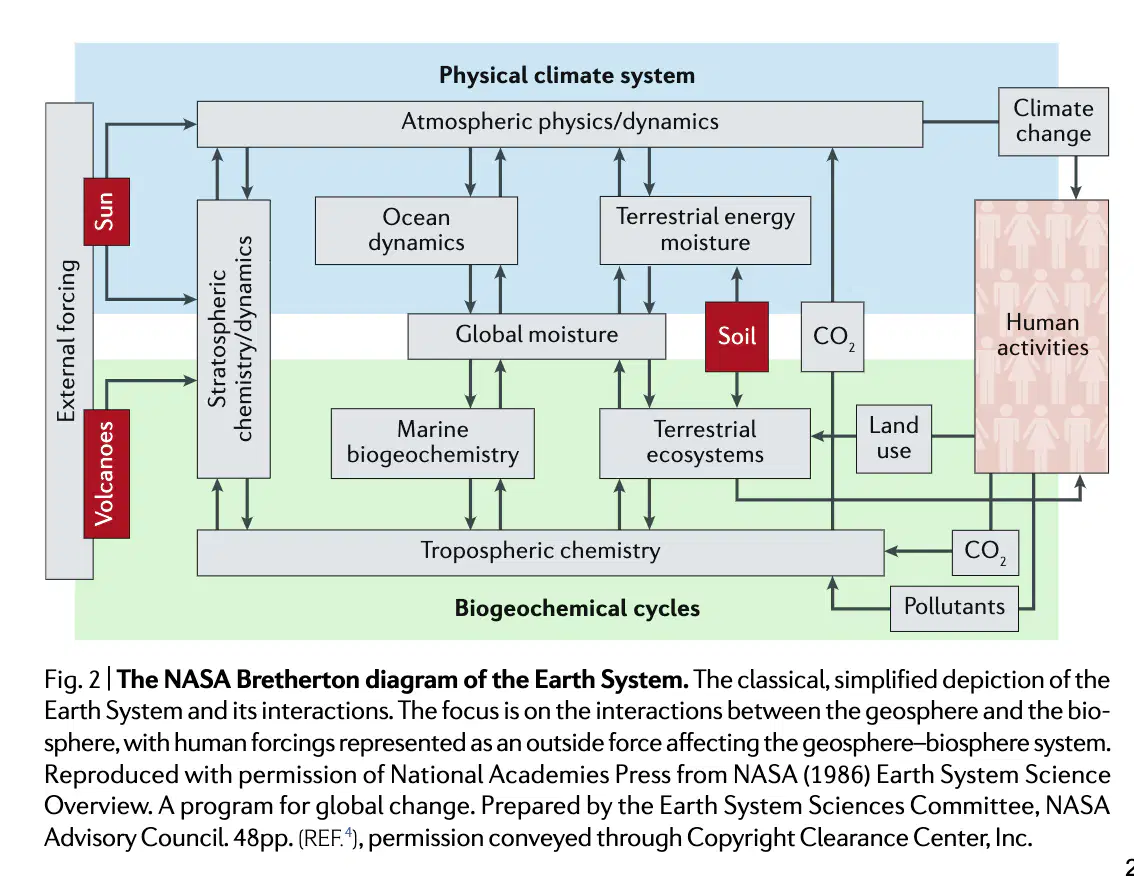
The Bretherton diagram (as it is often referred to) was the first systems-dynamics representation of the Earth System to couple the physical climate system and biogeochemical cycles through a complicated array of forcings and feedbacks.
The classical simplified depiction of the Earth System and its interactions. The focus is on the interactions between the geosphere and the biosphere, with human forcings represented as an outside force affecting the geosphere-biosphere system.
Need a more complex diagram b/c this diagram only shows CO2 as a greenhouse gas but there are others as well that affect the earth's system.
Sun and radioactive decay are the ultimate and main source of energy. Sun drives agriculture(soil) and economics(oil and stuff). The radioactive decay come from volcanoes and it keeps center of earth warm while being locked up inside earth. Radioactive decay create techtonic plates which are important to create life since sea floor have animals, recycle geologic. We need recycling in our oceans. allows heat from Earth's interior to escape to the surface, forming continents and other geological features necessary for life to emerge.
In the ocean, tectonic processes continuously create and destroy oceanic crust. When tectonic plates collide, denser plates dive under less dense ones, creating trenches and mountains. New sea floor is constantly created as plates move apart, keeping Earth from shrinking.
If all plate motion stopped, Earth would be a very different place. The agent responsible for most mountains as well as volcanoes is plate tectonics, so much of the activity that pushes up new mountain ranges and creates new land from volcanic explosions would be no more.
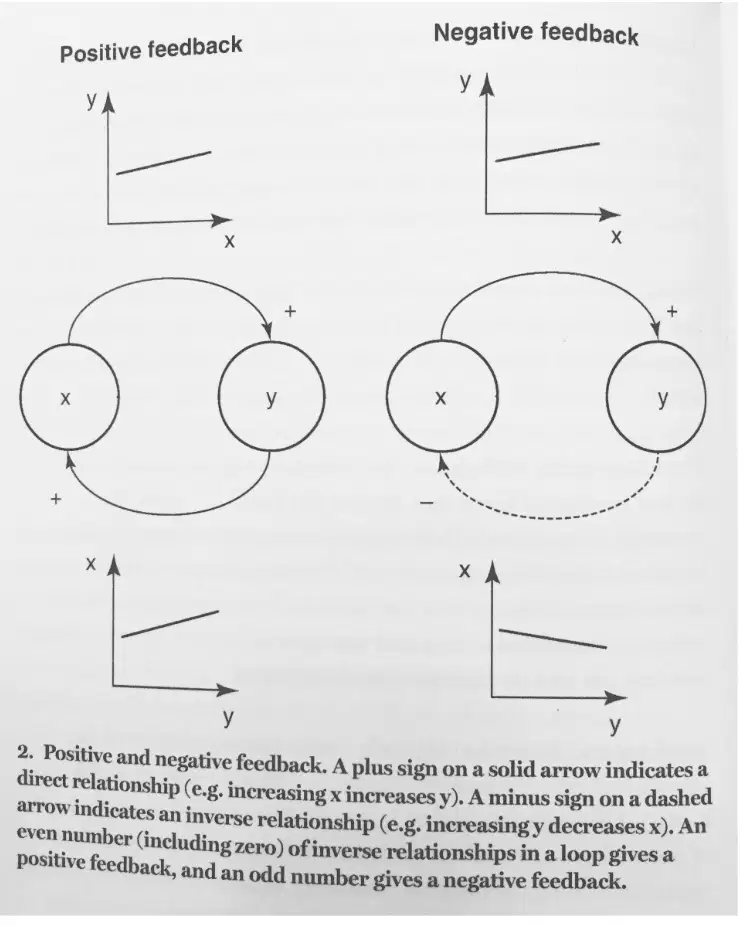
Positive and negative feedbacks!!
Models are built within a feedback.
True
False
Negative feedbacks:
Negative feedbacks tend to dampen or buffer changes; this tends to hold a system to some equilibrium state making it more stable.
NEGATIVE=REGULATORY FEEDBACK ROLE. This is a nonlinear relationships in a time graph.
only one variable increases while other decreases.
x changes. Has a increasing effect on y. y makes x decrease. x increases y then y increases.
Homeostasis= help system be balanced.
A negative feedback loop reduces the effect of change and helps maintain balance.
Positive feedback:
Positive feedback loops enhance or amplify changes; this tends to move a system away from its equilibrium state and make it more unstable
In a time graph, it is linear. Both variables increase while in a negative feedback, 1 increase and other decrease.
Both x and y variable increase. x variable has a direct relationship to y. y has a direct relationship to x and so on(the repetitions are the same)
occurs in nature when the product of a reaction leads to an increase in that reaction. If we look at a system in homeostasis, a positive feedback loop moves a system further away from the target of equilibrium
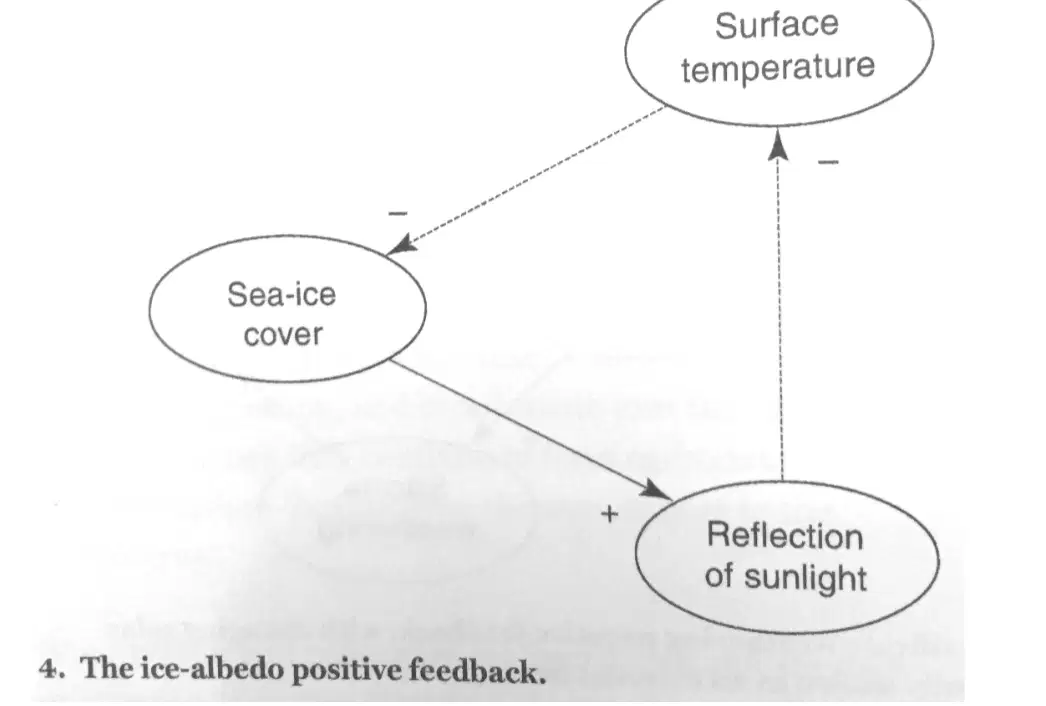
Ice-Albedo: Positive Feedback
**Positive feedback can enhance the rate of climate change.
**Positive feedback enhanced the initial variable.
Sea ice cover has a direct relationship to the reflection of sunlight. Reflection of sunlight has inverse relationship to surface temp. Surface temp has a inverse relationship to sea ice cover. Ex: sea ice changes. Ice has a high albedo because it is white so reflects. When warming increase it decreases sea ice cover decrease(inverse relationship) which decreases reflection of sunlight as there is less ice to reflect sunlight from(direct relationship) which further increase surface temp/globsl warming (inverse relationshio) furthering the melting of ice cover and the loop repeats.
no
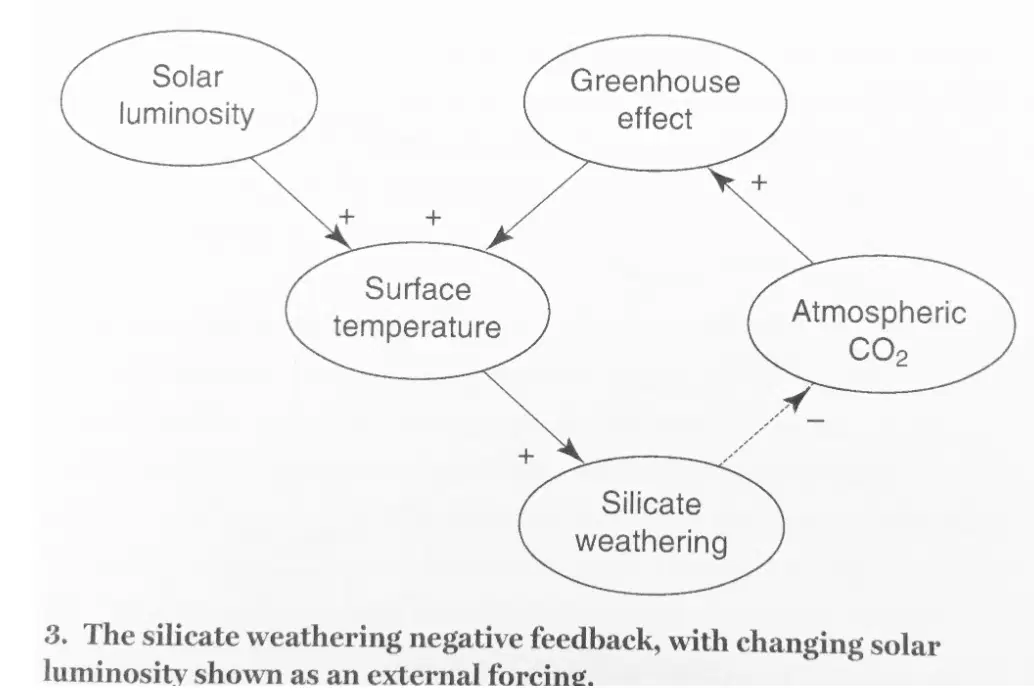
Silicate weathering(rock gets broken down): Negative Feedback.
CO2 are emitted mostly by humans. After Co2 is in atmosphere, plants and pythoplanton take in CO2 in photosynthesis. Another process is through the formation of carbonic acid(CO2 + H2O = H2CO3) through acid rain. This acid rain falls into rocks and takes them apart. This chemicals from the breaking of the rocks then flow through a river and into ocean. In ocean, pythoplankron use them to do photosyntesis.
To be able to do sillicate weathering, CO2 is needed. To accelerate sillicate, CO2 must decrease(direct), which will decrease greenhouse effect(direct), which will decrease surface temp/global warming(direct), which will decrease sillicate weathering(inverse). So less sillicate weathering will mean less CO2 is needed for it so Co2 will increase, which will increase greenhouse effect, increasing surface temps and then increaseing sillicate weathering, then will need more CO2 so less co2 in atmosphere and decrease greenhouse.etc.
REGULATORY ROLE

Reservoir(bath metaphor)=Negative Feedback
So if we first increase the amount of water in the tub, knocking the system out of its steady state, the drain responds by increasing its flow rate in order to decrease the amount of water in the tub.
If we instead decrease the initial amount in the tub, the negative feedback forces the amount of water in the tub to increase until the steady state is returned.
If we add water, it will increase the amount of water in bath(direct) whcih will increase the amount going out(direct) whcih will make the water level decrease(inverse) which will make output of eater decrease and then increase water level......etc
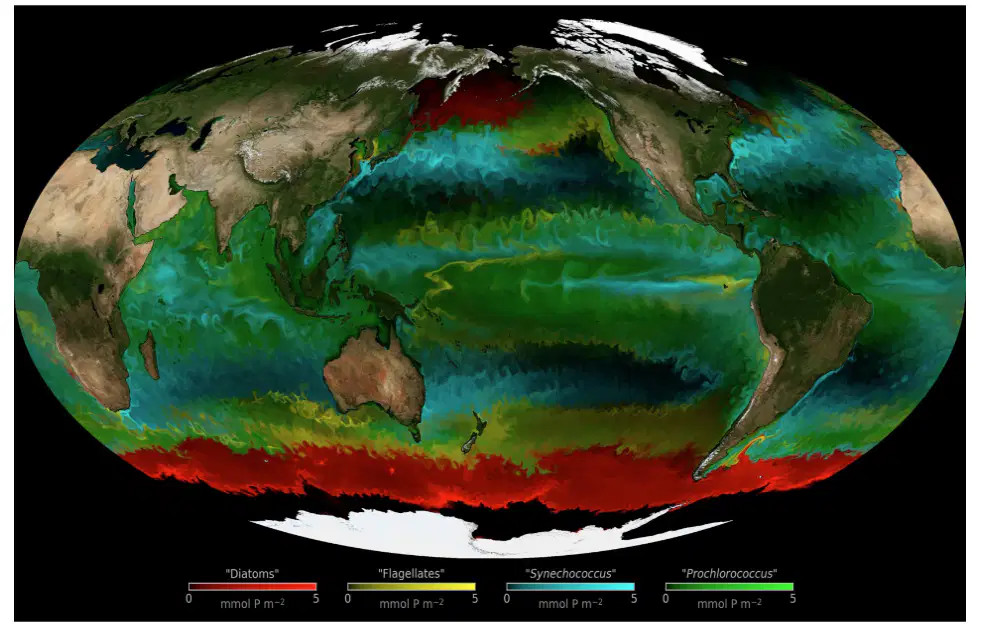
Modeled phytoplankton communities in a global ocean. Model incorporated physics, chemistry, and biology. (physical, chemistry, and biological processes).
-This model helps fisheries and climate change analysists
(True/False)
True
False
Phytoplankton: Phytoplankton growth depends on the availability of carbon dioxide, sunlight, and nutrients.
Phytoplankton are responsible for most of the transfer of carbon dioxide from the atmosphere to the ocean.
(a)
Greek deity who is the
personification of the Earth and the
ancestral Mother of all life: i.e. the Mother
Earth goddess.
(a)
Gaia Hypothesis
Developed by James Lovelock. He is a key
figure in the development of Earth
System Science.
“This paper examines the hypothesis
that the total ensemble of living
organisms which constitute the
biosphere can act as a single entity to
regulate chemical composition,
surface pH and possibly also climate.
The notion of the biosphere as an
active adaptive control system able to
maintain the Earth in homeostasis we
are calling the ‘Gaia’ hypothesis,
Lovelock (1972).”
(Lovelock & Margulis 1974)
Idea that earth is a system and how biology regulates it. That all systems come together to form one system. The statement 'the Earth behaves as a self-regulating system of physical and biological processes.
Self-regulatory systems, organizations, or activities are controlled by the people involved in them, rather than by outside organizations or rules
Lovelock saw planet as a living entity. Life on earth, is powered by life on earth!
Daisy World:
One two daisies exist: Black and white. Black has 0% albedo while white has 100% albedo. "examines the energy budget of a planet populated by two different types of plants, black daisies and white daisies. The colour of the daisies influences the albedo of the planet such that black daisies absorb light and warm the planet, while white daisies reflect light and cool the planet."
Theoretical Model that models a negative feedback loop (regulatory role)
Explains how life regulates temp in system. How each different colored daisy help the different colored daisy grow and regulate each other.
"The Daisyworld model [Lovelock, 1983a, 1983b] was invented to demonstrate that planetary self-regulation can emerge automatically from physically realistic feedback between life and its environment, without any need for foresight or planning on the part of the organisms, an early criticism"
Daisyworld is evidence for gaia hypothesis. Daisyworld is a simple planetary model designed to show the long-term effects of coupling between life and its environment.
The CLAW hypothesis:
An early example of using an ‘Earth System
science’ approach to understand the complex
interactions between different components of the
Earth.
Clouds affect pythoplankton growth because lack of sunlight. Pythoplaknton require sunlight and co2 to do photosynthesis and other stuff ig.
Explains how solar radiation goes in and affects system
CLAW hypothesis proposes a negative feedback loop that operates between ocean ecosystems and the Earth's climate.
"The CLAW hypothesis postulates a central role for dimethylsulphide (DMS) in the regulation of climate and invokes a plethora of biological, chemical and physical processes that interact to produce a climatic effect. None of these processes are well understood."
The CLAW hypothesis provides a mechanism by which plankton may modify climate through the atmospheric sulfur cycle via the provision of sulfate cloud condensation nuclei(CCN and aerosols.) Clouds form by water condensing on small particles suspended in the air (aerosols). Particles upon which cloud droplets form are called cloud condensation nuclei (CCN). Human emissions are increasing levels of aerosols in the atmosphere.
There is still not much knowledge and people also have rejected this theory.

Show how much each gas traps energy in surface.
(a)

Explains how clouds have a cooling effect-> hypothesis of paper
Also explain how......
Clouds play a major role in Earth’s heat budget.
We need to understand the processes that control
cloud formation to be able to better understand the
current climate and predict how it will change.
All cloud droplets grow on aerosol particles known
as cloud condensation nuclei (CCN)
Biological processes contribute to aerosol
formation; therefore there is the potential for
feedback between biology, cloud formation, and
climate.

This is a feedback mechanism. Seems like a negative feedback loops.
Part of the Claw Hypothesis
\In this hypothesis—referred to as CLAW—the increase in cloud condensation nuclei led to an increase in cloud albedo with the resulting changes in temperature and radiation initiating a climate feedback altering dimethyl sulphide emissions from phytoplankton.
Over the past two decades, observations in the marine boundary layer, laboratory studies and modelling efforts have been conducted seeking evidence for the CLAW hypothesis. The results indicate that a dimethyl sulphide biological control over cloud condensation nuclei probably does not exist and that sources of these nuclei to the marine boundary layer and the response of clouds to changes in aerosol are much more complex than was recognized twenty years ago. These results indicate that it is time to retire the CLAW hypothesis.
How people thought the feedback was. Dimethyl sufite (DMS) is a gas that was known to be the main natural source of sulfur in the atmosphere and is produced by phytoplankton. DMS contribure to cloud formation. It is first transformed into sulfate aerosols, acting as cloud condensations nuclei. This then increase cloud albedo and cools the earth. (AKS DMS COOLS THE TEMP)
Mine:
-Dimethysulfite with sea salt aerosols --->inject to CCN--> increase albedo-->less radiation-->phytoplankton reduce the DMS b/c they need sun for survival(because they are a plant)--> cause it to be less DMS so less aersols and ccn so less clouds so more sunlight so more pytoplankton so then more DMS and cycle goes on.
This hypothesis posits an example of planetary-scale homeostasis where phytoplankton, which produces dimethyl sulfide are responsive to variations in climate forcing, and that these responses lead to a negative feedback loop that acts to stabilize the temperature of the Earth's atmosphere.
The CLAW hypothesis proposes a negative feedback loop that operates between ocean ecosystems and the Earth's climate.[1] The hypothesis specifically proposes that particular phytoplankton that produce dimethyl sulfide are responsive to variations in climate forcing, and that these responses act to stabilise the temperature of the Earth's atmosphere
CLAW hypothesis and cloud albedo.
Increase in DMS emissions from the ocean would
result in an increase in cloud condensation nuclei
(CCN), and therefore an increase in cloud droplet
concentrations (i.e. clouds) and cloud albedo.
High cloud albedo would decrease the amount of solar
radiation reaching Earth’s surface (less light to drive
photosynthesis? Cooler surface ocean? Both?)
Change in the community composition and abundance
of phytoplankton, affecting how much DMSP is
produced.
Climate feedback loop.
The DMS proposed climate feedback loop requires:
1. that DMS is a significant source of CCN to the MBL*.
2) a change in DMS-derived CCN yields a change in cloud
albedo
3) A change in cloud albedo, surface temperature, and/or
incident solar radiation leads to a change in DMS
production
If any one step in the feedback loop shown in has a small
response, the proposed bioregulation of climate will be
minimal.
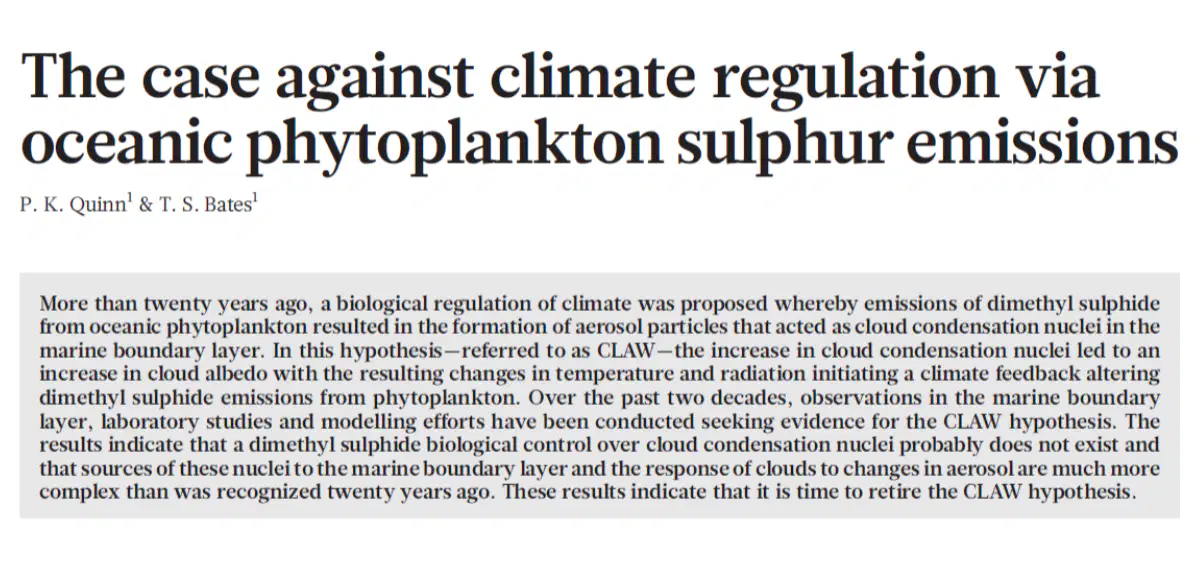
This shows how there is no evidence of climate regulation and pytoplankton and DMS.
Key points:
Its shows that this process is more complex that what was initially shown.
Retire Claw Hypothesis
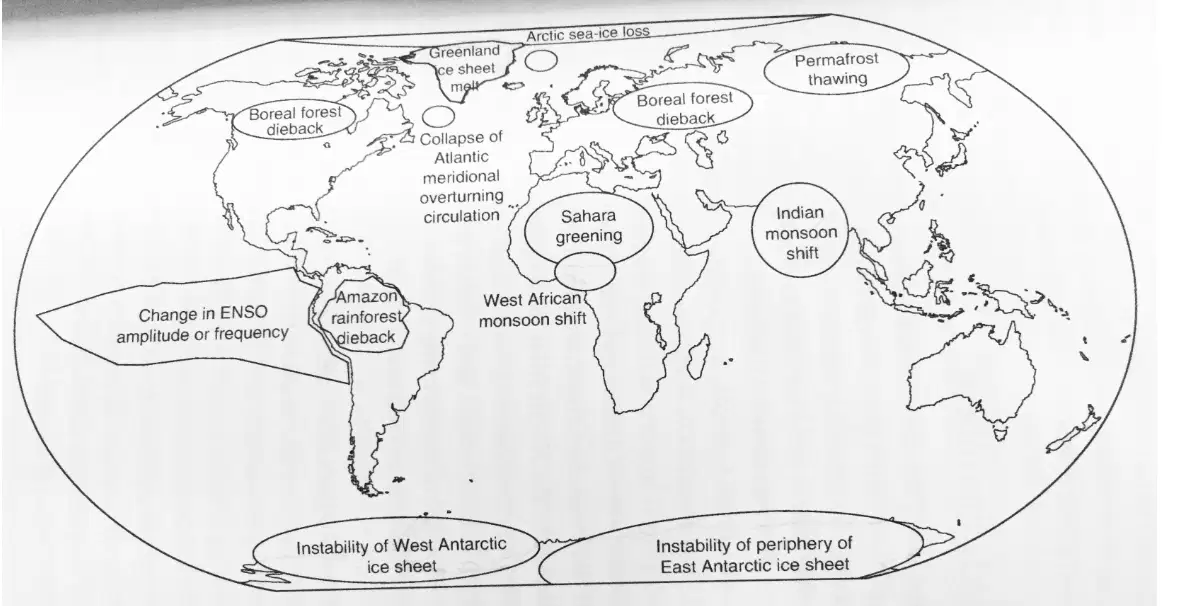
Potential tipping elements in the Earth's climate system.
In climate science, a tipping point is a critical threshold that, when crossed, leads to large, accelerating and often irreversible changes in the climate system.[3] If tipping points are crossed, they are likely to have severe impacts on human society and may accelerate global warming.[
Example: In the case of the Amazon rainforest, for example, hitting a climate tipping point, particularly in the face of continued deforestation, could eventually turn the tropical forest into an arid savannah.....(AKA: Amazon Rainforest being a potential tipping point elements in which there could be a drastic change from a forest to a desert)
The Intergovernmental Panel on Climate Change (IPCC) notes that more than a dozen natural systems—from ice sheets to the Amazon rainforest—are at risk of “tipping.” And although the actual tipping process could take years or even many centuries, it’s possible that once a threshold is passed, the shift is, essentially, a done deal—even if emissions are halted or reversed.
What is biogeochemistry?
Relates to oxygen, nitrogen, and carbon cycles
It is how chem elements important to life cycle in life and the local/large scale impacts.
It is a relatively new scientific
discipline that explores the physical, chemical,
biological, and geological processes and reactions
that govern the composition of and changes to the
natural environment.
biogeochemistry
studies the cycles of crucial elements, such as
carbon and nitrogen, and their interactions with
other substances and organisms as they move
through Earth’s atmosphere, hydrosphere (water
and ice), biosphere (life), and lithosphere (rock).
The field focuses especially on the diverse and
interlinked chemical cycles that are either driven by
or have an impact on biological activity, in particular
carbon, nitrogen, sulfur, and phosphorus.”
In a sense, chemicals are like currency, and biogeochemistry is the study of the nearly limitless “transactions” that drive the entire planetary system, including life on Earth......Ity is basically a recycling process between all the cycles/processes!

The rock cycle.
1. A prime example is carbon, the building block of life on Earth, and the planet-encompassing carbon cycle. Photosynthetic plants on land and sea take carbon dioxide (a form of inorganic carbon) from the atmosphere and convert it into the organic forms of carbon they need to live and grow. Animals that consume the plants incorporate the organic carbon into their own bodies.
2. Microbes eventually decompose dead plants and animals, and their carbon is recycled into soils and groundwater or swept into the oceans, where it becomes available to microbes and phytoplankton at the base of the marine food chain or it sinks and is buried in seafloor sediments. Over millions of years, carbon that is buried on land or at the bottom of the ocean becomes incorporated into rocks or hydrocarbons, where it might remain for tens to hundreds of millions of years. Ultimately, volcanoes return some of this carbon to the air as gas, where its heat-trapping properties affect Earth’s climate, or else the rocks containing carbon are uplifted onto continents and gradually weathered, releasing their carbon back to the environment and making it available to organisms once again.
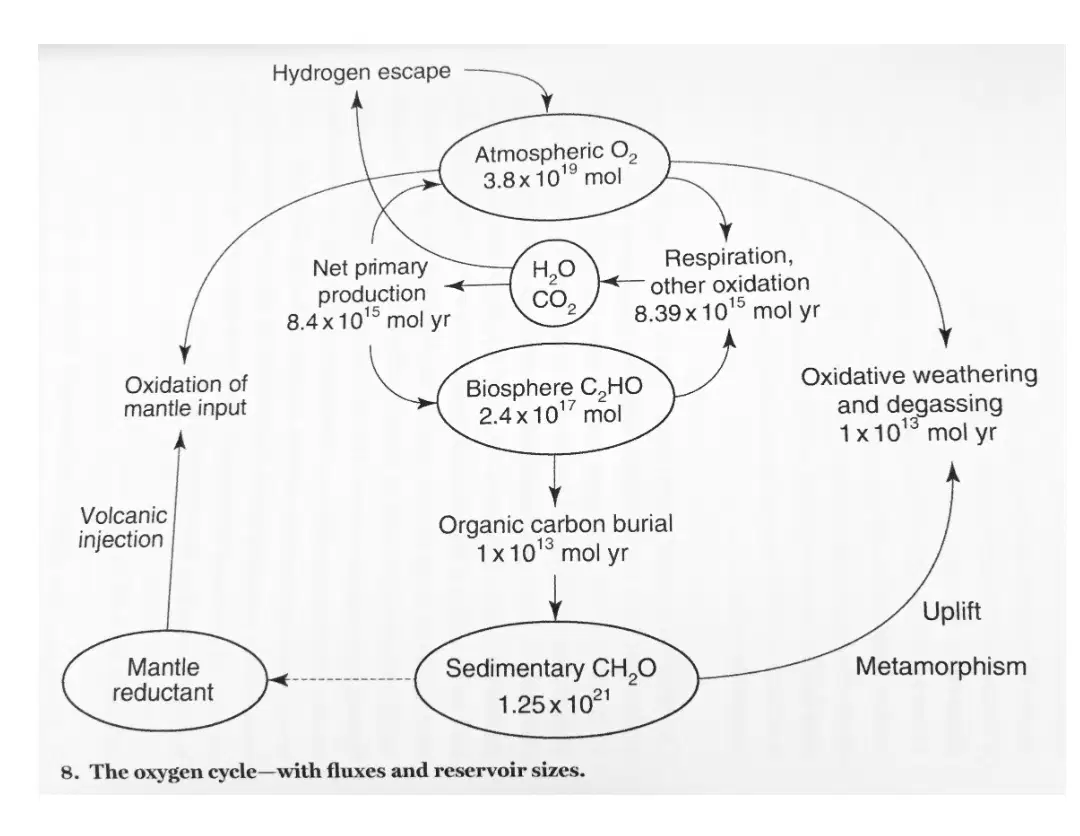
Oxygen Cycle
(a)
Ecosystem Services
Ecosystem services are those products or
functions of an ecosystem for which there is
a human demand or necessity.
Economists have attempted to place
monetary value on ecosystem services. This
is often difficult to do, but it does enable the
value of ecosystems to be directly compared
with the goods and services that are created
in the economy. This type of analysis is
potentially useful in decision making and
policy making.
Ecosystem services are those services from the environment we need. It is what we get from the ecosystem, like food. Example: Amazon Rainforest is important because it is a sink for carbon.
Human well-being is dependent on the services provided by
ecosystems (part of the infra-infrastructure). Human
activities produced significant changes in the ecosystem
functions that provide those services. ->In other words, we get the resources from ecosystems and damage that ecosystem.
Lists of ecosystem services:
Provisioning ecosystem services – e. g.
production of food
Regulating ecosystem services – e.g.
control of climate
Supporting ecosystem services – e.g.
nutrient cycles(natural cycles support us)
Cultural ecosystem services – e.g.
recreational or spiritual benefits(like natural parks because you have to pay to go in which giv e a dollar value to natural parks)
Preserving ecosystem services - e.g.
biodiversity maintains resilience(resistant to change and biodiversity)
Ecosystems assigned a monetary value:
Many of these ecosystem services are ‘free’,
i.e. they are not traded and don’t have a market
value. However, assigning a monetary value to
ecosystem services will help policy makers make
decisions. --->example are natural parks
Monetary value is usually assigned based on
what it would cost to generate that service
anthropogenically
For example, how much would it cost to
replace a estuarine mud flat that is a sink for
nitrogen with a waste water treatment works?

Mudflats, Great Ouse estuary (UK)
This place does not look like it has any value because it looks ugly and its stinky and people can get stuck and its risky.
Even though this looks ugly, this is an environmental service because the mud has nutrients which can other plants positively which benefit the economy,etc.
Nutrient fluxes and rates of processes were put together to
create a nitrogen budget for the River Colne estuary to help us
understand what was happening to nitrogen inside the estuary.
This mud place helps in nitrogen fixation.
Nitrogen fixation is a chemical process that converts atmospheric nitrogen into ammonia, which is absorbed by organisms. Nitrogen fixation is essentially converting atmospheric nitrogen into a form that plants can more readily utilize.
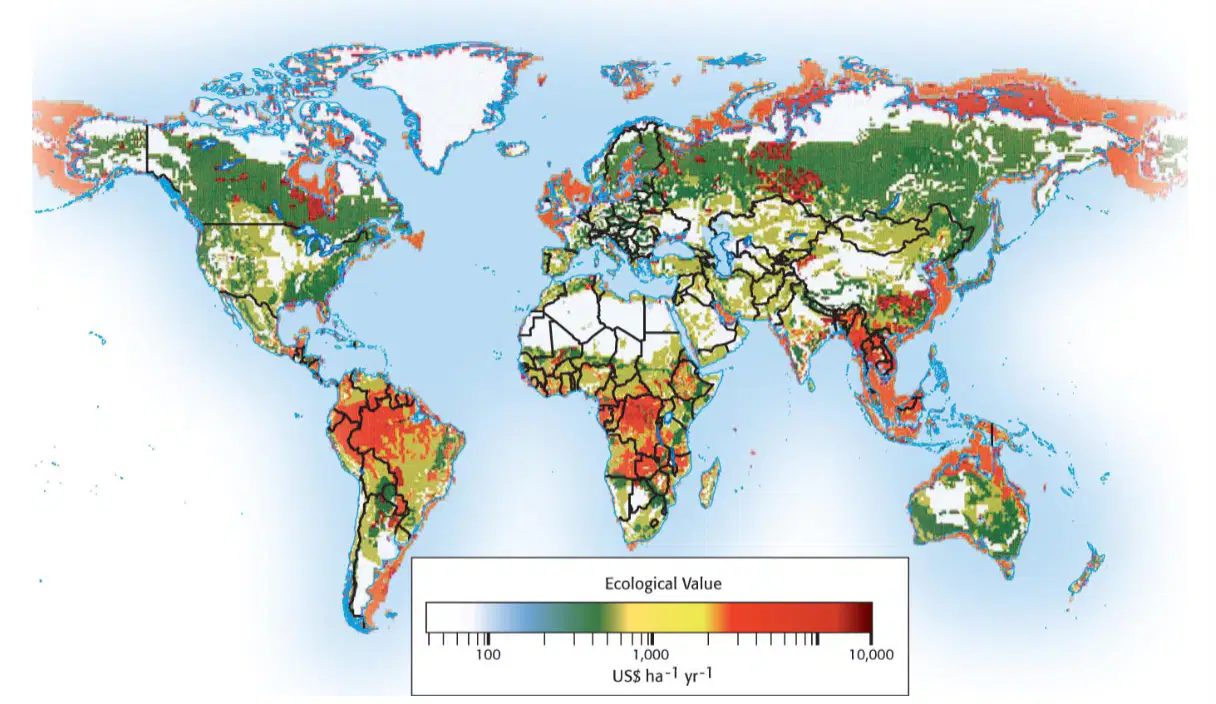
The value depends on where u are. (LOOK AT PIC IN PAPER)
Red stuff are the most valueable ecosystems on earth. Ex: tropical rainforest and also in oceans
White: no value because they do not provide ecosystem services. Example: greenland and cold deserts

