
 Worksheets
Jackson & Westward Expansion
Total questions: 87
Worksheet time: 44mins
A tax on imported goods entering a country is called a -
tariff
law
executive order
constitution
Why did Southerners object to the "Tariff of Abominations"?
It prohibited Northerners from importing goods.
It prohibited Southerners from exporting goods.
It made imported goods more expensive.
It made exported goods more expensive.
Who was the hero at the Battle of New Orleans and served 2 terms as president?
George Washington
Andrew Jackson
Thomas Jefferson
John Quincy Adams
What concern of Andrew Jackson was a primary issue dividing the political parties during his presidency?
The Civil War
Civil Disobedience
The Bank of the United States
"Common Sense"
Who was blamed for "ruin"ing the economy?
Martin Van Buren
George Washington
Alexander Hamilton
Agents X,Y, and Z
What religious group migrated west to Utah because of religious persecution?
James Audubon spent his life studying and drawing...
What did South Carolina threaten to do because of the "Tariff of Abominations" (protective tariff)?
What is it called when a person places the interests of his/her region or section of the country first?
What reformation movement wanted to ban alcohol?
Abolitionist Movement
Education Movement
Mentally Ill Movement
Heh wrote many compromises such as the Missouri Compromise of 1820. He was known as the "Great Compromiser".
What political party did Andrew Jackson start?
Who was president during the Louisiana Purchase?
Which is the best description of the works of the Hudson River School?
Nature Paintings
Portraits
Abstract paintings
Second Great Awakening
Where did Transcendentalists and artists come from during the late nineteenth century?
New York
Boston
Europe
Hudson River School
What kind of artwork was showcased in Hudson River School paintings?
landscapes
oceans
forests
tundras
When a state such as South Carolina decides not to follow a federal law, it is called...
Which state disagreed most with the protective tariff?
What did South Carolina do as a response to the protective tariff?
What did Henry Clay propose to do in order to prevent a Civil War?
a compromise
a law
a dinner
a convention
The name of the movement that believed we should put spiritual things over physical things.
Transcendentalism
Sectionalism
Nationalism
Andrew Jackson's first VP resigned because he supported South Carolina during the Nullification Crisis. Who was he?
Which of the following inventions was used on farms or plantations and increased agricultural production?
Cotton Gin
Factory System
Interchangeable Parts
Steam Boat
In the 1840s, Seneca Falls became the scene of an important convention for...
prison reforms
labor unions
temperance reform
women's rights
Andrew Jackson opened the White House to the public during his inauguration because he said he represented the...
common man
wealthy
educated
The forced journey of Native Americans to the West, especially Oklahoma, was called the...
Which of the following directly impacted the removal and resettlement of Cherokee Indians during the Jacksonian Era?
Worcester v. Georgia & Indian Removal Act
Embargo Act & Impressments
Protective Tariff & Nullification Crisis
Slavery & Underground Railroad
He was president during the Mexican War. He is also remembered as the "Manifest Destiny" president. Who was he?
Who was elected president in 1824 even though Andrew Jackson won the popular vote?
The act of giving government jobs to political friends is known as the...
Spoils System
Revolution
Civil Disobedience
Which of the following was a result of the Second Great Awakening?
Election of Jackson
Reform Movements
Tariff of Abomination
Free Speech
The Cherokees fought the state of Georgia in the Supreme Court and they won that case. What was the name of the case?
Why did Congress approve the Indian Removal Act?
Settlers wanted the land in the southwestern part of US for farming
When the Native Americans were removed from their land, where were they relocated to?
reservations in Oklahoma
Kansas Territory
Oregon Territory
California
What were two immigrant groups that worked on the construction and completion of the Transcontinental Railroad?
English and Spanish
German and Irish
Chinese and Irish
French and Dutch
What was the central economic concern of nativists during the nineteenth century?
Many worried that immigrants would take their jobs
Which immigrant group relocated due to major crop failure?
Irish
Chinese
Both
Which immigrant group relocated in search of gold?
Irish
Chinese
Both
Which immigrant group established communities in many major California cities?
Irish
Chinese
Both
Which immigrant group suffered from widespread famine in home country?
Irish
Chinese
Both
Which immigrant group was attracted by work available on the Transcontinental Railroad?
Irish
Chinese
Both
Which colonial region had lumbering?
New England
Middle
Southern
Which colonial region depended on cultivating cash crops?
New England
Middle
Southern
Which colonial region depended on fishing?
New England
Middle
Southern
Which colonial region cultivated tobacco?
New England
Middle
Southern
Which colonial region depended on whaling?
New England
Middle
Southern
Northwest Ordinance, Louisiana Purchase, or both?
Doubled the size of the U.S.
Louisiana Purchase
Northwest Ordinance
Both
Northwest Ordinance, Louisiana Purchase, or both?
Organized designated lands into territories
Louisiana Purchase
Northwest Ordinance
Both
Northwest Ordinance, Louisiana Purchase, or both?
Established rules for how states are added to the US
Louisiana Purchase
Northwest Ordinance
Both
Northwest Ordinance, Louisiana Purchase, or both?
Slavery prohibited in select territories
Louisiana Purchase
Northwest Ordinance
Both
Northwest Ordinance, Louisiana Purchase, or both?
First major cession (addition) of lands for the US
Louisiana Purchase
Northwest Ordinance
Both
What contributed to the growth of free enterprise system in the American colonies?
very little government interference
a lot of government interference
royal control over colonial businesses
Which institution did Andrew Jackson want to destroy?
This word means establishing a guide, example, or tradition for the future.
Precedent
Which branch of government interprets the laws?
Executive
Legislative
Judicial
Which branch of government enforces the laws?
Executive
Legislative
Judicial
Which branch of government makes the laws?
Executive
Legislative
Judicial

This cartoon was an insult to Jackson. Which party would have been responsible for publishing (making) this?
Democratic-Republicans
Whig Party
Democratic
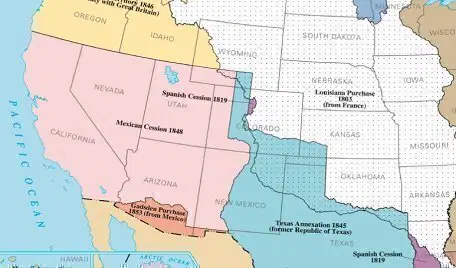
What land purchase was made so that the United States cold build the Transcontinental Railroad?
Gadsden Purchase
Louisiana Purchase
Mexican Cession
Oregon Territory

What can be inferred about how Americans viewed the idea of Westward Expansion?
Native Americans welcomed the white settlers west of the Mississippi River.
New innovations had little impact on the geography of new territories.
New innovations helped settlers continue to travel and relocate westward.
Cities and trade posts were unsuccessful in many of the new territories.
Who closed the Western Hemisphere (North and South America) to European colonization?
James Madison
George Washington
James Monroe
Abraham Lincoln
Harriet Tubman impacted society through her work leading the -
Underground Railroad
Women's Suffrage
Temperance Movement
Labor Union
Harriet Tubman was known for her help during the -
American Revolution
French and Indian War
War of 1812
Civil War
In what two ways did Dorothea Dix impact society within the United States?
fought for women's suffrage and temperance
created facilities for mental health patients and facilities for the disabled
advocated for abolition and women's suffrage
advocated for an 8hr work day and education reform
Horace Mann is best known for -
abolition of slavery
mental health facilities
free public education
women's suffrage
Henry David Thoreau was against the idea of -
Indian Removal
Manifest Destiny
Industrial Revolution
Agricultural Revolution
Henry David Thoreau refused to ________ __________ in protest to westward expansion and the U.S. Mexican War.
pay taxes
follow laws
Henry David Thoreau refused to pay taxes in protest to westward expansion and the U.S. Mexican War which is an example of ______________ __________________.
civic virtue
civil disobedience
Steam Boat, Telegraph, or Factory System?
Created a space for workers to do specialized jobs
Steam Boat
Telegaph
Factory System
Steam Boat, Telegraph, or Factory System?
it allowed for faster, more efficient movement of goods on water
Steam Boat
Telegaph
Factory System
Steam Boat, Telegraph, or Factory System?
it allowed people to communicate with each other over large distances
Steam Boat
Telegaph
Factory System
Steam Boat, Telegraph, or Factory System?
different jobs were brought together into one location
Steam Boat
Telegaph
Factory System
Steam Boat, Telegraph, or Factory System?
it made communication faster across large distances
Steam Boat
Telegaph
Factory System
What was the Temperance Movement?
social movement to stop the use and sale of alcohol
social movement to gain women's suffrage
social movement to spread public education to all
social movement to create better facilities for the mentally ill and incarcerated
Which of the following felt the impact (caused) of prison reform, women's suffrage, and the Temperance Movement?
LIncoln's election
national wake-up call
Second Great Awakening
manifest destiny
Which of the following reform movements describes "rights for women and suffrage"?
Care of disabled
Education
Women's Rights
Abolition
Which of the following reform movements describes "hospitals for mentally disabled"?
Care of disabled
Education
Women's Rights
Abolition
Which of the following reform movements describes "free public education"?
Care of disabled
Education
Women's Rights
Abolition
Which of the following reform movements describes "improved condition of prisons"?
Prison Reform
Labor Reform
Women's Rights
Temperance
Which of the following reform movements describes "stop the drinking of alcohol"?
Prison Reform
Labor Reform
Women's Rights
Temperance
Which of the following reform movements describes "push to end slavery"?
Prison Reform
Labor Reform
Abolition
Temperance
Which of the following reform movements describes "improved working conditions"?
Prison Reform
Labor Reform
Abolition
Temperance
Which of the following reformers helped the abolitionist movement by speaking as a former slave?
Harriet Beecher Stowe
Frederick Douglass
Elizabeth Cady Stanton
Henry David Thoreau
William Lloyd Garrison, Frederick Douglass, Sojourner Truth and Harriet Beecher Stowe all helped what reform movement?
Women's Movement
Labor Movement
Temperance Movement
Abolition Movement
What contributed to the growth of mass production in American manufacturing?
Interchangeable Parts
Telegraph
Steam Boat
Mechanical Reaper
How did the transportation revolution affect industrial growth?
increased the cost of and expense of distributing goods
decreased the cost and expense of distributing goods
increased imports of foreign goods
decreased exports of domestic good
What factor led many farmers, families, and young women to move to cities during the nineteenth century?
Growing availability of factory jobs

