
 Worksheets
Cell Transport
Total questions: 25
Worksheet time: 23mins


Nucleus control center of the cell
Selectively Permeable golgi apparatus
Non Permeable membrane

Simple Diffusion
Facilitated diffusion

When the concentration of solutes on both sides of a membrane is the SAME, the solution is

A solution is considered hypotonic to the cell if it has....
A lower amount of water compared to the cell.
A higher amount of solute compared to the cell.
A lower amount of solute compared to the cell.
A solution is considered hypertonic to the cell if it has....
A higher amount of water compared to the cell.
A higher amount of solute compared to the cell.
A lower amount of solute compared to the cell.
Simple Diffusion
When molecules passively cross the plasma membrane through the phospholipid bilayer
Facilitated Diffusion
When molecules passively cross the plasma membrane through a channel protein
Osmosis
The movement of water across the cell membrane
Endocytosis
Bringing in large materials through the cell membrane into a vacuole.
Exocytosis
Moving larger amounts or large quantities of materials through the cell membrane
Hypertonic
The solution contains a high concentration of solute an and low concentration of water
Hypotonic
The solution contains a low concentration of solute an and high concentration of water
Isotonic
The solution has an equal concentration of solute and water compared to the inside of the cell
The role of the nucleus is to ...
produce the energy the cell needs
direct all cell activities
transport proteins
make proteins
A power plant is like the ...
golgi body
lysosome
mitochondria
ribosomes
City limits and guards are like the ...
cell membrane
cell wall
lysosome
nucleolus
Roads and highways are like the ...
centrioles
vesicles
endoplasmic reticulum
golgi body
Factories a like the ...
vacuole
mitochondria
ribosomes
lysosomes
The Post Office is the like ...
chlorplasts
endoplasmic reticulum
golgi body
vesicles
The role of the golgi body is to ....
create ribosomes
sort and package proteins
transport proteins throughout the cell
protect the cell
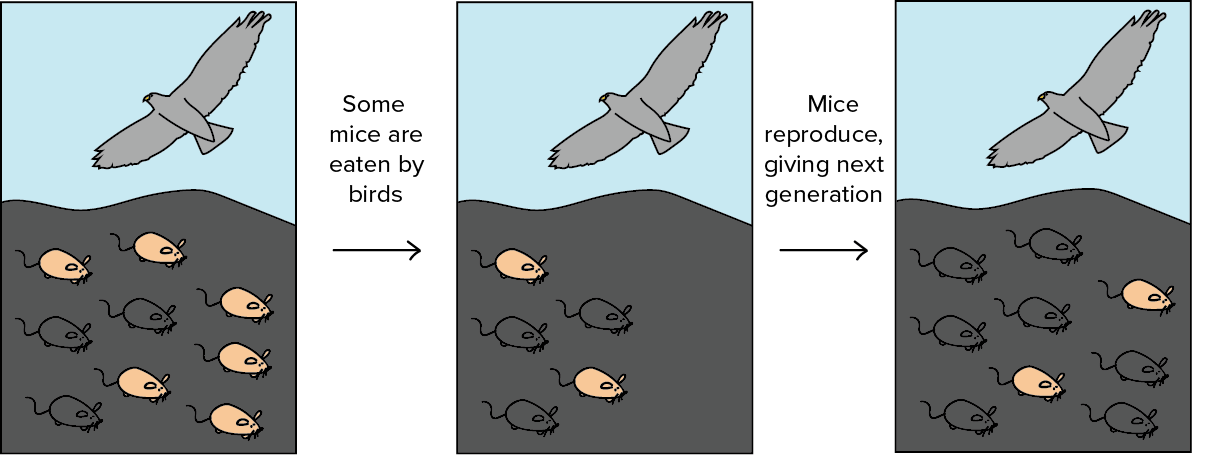
The light mice can reproduce more successfully than the dark mice
The hawks eat more dark mice than light mice because the dark mice taste better
The hawks eat more light mice than dark mice because they can see the light mice more easily
The hawks eat more dark mice than light mice because they can see the dark mice more easily

The graphs below show the changes in crab color at one beach.
Which of the following is most likely to have caused the change in the distribution?
A new predator arrived that preferred dark-tan crabs.
A new predator arrived that preferred light-tan crabs.
A change in beach color made medium-tan crabs the least visible to predators.
A change in beach color made medium-tan crabs the most visible to predators.

The figure shows how natural selection of a single-trait gene affects lizard survival.
Which of the following most likely causes the changes in allele distribution?
The allele for light gray coloration disappears from the population. This may be because light gray lizards are more visible to predators and therefore they might be less likely to survive and reproduce.
The allele for black coloration decreases fitness and becomes less common. This may be because black coloration keeps the lizards cool during hot summer temperatures.
Medium gray coloration in lizards appears to be a neutral mutant allele that allows the lizards to hide better from predators. This leads to increases in phenotype and allele frequency of gray coloration.
Because black and medium gray lizards are less visible to predators, these alleles are neutral to natural selection and therefore will not disappear from the population of lizards.
Grass plants in a population range in height from 6 cm to 25 cm. The short plants receive little sunlight, and the tall plants are eaten by grazing animals. Which statement best describes the effect of natural selection on the grasses?
Because average height grass plants are favored, stabilizing natural selection is occurring.
Because average height grass plants are favored, disruptive natural selection is occurring.
Because tall grass plants are favored by the animals that eat grass, directional selection is occurring.
Because short and tall grass plants are favored, normal natural selection is occurring.

