wayground logo

Free Printable Worksheets

Font size

S
M
L
XL
Worksheets

7.1-7.2 Gregor Mendel and Modern Genetics Assignment

Total questions: 55

Worksheet time: 1hrs 14mins

Name
Class
Date
1.

Where was Gregor Mendel born?

a)

Italy

b)

Germany

c)

Austria

d)

France

2.

What field is Gregor Mendel known as the father of?

a)

Biology

b)

Physics

c)

Genetics

d)

Chemistry

3.

What did Mendel's experiments with pea plants help establish?

a)

The field of modern genetics

b)

The field of botany

c)

The field of geology

d)

The field of astronomy

4.

When did Mendel die?

a)

1867

b)

1884

c)

1901

d)

1920

5.

What is the theory now known as the law of segregation?

a)

There are dominant and recessive traits in all organisms

b)

Traits are passed on randomly based upon the mixing of genes between the two parents

c)

Traits are passed on by the laws of biochemistry

d)

Traits are inherited mostly from the mother's genes

6.

What is the law of independent assortment based on?

a)

Traits are passed on randomly and do not rely on any other trait which as also passed on randomly

b)

Traits are inherited in equal proportions from both parents

c)

There are dominant and recessive traits in all organisms

d)

Traits are passed on statistically based upon the mixing of genes between the two parents

7.

What did Mendel's research lay the foundation for?

a)

Modern medicine

b)

Modern genetics

c)

Modern gene therapy

d)

Modern physics

8.

What did Mendel become in his later years?

a)

An abbot

b)

A teacher

c)

A doctor

d)

A scientist

9.

Who is Gregor Mendel

a)

an Austrian Monk from the mid 1800s who contributed to the study of Genetics

b)

The scientist who discovered the structure of DNA

c)

a British scientist who discovered penicillin

d)

The scientist who used X-Ray Crystallography to shed light on the structure of DNA

10.

What did Gregor Mendel study?

a)

Mold Spores

b)

Pea Plants

c)

Sun Flowers

d)

Rats

11.

an observable characteristic

a)

trait

b)

personality

c)

cell

d)

DNA

12.

When an organism has two of the same alleles, it is called

a)

homozygous

b)

heterozygous

c)

recessive

d)

dominant

13.

When an organism has two different alleles, it is called

a)

homozygous

b)

heterozygous

c)

recessive

d)

dominant

14.

______ is the set of genes possessed by someone

a)

Karyotype

b)

Fingerprint

c)

Genotype

d)

Phenotype

15.

Humans have _______ pairs of chromosomes, for a total of _______ chromosomes.

a)

10, 20

b)

25, 100

c)

23, 46

d)

46, 92

16.
Homozygous is when...
a)
the alleles are the same
b)
the alleles are different
c)
the alleles are absent
d)
the alleles are present
17.
Heterozygous is when...
a)
the alleles are the same
b)
the alleles are different
c)
the alleles are absent
d)
the alleles are present
18.
T - tall and t = short
In the punnett square below, what belongs in the missing square
a)
tt
b)
Tt
c)
Bb
d)
TT
19.
B = brown fur  b = white fur
In the punnett square, what is the probability for white fur? 
a)
0%
b)
25%
c)
50%
d)
75%
20.
Dominant or recessive?
tt
a)
Dominant 
b)
Recessive
21.
What is the probability of heterozygous offspring?
a)
25%
b)
50%
c)
0%
d)
100%
22.
What allele combination should go in the missing box?
a)
AA
b)
Aa
c)
aa
d)
none of these
23.
What is the phenotype of the offspring? (A-Brown hair; a-blond hair) 
a)
50 % Brown Hair and 50% Blond Hair 
b)
25 % Brown Hair and 75% Blond Hair 
c)
75 % Brown Hair and 25% Blond Hair 
d)
0% Brown Hair and 100% Blond Hair 
24.
What is a dominant allele?
a)
A trait that is always shown (capital letter)
b)
A trait that can be hidden (lower case letter)
c)
Alleles that are the same
d)
Alleles that are different
25.
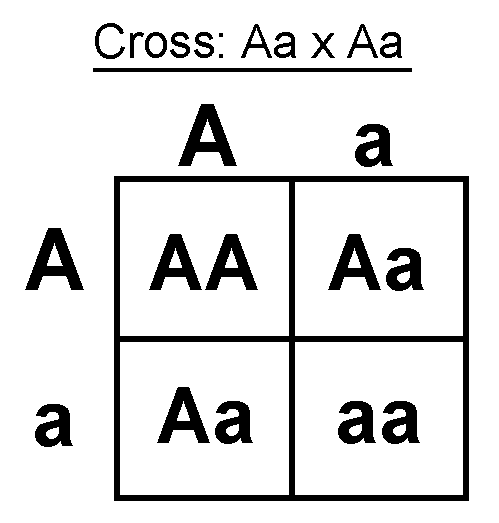
This image shows a...
a)
Punnett Square
b)
Phenotype
c)
Genotype
d)
Dominant allele
26.
What does heterozygous mean?
a)
An organism that has the same genes for a trait (TT or tt)
b)
An organism that has different genes for a trait (Tt)
c)
When neither gene is fully dominant; offspring is a mixture of both
d)
the different forms of a trait (hair color--> brown, blonde, red
27.

If a heterozygous parent and a homozygous recessive parent mate, what percentage of their offspring will be dominant?

a)

25%

b)

50%

c)

75%

d)

100%

28.
Two brown eyed parents (Bb) have a baby. What is the chance the baby is blue eyed?
a)
0 %
b)
25%
c)
50%
d)
75%
29.
Two brown eyed parents (Bb) have a baby. What is the chance the baby is blue eyed?
a)
0 %
b)
25%
c)
50%
d)
75%
30.

What is the term for the physical appearance of an organism as a result of its genotype?

a)

Phenotype

b)

Genotype

c)

Karyotype

d)

Allele

31.

What is the probability of a homozygous dominant offspring if both parents are heterozygous?

a)

25%

b)

50%

c)

75%

d)

100%

32.

(a)   - refers to the physical appearance of an organism.

33.

(a)   refers to the genetic makeup of an organism.

34.

(a)   means traits that are covered up or “masked”.

35.

(a)   means traits that are always expressed.

36.

(a)   means the study of genes and heredity.

37.

(a)   means how traits or characteristics are passed on from generation to generation.

38.

(a)   means "a permanent change in DNA sequence."

39.

A _______ cross is one where there is only 1 trait that is being expresses

a)

monohybrid

b)

dihybrid

c)

trihybrid

d)

antihybrid

40.

A _______ cross is one where there 2 traits are being expresses

a)

monohybrid

b)

dihybrid

c)

trihybrid

d)

antihybrid

41.
Dominant alleles are represented by a:
a)
Male gene
b)
lowercase letter
c)
recessive trait
d)
capital letter
42.
Aa, DD, bB, yy are all examples of
a)
genotypes
b)
phenotypes
43.

How many alleles (letters) does each person carry for a trait?

a)

1

b)

2

c)

3

d)

4

44.
In a heterozygous genotype, the ___________ allele takes over in the phenotype.
a)
recessive
b)
dominant
c)
lower case letter
d)
both 
45.
What you see, or the physical appearance.
a)
Genotype
b)
Phenotype
c)
Homozygous
d)
Heterozygous
46.
Which of the following is a phenotype?
a)
Aa
b)
red hair
c)
heterozygous
d)
DNA
47.
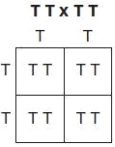
What ratio of the offspring from the cross shown will be homozygous recessive for the  trait of tallness? 
a)
0 in 4
b)
1 in 4
c)
2 in 4
d)
4 in 4
48.
Which of the following is homozygous dominant?
a)
Yy
b)
Y
c)
yy
d)
YY
49.
Which of the following is homozygous recessive?
a)
Tt
b)
tt
c)
TT
d)
T
50.

A-Brown hair; a-blond hair

Which describes is the phenotypes of the offspring?

a)

50 % Brown Hair and 50% Blond Hair

b)

25 % Brown Hair and 75% Blond Hair

c)

75 % Brown Hair and 25% Blond Hair

d)

0% Brown Hair and 100% Blond Hair

51.
What is the probability of heterozygous offspring?
a)
25%
b)
50%
c)
0%
d)
100%
52.
What allele combination should go in the missing box?
a)
AA
b)
Aa
c)
aa
d)
none of these
53.
What characteristic would a child NOT inherit from parents?
a)
freckles
b)
eye color
c)
hair style
d)
dimples
54.
Homozygous is when...
a)
the alleles are the same
b)
the alleles are different
c)
the alleles are absent
d)
the alleles are present
55.
Heterozygous is when...
a)
the alleles are the same
b)
the alleles are different
c)
the alleles are absent
d)
the alleles are present