wayground logo

Free Printable Worksheets

Font size

S
M
L
XL
Worksheets

Basic Economics

Total questions: 34

Worksheet time: 20mins

Name
Class
Date
1.
In an economy what three things must take place?
a)
Production, Relocation, Consumption
b)
Production, Distribution, and Consumption
c)
Production, Distribution, and Labeling
2.
____________ are the products made in an economy. 
a)
Goods
b)
Services
c)
Consumption
3.
______________________ are provided to you by a company. 
a)
Consumption
b)
Goods
c)
Services
4.

The problem of unlimited desires and limited resources is the problem of

a)

wants

b)

marginal benefit

c)

scarcity

d)

free enterprise

5.

What is an entrepreneur

a)

the exchange of goods or services

b)

a person who starts a new business hoping to make a profit

c)

the work that people do when producing goods or services

d)

a type of business

6.

Natural resources are

a)

something found in nature that satisfies our wants and needs (like a tree cut down for timber)

b)

the amount of goods and services people are willing to buy at a specific time

c)

the work that people do in nature

d)

making goods or service

7.

Human Resources are

a)

makes goods or service

b)

the amount of goods and services people are willing to buy at a specific time

c)

found in people, like their skills and ideas

d)

the work that people do when producing goods or services

8.

When you have INCOME, you have

a)

money that you earned (used to buy a good or service)

b)

money that you have given away to others

c)

money that you have place in the bank

d)

None of above

9.

Labor is

a)

the work that people do when producing goods or services

b)

just like supply and demand

c)

the amount of goods or services available to sell at a given time

d)

the amount of goods and services people are willing to buy at a specific time

10.

Water, shelter, and food are all examples of -

a)

needs

b)

wants

11.

Who is noted as being the "founding father" of capitalism, as seen in his book The Wealth of Nations?

a)

John Maynard

b)

David Ricardo

c)

Karl Marx

d)

Adam Smith

12.

The Circular Flow model of economies connects...

a)

Command, Market, and Traditional Economies

b)

Supply, Demand, and Competition

c)

Households, Businesses, and Government

d)

Trade Offs, Opportunity Costs, and Scarcity

13.

Define Shortage

a)

more people want an item than is available for purchase

b)

more items available for sale than people want to purchase

14.

Define Surplus

a)

more items available for sale than people want to purchase

b)

more people want an item than is available for purchase

15.
What is the fundamental problem of every society?
a)
labor costs
b)
scarcity
c)
economic interdependence
d)
market fluctuation
16.

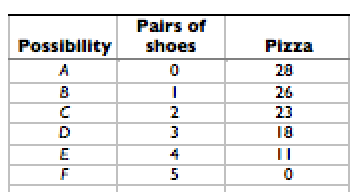
The table shows the production possibilities for a country. Based on the table, which of the following production combinations is a possibility?

a)

28 pizzas and 5 pairs of shoes

b)

3 pairs of shoes and 23 pizzas

c)

2 pairs of shoes and 20 pizzas

d)

4 pairs of shoes and 15 pizzas

17.
Based on the table, if the country is currently producing at point B and decides to produce at point C, the opportunity cost for the additional pair of shoes is ____ pizzas.   
a)
26
b)
23
c)
3
d)
2
18.
What is the production possibilities curve?
a)
a graph that shows how much an economy can produce between 2 goods
b)
how much money something is
c)
the opportunity one has to give up in order to gain something else
d)
land, labor, capital, entrepreneurs
19.
Land, Labor, Capital, and Entrepreneurship 
a)
Diversification
b)
Deductions
c)
Portfolio
d)
Factors of Production 
20.
Movement down the PPF curve indicates that the opportunity cost of more capital goods is producing more consumer goods
a)
True
b)
False
21.
Efficiency is producing the maximum possible output from available resources
a)
True
b)
False
22.
What do points inside the PPF indicate?
a)
The combination of goods that employ goods efficiently
b)
The combination of goods that employ resources fully
c)
The combination of goods that do not employ resources fully
23.
An increase in the labor force would cause the PPF to 
a)
Shift inward
b)
Shift outward
c)
Do nothing
d)
Turn into a straight line
24.
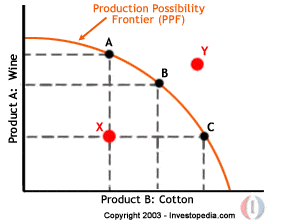
What does point Y represent on the PPC?
a)
Efficiency
b)
Unattainable / impossible
c)
Inefficency
d)
Nothing
25.
What does point B represent?
a)
Production at greater than the country's minimum potential
b)
Production is less than the country's minimum potential
c)
Productive inefficiency
d)
Productive efficiency
26.
Which point represents "resources are not being used efficiently, or resources are being wasted or idle"?
a)
Point A
b)
Point Y
c)
Point X
d)
All of the above
27.
Labor, human capital, entrepreneurship, natural resources, and capital are all examples of which of the following?
a)
Outputs
b)
Substitutes in Production
c)
Absolute Advantage
d)
Factors of Production
28.
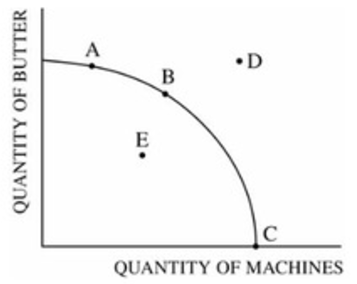
The diagram shows the production possibilities curve for Country Y. Which of the following statements is true?
a)
If Country Y is producing at point C, it is using all its resources efficiently
b)
The opportunity cost of producing more machines is constant
c)
Country Y cannot produce at point E
d)
The most efficient point of production is point D
29.

When individuals work for businesses, what resource are they providing?

a)

Capital

b)

Labor

c)

Loans

d)

Raw materials

30.

When individuals work for businesses, what do they get in return?

a)

Capital

b)

Labor

c)

Income

d)

Raw materials

31.

What model shows how products, resources, and money flow in the economy?

a)

Circular flow model

b)

aggregate model

c)

GDP output expenditure model

d)

the Cobb-Douglas production function

32.

In what market do businesses sell goods and services to households?

a)

Product Market

b)

Factor Market

c)

Resource Market

d)

None of the above

33.

In what market are the factors of production bought and sold?

a)

Product Market

b)

Resource Market (AKA- Factor Market)

34.

In a free market economy who owns the resources?

a)

state governments

b)

the federal government

c)

households

d)

local governments