
 Worksheets
Kinetic Theory & States of Matter
Total questions: 35
Worksheet time: 25mins

Which state of matter has both definite shape and definite volume?
Gas
Liquid
Solid
What is the phase change of a solid to a liquid?
freezing
melting
boiling
condensation
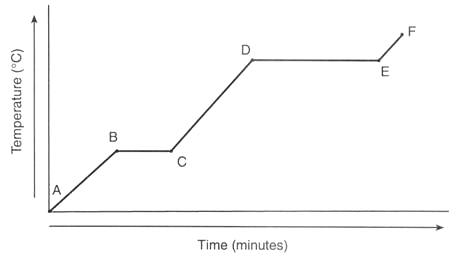
What state/phase is the object likely from points A to B?
Solid
Liquid
Gas
Plasma
What is happening to the particles in the substance between points A and B?
Melting
Freezing
Speeding Up
Slowing Down
What is happening to the particles in the substance between points D and E?
Melting
Freezing
Vaporizing
Sublimating
Physical Properties
Can't be observed unless you change what they are made of.
Can only be observed under a microscope
describe the appearance of something.
Can only be done in science.
What are 4 forms of matter?
solid, liquid, air, lava
solid, liquid, gas, plasma
Earth, Wind, Fire, Ether
Fire, Water, Soil, Wind
What does volume measure?
mass
the size of something
how much space something takes up.
the speed something goes
What does density measure?
Nothing
How much volume something has
how packed particles are in a substance.
the temperature of an object.
Grams is a unit of ___
mass
volume
conductivity
melting point
Unit of volume.
g
ml
g/ml
K
Unit of mass.
g
ml
g/ml
K
Unit of density.
g
ml
g/ml
K
Which state of matter has both definite shape and definite volume?
Gas
Liquid
Solid
Which of the following is (are) fluids?
Solid
Liquid
Gas
All of the following are physical changes except:
Melting
burning
condensing
vaporizing

Atoms in a _______ are closely packed vibrating particles.
plasma
liquid
solid
gas

When the particles of a liquid are heated, they begin to expand, and the phase changes to a _____. These particles then move in straight lines until they bounce off of something. When the particles cool back down to a liquid it is called _________
Gas, condensation
Plasma, condensation
Gas, Sublimation
Plasma, vaporization
Increasing the temperature of a substance causes the particles to speed up and can cause which of the following to occur? (choose 3)
condensing
vaporizing
melting
boiling

At higher temperatures
particles in an object have less kinetic energy
particles in an object move faster
a gas contracts
Thermal energy is...
heat energy
the energy of motion
energy of nuclear processes.
an indication of physical change.
Which of the following states of matter has the LOWEST level of kinetic energy?
Solid
Liquid
Gas
Plasma
Which of the following states of matter can easily be compressed (made to fit into a small volume)?
Solid
Liquid
Gas
The kinetic theory of matter states that all particles are constantly
growing
contracting
reacting
moving
Evaporation is what kind of change and WHY?
Endothermic because it requires energy
Exothermic because it requires energy
Endothermic because it releases energy
Exothermic because it requires energy
The 3 MAIN states of matter are:
(a) (b) (c)
plasma
Bose-Einstein Condensates
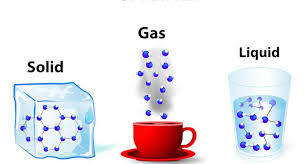
The properties of liquids include (SELECT ALL THAT APPLY)
definite volume
take the shape of the container
can flow
are relatively incompressible
can diffuse and have surfacre tension

