
 Worksheets
Lewis Structures, Molecular Geometry, and Intermolecular Forces
Total questions: 40
Worksheet time: 24mins

How many total valence electrons are present in the Lewis structure of CO2?
16
20
24
32
Which of the following molecules will have a Lewis structure with a double bond?
O2
H2O
NH3
CH4
In drawing the Lewis structure for SF4 how many lone pairs of electrons are around the central sulfur atom?
0
1
2
3
Which element typically does NOT follow the octet rule in its compounds?
Carbon
Oxygen
Hydrogen
Nitrogen

How many valence electrons should be represented in the Lewis structure of ammonium ion NH4+?
8
9
18
20
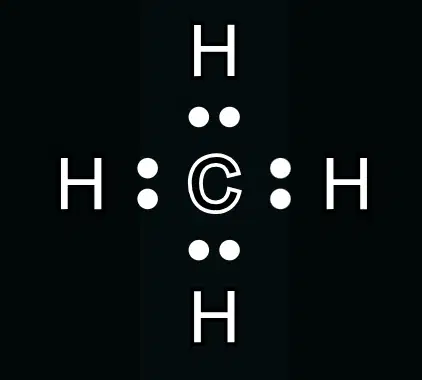
What is the molecular geometry of CH4, which Lewis structure is depicted in the picture?
Tetrahedral
Trigonal planar
Linear
Bent
The molecule SF6 exhibits which type of molecular geometry?
Octahedral
Tetrahedral
Trigonal bipyramidal
Square planar
What is the molecular geometry of water H2O?
Linear
Bent
Tetrahedral
Trigonal planar
Which of the following molecules has a trigonal planar shape?
BF3
NH3
CH4
H2O
In CO2 what is the shape around each carbon atom?
Linear
Bent
Tetrahedral
Trigonal planar

Which type of intermolecular force is primarily responsible for the high boiling point of water?
London dispersion forces
Dipole-dipole interactions
Hydrogen bonding
Ionic bonding

In the picture attached you have depicted the molecular shape of an I2 molecule. What type of intermolecular forces exist between I2 molecules in the solid phase?
Hydrogen bonding
Dipole-dipole interactions
London dispersion forces
Ionic bonding
Which of the following molecules would exhibit dipole-dipole interactions?

O2
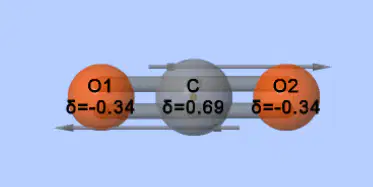
CO2
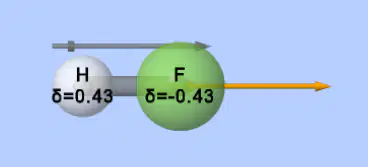
HF

N2
In which of the following substances would you expect the weakest intermolecular forces?
Ne
MgCl2
NH3
H2O

What is the predominant intermolecular force in a sample of CH3OH (methanol)?
London dispersion forces
Dipole-dipole interactions
Hydrogen bonding
Ionic bonding

What is the main intermolecular force within a sample of pure Hydrofluoric acid HF, at liquid state?
LDF's
Dipole-dipole
Hydrogen bond
Dipole-induced dipole

Choose the sentence that best describes the molecule of N2.
There is a triple covalent bond between the Nitrogen atoms, and they are bonding to each other by means of dipole-induced dipole intermolecular force.
There is strong covalent bond between the Nitrogen atoms, and they are bonding to each other by means of London Dispersion Forces intermolecular force.
There is a weak intramolecular force between the Nitrogen atoms, and a very strong intermolecular force.
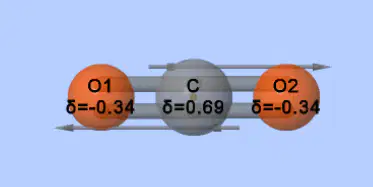
True or false: "The CO2 molecule is a nonpolar molecule".
TRUE
FALSE
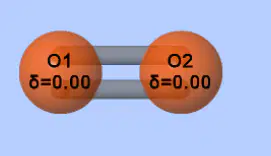
Choose the sentence that best describes the O2 molecule.
Intramolecular force is covalent bond and Intermolecular force is dipole-dipole.
Intramolecular force is ionic bond and Intermolecular force is dipole-dipole.
Intermolecular force is ionic bond and Intramolecular force is dipole-dipole.
Intramolecular force is a double bond with 4 electrons being shared and Intermolecular force is London Dispersion Force.
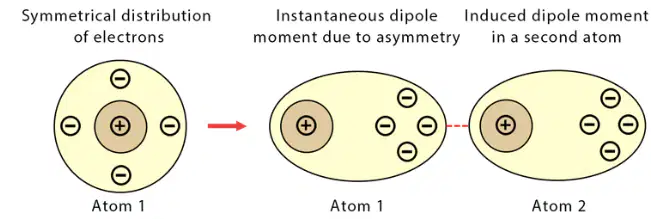
What type of intermolecular force is depicted in the picture attached?
London Dispersion Forces
Dipole- Dipole
Dipole-Induced diploe
Hydrogen bond

Choose a sentence that is true.
Fluorine atom in the BF3 molecule has an expanded octet.
Boron octet in the BF3 molecule has 6 electrons only.
The number of valence electrons in the molecule of BF3 is 22.

TRUE or FALSE: " Compounds whit strong intermolecular forces have lower boiling points than those with weak intermolecular forces".
TRUE
FALSE

What type of Intermolecular force is present among Cl2 molecules?
London Dispersion forces
Dipole-Dipole
Ion-dipole
Hydrogen bond

What type of intermolecular force is depicted in the picture?
Ion-dipole
Ionic bond
Dipole-dipole
Ion-induced-dipole

What type of Intermolecular force is holding the molecules of water to each other in the solid phase or in the liquid phase?
Dipole-dipole
London Dispersion Forces
Hydrogen bond
Covalent bond

What type of intermolecular force is depicted in the picture?
Ion-dipole
Ion-induced dipole
Ionic bond
Covalent bond and ionic bond

Choose the answer that best describes the interactions present in a sample of liquid Hydrochloric acid:
The intramolecular force is dipole-dipole and the intermolecular force is dipole-induced dipole.
The intramolecular force is covalent bond and the intermolecular force is ion-dipole.
The intramolecular force is a single bond with 2 electrons being shared and the intermolecular force is hydrogen bond.
The intramolecular force is a single bond with 2 electrons being shared and the intermolecular force is dipole-dipole.

Which one of the following molecules would present a trigonal pyramidal molecular shape?
CH4
NH3
NH4+
BeH2

What is the name of the molecular geometry depicted in the picture?
Tetrahedral
Trigonal planar
Trigonal pyramid
See saw
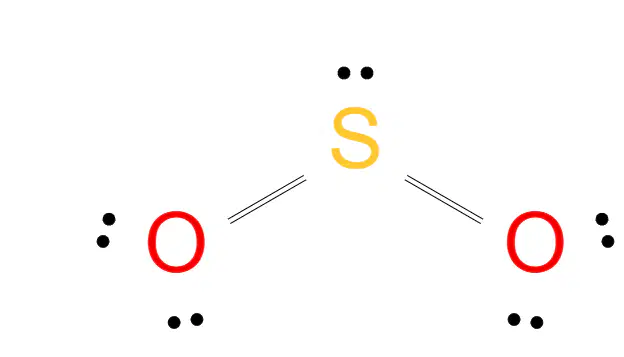
Choose the sentence that best represents the SO2 molecule.
SO2 has a bent molecular geometry with 2 bonding areas and 5 lone pairs of electrons around the central atom.
SO2 has a trigonal planar molecular geometry with 2 bonding areas and 1 lone pairs of electrons around the central atom.
SO2 has a bent molecular geometry with 2 bonding areas and 1 lone pairs of electrons around the central atom.
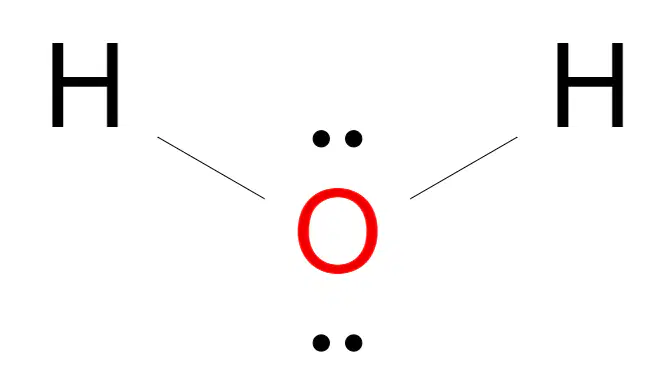
TRUE or FALSE: "The molecule of water is bent"
True
False
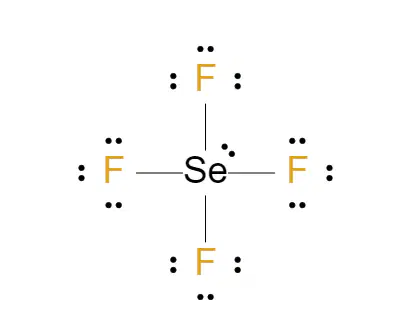
What is the molecular shape of the SeF4 molecule?
Square planar
See saw
Square pyramidal
T-shape

What is the molecular geometry of the molecule of ClF3?
T-shape
See saw
Trigonal planar
Trigonal bypiramidal

What is the name of the molecular geometry depicted in the picture?
Tetrahedral
Trigonal pyramidal
T shape
Square pyramidal
Which substance would have the weakest intermolecular forces of attraction?
CH4
NaCl
H2O
MgF2

Intermolecular forces for: NH3
Dispersion Force
Dipole dipole
Hydrogen bonding
Which substance has the weakest intermolecular forces?
Substance A, boiling point of 75 °C
Substance B, boiling point of 105 °C
Substance C, boiling point of 25 °C
Substance d, boiling point of 45 °C

