
NEW
Font size
 Worksheets
Turning Effect of Force, Hooke's Law
Total questions: 63
Worksheet time: 2hrs 4mins
What is force in physics?
A power in star wars
A push or pull on an object
A stop on an object
The start of an object
What is the measure of force?
Newtons
Light years
Inches
Gallons
What is the unit for FORCE?
N (Newtons)
lbs (pounds)
g (grams)
m/s (meters per second)
Moment can be calculated using the equation:
M = F × d
M = F / d
M = F2 × d
M = F / d2
The moment of a force causes an object to
move forward.
move backward.
stop moving.
turn about a fixed point

Mr Wang uses a metal rod to raise a large stone, as shown below.
Which force would raise the large stone most easily?
A
B
C
D
Turning effect of force is ________.
torque
moment of force
balancing moment
couple
The SI unit of moment of force is –
m
N
kgf
Nm
Moment can be calculated using the equation:
M = F × d
M = F / d
M = F2 × d
M = F / d2

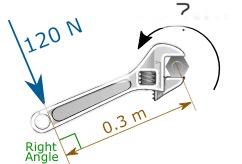
What is the size of the moment shown by the black arrow?
30 Nm
36 Nm
40 Nm
60 Nm
Moment (Nm) =
Force (N) x distance (m)
Angular Force (N°) x distance (m)
Work done (J)
Force (N) x distance (s)
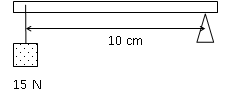

A see-saw is made by resting a long plank of wood with its centre of gravity on the barrel.
A boy sits on one side of the barrel and a girl sits on the other side so that the see-saw is balanced.
Which of the following statements must be true?
boy’s weight = girl’s weight
distance x = distance y
moments of the girl = moments of the boy
moment of the girl > moment of the boy
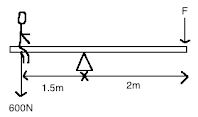
A boy of weight 600N sits on the see-saw as shown at a distance of 1.5m from the pivot. What is the force F required at the other end to balance the see-saw?
450 N
350 N
4.5 N
200 N

What is the force F needed to balance the bar shown?
4
6
8
12
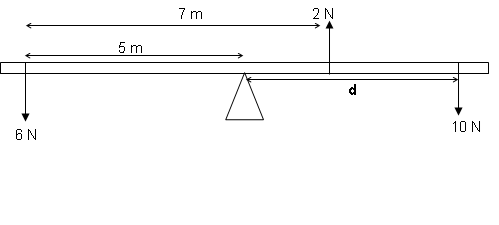
Assuming the system is in equilibrium, calculate the missing distance d
3.4 m
2.8 m
4.4 m
1.6 m
A boy of weight 600N sits on the see-saw as shown at a distance of 1.5m from the pivot. What is the force F required at the other end to balance the see-saw?
450 N
350 N
4.5 N
200 N
A moment is...
a force measured in Newtons
a turning force measured in newton metres
a distance measured in metres
a time intervals measured in clicks
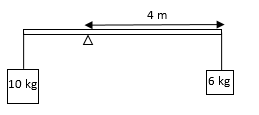
Two masses of mass 10.0 and 6.0 kg are hung from massless strings at the end of a light rod. The rod is virtually weightless. A pivot (fulcrum) is placed off center and the system is free to rotate. If the 6.0 kg mass is 4.0 m away from the pivot, how far away is the 10.0 kg mass if the system is not rotating?
0.42 m
2.4 m
4.8 m
4.2 m
What is force in physics?
A power in star wars
A push or pull on an object
A stop on an object
The start of an object
What is the measure of force?
Newtons
Light years
Inches
Gallons
What is the unit for FORCE?
N (Newtons)
lbs (pounds)
g (grams)
m/s (meters per second)
Moment can be calculated using the equation:
M = F × d
M = F / d
M = F2 × d
M = F / d2
The moment of a force causes an object to
move forward.
move backward.
stop moving.
turn about a fixed point
Mr Wang uses a metal rod to raise a large stone, as shown below.
Which force would raise the large stone most easily?
A
B
C
D
Turning effect of force is ________.
torque
moment of force
balancing moment
couple
The SI unit of moment of force is –
m
N
kgf
Nm
Moment can be calculated using the equation:
M = F × d
M = F / d
M = F2 × d
M = F / d2
What is the size of the moment shown by the black arrow?
30 Nm
36 Nm
40 Nm
60 Nm
Moment (Nm) =
Force (N) x distance (m)
Angular Force (N°) x distance (m)
Work done (J)
Force (N) x distance (s)
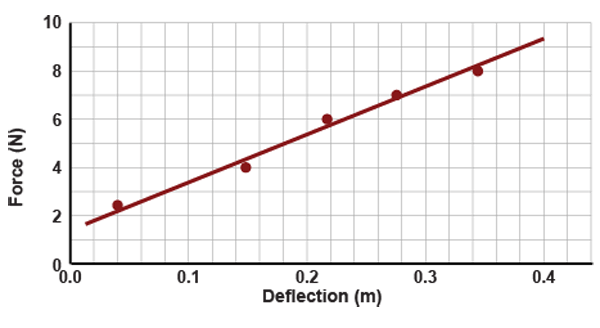
A 25,000 N Car is supported by 4 springs. If each spring is deflected by 0.040 m what is the spring constant? (Think about how much weight each spring holds up!)
160,000 N /m
620,000 N/m
630,000 N/m
120,000 N/m

What type of force is shown inside of the picture?
Tension
Friction
Elastic
Gravitational
What happens when the stretching force on an elastic material is released?
The material breaks.
The material remains stretched out.
It does nothing
The material snaps back to its original shape.
Spring constant is measured in
N
N/m
m
The formula to calculate extension is =
Extended length – original length
Original length - extended length
Extended length + original length
None of the above
_________ is the unit of Spring Constant
N
N/m
m
Load is also known as the
Extension (in m)
Extended length (in m)
Force applied (in N)
Spring constant
A force of 400 N is applied to stretch a spring which has a spring constant, k=100 N/m. How much does the spring stretch past its free length?
0.4 m
2.34 m
4 m
5.17 m
Who discovered Hooke's law?
Robert Hooke
Charlie
Newton
If the original length of a spring is 20m and its extended length is 30m. What is the extension?
20m
12m
75m
45m
10m

The Diagram shows a load-extension graph for a wire. Which point is the limit of proportionality?
A
B
C
D

