
 Worksheets
AP 5-4.2, 5-5: Synapse Transmission & Neurotransmitters
Total questions: 36
Worksheet time: 28mins
A(n) (a) is a chemical messenger in the nervous system.

The part of the neuron that receives messages from other neurons is called a(n): (a)
axon
cell body
Schwann cell
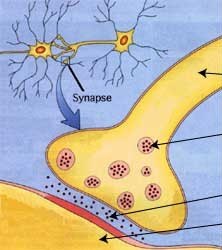
Neurotransmitters are located in the (a) .
dendrites
Schwann cells
cell body
Reorder the following steps to represent the first part of synapse communication:
An action potential arrives at presynaptic membrane.
Voltage-gated calcium channels enter cell, fusing to vesicles.
Vesicle with neurotransmitters fuses with presynaptic membrane.
Neurotransmitters released into synaptic cleft.
Neurotransmitters bind to receptors on dendrite.
Synapse communication is ___; it involves the transmission of the action potential and the stimulation of the postsynaptic neuron by neurotransmitters.
electrochemical
mechanochemical
propriochemical
chemiosmotic
selectively diffusive
What generates a nerve impulse on the postsynaptic neuron?
calcium leaking into the postsynaptic membrane
reuptake of neurotransmitter from synapse
potassium leaking into the postsynaptic membrane
calcium binding with a receptor site
neurotransmitter binding with receptor site
Reorder the structures to demonstrate the correct pathway of nerve impulse (from start of neuron to end):
Dendrite
Soma
Axon Hillock
Axon
Synaptic End Bulbs
The essential ion in the process of synapse communication is:
sodium
calcium
potassium
iodine
oxygen
Communication of information between neurons is accomplished by movement of chemicals across a small gap called the
AXON TERMINAL
NEURONAL CLEFT
SYNAPSE
VESICLE JUNCTION
ACTION POTENTIAL
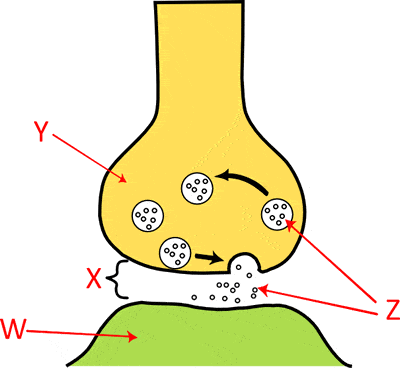
What is W?
Axon Terminal
Neurotransmitters
Dendrite
Synapse

What is Y?
Axon terminal
Neurotransmitters
Dendrite
Synapse

Calcium ions (Ca2+)are responsible for.....
signaling the release of the neurotransmitter
signaling Na+ to be released into the membrane
signaling the release of K+ out of the membrane
serving as the neurotransmitter

The actual gap in the synapse is called the...
synaptic bridge
synaptic vesicle
synaptic membrane
synaptic cleft

Neurotransmitters are released from the....
Dendrites
Post-synaptic neuron
Presynaptic neuron
Axon

Which is the correct sequence in the transmission of a neural impulse?
axon, dendrite, cell body, synapse, axon terminal
dendrite, axon, axon terminal, cell body, synapse
synapse, axon terminal, axon, dendrite, cell body
dendrite, cell body, axon, axon terminal, synapse

What type of gated channel is #2?
Na+
K+
Ca2+
Mg2+
What is contained in #4?
Acetylcholine
Acetylcholinase
Na+
K+
Ca2+
By what process do vesicles containing neurotransmitter leave the axon terminal?
Exocytosis
Endocytosis
Diffusion
Through gated channels
What is the purpose of Ca2+ entering the cell?
They halt the action potential
They signal for the synaptic vesicles to move towards the membrane
The start a new action potential
The signal the release of acetylcholinase

What is happening at the point labelled X?
Neurotransmitter binding
Ca2+ diffusing
Neurotransmitter moving across synapse
Na2+ binding
_______ is primarily an inhibitory transmitter
GABA
Serotonin
Norepinephrine
Dopamine
Neurotransmitters are released from...
dendrites
synaptic vesicles
cell bodies
nucleus
Which of these is an excitatory neurotransmitter?
Acetylcholine
Dopamine
GABA
Endorphins
Which of these is an inhibitory neurotransmitter?
Glutamate
Epinephrine
Serotonin
Endorphins
Which of these is a FALSE statement about neurotransmitters?
They act as chemical messengers
They can be inhibitory
They can be excitatory
Glucose is an example
Which neurotransmitter causes muscle contractions?
Acetylcholine
Dopamine
Serotonin
Endorphins

Which of the following events corresponds to number 1 on the diagram?
Neurotransmitter binds to receptors on the post-synaptic neuron's membrane
Nerve impulse arrives in the pre-synaptic nerve ending
calcium channels in the plasma membrane open (calcium ions enter the pre-synaptic neuron)
Sodium ion channels open in the pots-synaptic neuron

Which of the following events corresponds to number 2 on the diagram?
Sodium ions flood into post-synaptic neuron, depolarize the resting potential and nerve impulse is created.
Vesicles of neurotransmitter fuse with the membrane of the pre-synaptic axon ending
Calcium channels in the plasma membrane open (calcium ions enter the pre-synaptic neuron)
Sodium ion channels open in the pots-synaptic neuron

Which of the following event corresponds to number 3 on the diagram?
Sodium ion channels open in the pots-synaptic neuron
Neurotransmitter binds to receptors on the post-synaptic neuron's membrane
Sodium ions flood into post-synaptic neuron, depolarize the resting potential and nerve impulse is created.
Vesicles of neurotransmitter fuse with the membrane of the pre-synaptic axon ending

Which of the following event corresponds to number 4 on the diagram?
Vesicles of neurotransmitter fuse with the membrane of the pre-synaptic axon ending
Neurotransmitter binds to receptors on the post-synaptic neuron's membrane
Sodium ion channels open in the pots-synaptic neuron
Nerve impulse arrives in the pre-synaptic nerve ending

Which of the following event corresponds to number 5 on the diagram?
Fused vesicles release the neurotransmitter chemical into the synaptic cleft
Calcium channels in the plasma membrane open (calcium ions enter the pre-synaptic neuron)
Sodium ions flood into post-synaptic neuron
The neurotransmitter diffuses across the synaptic cleft

Which of the following event corresponds to number 6 on the diagram?
Depolarization of the resting potential in the post-synaptic neuron and nerve impulse is created.
The neurotransmitter diffuses across the synaptic cleft
Sodium ion channels open in the pots-synaptic neuron
Nerve impulse arrives in the pre-synaptic nerve ending
The channels that are opened by an action potential reaching an axon terminal, sending the final trigger to release neurotransmitters:
ligand-gated sodium channels
ligand-gated potassium channels
voltage-gated calcium channels
voltage-gated potassium channels
Neurotransmitters that lead to depolarization of the postsynaptic neuron:
excitatory neurotransmitters
hyperpolarizing neurotransmitters
neutral ions
inhibitory neurotransmitters

