
Font size
 Worksheets
u8 lesson 1 an3 - U9 L1
Total questions: 84
Worksheet time: 55mins
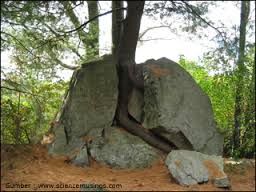
How do plants most commonly break large rocks into smaller pieces?
Seeds from plants fall onto rocks and release acidic compounds.
Plant roots grow into cracks in rocks.
Stems of plants surround and squeeze rocks.
Plant protects surrounding rocks from extreme temperatures.
Hillsides are sometimes terraced to grow plants. What is the purpose of using terraces?
to keep roots from spreading
to increase wind erosion
to retain soil and water
to provide protection from animals
Which of the following statements does NOT illustrate the effects of human activity in creating erosion problems?
Building roads can increase erosion due to the change in drainage patterns.
Terracing along a mountainside can lead to erosion
Building on steep slopes can lead to landslides.
soil can be washed away from new construction sites due to clearing trees and brush
Which of the following causes of the Dust Bowl were due to HUMAN IMPACT?
- Over-tilling the land
- Severe heat and drought for almost a decade
- Overgrazing of farm animals
- High winds in the area
All answer options
1 and 3
1, 2, and 3
1 and 2
Which soil conservation practice aims to keep nutrients in the soil?
no-tilling farming
crop rotation
contour plowing on hillsides
terracing hillside farms
The rate of soil erosion will be higher in a field of crops planted in rows than in a field covered with grass because
grass grows lower to the ground than most crops
more soil is exposed to wind and water
most crops grow lower to the ground than grass
less soil is exposed to wind and water
Which of the following soil types would contain the most nutrients?
soil that has many large rock particles
soil that allows water to drain very quickly through it
soil with a lot of decomposed organic material
soil with a bedrock that is very close to the surface

The layer in the soil profile that has the most humus is
2
4
1
3
Which statement best describes soil formation?
it occurs primarily through leaching
the "parent rock" helps determine what type of soil forms
It is a completely inorganic process (not from living matter)
it occurs more quickly in dry climates

A scientist is studying geologic formations in deserts. During the study, the scientist draws a diagram of a canyon that has a unique shape.
Which of these BEST explains why the canyon has a unique shape?
The layers of the canyon are composed of different rocks and erode at different rates
The canyon is located in an area next to a river; the bottom layers experience more erosion than the upper layers
All layers of the canyon erode at the same time
The canyon is located in an area that receives heavy rainfall; erosion occurs more quickly due to the constant exposure of water
Which geologic processes have changed the landscape of Georgia the most during the last 10,000 years?
continental drift and plate movement
glacial erosion and deposition
water erosion and deposition
volcanoes and faulting
Which best describes the surface of the earth over billions of years?
High mountains gradually wear down until most of the earth is at sea level
High mountains stay side by side for billions of years with little change
Flat surface is gradually pushed up into higher and higher mountains until the earth is covered with mountains
High mountains gradually wear down as new mountains are continuously being formed, over and over again

The picture shows a kind of glacier that can be many meters thick. In this landscape, which of the following is most likely directly affected by this kind of glacier?
The average height of plants on the mountainside
the average mass of trees near the lake
the shape of clouds that form above the glacier
the shape of the valley between the mountains
Which of the following is the most important factor in erosion (transportation) of soil?
none of the choices
wind
glaciers
water
Which of these processes describes how sand is deposited on beaches?
waves carry sand to the beach and the sun dries the water, leaving sand behind.
Wind and waves grind up rocks under the beach into grains of sand.
Wind carries sand onto beaches from the land and then levels it out.
waves carry sand up the sloping beach, depositing sand as the waves lose speed.

In Spring 2003, a natural rock outcropping in New Hampshire called the Old Man of the Mountain collapsed. Which of the following most likely loosed the rock and caused it to fall?
oxygen reacting with iron on the surface of the rock
heat turning sedimentary rock into metamorphic rock
volcanic activity producing pressure at the rock's base
water freezing and thawing inside cracks in the rock
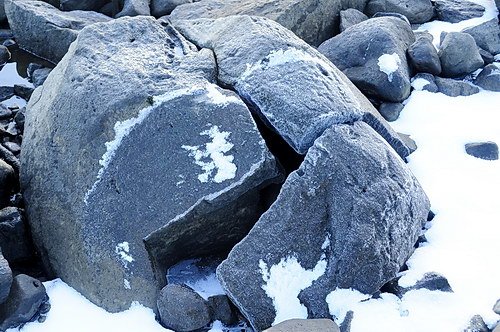
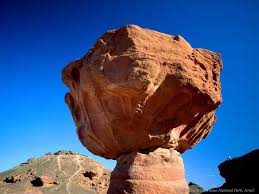



the process of wearing down by friction - like sand blasting
exfoliation
abrasion
erosion
deposition


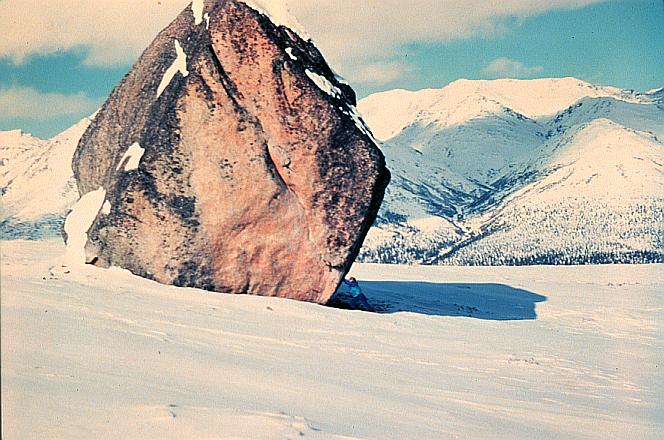

The photograph shows scratched and grooved
bedrock with boulders on its surface. The scratches and grooves were most likely created when
alternating thawing and freezing of water cracked the bedrock
flooding from a nearby lake covered the bedrock
a glacier dragged rocks over the bedrock
rocks from a landslide slid along the bedrock

The photograph shows a valley. Which agent of erosion most likely produced this valley's shape?
blowing wind
ocean waves
moving ice
running water


Which statement best explains why this process results in weathering?
Earth's crust is made up of plates that rest on the mantle. Which of the following is the best estimate of how many plates make up Earth's crust?
10
100
1,000
10,000
Certain land features form where plates meet. Which land feature forms where two continental plates move toward each other?
glaciers
mountains
oceans
trenches
Once in a while a small area of Earth can shake enough to crumble buildings to the ground.
In which layer of the Earth is an earthquake felt?
the inner core
the outer core
the mantle
the crust
Scientists use a seismograph to measure the strength of an earthquake. Which specific aspect of an earthquake does a seismograph measure?
the depth of the fault
the total energy released
the size of the energy waves
the location of the epicenter
Certain land features form at plate boundaries. Which land feature is likely to form most quickly?
a volcano
a rift valley
a chain of islands
a mountain range
Different types of plate motion produce boundaries that shape different landforms and cause different natural events. Which event will MOST LIKELY occur where two plates move in different directions and slide against each other?
an earthquake
a fault
a flood
a volcano

Largest portion of the Earth's interior. And is the thickest layer of the Earth
Mantel
outer core
inner core
crust
Made of molten metal
Mantel
outer core
inner core
crust
Made of solid iron and nickel
Mantel
outer core
inner core
crust
Thin, rigid rock layer. Is hard and made of many minerals.
Mantel
outer core
inner core
crust

What are plate tectonics?
In the past, there was the idea of a supercontinent.
Is the theory that Earth's outer shell is divided into several plates that glide over the mantle, the rocky inner layer above the core.
They move
Is the theory that Earth's outer shell is divided into several plates that glide over the mantle, the rocky inner layer above the core.
Pangea
Plate tectonics
Volcanoes
Earthquakes

In the past, there was the idea of a supercontinent. It existed 250 millions of years ago.
Pangea
Plate tectonics
Volcanoes
Earthquakes

The movements of the plate tectonics during millions of years produced:
Pangea
Plate tectonics
Volcanoes
The continents
The Earth crust is made up of:
Nickel
Water
Large tectonic Plates
Volcanoes
An opening in Earth's crust where magma can reach the surface.
Mountains
Earthquakes
Mantle
Volcanoes
Pieces of Earth's crust move in a process called:
(a)
The point inside Earth where an earthquake begins is called:
(a)
The point on Earth's surface directly above the focus is called:
(a)
A break in the crust where rock can slide past other rock
mantle
fault
crust
focus
Shaking ground at moving fault
epicenter
fault
core
earthquake
You can measure earthquakes by using:
(a)
What's the name of scale that measure earthquakes?
Earthquake Scale
The Richter Scale
The Richard Scale
1 to 10
The Richter Scale was developed on
1935
1945
1550
2000
Uses a mathematical formula to calculate the total energy that an earthquake releases.
Moment Magnitud Scale (MMS)
Richard Scale
Earth scale

Identify the volcano:
Shield
Cinder cone
Composite

Identify the volcano:
Shield
Cinder cone
Composite

Identify the volcano:
Shield
Cinder cone
Composite
The shape of a volcano depends on how that volcano erupts?
True
False
An earthquake magnitude is the amount of energy that it release.
True
False
You can feel earthquakes that measure 2.0 on Richter Scale.
False
True
Earthquakes that measure 6.0 or more on the Richter scale are not destructive.
False
True
Why the Himalaya is growing:
The Himalaya is growing today.
The Indoa-Astralian Plate pushes against the Eurasian Plate, forcing the crust at the edge of the plates to fold a bend.
The Eurasian Plate is forcing the Indo-Australian Plate.


A mineral can scratch another mineral that has a _________ hardness.
Higher
Same
A mineral can not scratch another mineral
Lower
Which of the following is not an identifying property of minerals?
Color
Luster
Cleavage
Weight
Streak
A mineral is a living solid that has a crystal form.
True
False
Which of the following describes how minerals reflect light?
Color
Streak
Luster
Minerals cannot reflect light.
Which of the following can scratch minerals with a 6 or less on the hardness scale?
Fingernail
Nothing can scratch them
Iron nail
Anything can scratch them
Steel nail
All minerals have which of the following?
A streak color
A hardness number
A crystal structure
Cleavage
Color
What is the color a mineral leaves behind when it is scratched on a white tile?
Luster
Streak
Color
Hardness
Which of the following is the hardness mineral
Talc
Apatite
Quartz
Diamond
Which minerals can you scratch with your fingernail?
Only minerals with a 1.
You cannot scratch a mineral with your fingernail
Only minerals with a 2 or less?
All minerals.
What can scratch a diamond?
Nothing can scratch a diamond.
Only another diamond.
Quartz
Corundum.

