
 Worksheets
Unidad 5 Revision
Total questions: 157
Worksheet time: 36hrs 23mins
Which of these substances is a liquid form of precipitation?
rain
sleet
hail
snow
Which of the following is the best definition of precipitation?
liquid water found on Earth’s surface
any form of water present in Earth’s atmosphere
water that falls to Earth’s surface from clouds
water vapor that has formed liquid droplets in a cloud
On an island near the equator, the sun's energy causes ocean water to evaporate during the day. In the afternoon, heavy rains fall. This process is repeated during the summer months. What does this example BEST show?
how most water on Earth is in the form of water vapor
how the sun is the main source of energy for the water cycle
how land is the main source of water during the water cycle
how the ocean is large enough that it never runs out of water
Clouds form when water vapor condenses onto
oxygen atoms
dust particles
nitrogen atoms
none of the above
Condensation occurs because
temperature decreases with height in the atmosphere
temperature increases with height in the atmosphere
The continent of Antarctica is covered with an ice sheet. Which part of the Earth system includes the ice sheet?
biosphere
cryosphere
geosphere
atmosphere
Sometimes fires burn down large areas of forests that are part of the biosphere. Other than the biosphere, which of Earth’s other systems is a forest fire most likely to affect?
geosphere
cryosphere
atmosphere
hydrosphere
When trees die, they often fall on the ground and decompose. Which part of the Earth system includes dead and decomposed trees?
biosphere
geosphere
hydrosphere
cryosphere
Where is the atmosphere located?
above the crust
below the crust
above the core
below the oceans
Which of these answers describes Earth’s atmosphere?
all living and once-living things
the mixture of gases that surrounds Earth
a mixture of nickel and iron below the mantle
all the salt and fresh liquid water on Earth’s surface
Which of these parts of the Earth system are interacting when Florida’s orange trees grow?
biosphere, hydrosphere, and atmosphere
geosphere, cryosphere, and atmosphere
biosphere, hydrosphere, and cryosphere
cryosphere, atmosphere, and hydrosphere
Which of these pairs are part of the cryosphere?
rain and snow
glaciers and lakes
permafrost and icebergs
Arctic ice sheet and rainfall


what is a cryosphere
parts of earth with animals
hot parts of earth
a portion of earth with solid water
Each of Earth's spheres is distinguished by the materials from which it is made. Plants and animals make up part of which sphere?
biosphere
cryosphere
atmosphere
hydrospheres

Look at the illustration. The volcanic eruption is sending out clouds of dust and ash. An interaction between which two spheres is being demonstrated?
biosphere and geosphere
cryosphere and biosphere
geosphere and atmosphere
atmosphere and hydrosphere
Solar energy does not warm Earth’s surface evenly. For example, during the day, land areas warm up faster than nearby bodies of water. How does this uneven warming affect the movement of air over land and water?
The cooler, denser air above the water flows toward the warmer, less dense air above the land, causing a sea breeze.
The warmer, less dense air above the land flows toward the cooler, denser air above the water, causing a land breeze.
The cooler air over the water would absorb water vapor and rise, resulting in rainy conditions over the shoreline.
The warmer air over the land would transfer energy to the cooler air by conduction, leading to a uniform air temperature.

According to this picture, what kind of air is the Jet Stream bringing to most of the continental USA?
Warmer Air
Colder Air
How does wind move?
From areas of low pressure to areas of high pressure.
From areas of high pressure to areas of low pressure.
From areas of high temperature to areas of low tempreture
From areas of low temperature to areas of high temperature
Why is the ocean the NOT the only source of water in the water cycle?
because water vapor can be evaporated by trees, rivers, lakes, streams and puddles
because water vapor is only evaporated by precipitation
because water vapor is only evaporated by vegitation
None of the above, the ocean IS the only source for evaporation of water.
If Florida is having a week of high humidity, what is causing that?
smaller amount of water vapor in the air
larger amount of water vapor in the air
no water vapor in the air
high pressure system moving out
when water vapor in the clouds turns back into liquid water that is called...
conduction
condensation
convection
precipitation
Rain, snow, and hail are also referred to as...
water vapor
storms
condensation
precipitiation
What is water gas in our atmosphere called?
precipitation
water vapor
water
rain
What is it called when water molecules are heated by the sun?
condensation
evaporation
precipitation
transpiration
The sun cause evaporation by heating water molecules. Plants take in water through their roots and transpiration occurs through their leaves. These are both processes that happen in during...
the carbon cycle
the water cyle
the oxygen cycle
the carbon dioxide cycle
Which of the following is water being evaporated through leaves of plants?
condensation
evaporation
transpiration
precipitation

Which stage in the water cycle is represented by the arrow showing water vapor rising from the sea?
collection
condensation
evaporation
precipitation
Which sequence below shows how water leaves the ocean and returns to land as it moves through the water cycle?
condensation, precipitation, evaporation
evaporation, condensation, precipitation
evaporation, precipitation, condensation
precipitation, condensation, and precipitation
One morning, Ryan noticed there were tiny drops of water on the grass as he walked to school. That afternoon, he did not see any drops of water on the grass when he returned home. Which of the following best explains what happened to the drops of water?
The heat from the air caused the water drops to boil.
The air cooled the water and caused the drops to freeze.
The Sun heated the water and caused the drops to evaporate.
The energy from the Sun caused the water drops to condense.
Water runs down creeks and rivers until it flows into the ocean. At what stage in the water cycle does the water return to creeks and rivers?
Condensation
Evaporation
Precipitation
Vapor formation
Why are oceans such an important part of the water cycle?
Oceans contain most of the water on Earth.
Oceans help to replenish the water in rivers and streams via evaporation and precipitation.
The water from oceans evaporates back into the air.
All of the above.
Rain, sleet, snow, and hail are all examples of what?
precipitation
evaporation
condensation
groundwater

The Coriolis effect causes ___________.
the Earth to rotate on its axis
earthquakes
global winds to move in a curved path instead of a straight line
the Earth to revolve around the sun

What type of storm is pictured here?
Tornado
Thunderstorm
Winter storm
Hurricane
True or false: Storms are caused by slow, steady changes in air pressure.
True
False
Thunderstorms can bring:
Heavy precipitation
Thunder and lightning
Strong winds
All of the above

This is a picture of a
Thunderstorm
Hurricane
Tornado
High pressure system
Tornadoes are different from hurricanes because...
They are short lived
They are smaller
They are short lived and smaller
They have strong winds.
Tornadoes form when...
Warm, humid air mixes with cold, dry air
Warm, dry air mixes with cold, wet air
Two cumulonimbus clouds collide
Cold air rises and warm air sinks
The area of lowest pressure in a hurricane is...
Farthest from the middle or "eye"
Half way between the eye and the outer edge
At the middle or "eye"
Nowhere; Hurricanes are high pressure systems
Hurricanes form over
Warm land near the equator
Cold land near the poles
Cold water near the poles
Warm water near the equator
Winds in a hurricane move from the outside of the storm towards the eye because...
The eye has the lowest pressure and air moves from high to low pressure.
The eye has the highest pressure and air moves from low to high pressure
In order for a thunderstorm to occur, what must happen?
Cold, less dense air must rise, warm and condense.
Warm, less dense air must rise, cool and condense.
A sudden spark or electrical discharge within a cloud is
Lightning
Impossible
Thunder
Aurora Borealis
You see lightning first, before you hear thunder...
Because lightning travels slower than the sound of thunder
Because lightning travels faster than the sound of thunder
Because of the Doppler effect
Because magic.
Long periods of rain can cause a...
Thunderstorm
Hurricane
Drought
Flood
What kind of storm can happen anytime of the year, and usually brings lightning and thunder?
tornado
hurricane
thunderstorm
blizzard
In which type of storm does a storm surge occur?
hurricanes
flash floods
water spouts
thunderstorms
What scale is used for tornadoes?
Category Scale
EF Scale
Saffir-Simpson Scale
Metric Scale

What type of storm is indicated by picture?
thunderstorm
blizzard
hurricane
tornado

What type of storm is indicated by the picture?
thunderstorm
blizzard
hurricane
tornado

What type of storm is pictured?
thunderstorm
blizzard
hurricane
tornado
This type of storm has swirling winds around a calm center called an eye.
thunderstorm
blizzard
hurricane
tornado


The warm _____ brought rain to McDonough as it moved in over the cold air that was already here.
climate
back
front
fog


What is a large body of air that has the same characteristics such as temperature & humidity?
hurricane
tornado
weather front
air mass

Which information could be used to determine the climate of a region?
the humidity on a cloudy day
the total amount of rainfall over several years
the average wind speed during a specific week
the sea’s surface temperature during a hurricane
Humidity is the...
Amount of water vapor in the air
Measure of air speed
Measure of precipitation
Measure of air pressure
In what direction do winds always blow?
From areas of high pressure to areas of low pressure
From areas of low pressure to areas of high pressure

When two air masses meet, there is a _____, or boundary.
thunderstorm
watch
front
cloud

Name this front
warm front
cold front
stationary front
occluded front

Name this front
warm front
cold front
stationary front
occluded front

What part of the illustration shows Evaporation?
1
2
3
4

Which number illustrates Condensation?
1
2
3
4
The polar jet stream changes location depending on the season. It affects the weather conditions of the central part of the United States during the winter. During the summer the area becomes warmer. Which statement is true about how the polar jet stream causes this temperature increase?
The polar jet stream has moved south, allowing cold air to move into the central United States.
The polar jet stream has moved north, causing warm air to move south into the central United States.
The polar jet stream has moved north, causing cold air to move north into the northern United States.
The polar jet stream has moved south, causing warm air to move north into the northern United States.
Which of the following correctly describes the surface air movements within a low-pressure system in the Northern Hemisphere?
clockwise towards the center of the low-pressure system
clockwise away from the center of the low-pressure system
counterclockwise toward the center of the low-pressure system
counterclockwise away from the center of a low-pressure system
What type of weather does a high pressure system bring?
Cloudy with a chance of precipitation
Clear skies and sunny
Thunderstorms followed by cooler temperatures
Steady precipitation followed by warmer temperatures
What type of weather does a low pressure system bring?
Cloudy with a chance of precipitation
Clear skies and sunny
Thunderstorms followed by cooler temperatures
Steady precipitation followed by warmer temperatures
What type of weather does a warm front bring?
Cloudy with a chance of precipitation
Clear skies and sunny
Thunderstorms followed by cooler temperatures
Steady precipitation followed by warmer temperatures
Humidity is:
a boundary separating two masses of air of different densities.
a body of air with horizontally uniform temperature, humidity, and pressure.
a quantity representing the amount of water vapor in the atmosphere.
none of the above.

Which position on the map indicates an air mass that is warmer and drier?
A
B
C
D

Which of these in NOT one of the reasons the atmosphere is important?
it is where weather occurs
it is where you can find the aurora borealis, beautiful lights in the night sky
it contains gases needed for photosynthesis
without it, sound could not travel to our ears

What happens to most solar radiation when it reaches the surface of the earth?
It reflects back
It's collected in solar panels
It's absorbed by land, water, and plants
It disperses throughout the earth's atmosphere

(_______________)- Land (Earth's core, mantle, mountains, sand, metals)
Geosphere
Hydrosphere
Atmosphere
Biosphere

(_______________)- Water (oceans, lakes, rivers, groundwater, glaciers)
Geosphere
Hydrosphere
Atmosphere
Biosphere

(_______________)- Air (oxygen, nitrogen, water vapor, zone, wind)
Geosphere
Hydrosphere
Atmosphere
Biosphere

(_______________)- Life (plants, animals, insects, humans)
Geosphere
Hydrosphere
Atmosphere
Biosphere

(_______________) Water in a lake becomes groundwater (_______________).
Geosphere
Hydrosphere
Atmosphere
Biosphere

(_______________) Ocean water evaporates into the air (_______________).
Geosphere
Hydrosphere
Atmosphere
Biosphere

(_______________) Groundwater is absorbed plants into their roots (_______________).
Geosphere
Hydrosphere
Atmosphere
Biosphere

(_______________) Humans breathe in oxygen (_______________).
Geosphere
Hydrosphere
Atmosphere
Biosphere

(_______________) Oil wells burn fossil fuels (_______________).
Geosphere
Hydrosphere
Atmosphere
Biosphere

(_______________) River deposits sediment (_______________).
Geosphere
Hydrosphere
Atmosphere
Biosphere

Comes from the Greek word for "water"
bio-
hydro-
atmo-
geo-

Comes from the Greek word for "life"
bio-
hydro-
atmo-
geo-

What is the atmosphere?
all the air and gases on the planet
made up of living things
the non-living soil, rocks, and minerals of the Earth
the rivers, lakes, and oceans of the Earth

What is the hydrosphere?
all the air and gases on the planet
made up of living things
the non-living soil, rocks, and minerals of the Earth
the rivers, lakes, and oceans of the Earth

What is the biosphere?
all the air and gases on the planet
made up of living things
the non-living soil, rocks, and minerals of the Earth
the rivers, lakes, and oceans of the Earth

What is the geosphere?
all the air and gases on the planet
all the frozen water on the Earth
the non-living soil, rocks, and minerals of the Earth
the rivers, lakes, and oceans of the Earth
Why do Australia and China have opposite seasons?
They are both in the northern hemisphere
They are both in the southern hemisphere
They are in opposite hemispheres
They are both in the western hemisphere
What is climate?
What's happening in space at a time and place.
What's happening in our atmosphere at a time and place
The average weather over many years
The average temperature over many years.
The seasons are caused by___________?
The direction the Earth's axis is tilted toward the sun
Tropical Storms
Changes in the moon
The Earth's revolution on its axis around the Sun
Three Characteristics that make up climate
weather, humidity
seasons, precipitation, temperature
wind, latitude, pollution
nearness to a desert

What Hemisphere is Sydney Australia?
Northern Hemisphere
Southern Hemisphere
What type of Climate would you find at the high latitudes?
warm summers and cool winters
cold all year long
hot all year long
hot summer and cold winters
As the elevation increases the temperature
decreases
increases
stays the same
none of the above
Opposite Hemispheres (Northern and Southern) have opposite seasons.
True
False
Countries in the Southern Hemisphere have summer:
At the same time of year as countries in the Northern Hemisphere
At the opposite time of year as countries in the Northern Hemisphere
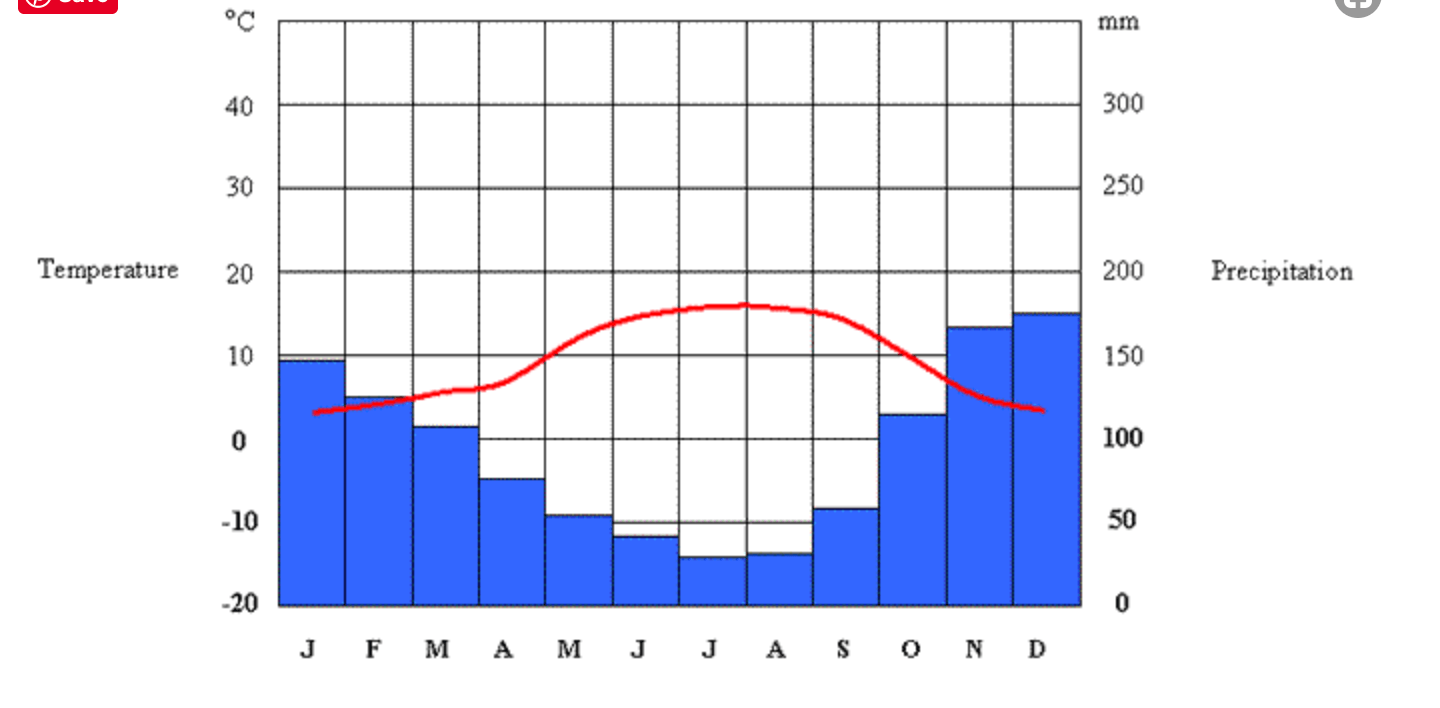
This graph shows the hottest temperatures (red line) in:
June, July and August
January, February, March
October, November, December
This graph is from a place:
in the Northern Hemisphere
in the Southern Hemisphere
At the equator

What climate region do you think graph 3 has?
Humid Subtropical
Mediterranean
Tropical Savanna
Humid Tropical
What form or precipitation does graph 3 have?
Rain
Snow
Both
Which hemisphere is graph 3 in?
Northern Hemisphere
Southern Hemisphere
Determine if this statement is true or false: Florida can flood from storm surges that push ocean water inland during hurricanes
True
False
Which of these is/are true about flood waters.
They can damage properties
The can cause injury
The can contaminate drinking water supplies
All of the above

The picture below shows the remnants of a home on the Florida coast. The destruction of this home was most likely an impact from which type of natural disaster?
earthquake
hurricane
sinkhole
wildfire
In Florida, the land and air warm up during a long summer day. Then cool sea breezes blow in from both coasts of the peninsula at once. The two sea breezes together push the warm, humid air over the land upward quickly. To what type of natural hazard does this weather pattern lead?
a hurricane
a sinkhole
a thunderstorm
a wildfire

