
Font size
 Worksheets
Trophic levels and transfer of energy
Total questions: 80
Worksheet time: 2hrs 0mins

According to the image, what is the producer?
plant
insect
mouse
snake


If the amount of food or resources available increases, the carrying capacity for an animal.....
Stays the same
Increases
Decreases
Fluctuates

This is the largest number of individuals of a population that the environment can support...
carrying capacity
population crash
lag phase
mutualism


If the hawk population decreases, what will happen to the snakes and rabbits?
Snakes and rabbits will increase
Snakes and rabbits will decrease
Snakes will decrease, rabbits will increase
Snakes will increase, rabbits will decrease
Producers
Plants
1 consumer
Rabbit
2nd Consumer
Snake
Tertiary consumer
Hawk


Which scenario would affect the MOST organisms?
All producers die.
All primary consumers die.
All secondary consumers die.
All apex predators die.


In the food web shown, the snail would be considered...
En la red alimentaria que se muestra, el caracol se consideraría...
Which best describes the trophic level of an organism?
number of calories it consumes
amount of energy it produces
its life cycle from birth to death
its position in a food chain


The ecological role an organism performs in their specific environment is considered the organism's...
Habitat
Population
Biome
Niche


This diagram shows how energy flows through an eco-system. What is the first source of energy in this pyramid?
sharks and large birds
algae, plankton and seagrass
herbivorous fish, crustaceans and sea urchins
seals and carnivorous fish
As you work your way up the energy pyramid, what happens to the energy?
It increases
It decreases
It stays the same
Nothing
If there is 1000 Kcal available at the producers level, how much energy is available in the primary consumers level?
100 Kcal
10 Kcal
1 Kcal
1000 Kcal

If the producer has 20,000 kJ of energy, how much energy should the secondary consumer have?
2,000 kJ
500 kJ
200 kJ
1,000 kJ
Which of the following animals is a primary consumer?
Cow
Wolf
Eagle
Whale
In a marine food chain, small fish eat plankton, big fish eat small fish, and sharks eat big fish. Which organism has the smallest population?
The plankton
The small fish
The big fish
The sharks
How might a lack of sunlight disrupt the food web
It would cause consumers to consume less
It would prevent decomposers from decomposing matter
It would prevent producers from producing nutrients.
It would not disrupt the food web at all.

Fungi, bacteria and worms can all break down organic material, what is the correct name for these type of organisms.
Producers
Consumers
Predators
Decomposers
Apex (top) predator.
Primary Consumer
Secondary Consumer
Tertiary Consumer
Producer
Has to go find food also called Heterotroph.
Consumer
Producer
Apex Predator
Scavenger
What is an Abiotic Factor?
A NON-living factor that can affect an ecosystem
A living factor that can affect an ecosystem
The carrying capacity of an ecosystem
What is a Biotic Factor?
The carrying capacity of an ecosystem
A NON-living factor that can affect an ecosystem
A living factor that can affect an ecosystem
Check all of the boxes that show examples of biotic factors.
Rain
Humans hunting
Predators
Wildfire
Check all of the boxes that are examples of abiotic factors.
Prey
Rainfall
A pack of wolves
A tornado
What is a limiting factor?
Factors that always increase a population
Factors that always decrease a population
Resources that are unlimited
Factors/resources that limit how many organisms can live in an area at the same time
If there was a wildfire in the forest that destroyed the plant life, what would happen to the herbivore population?
Herbivores would decrease due to a lack of food
Herbivores would increase due to an increase of food
Herbivores would not be affected
Herbivores would decrease due to an increase in predators
If humans were to release a pack of wolves into the forest, what type of factor would this be?
Abiotic
Biotic
What does the carrying capacity of a population show?
How many organisms live in the ecosystem
The maximum number of organisms that an ecosystem can support for a long period of time
The minimum number of organisms that can live in an area
The types of organisms living somewhere
What is a population?
All the organisms living in an area
The living and non-living organisms in an area
A group of the same species living in an area
Can a population go over its carrying capacity?
Yes
No
Maybe
What happens if a population goes over its carrying capacity?
It will continue to grow
It will eventually decrease due to a lack of resources
It will die immediately
It will get unlimited resources
Choose the 4 limiting factors.
Food
Water
Time
Space
Shelter

What is the overall trend of this population graph?
Increasing
Decreasing
Constant
No trend
What do limiting factors do?
Separate biotic factors from abiotic factors.
Determine which is the predator and which is the prey.
Regulate how many organisms live in an ecosystem.
Determine which natural disasters will hit an area.
Which of the following are abiotic limiting factors?
The decomposers in an ecosystem.
The populations of producers in a given habitat.
Carrying capacities of several species.
Water, space, and oxygen.
The size of the population of a species in an ecosystem is determined by the (a) factors available to them.

What happens to the rabbit population on year 4?
It begins to decrease
It stays the same
It increases
It reaches carrying capacity

What is the carrying capacity of the beetle population?
3
5
7
9

During which day did this population reach carrying capacity?
Day 2
Day 11
Day 23
Day 35
An educated guess is a __________.
hypothesis
procedure

Which statement best describes the predator-prey relationship displayed on this graph?
There is no relationship between the predator and prey.
When the prey population increases, the predator population decreases.
When the prey population increases, the predator population increases.
when the predator population increases, the prey population increases.

Something that regulates the size of a population is called...
a limiting measure
a limiting factor
carrying capacity
biodiversity

What is the carrying capacity of the graph?
1000
8000
800
600
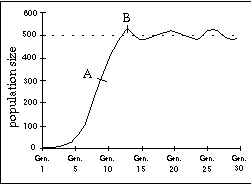
What is the carrying capacity of the graph?
around 500
more than 800
less than 300
around 700
This is the largest number of individuals of a population that the environment can support...
carrying capacity
population crash
lag phase
mutualism
The ecological role an organism performs in their specific environment is considered the organism's...
Habitat
Population
Biome
Niche
"Organisms that have moved to a location that does not naturally support them."
Invasive species
Destructive species
Unwelcomed species
Infected species
Click on the TERTIARY CONSUMERS in this food web.
HINT: Don't pick the hawk! It is only a secondary or quaternary (4th) consumer.
Label the Energy Pyramid to the right with the different trophic levels.
Secondary Consumers
Producers
Primary Consumers
Top Carnivore


Why are producers found at the base of the pyramid?
They create all of the energy and therefore have the most energy of all of the trophic levels
There are more plants than animals.
They begin the flow of energy in an ecosystem.
All of these answers are correct.
What makes an energy pyramid different than a food web or chain?
It shows energy flowing from the top of the chain and downward.
The tropic levels are the opposite
It shows the amount of energy in each trophic level
It shows specific predator/prey relationships
Which kind of organism is an autotroph?
consumer
producer
decomposer
herbivore
Which organisms are heterotrophs?
photosynthesizers
producers
consumers
plants
Which organism is an example of a producer?
moth
mushroom
rose bush
cheetah
Why are mushrooms important to the food chain?
They recycle nutrients into the ecosystem.
They produce food energy for other living things.
They recycle oxygen into the atmosphere.
They consume excess herbivores in the ecosystem.
Maggots feed on dead and decaying organisms for energy. What are maggots?
autotrophs
producers
decomposers
heterotrophs
Yellowfin tuna, or Thunnus albacores, are large sport fish that are found in tropical and subtropical waters around the world. They typically school under objects such as boats or patches of driftwood for protection from predators. Schooling under these structures also provides yellowfin tuna with easy access to a food source such as smaller herbivorous fish that may be foraging for food around the structures. Which trophic level does yellowfin tuna fill in a food chain?
producer
primary consumer
secondary consumer
tertiary consumer
From the producer level to which level does energy flow directly?
decomposer
tertiary consumer
secondary consumer
primary consumer
An organism that consumes both animals and plants
Carnivore
Herbivore
Omnivore
Frugivore
Anything that has volume and mass
Biomass
Energy
Matter
Trophic Pyramid
An organism that must consume other organisms for nutrients
Producer
Consumer
Autotroph
Cannibal

