
 Worksheets
INTRODUCTION TO NAMING COMPOUNDS
Total questions: 34
Worksheet time: 9hrs 30mins
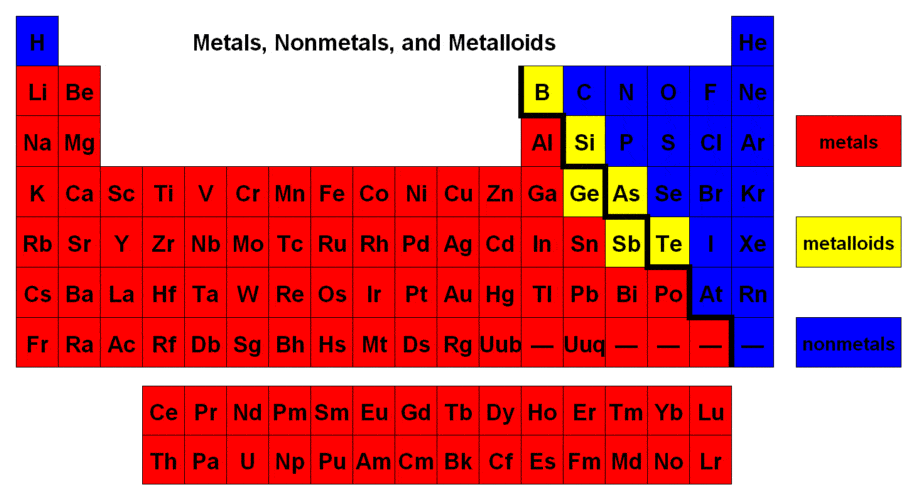

Atoms from family IIA on the Periodic Table are likely to form ions of what charge?
+1
+2
0
−1
−2
Atoms from family VIA on the Periodic Table are likely to form ions of what charge?
+1
+2
0
−1
−2
What number of valence electrons makes a non-metal ion stable?
0
2
4
6
8
A diatomic molecule consists of 2 atoms of the same element bonded together by a covalent bond
TRUE
FALSE
Indicate below which elements exist as diatomic molecules
phosphorus
potassium
fluorine
fluorine, phosphorus, and potassium
Indicate below which elements exist as diatomic molecules
chlorine
bromine
iodine
helium
Indicate the correct formulas for the following diatomic molecule:
iodine
I
I1
I2
I7
What charge does an atom have when it GAINS electrons?
Positive
Negative
Neutral

What is the picture displayed?
atom
element
compound
How would O2 be qualified. Check all answers that apply.
Atom
Molecule
Compound
CO32-
carbonate
carbonite
hypocarbonite
percarbonate
CrO42-
chromate
chromite
hypochromite
perchromate
Cr2O72-
dichromate
dichromite
hypodichromite
perdichromate
LiBr is called
lithium bromine
lithium(I) bromine
lithium bromide
lithuim(I) bromide
Name the following ionic compound: BeCl2
beryllium chlorine
beryllium(II) chloride
beryllium chloride
beryllium dichloride
Name the following ionic compound: Cs2S
cesium sulfide
cesium sulfate
cesium(II) sulfate
cesium(II) sulfide
What is the name of the compound Na2(SO4)?
Sodium sulfate
Sodium sulfide
Sodium sulfite
Sodium sulfuroxide
What is the name of the compound Sc(OH)3?
Scandium(III) hydroxide
Scandium(I) hydroxide
Scandium(II) hydroxide
Scandium hydroxide
What is the name of the following compound: K2SO4
potassium sulfur
potassium sulfate
potassium(I) sulfate
potassium(II) sulfide
MgI2
Magnesium Iodine
Monomagnesium di-iodide
Magnesium iodide
Magnesium tetraiodide
AlCl3
Aluminum dichlorine
Aluminum trichlorine
Monoaluminum chloride
Aluminum chloride
KF
Which of these is NOT a polyatomic ion?
OH-
CO32-
PO43-
Cl-
ClO4-
Which of these is a monoatomic anion?
O22-
P
S2-
Na+

