
NEW
Font size
 Worksheets
BIO 112 Chapter 6
Total questions: 72
Worksheet time: 1hrs 12mins
A phospholipid is a ________.
nonpolar lipid molecule that is made polar by the addition of a phosphate
nonpolar lipid molecule that is made amphipathic by the addition of a phosphate
polar lipid molecule that fully interacts with water
polar lipid molecule that fully repels water
Which of the following accurately describes a reason why fats store more energy than carbohydrates?
Fats molecules are always larger than carbohydrate molecules.
Compared to carbohydrates, fatty acid chains have a higher ratio of bonds with high potential energy to bonds with low potential energy.
Fatty acid chains have more carbon-carbon bonds than carbohydrates.
Carbohydrates can be incorporated into polymers through dehydration reactions, while fats cannot form polymers.
Fats contain more polar groups than carbohydrates.
Lipids that contain a high number of double bonds in their fatty acid chains will ________.
contain more hydrogens than lipids that contain few double bonds in their fatty acid chains
have a higher melting temperature than lipids that contain few double bonds in their fatty acid chains
pack very tightly together at room temperature
likely be liquid at room temperature
have more carbons that rotate freely than lipids that contain few double bonds in their fatty acid chains
Which of the following statements is true?
Saturated lipids have a higher melting temperature than polyunsaturated lipids.
Unsaturated lipids have fewer carbon-carbon double bonds than saturated lipids.
Current research suggests that polyunsaturated lipids may induce heart disease.
Unsaturated lipids pack more tightly together than saturated lipids.
Saturated lipids are typically liquid at room temperature.
What region of the steroid cholesterol is hydrophilic?
The methyl (–CH3) groups
The terminal hydroxyl group
The ring structures
The long hydrocarbon chain
Cooking oil and gasoline (a hydrocarbon) are NOT amphipathic molecules because they
do not have a polar or charged region
do not have a nonpolar region
have hydrophobic and hydrophilic regions
are highly reduced molecules
Phospholipids and triglycerides both ________.
contain serine or some other organic compound
have three fatty acids
have a glycerol backbone
have a phosphate
Lipids ________.
are insoluble in water
are made from glycerol, fatty acids, and nitrogen
contain less energy than proteins and carbohydrates
are made by dehydration reactions
contain sulfur polymers
Which of the following is a large organic molecule that is NOT assembled by polymerization of a few kinds of simple subunits?
A steroid
Cellulose
DNA
An enzyme
A contractile protein
Steroids are considered to be lipids because they ________.
are essential components of cell membranes
are not soluble in water
are made of fatty acids
are hydrophilic compounds
contribute to atherosclerosis
A major feature of phospholipids that causes a portion of their structure to be hydrophilic is ________.
the glycerol backbone
the unsaturated fatty acid tails
the phosphate group
the ester linkages
the saturated fatty acid tails
The presence of cholesterol in the plasma membranes of some animal cells ________.
enables the membranes to stay fluid when cell temperature drops
enables the cell to remove hydrogen atoms from saturated phospholipids
enables the cell to add hydrogen atoms to unsaturated phospholipids
makes the cell membrane less flexible, allowing it to sustain greater intracellular pressure
reduces mutations to genetic material inside the cell
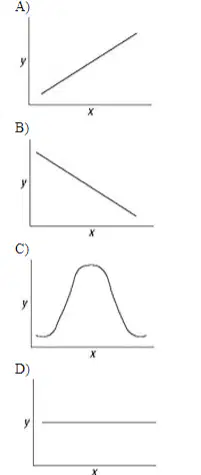
You make a phospholipid bilayer with short, saturated hydrocarbon tails. You measure the permeability of this membrane to oxygen. You then double the length of the hydrocarbon tails and remeasure membrane permeability. Next, you again double the length of the hydrocarbon tails and make a third measurement of membrane permeability. You graph membrane permeability as a function of hydrocarbon tail length. Which of the accompanying graphs best represents the data you expect?
Graph A
Graph B
Graph C
Graph D
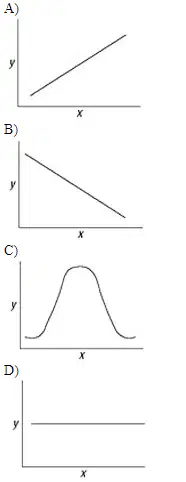
You make a phospholipid bilayer with short, saturated hydrocarbon tails. You measure the permeability of this membrane to oxygen. You are going to change the length of the hydrocarbon tails and remeasure membrane permeability, but first your boss asks you to graph the data you expect if there is no effect of hydrocarbon tail length on membrane permeability (your null hypothesis). Which of the accompanying graphs best represents the data you expect if your null hypothesis is correct?
Graph A
Graph B
Graph C
Graph D
Lipids that form membranes have what kind of structure?
Polar heads and polar tails, which allows them to interact with water on both sides of the membrane.
Completely polar, which allows them to dissolve in water.
Polar heads and nonpolar tails; the nonpolar tails interact with water.
Polar heads and nonpolar tails; the polar heads interact with water.
If you mechanically shook a mixture of phospholipids and water, what would you expect to see when you observe the solution using an electron microscope?
The lipids and water will have separated into two distinct layers because the lipids are partially nonpolar.
Some lipids will have formed tiny vesicles filled with water.
All the lipids will have formed planar bilayer membranes.
Most lipids will have completely dissolved in solution because they are partially polar.
In an experiment involving planar bilayers, a solution of table salt (sodium and chloride ions in water) is added on the left side of the membrane while pure water is added on the right side. After 30 minutes, the researchers test for the presence of ions on each side of the membrane. The right side tests negative for ions. What do you conclude?
The experiment failed.
The water somehow blocked the movement of ions across the membrane.
The left side would probably also test negative for ions.
Ions cannot cross planar bilayers.
Which of the following is the best explanation for why cholesterol decreases the permeability of biological membranes?
Cholesterol binds to the outside surface of a membrane, thus blocking the movement of solutes.
Because cholesterol is amphipathic, it forms tiny vesicles that trap solutes.
Because cholesterol is amphipathic, it fits in between the phospholipids and blocks diffusion through the membrane.
Cholesterol has four rings in its structure that can sequester ("trap") solutes.
Which aspect of phospholipids is most important to the formation of bilayers?
They are amphipathic.
Their polar heads can interact with water.
The length of their hydrocarbon tails can be altered to modulate membrane fluidity.
Their hydrocarbon tails can consist of fatty acids or isoprene subunits.
Which of the following increases the strength of the hydrophobic interactions in lipid bilayers and thus makes them less permeable to polar molecules?
The presence of double bonds
Increasing temperature
Removing cholesterol
Increasing length of the hydrocarbon chains
Which of the following crosses lipid bilayers the fastest?
A sodium ion
A small, polar molecule like water
A large, polar molecule like glucose
A small, nonpolar molecule like oxygen (O2)
Which of the following crosses lipid bilayers the slowest?
A sodium ion
A small, polar molecule like water
A large, polar molecule like glucose
A small, nonpolar molecule like oxygen (O2)
You have just discovered an organism that lives in extremely cold environments. Which of the following would you predict to be TRUE about the phospholipids in its membranes, compared to phospholipids in the membranes of organisms that live in warmer environments?
The membrane phospholipids of cold-adapted organisms will have longer hydrocarbon tails.
The membrane phospholipids of cold-adapted organisms will have more saturated hydrocarbon tails.
The membrane phospholipids of cold-adapted organisms will have more unsaturated hydrocarbon tails.
You have a planar bilayer with equal amounts of saturated and unsaturated phospholipids. After testing the permeability of this membrane to glucose, you increase the proportion of unsaturated phospholipids in the bilayer. What will happen to the membrane's permeability to glucose?
Permeability to glucose will increase.
Permeability to glucose will decrease.
Permeability to glucose will stay the same.
You cannot predict the outcome; you must measure the permeability.
The membranes of winter wheat remain fluid when it is extremely cold by ________.
A) increasing the percentage of unsaturated phospholipids in the membrane
B) increasing the percentage of saturated phospholipids in the membrane
C) decreasing the number of hydrophobic proteins in the membrane
D) cotransport of glucose and hydrogen
Which of the following would likely move through the lipid bilayer of a plasma membrane most rapidly?
CO2
An amino acid
Glucose
K+
Starch
Which of the following factors tend to increase membrane fluidity? - A greater proportion of unsaturated phospholipids - A greater proportion of saturated phospholipids - Lower temperature - A relatively high protein content in the membrane - A greater proportion of relatively large glycolipids compared with lipids having smaller molecular masses
A greater proportion of unsaturated phospholipids
A greater proportion of saturated phospholipids
Lower temperature
A relatively high protein content in the membrane
A greater proportion of relatively large glycolipids compared with lipids having smaller molecular masses
Which of the following is TRUE regarding how cholesterol affects the fluidity and permeability of biological membranes? - At low temperatures, cholesterol causes phospholipids to pack more tightly together, and therefore, decreases membrane fluidity and permeability. - At high temperatures, cholesterol increases the spacing between phospholipids and therefore, increases membrane fluidity and permeability. - At low temperatures, cholesterol increases membrane fluidity and permeability by reducing the extent to which phospholipids pack tightly together. - At high temperatures, cholesterol decreases membrane fluidity by reducing the extent to which phospholipids pack tightly together.
At low temperatures, cholesterol causes phospholipids to pack more tightly together, and therefore, decreases membrane fluidity and permeability.
At high temperatures, cholesterol increases the spacing between phospholipids and therefore, increases membrane fluidity and permeability.
At low temperatures, cholesterol increases membrane fluidity and permeability by reducing the extent to which phospholipids pack tightly together.
At high temperatures, cholesterol decreases membrane fluidity by reducing the extent to which phospholipids pack tightly together.
Ribonucleotides can diffuse through some types of liposomes. It is likely that the lipids present early in chemical evolution had short chains. Would liposomes formed from these types of lipids be more or less permeable to ribonucleotides than if early cells formed from long-chained lipids? - More permeable - Less permeable - Same permeability
More permeable
Less permeable
Same permeability
What is the most important factor in explaining why osmosis occurs spontaneously?
It leads to an increase in entropy.
It leads to a decrease in entropy.
The process is exothermic.
The process is endothermic.
Which of the following is TRUE of osmosis?
Osmosis only takes place in red blood cells.
Osmosis is an energy-demanding or "active" process.
In osmosis, water moves across a membrane from areas of lower solute concentration to areas of higher solute concentration.
In osmosis, solutes move across a membrane from areas of lower water concentration to areas of higher water concentration.
Celery stalks that are immersed in freshwater for several hours become stiff. Similar stalks left in a 0.15 M salt solution become limp. From this, we can deduce that the freshwater
and the salt solution are both hypertonic to the cells of the celery stalks
and the salt solution are both hypotonic to the cells of the celery stalks
is hypotonic and the salt solution is hypertonic to the cells of the celery stalks
is hypertonic and the salt solution is hypotonic to the cells of the celery stalks
is isotonic and the salt solution is hypertonic to the cells of the celery stalks
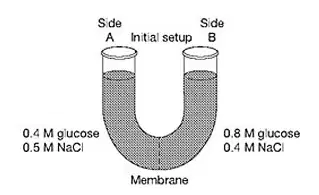
Refer to the figure. At the beginning of the experiment, which statement is correct?
side A is hypertonic to side B.
side A is hypotonic to side B.
side A is isotonic to side B.
side A is hypertonic to side B with respect to glucose.
side A is hypotonic to side B with respect to NaCl.
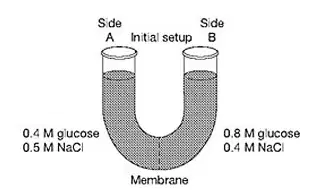
Refer to the figure. If you examine side A after three days, you should find ________.
a decrease in the concentration of NaCl and glucose and an increase in the water level
a decrease in the concentration of NaCl, an increase in the water level, and no change in the concentration of glucose
no net change in the system
a decrease in the concentration of NaCl and a decrease in the water level
no change in the concentration of NaCl and glucose and an increase in the water level
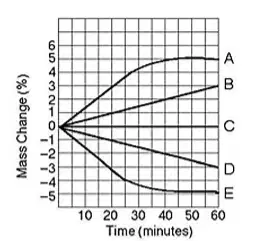
Which line in the graph represents the bag that contained a solution isotonic to the 0.6 M solution at the beginning of the experiment?
A) A
B) B
C) C
D) D
E) E
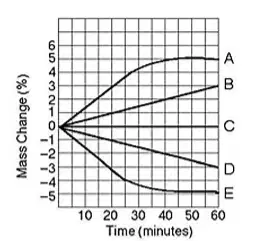
Which line in the graph represents the bag with the highest initial concentration of sucrose?
A) A
B) B
C) C
D) D
E) E
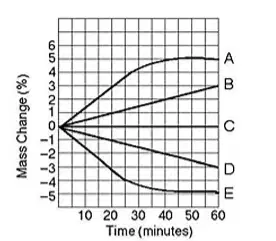
Which line or lines in the graph represent(s) bags that contain a solution that is hypertonic at 50 minutes?
A and B
B
C
D
D and E
A patient was involved in a serious accident and lost a large quantity of blood. An inexperienced observer suggests replenishing body fluids by adding distilled water to the blood directly via one of their veins. What would be the most probable result of this transfusion?
It will have no unfavorable effect as long as the water is free of viruses and bacteria.
The patient's red blood cells will shrivel up because the blood has become hypotonic compared to the cells.
The patient's red blood cells will swell and possibly burst because the blood has become hypotonic compared to the cells.
The patient's red blood cells will shrivel up because the blood has become hypertonic compared to the cells.
The patient's red blood cells will burst because the blood has become hypertonic compared to the cells.
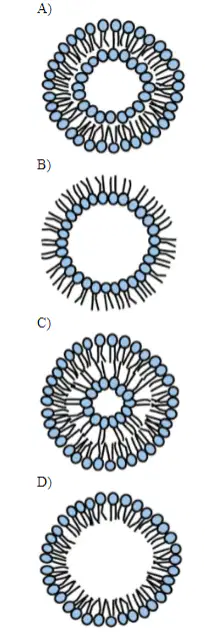
Your study partner has drawn four models of membrane-bound vesicles to try to show what a vesicle would look like with water both inside and outside of the membrane. Help him to select the most accurate model.
Model A
Model B
Model C
Model D
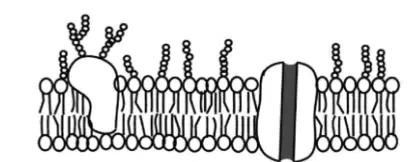
A student has drawn this model to study for her exam. Interpret the model. The model shows a cross-sectional, or side, view of a membrane.
True
False
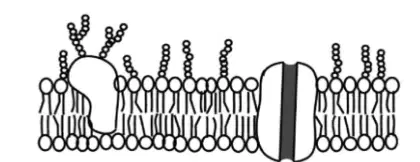
A student has drawn this model to study for her exam. Interpret the model. The shape with the dark area represents a barrier to transport.
True
False
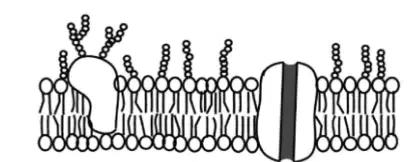
A student has drawn this model to study for her exam. Interpret the model. The phospholipids are drawn with their heads and tails in the correct orientation in the bilayer.
True
False
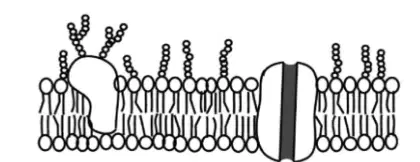
A student has drawn this model to study for her exam. Interpret the model. Three different types of macromolecules are represented in this model.
True
False
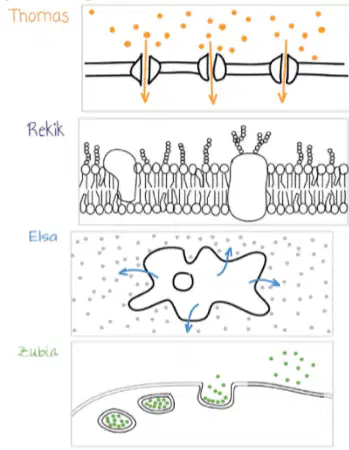
Four students have done a nice job drawing membrane models. Which model does the best job of showing osmosis?
Thomas
Rekik
Elsa
Zubia
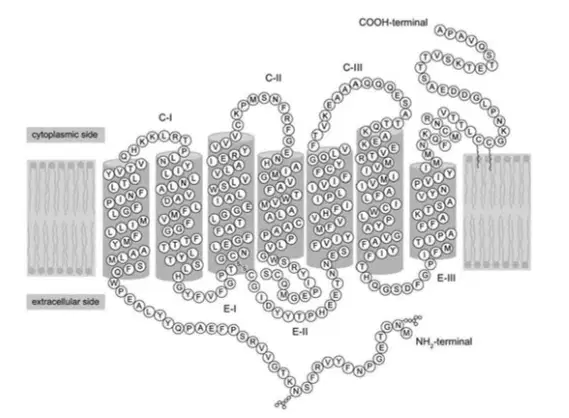
Which term best describes the type of membrane protein in the figure?
Peripheral
External
Internal
Integral
Under what circumstances does membrane transport require energy?
Whenever large molecules are moved within a cell
Whenever a solute is moved against its electrochemical gradient
Whenever an ion moves through a phospholipid bilayer membrane
Whenever oxygen moves through a phospholipid bilayer membrane
Where would you most likely find an integral membrane protein?
On the inside surface of the cell membrane
On the outside surface of the cell membrane
Floating freely in the cytoplasm
Spanning the cell membrane, with parts of the protein visible from both the inside and the outside of the cell
Gramicidin is an antibiotic that increases the permeability of bacterial cell walls to inorganic ions. What is the most likely mode of action of gramicidin?
It acts by active transport.
It causes membranes to fuse with one another.
It forms a channel in the membrane.
It removes electrical charges from solutes.
49) Use the following information when answering the corresponding question.
Rhodopsins are light-sensitive molecules composed of a protein (opsin) and retinal (derivative of
vitamin A). Opsin is a membrane protein with several α-helical segments that loop back and
forth through the plasma membrane. There are two classes of rhodopsins. According to Oded
Beje, one class has relatively slow dynamics (a photocycle of approximately 0.5 second) and is
well suited for light detection. The second class has faster dynamics (a photocycle of
approximately 0.02 seconds) and is well suited for chemiosmosis: pumping of protons or
chloride ions across cell membranes. Oded Beje was the first, in September 2000, to report on a
rhodopsin (proteorhodopsin) found in the domain Bacteria. [Source: O. Beje et al., Science 289
(2000): 1902.]
Refer to the paragraph on rhodopsins. Which of the following best describes rhodopsin?
A) Integral
B) Peripheral
C) External
D) Internal
50) A number of systems for pumping ions across membranes are powered by ATP. Such ATP-
powered pumps are often called ATPases, although they do not often hydrolyze ATP unless they
are simultaneously transporting ions. Because small increases in calcium ions in the cytosol can
trigger a number of different intracellular reactions, cells keep the cytosolic calcium
concentration quite low under normal conditions, using ATP-powered calcium pumps. For
example, muscle cells transport calcium from the cytosol into the membranous system called the
sarcoplasmic reticulum (SR). If a resting muscle cell's cytosol has a free calcium ion
concentration of 10−7 while the concentration in the SR is 10−2, then how is the ATPase acting?
A) ATPase activity must be powering an inflow of calcium from the outside of the cell into the
SR
B) ATPase activity must be transferring Pi to the SR to enable this to occur
C) ATPase activity must be pumping calcium from the cytosol to the SR against the
concentration gradient
D) ATPase activity must be opening a channel for the calcium ions to diffuse back into the SR
along the concentration gradient.
51) Which of the following types of molecules are the major structural components of the cell
membrane?
A) Phospholipids and cellulose
B) Nucleic acids and proteins
C) Phospholipids and proteins
D) Proteins and cellulose
52) When biological membranes are frozen and then fractured, they tend to break along the
middle of the bilayer. The best explanation for this is that ________.
A) the integral membrane proteins are not strong enough to hold the bilayer together
B) water that is present in the middle of the bilayer freezes and is easily fractured
C) hydrophilic interactions between the opposite membrane surfaces are destroyed on freezing
D) the carbon–carbon bonds of the phospholipid tails are easily broken
E) the hydrophobic interactions that hold the membrane together are weakest at this point
53) For a protein to be an integral membrane protein, it would have to be ________.
A) hydrophilic
B) hydrophobic
C) amphipathic, with at least one hydrophobic region
D) completely covered with phospholipids
54) When a membrane is freeze-fractured, the bilayer splits down the middle between the two
layers of phospholipids. In an electron micrograph of a freeze-fractured membrane, the bumps
seen on the fractured surface of the membrane are
A) peripheral proteins
A) peripheral proteins
C) carbohydrates
D) integral and peripheral proteins
55) A membrane protein that spans the phospholipid bilayer one or more times is ________.
A) a transmembrane protein
B) an associated protein
C) a peripheral protein
56) Why are lipids and proteins free to move laterally in membranes?
A) The interior of the membrane is filled with liquid water.
B) Lipids and proteins repulse each other in the membrane.
C) Hydrophilic portions of the lipids are in the interior of the membrane.
D) There are only weak hydrophobic interactions in the interior of the membrane.
57) Which of the following is a characteristic feature of a carrier protein in a plasma membrane?
A) It is a peripheral membrane protein.
B) It exhibits a specificity for a particular type of molecule.
C) It requires the expenditure of cellular energy to function.
D) It works against diffusion.
58) Which of the following allows water to move much faster across cell membranes?
A) The hydrophobic interior of a cell membrane
B) The sodium–potassium pump
C) ATP
D) Peripheral proteins
E) Aquaporins
59) Ions diffuse across membranes through specific ion channels down ________.
A) their chemical gradients
B) their concentration gradients
C) their electrical gradients
D) their electrochemical gradients
60) In order for molecule X to cross the plasma membrane of a cell, it must first bind to an
integral membrane protein. The binding of molecule X to the integral membrane protein
immediately causes a conformational change to the integral membrane protein, which exposes
molecule X to the other side of the membrane where it is then released. What is this an example
of?
A) Active transport
B) Passive transport
C) Neutral transport
61) Carrier proteins release their cargo molecules ________.
A) on the side of the membrane that has a lower concentration of the cargo molecule
B) on the side of the membrane that has a higher concentration of the cargo molecule
C) immediately after a phosphate has been added to the carrier protein
D) immediately after a phosphate has been removed from the carrier protein
62) Preventing the release of the phosphate from the Na+/K+-ATPase will have which of the
following effects?
A) It will prevent sodium from binding the pump.
B) It will prevent sodium from being released from the pump.
C) It will prevent potassium from binding the pump.
D) It will prevent potassium from being released from the pump.
63) The phosphate transport system in bacteria imports phosphate into the cell even when the
concentration of phosphate outside the cell is much lower than the cytoplasmic phosphate
concentration. Phosphate import depends on a pH gradient across the membrane–more acidic
outside the cell than inside the cell. Phosphate transport is an example of ________
A) passive diffusion
B) facilitated diffusion
C) active transport
D) osmosis
E) cotransport
64) Glucose diffuses slowly through artificial phospholipid bilayers. The cells lining the small
intestine, however, rapidly move large quantities of glucose from the glucose-rich food into their
glucose-poor cytoplasm. Using this information, which transport mechanism is most probably
functioning in the intestinal cells?
A) Simple diffusion
B) Phagocytosis
C) Active transport pumps
D) Exocytosis
E) Facilitated diffusion

65) For the following question, match the labeled component of the cell membrane in the figure
with its description
Which component is a peripheral protein?
A
B
C
D
E
66) In what way do the membranes of a eukaryotic cell vary?
A) Phospholipids are found only in certain membranes.
B) Certain proteins are unique to each membrane.
B) Certain proteins are unique to each membrane.
D) Only certain membranes are constructed from amphipathic molecules.
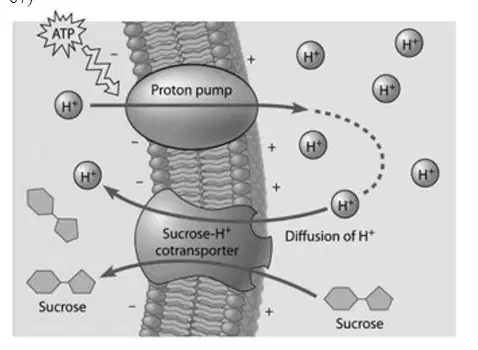
Based on the accompanying figure, which of these experimental treatments would increase the
rate of sucrose transport into the cell? In this figure, sucrose is being imported into the cell
A) Decreasing extracellular sucrose concentration
B) Decreasing extracellular pH
C) Decreasing cytoplasmic pH
D) Adding an inhibitor that blocks the regeneration of ATP
68) Which of the following membrane activities requires energy from ATP?
A) Facilitated diffusion of chloride ions across the membrane through a chloride channel
B) Movement of water into a cell
C) Movement of Na+ ions from a lower concentration in a mammalian cell to a higher
concentration in the extracellular fluid
D) Movement of glucose molecules into a bacterial cell from a medium containing a higher
concentration of glucose than that inside the cell
69) In some cells, there are many ion electrochemical gradients across the plasma membrane
even though there are usually only one or two proton pumps present in the membrane. The
gradients of the other ions are most likely accounted for by ________
A) cotransport proteins
B) ion channels
C) pores in the plasma membrane
D) passive diffusion across the plasma membrane
70) Which of the following is most likely TRUE of a protein that cotransports glucose and
sodium ions into the intestinal cells of an animal?
A) Sodium and glucose compete for the same binding site in the cotransporter.
B) Glucose entering the cell down its concentration gradient provides energy for uptake of
sodium ions against the electrochemical gradient
C) Sodium ions can move down their electrochemical gradient through the cotransporter whether
or not glucose is present outside the cell
D) The cotransporter can also transport potassium ions
E) A substance that blocks sodium ions from binding to the cotransport protein will also block
the transport of glucose.
71) Steroid hormones are large communication molecules that are modified cholesterol
molecules. How do you think they enter a cell?
A) Their size probably allows them to diffuse through the plasma membrane.
B) Their lipid nature probably allows them to diffuse through the plasma membrane.
C) Their protein structure probably allows them to diffuse through the plasma membrane.
D) They must require a protein transporter, because the plasma membrane is completely
impermeable to molecules.
72) Which of the following processes includes all others?
A) Osmosis
B) Diffusion of a solute across a membrane
C) Facilitated diffusion
D) Passive transport

