
 Worksheets
BIE EXAM 1
Total questions: 97
Worksheet time: 1hrs 4mins
name for polyploid organisms that have more than two complete sets of chromosomes
(a)
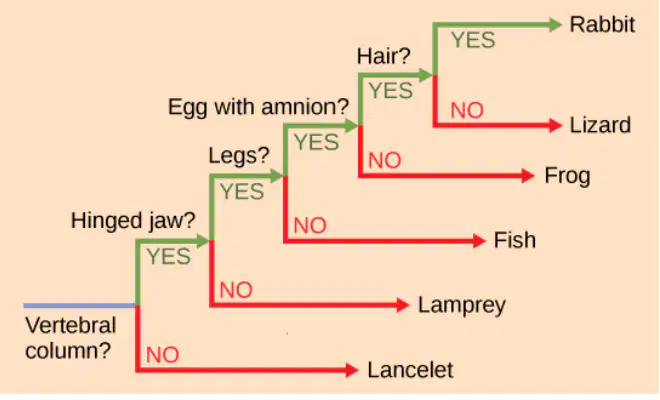
Select which of the following options evolved earliest, based on the phylogenetic tree below.
Hinged jaw
Rabbit
Legs
Hair
Eggs with amnion
Bony fish use ___ through their gills to maximize gas exchange.
countercurrent flow
current flow
gills are suported by gill arches that lie between the mouth and the opercular flaps
water flows unidirectionally into the mouth, over the gills, and out from the opercular flaps
the size of gas exchange and minimize the diffusion path length (L) between blood and water in fish.
lamellae
mouth
lololemon
arteries
DEOXIGINATED blood in fish. countercurrent flow is (a) efficient. what direction is the flow of blood and water?
more
less
blood flows in, water flow out
blood flows in, water flows in
blood flows out, water flows in
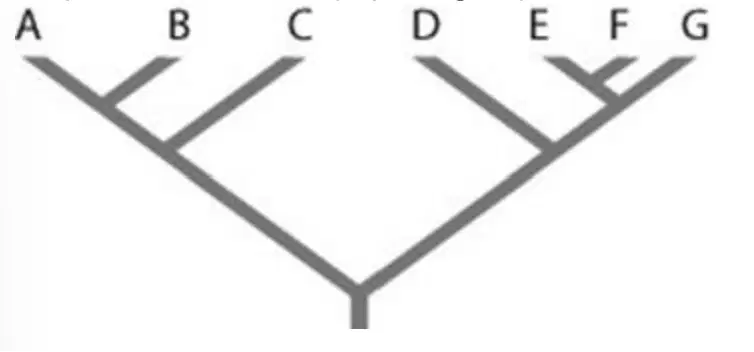
Use the information from this phylogenetic tree to determine which of the following groups of species form a monophyletic group.
E, F and G
A, B, C, D
D, E and F
C and D
Which of the following statements is accurate with regard to a phylogeny, as represented by a phylogenetic tree?
The ancestral group often has all the derived characters of the descendant species.
A monophyletic group can be properly based on convergent features.
Shared ancestral characters are excellent traits to use in developing a phylogeny.
Descendant groups (branches) from the same node likely share many derived characters.
Select all correct answers. Which kinds of evidence so scientists use to determine evolutionary relationships among organism?
Fossils
DNA
The environment where organisms live
Body structures of living organisms
What is the difference between allopatric speciation and sympatric speciation?
In allopatric speciation there is gene flow among populations that evolve into separate species, in sympatric speciation there is no gene flow among populations that evolve into separate species.
In allopatric speciation groups from the same ancestral population evolve into separate species after a period of geographic separation while sympatric speciation occurs with no geographic separation.
In allopatric speciation groups from different ancestral populations evolve into separate species, in sympatric speciation groups from the same ancestral population evolve into separate species
Which of the following describes a postzygotic mechanism of reproductive isolation?
The northern red-legged frog (Rana aurora) and the foothill yellow-legged frog (R. boylii) have overlapping geographic ranges, but mate at different times of year.
The apple maggot fly (Rhagoletis pomonella) breeds on apples and hawthornes, while the blueberry maggot fly (R. mendax) breeds only on blueberries.
Crosses between two species of dwarf hamsters, Phodopus campbelli and P. sungorus, result in embryos with severe developmental defects.
Two species of South African irises, Lapeirousia anceps and L. oreogena are pollinated by different species of long-tongued flies.
Which of the following statements best describes the difference between evolution and speciation?
Evolution refers to major changes in organisms; speciation refers to subtle changes.
They are not actually that different: evolution and speciation both deal with natural selection.
Evolution refers to changes in an individual; speciation refers to changes in a group of individuals.
Evolution refers to changes in a group of individuals; speciation refers to changes between groups of individuals.
Gene flow is likely to occur among populations of the same species.
False
True
Homeostasis means to maintain dynamic equilibrium in the body. What is the meaning of dynamic equilibrium in this context?
The body's processes do not change regardless of environmental conditions.
The body's processes are constantly changing to keep bodily functions within a set range.
Animals that are moving need special functions to maintain their balance.
The function of negative feedback is to:
Increase the levels of a stimulus to bring a process to completion.
Indicate that something in the body is not working correctly.
Change the direction of a stimulus to bring levels back to the set point.
Make sure no levels of substances in the body can change.
Ecotherms:
Rely on external temperatures to set body temperatures.
Have constant body temperatures because they live in environments with constant temperatures.
Use metabolic heat to maintain body temperatures.
What part of the brain maintains the set point for body temperature?
Pineal gland
Cerebrum
Cerebellum
Hypothalamus
Which of the following traits does NOT help an organism conserve heat?
Large ears
Countercurrent heat exchange
Vasoconstriction of the blood vessels
Thick fur
Eastern and western meadowlarks look very similar, however they have different calls that only members of their own species can recognize. This is an example of:
Gametic barrier
Hybrid inviability
Behavioral isolation
Temporal isolation
Animals that possess homologous structures probably _______________.
Are headed for extinction.
By chance had similar mutations in the past.
Evolved from the same ancestor.
Are not related.
autopolyploid cannot bread with each other but can bread with other individuals to create a new single generation.
synonymous substitution
missense mutation
silent mutation
nonsense mutation
stop mutation
nonsynonymous substitution
missense mutation
nonsense mutation
silent mutation
phenotypic change
N/S = I
neutral
positive selection
purifying selection
opaque selection
N/S < I
neutral
positive selection
purifying selection
opaque selection
N/S > I
neutral
positive selection
purifying selection
opaque selection
Define the molecular clock hypothesis
what is a pseudogene?
key concept. for surface area/volume for LARGE objects there is a greater volume (inside) and smaller surface area (outside). thus the surface area/volume ratio should be
high
low
what type of genes has a high mutation rate? high evolutionary change over time?
pseudogene
nonsynonomous
synonomous
histone gene
this gene is under strong negative selection because changes in these genes are strongly deleterious
(a)
smaller objects have more (A) and less (b)
(a) surface area
(a) volume
(b) surface area
(b) volume
All the cubes (1 cm, 2 cm, 3 cm) are placed in vinegar (an acid) for six minutes. How does the DISTANCE the acid diffuses into each cube compare?
the acid will diffuse farthest into largest cube
the acid will diffuse farthest into the smalles cube
the acid will diffuse equally into each cube
Decreased surface area (_______________) provides little surface area and less exchange with environmet
flat leaves instead of spines
spines instead of flat leaves
surface area/volume relationships will depend on exchange with the external environment will decrease in effectiveness as size increases. such processes include things like
gas exchange
regulation of body temp
water balance
absorption of nutriens and disposal of wastes
In populations undergoing genetic drift allele frequencies change from one generation to another due to ____________.
Migration of individuals from one population to another.
Chance events
Selection for the most fit organisms
Which of the following types of selection decreases genetic variability for a particular trait?
Frequency-dependent selection
Directional selection
Diversifying selection
Stabilizing selection
The effects of _______________ are more strongly seen in small populations.
Gene flow
Diversifying selection
Genetic drift
Natural selection
Ficks law. q = DA (p1-p2)/L . what does q stand for
the rate of diffusion
the diffusion coefficient (the diffusing substance, the medium, the temp)
the cross-sectional area of the surface area of the surface on which diffusion occurs
the partial pressures of the gas at two locations
the path length between the locations
Ficks law. q = DA (p1-p2)/L . what does D stand for
the rate of diffusion
the diffusion coefficient (the diffusing substance, the medium, the temp)
the cross-sectional area of the surface area of the surface on which diffusion occurs
the partial pressures of the gas at two locations
the path length between the locations
Ficks law. q = DA (p1-p2)/L . what does A stand for
the rate of diffusion
the diffusion coefficient (the diffusing substance, the medium, the temp)
the cross-sectional area of the surface area of the surface on which diffusion occurs
the partial pressures of the gas at two locations
the path length between the locations
Ficks law. q = DA (p1-p2)/L . what does L stand for
the rate of diffusion
the diffusion coefficient (the diffusing substance, the medium, the temp)
the cross-sectional area of the surface area of the surface on which diffusion occurs
the partial pressures of the gas at two locations
the path length between the locations
in a mixture of gases each component gas has what kind of pressure?
Gene duplications may give rise to
one copy becomes nonfunctional (pseudogene)
one copy accumulates substitutions that allow it to perform a new function
one copy accumulates substitutions that allow it to perform a new function
both copies retain original function
antifreeze protein in antarctic icefish derived from duplicated gene that performs a new function
pseudogene
neofunctionalization
subfunctionalization
no function divergence
gene performs a subset of the functions of the original gene. retain original function but expression diverges.
pseudogene
neofunctionalization
subfunctionalization
no function divergence
both copies retain original function
pseudogene
neofunctionalization
subfunctionalization
no function divergence
Which of the following scenarios describes populations that have the greatest amount of gene flow?
Salmon that return to the same rivers each year to breed.
Two squirrel populations that are separated by a mountain range.
Two populations of monkeyflowers use different pollinators. Hummingbirds only pollinate flowers in one population and bees pollinate flowers in the other population.
Coconut palms have fruit that can travel long distances across oceans before landing on a beach and germinating.
Gibberish random parts of DNA become functional genes
pseudogene
De Novo gene
antifreeze protein
Which of the following is NOT an adaptation?
Snake venom that paralyzes prey and makes them easier to eat.
The white fur of a snowshoe hare in winter which allows it to survive in snowy environments.
A prosthetic leg that allows humans to run faster.
The thick stem of a cactus which allows it to store water and thrive in deserts.
(a) is active movement of (b) over the gas exchange surfaces: it has the effect of increasing P1
(a) ventilation (breathing)
(a) perfusion (circulation)
(b) respiratory medium (air or water)
(b) blood
gases are carried close to target tissues by respiratory and circulatory systems, thus _______ diffusion path length L to target tissues
increasing
decreasing
neutralizing
(a) is active circulation of (b) over the gas exchange surfaces: it has the effect of decreasing P2
(a) ventilation (breathing)
(a) perfusion (circulation)
(b) respiratory medium (air or water)
(b) blood
Surface area to volume ratio for small and thin objects
high
low
Surface area to volume ratio for large and thick object
high
low
In frequency-dependent selection it can be beneficial to have:
a common or rare phenotype depending on the type of frequency-dependent selection
a common phenotype
a rare phenotype
Select the correct answer(s). The effect of a mutation on an organism's phenotype can be:
Neutral
Beneficial
Deleterious
The rate at which a specific allele appears within a population is
gene pool
allele frequency
natural selection
adaptation
In a population undergoing natural selection you will see:
Greater reproduction of individuals with favorable traits.
Individuals becoming less fit in their environment.
All members of a population increasing their reproductive rate.
An increase in population size.
a series of duplication events lef to multiple globin genes that perform subsets of the function of the original globin genes. This is an example from.
pseudogene
neofunctionalization
subfunctionalization
no function divergence
Any reason for organisms with certain phenotypes to have either a survival benefit or disadvantage
(a)
Low UV radiation
less folate destruction
less vitamin D production
more folate destruction
more vitamin D production
The population mean is shifted. Before a drought there were big and small seeds, now after the drought their were more big seeds. We saw overtime the size of finch beaks increase.
directional selection
stabilizing selection
disruptive selection
frequency-dependent selection
Maintains the status quo and acts against extremes. The baby is too small or too large the baby may not survive or the mother and baby may die, optimal birth weight is between the two extremes.
directional selection
stabilizing selection
disruptive selection
frequency-dependent selection
Selects against the mean phenotype. Apple and hawthorn trees fruit at different times, so flies whose life cycles are coordinated with the fruiting of specific tree species would have greater fitness than flies whose life cycles place them between the fruiting of either tree species.
directional selection
stabilizing selection
disruptive selection
frequency-dependent selection
More common phenotypes have a higher fitness. An individual of a rare morph is more likely to be the unlucky prey that educates the bird, and gets killed in the process.
directional selection
stabilizing selection
disruptive selection
positive frequency-dependent selection
negative frequency-dependent selection
More rare phenotypes have higher fitness. Maintains genetic diversity for phenotypes within a population. Grove snails have a wide variety of color and banding patterns on their shells.
directional selection
stabilizing selection
disruptive selection
positive frequency-dependent selection
negative frequency-dependent selection
This skin color can make enough vitamin D, but the issue is folate destruction. These individuals have (a) color skin to protect against folate destruction, though they do produce enough vitamin D.
a process in which allele frequencies within a population change by chance alone as a result of random sampling from generation to generation. DOES NOT LEAD TO ADAPTATION.
(a)
Genetic drift is especially important in
small populations
large populations
medium-sized populations
This is a type of genetic drift. The size of the population is decreased significantly for at least one generation.
(a)
A type of Genetic Drift. The loss of genetic variation when a new colony is formed by a very small number of individuals from a larger population.
(a)
Migration in population genetics, is the transfer of genetic material in the form of alleles from one population to another. This can add new alleles to a population or change the frequencies of existing alleles.
(a)
What factors affect gene flow?
Habitat fragmentation
Species mobility (birds can fly long distances)
location (populations on islands don't easily exchange genetic material)
bombastic selection
what do the red dots mean on the phylogeny tree represent
(a)
A group or organisms that consists of ONE ancestor and all of its descendants. can snip it off with one snip.
clade
taxon
traits
monophyletic group
Named group eg. reptiles and vertebrates. may or may not be a clade
clade
taxon
traits
monophyletic group
Featured shared by two or more species that were inherited from a common ancestor. May or may not appear similar. Arm bones in human, cat, whale, bat. This is what phylogenetic trees are constructed based on.
homologous traits
homoplasy
analogous trait
divergent trait
The development of organs or other bodily structures within different species, which resemble each other and have the same functions, but did not have a common ancestral origin. ex: new world cactus and African euphorb have spines for protection, both are adapted for survival in arid desert regions with low rainfall.
homologous traits
homoplasy
analogous trait
divergent trait
ONLY THIS TRAIT CAN BE USED TO CONSTRUCT PHYOGENETIC TRAITS!
homologous traits
analogous traits
homoplasy
convergent evolution
independently evolved traits subjected to similar selection pressures may become superficially similar. not due to shared ancestry, due to environment.
convergent evolution
divergent evlotion
disruptive selection
selective selection
what results from convergent evolution (starts with an h :) )
(a)
a trait that was present in the ancestor of a group
ancestral
derived
a trait found in a descendent that differs from the ancestral trait is
ancestral
derived
a group of organisms that share cetain traits. represents a closed gene pool in which allels are shared with other members of that specific (a) .
members of species look alike and share physical traits.
morphological species concept
lineage species concept
ecological species concept
biological species concept
species as branches on the tree of life. can describe species for organisms without sexual reproduction such as bacteria
morphological species concept
lineage species concept
ecological species concept
biological species concept
species in which a species is a set of organisms adapted to a particular set of resources, called a niche, in the environment.
morphological species concept
lineage species concept
ecological species concept
biological species concept
groups of actually or potentially interbreeding populations reproductively isolated from other such groups. doesn't apply to asexual organisms
morphological species concept
lineage species concept
ecological species concept
biological species concept
when is the morphological species concept used?
preliminary designation before other observations can be made
in fossils where genetic, behavioral, or reproductive behaviors cannot be observed
one species splits into two (begins with an s). evolution of reproduction isolation within a populations whose members formely exchange genes
(a)
what is the best species concept to use when trying to classify asexual organisms?
morphological species concept
biological species concept
ecological species concept
lineage species concept
Select the correct answer(s). Charles Darwin argued that natural selection was the result of which principle(s).
Offspring vary in their inherited characteristics.
The environment can cause changes in an organism during its lifespan.
More offspring are produced than can survive.
Characteristics must be inherited.
involving geographic barriers
allopatric
sympatric
involving geographic barriers
allopatric
sympatric
if a population can interbreed after a geographic seperation then speciation (a) occured
(a) is change in the genetic composition of a population across generations
criteria for natural selection
variation for a trait
differential survival or reproductive success (fitness) depending on trait value
transmission of trait value to next generation (trait variation must be heritable)
change in allele freq such that a higher proportion of the pop has the fitter trait value
ur mom

