
 Worksheets
Living Environment Mid-Term Review
Total questions: 57
Worksheet time: 2hrs 26mins
What term is used to describe the living components of an ecosystem?
Abiotic
Biotic
aerobic
anaerobic

What occurs in the organelle that looks like this?
Break down excess or worn-out cell parts.
Helps process and package proteins and lipid molecules
Production of Ribosomes
Production of Energy
What is the substance the enzyme works on called?
Substrate
Product
Active Site
Complex

Which biological process is represented in the diagram below?
photosynthesis
respiration
digestion
replication
A small lizard spends the morning hours lying in the sunlight until its body temperature rises. Later on in the day, the lizard rests in a shady area until its body temperature cools. This type of behavior is important to
maintain homeostasis
detect variations
attract mates
obtain nutrients

The Venus flytrap is a plant that has a unique system by which it traps and breaks down its prey. Unsuspecting insects land on the leaf and touch tiny hairs located on the leaf, triggering the leaf to close around the prey. The substance responsible for breaking down the Venus flytrap’s prey most likely contains
chlorophyll molecules
glucose molecules
hormone molecules
enzyme molecules
It may be harmful when people compete to see who can hold their breath the longest under water. Without oxygen, brain cells
cannot make enough ATP
have too few mitochondria
make too many enzymes
have too much water

Students did an experiment comparing the activity of four different enzymes, A, B, C, and D. The results are represented in the graph below. A valid conclusion based on the information in the graph is that
the pH of some enzymes changes as the temperature changes
enzymes change color in proportion to the rate of activity
a difference in the pH of an environment changes enzyme activity
enzyme activity causes acids to change into bases over time
In the 1660s, Flemish physician Jan van Helmont grew a small willow tree in a pot of soil. He added only water to the pot. At the end of five years, he found that the tree had gained 75 kilograms, but there was very little change in the mass of the soil. Van Helmont concluded that the plant gained weight directly from the water. We now know that this conclusion is only partially correct because, in addition to water, photosynthesis also requires
oxygen from the atmosphere
carbon dioxide from the atmosphere
proteins from animal prey
carbohydrates from the soil
Organic compounds such as starch are too ___ to fit though the cell membrane. They must be digested into ___ before they can be absorbed
Big
simple sugars
Big
amino acids
small
amino acids
Big
fatty acids
What is the total magnifications of a microscope on high power (40x) if the eyepiece is 10x?
40x
400x
4000x
4x
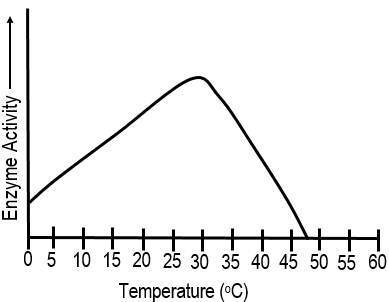
Based on the graph, what is the optimum temperature for this enzyme?
Which sequence shows increasing complexity of levels of ecological organization?
biosphere, ecosystem, population, community,
population, biosphere, community, ecosystem
population, community, ecosystem, biosphere
ecosystem, population, biosphere, community
What impact do the amounts of available energy, water, and oxygen have on an ecosystem?
They act as limiting factors.
]They are used as nutrients.
They recycle the residue of dead organisms.
They control environmental temperature.
An environment can support only as many organisms as the available energy, minerals, and oxygen will allow. Which term is best described by this statement?
biological feedback
carrying capacity
homeostatic control
biological diversity

Energy for this ecosystem originally comes from
water
consumers
sunlight
plants

The organisms represented by X are
Decomposes
Producers
Carnivores
Scavengers
Humans have an effect on ecosystems when they use native grasslands or forested areas for farming or urban use. One negative effect of these changes on the ecosystem is that there will be
Less biodiversity
More homes
Successful economic growth
Increased food production

Which organisms are not shown in this diagram but are essential to a balanced ecosystem?
heterotrophs
autotrophs
producers
decomposers
Organisms that can make their own food are called
consumers
heterotrophs
detrivores
autotrophs
Which of these is an abiotic factor?
Bacteria
Sunlight
Worms
Algae


What is the correct order of organization?
cells->tissue->organs->organ systems-> organism
tissue->cells->organs->organ systems-> organism
organs->organ systems-> organism->cells->tissue

ANSWER THE QUESTION IN THE IMAGE
1
2
3
4
Which of the following is an example of a non-renewable resource?
Solar Energy
Wind Energy
Hydro Energy
Fossil Fuel Energy
A glacier in Alaska sweeps through leaving bare rock in its path. Which of the following will most likely be the pioneer species?
grass
lichen
insects
birds
The final stable community in an ecosystem at the end of succession is called the _____________.
pioneer species
climax community
primary population
carrying capacity
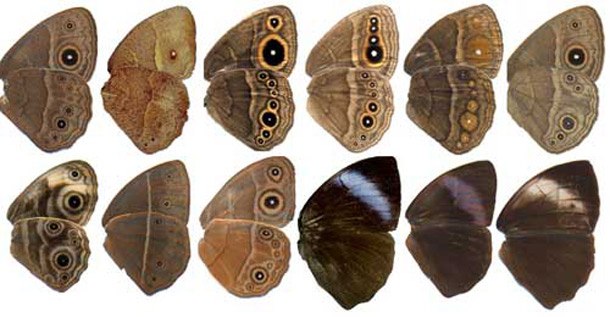
Natural Selection
Variation
Homeostasis
Extinction
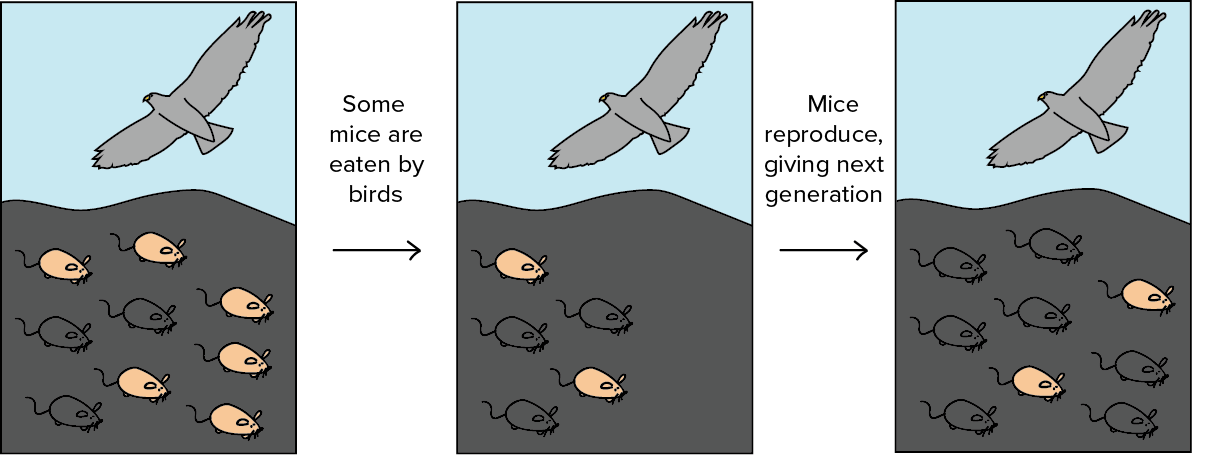
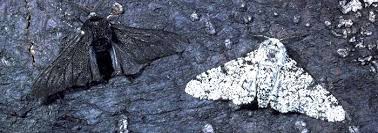
The light mice can reproduce more successfully than the dark mice
The hawks eat more dark mice than light mice because the dark mice taste better
The hawks eat more light mice than dark mice because they can see the light mice more easily
The hawks eat more dark mice than light mice because they can see the dark mice more easily
the best adapted
the fastest
the strongest
the most domesticated (tamed)


The cave fish and minnow are related to each other but the cave fish is blind and only has the remnants of an eye. What type of structure is this?
vestigial
analogous
Scientists are studying a particular protein found in blood cells. Based on this, which animals are most closely related?
Dog: ARG - LYS - HIS - TYR
Rabbit: ARG - LYS - TYR - TYR
Elk: ARG - PRO - TYR - ARG
Dog & Rabbit
Rabbit & Elk
Dog & Elk

Gas exchange is needed to supply _____________ to cells and remove __________________
carbon dioxide; oxygen
oxygen; food
oxygen; carbon dioxide
carbon dioxide; water

The air sacs that are covered with capillaries where gas exchange takes place.
Bronchi
Trachea
Oxygen
Alveoli
Your circulatory and ______________ systems work together to get oxygen and bring it to your cells.
respiratory
integumentary
skeletal
digestive
Homeostasis helps your body maintain a
stable oxygen rich blood
energy by breaking down food
unstable external environment
stable internal environment
The ______ system gets nutrients into the blood; the _______ system gets them to your cells.
excretory; circulatory
digestive; circulatory
circulatory; digestive
digestive; excretory
The role an organism plays in its environment is known as its
ecosystem
habitat
niche
biosphere
All the organisms of the same species living in the same area
Community
Population
Habitat
Ecosystem
The non-living parts of the environment such as rocks, air, temperature, sunlight, and water
Abiotic
Biotic
Habitat
Community
A group of very similar organisms that can mate and reproduce offspring of the same type
Community
Population
Species
Niche

How are fossil fuels formed?
by recycling
by mixing ocean water with soil
by burning coal
by the remains of living things

