
 Worksheets
Chapter 9 Test
Total questions: 79
Worksheet time: 40mins
Name
Class
Date
1.

Which years would Lewis and Clark have spent a winter in Fort Clatsop in present day Oregon?
a)
1803-1804
b)
1804-1805
c)
1805-1806
d)
1806-1807
2.
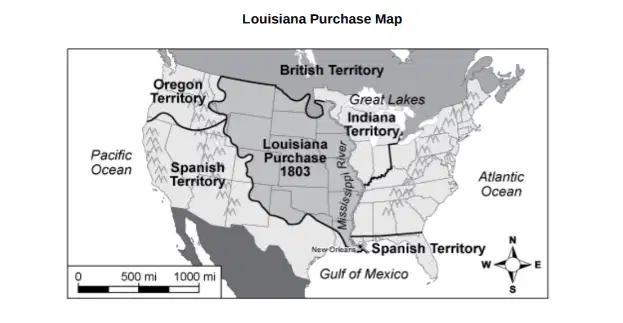
Based on the source below, which statements best describe the effects of the Louisiana Purchase?
a)
It cost the United States about 15 million dollars or 3 cents an acre to purchase Louisiana from France.
b)
It decided where the final borders of the United States would be located and opened the area for exploration.
c)
It increased the the land area of the United States, opening the way for westward expansion and trade on the Mississippi River.
d)
It provided easy access to territories in the Northwest, which the United States hoped to buy from Britain
3.

What city was the point of origin for Pikes, and Lewis and Clark's explorations into the Louisiana Territory?
a)
New Orleans
b)
Washington, D.C.
c)
Santa Fe
d)
St. Louis
4.

According to the series of maps below, what was the claimed area to become US territory in 1818?
a)
Red River Basin
b)
Louisiana Territory
c)
Oregon Country
d)
Spanish Country
5.

Which of the following did not gain statehood during the years depicted on the series of maps below?
a)
Kentucky
b)
Alabama
c)
Lousiana
d)
Michigan
6.

According to the map below, what was the only victory the British had during the war of 1812?
a)
New Orleans
b)
York
c)
Baltimore
d)
Washington, D.C.
7.

These policies reflect what characteristic of the United States economic system?
a)
Monopoly
b)
laissez-faire
c)
mercantillism
d)
protectionalism
8.

What do the ships off the coast represent on the map below?
a)
American Naval Victories
b)
British Naval Victories
c)
British Naval Blockade
d)
American Naval Blockade
9.

a)
limiting immigration
b)
settling territorial disputes
c)
imposing trade restrictions
d)
establishing military alliances
10.

According to this map, which was not a native group found west of the Mississippi River?
a)
Natchez
b)
Osage
c)
Seminole
d)
Kansas
11.

Use the map’s key to answer the question. When Lewis and Clark set off from St. Louis in 1804, how was the expedition traveling?
a)
by keel boat
b)
by dugout canoe
c)
on horseback
d)
on foot
12.

Which of the following is not true based on the map of electoral vote distribution in the election of 1800?
a)
Virginia and Massachusetts were the states with the most electoral votes
b)
Kentucky was a Federalist state
c)
Southern States tended to vote Democratic Republic
d)
Northern States tended to vote Federalist
13.

Based on the maps, how many states entered the nation between 1810 and 1820?
a)
four
b)
five
c)
six
d)
eight
14.

10. The numbers in each state represents how each state's electoral votes were distributed during the election of 1800. What assumption can be made about the states of Pennsylvania and North Carolina?
a)
Both states had a lot of Federalists
b)
Both states electoral votes had no impact on the election
c)
Both states let other states influence their decisions
d)
Both states split their electoral college votes
15.

Which statement best describes Tecumseh’s view on the sale of land?
a)
Anyone can sell the land their people live on for the best price they can get.
b)
The Great Spirit gave the land to all red men, individual group do not have the right to sell it.
c)
Native Americans may only trade land among themselves, not with whites.
d)
The Great Spirit gave the land to the settlers to share equally with the Native American peoples.
16.
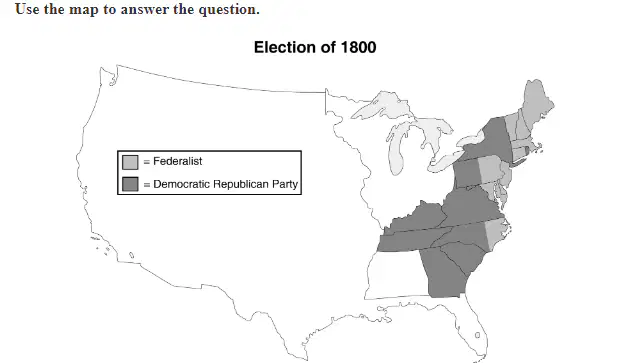
What conclusion can be drawn from the map regarding the growth of political parties in the United States by 1800?
a)
Both parties shared widespread support in the southern states
b)
The Federalist Party obtained most of its support from northern merchants
c)
The Democratic Republican Party achieved its greatest support in the New England region
d)
Neither political party had overwhelming support in the primary agricultural regions
17.
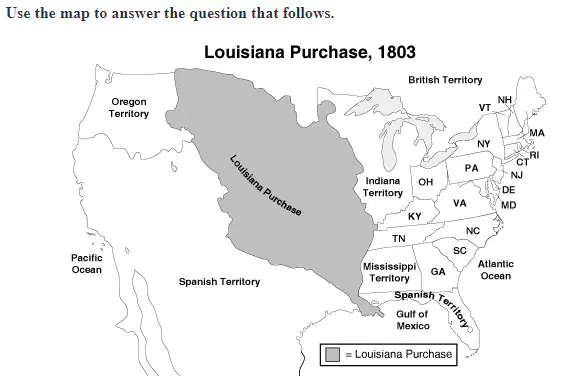
What was one benefit that the Louisiana Purchase provided for the United States?
a)
control of the Great Lakes
b)
a port on the Gulf of Mexico
c)
less chance of conflict with Spain
d)
protection against a British invasion
18.
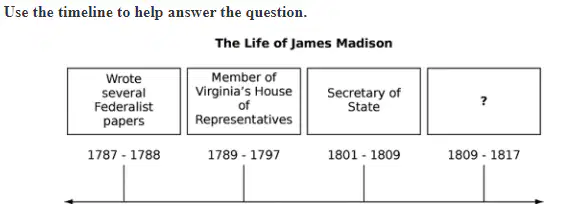
Which role completes the timeline?
a)
Governor of Virginia
b)
Secretary of Treasury
c)
General in the War of 1812
d)
President of the United States
19.
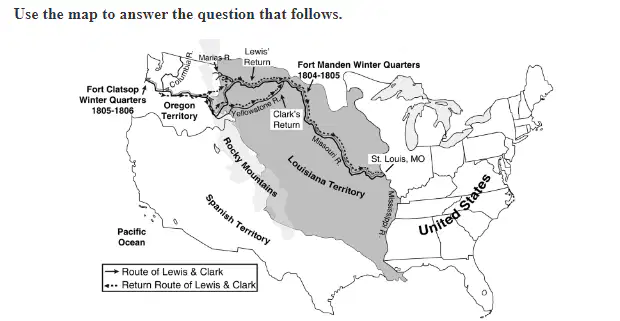
The Lewis and Clark expedition left its camp near St. Louis, Missouri, in May 1804 and arrived at the Pacific Ocean in November 1805. How did the Louisiana Territory's geography help them make their journey?
a)
the flat terrain kept their route free of difficult obstacles
b)
the roads built by the French made traveling safe and fast
c)
The region's war climate let them travel throughout the year
d)
the extensive river system allowed them to make the trip by boat
20.
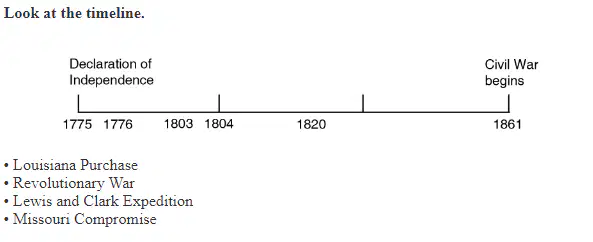
If you were going to complete the timeline below, in what order you put these events?
a)
Missouri Compromise, Revolutionary War, Lewis and Clark Expedition, Louisiana Purchase
b)
Revolutionary War, Missouri Compromise, Lewis and Clark Expedition, Louisiana Purchase
c)
Revolutionary War, Louisiana Purchase, Lewis and Clark Expedition, Missouri Compromise
d)
Louisiana Purchase, Lewis and Clark Expedition, Missouri Compromise, Revolutionary War
21.

Which man is described in the passage?
a)
Thomas Jefferson
b)
James Madison
c)
John Marshall
d)
James Monroe
22.
What best explains how one group in the United States benefited economically from the War of 1812?
a)
Southern farmers were able to charge high prices to ship cotton to Northern States
b)
Women had more employment opportunities after they had filled the jobs of men who had gone to war
c)
Settlers purchased good farmland cheaply in territories that the United States acquired as a result of the war.
d)
Manufacturers profited because they began making goods that used to be imported from Great Britain
23.
Which event showed that Thomas Jefferson accepted a broader interpretation of the Constitution than he had before?
a)
the elections of 1800
b)
the Embargo of 1807
c)
the War of 1812
d)
the Louisiana Purchase
24.
How did the War of 1812 affect the relationship between the United States and Britain?
a)
It brought about an end to the slave trade between the two countries
b)
It resulted in a military alliance between the two countries
c)
It ended the presence of British troops on US soil
d)
It gave Britain the status of a "most favored" trade partner
25.
What was the primary foreign policy goal of the United States during the War of 1812?
a)
to remove British influence in North America
b)
to terminate a military alliance with France
c)
to increase trans-Atlantic trade with Spain
d)
to gain access to ports in South America
26.
Who forced Napoleon to give up his plans of an empire in North America?
a)
Toussaint-Louveture
b)
Zebulon Pike
c)
Merriwether Lewis
d)
Nat Turner
27.
How did the War of 1812 affect the economy of the United States?
a)
More people turned to farming because the war disrupted overseas trade
b)
Manufacturing increased because British goods were no longer imported
c)
the destruction of factories caused by the fighting resulted in a slow recovery
d)
Labor costs increased due to shortages of workers who went to fight in the war
28.
This French ruler had plans for empires in Europe and United States?
a)
Toussaint-Louverture
b)
Zebulon Pike
c)
Napoleon Bonaparte
d)
Marquis de Layfette
29.
Why did many manufacturers in the northeastern United States favor high tariff rates after the War of 1812?
a)
to promote competition among producers that would benefit American consumers
b)
to raise revenue to pay for rebuilding parts of the country destroyed during the war
c)
to protect domestic markets that had grown due to lack of competition from British imports
d)
to ensure that goods produced in the country would be sold domestically rather than overseas
30.
President Jefferson decided he needed to send these explorers into the Northwest portion of the Louisiana Territory?
a)
Zebulon Pike and Kit Carson
b)
York and Sacagewea
c)
Merriwether Lewis and William Clark
d)
Zebulon Pike and George Rodger Clark
31.
President Jefferson decided he needed to send this explorer into the Southwest portion of the Louisiana Territory?
a)
Merriwether Lewis
b)
Zebulon Pike
c)
William Clark
d)
George Rodger Clark
32.
The United States bought the Louisiana Territory with a treaty from what country?
a)
Mexico
b)
Great Britain
c)
France
d)
Spain
33.
This Native American helped guide Lewis and Clark through out the tribes of America?
a)
Tecumseh
b)
Kit Carson
c)
York
d)
Sacagewea
34.
How did events in Santo Domingo (Haiti) influence American expansion?
a)
It made Napoleon give up his thought of an empire in North America.
b)
It doubled the size of the United States
c)
The Louisiana Purchase was bought by a treaty
d)
All the above
35.
Why were the Mississippi River and New Orleans important to the United States?
a)
It was their eastern border.
b)
It was important for trade for farmers.
c)
both A and B
d)
Neither A and B
36.
Who broadened the Supreme Court's power?
a)
John Adams
b)
Thomas Jefferson
c)
William Marbury
d)
John Marshall
37.
The Election of 1800 was decided by which part of Congress?
a)
The Senate
b)
The House of Representatives
c)
Popular vote
d)
The Electoral College
38.
Tecumseh joined the British troops after this battle?
a)
Battle of Greenville
b)
Battle of Tecumseh
c)
Battle of Vandalia
d)
Battle of Tippecanoe
39.
Who urged Native Americans to return to the customs of their of their ancestors?
a)
Tecumseh
b)
Blue Jacket
c)
Prophet
d)
Little Turtle
40.
Which Native American wanted to build a strong confederacy?
a)
Tecumseh
b)
Blue Jacket
c)
Prophet
d)
Little Turtle
41.
Which Act did the United States pass to prohibit trade with another country?
a)
Townshend Act
b)
Embargo Act
c)
Neutral Act
d)
Boycott Act
42.
Which amendment dealt with the requirements for presidential elections after the Election of 1800?
a)
Tenth Amendment
b)
Thirteenth Amendment
c)
Twelfth Amendment
d)
Fifteenth Amendment
43.
The War of 1812 was ended by both countries agreeing to sign this treaty.
a)
Treaty of Greenville
b)
Treaty of Paris of 1814
c)
Treaty of 1812
d)
Treaty of Ghent
44.
Who were the best known War Hawks who pressured James Madison into declaring war on Great Britain?
a)
Daniel Webster and John Adams
b)
Henry Clay and John C. Calhoun
c)
Alexander Hamilton and William Harrison
d)
John C. Calhoun and Andrew Jackson
45.
One result of the Election of 1800 for Alexander Hamilton was.
a)
Being vice president of James Madison
b)
Being impeached for wrong doings over the election of 1800
c)
Being killed dueling against Aaron Burr.
d)
retiring to his plantation White Ash.
46.
Even with a small navy, this U.S. commander destroyed the British naval forces on Lake Erie.
a)
John Paul Jones
b)
Oliver Hazard Perry
c)
William Hull
d)
Andrew Jackson
47.
During the taking of Washington D.C. the British Army did what?
a)
The burning of capitol and presidential mansion
b)
Declare slavery unconstitutional
c)
Hanged President Madison
d)
Knocked down the Washington Monument
48.
This song was written by Francis Scott Key after the Battle of Fort McHenry.
a)
America the Beatiful
b)
Oh....Canada
c)
Battle of New Orleans
d)
The Star Spangled Banner
49.
What political group wanted to break away from the United States and start their own "Northern Confederacy"?
a)
Whigs
b)
Democratic-Republicans
c)
Know-Nothing
d)
Federalist
50.
President Adams lost the Election of 1800 so he attempted to put Federalist in positions in government, what were they called?
a)
Marshall Judges
b)
Midnight Judges
c)
War Hawks
d)
Greenbacks
51.
What geographical barrier did Lewis and Clark have to cross in order to reach the Pacific Ocean?
a)
Mississippi River
b)
Missouri River
c)
Rocky Mountains
d)
Appalachian Mountains
52.
Which document was written to serve as the supreme law of the United States?
a)
The Virginia Plan
b)
The Constitution
c)
The Federalist Papers
d)
Declaration of Independence
53.
Use the information to answer the question that follows.
Believing with you that religion is a matter which lies solely between Man & his God, that he owes account to none other for his faith or his worship, that the legitimate powers of government reach actions only, & not opinions, I contemplate with sovereign reverence that act of the whole American people which declared that their legislature should “make no law respecting an establishment of religion, or prohibiting the free exercise thereof,” thus building a wall of separation between Church & State.
—Thomas Jefferson, Letter to the Danbury Baptists, January 1, 1802
Thomas Jefferson would most likely agree with which statement about the relationship between religion and American democracy?
a)
The government should control the affairs of religious organizations.
b)
Membership in a religious group should be a requirement for citizenship.
c)
Public officials should get the approval of religious leaders before passing laws.
d)
Religious life in the United States is strong because the First Amendment protects it.
54.
What was the ultimate result of the Supreme Court decision in Marbury v. Madison?
a)
integrated schools
b)
women could vote
c)
prohibition
d)
judicial review
55.
What statement best explains the significance of the Supreme Court decisions McCulloch v. Maryland (1819) and Gibbons v. Ogden (1824) for the development of the federal government?
a)
They shifted some duties of the national government to the states.
b)
They revised the election process for president and vice president.
c)
They agreed that states could nullify national laws that they disliked.
d)
They upheld the authority of the national government over the states.
56.
Use the information to answer the question that follows.
In its 1824 Gibbons v. Ogden decision, the Supreme Court based its ruling on an interpretation of the Commerce Clause in Article I, Section 8 of the Constitution. It determined that under that clause Congress had powers to regulate any kind of commerce that crossed state lines.
How did this Supreme Court decision affect life in the United States?
a)
It gave the federal government a larger role in the national economy.
b)
It forced businesses to work only within the borders of their home state.
c)
It made government officials the main authorities for managing businesses.
d)
It took away any powers states had to make decisions about economic matters.
57.
Use the excerpt below to answer the question that follows.
It is emphatically the province and duty of the judicial department to say what
the law is . . . . If two laws conflict with each other, the courts must decide
on the operation of each.
—Chief Justice John Marshall, Marbury v. Madison, 1803
This excerpt supports what principle established in the United States Constitution?
a)
trial by jury
b)
laissez-faire
c)
nullification
d)
judicial review
58.
Read the passage and answer the question that follows.
In 1819, the Supreme Court decided in the McCulloch v. Maryland case that the Constitution gave Congress the authority to establish a national bank. In its 1824 decision in Gibbons v. Ogden, the Supreme Court ruled that Congress had the power to regulate economic activity that crossed state lines.
Which statement best explains the lasting impact of these turning points in United States history?
a)
They made the legislative branch the most powerful branch of government.
b)
They recognized a role for the federal government in the nation’s economy.
c)
They established government planning as a feature of the socialist economy.
d)
They delayed the growth of a national economy by limiting trade between states.
59.
Use the information below to answer the question that follows.
In 1824, the Supreme Court delivered its ruling in the Gibbons v. Ogden
case. Aaron Ogden claimed that a New York license gave his company
the sole right to operate steamboat ferries between New York City and
New Jersey. Thomas Gibbons claimed that a federal law gave him the
right to operate steamboat ferries, too. The Supreme Court agreed with
Gibbons.
The Supreme Court’s decision in this case upheld what characteristic of the United States free enterprise system?
a)
monopoly
b)
competition
c)
redistribution
d)
protectionism
60.
Use the information in the box to answer the question that follows.
[Y]ou should understand what I deem the essential principles of our
Government . . . economy in the public expense, that labor may be
lightly burthened; the honest payment of our debts and sacred
preservation of the public faith; encouragement of agriculture, and of
commerce as its handmaid . . . .
—Thomas Jefferson, First Inaugural Address, March 4, 1801
Based on this excerpt, what would Jefferson most likely support?
a)
low tax rates
b)
high interest rates
c)
restrictive trade policies
d)
government monopolies
61.
Use the excerpt to answer the question that follows.
Government is instituted to protect property of every sort . . . . This being the
end of government, that alone is a just government, which impartially secures
to every man, whatever is his own . . . . That is not a just government, nor is
property secure under it, where arbitrary restrictions, exemptions, and
monopolies deny to part of its citizens that free use of their faculties, and free
choice of their occupations . . . .
—James Madison, 1792
What kind of government role in the economy would be most acceptable to James Madison?
a)
making laws to protect a company from competition
b)
awarding patents to allow people to profit from new ideas
c)
creating government-run businesses to replace private businesses
d)
taking resources from a business and giving them to a more profitable one
62.
Use the excerpt to answer the question that follows.
The path we have to pursue is so quiet that we have nothing scarcely to
propose to our Legislature . . . . [N]ot meddling with the affairs of others . . .
is a mark that society is going on in happiness. If we can prevent the
government from wasting the labors of the people, under the pretence of
taking care of them, they must become happy. Their finances are now under
such a course of application as nothing could derange but war or federalism.
—Thomas Jefferson to Thomas Cooper, November 29, 1802
Based on this excerpt, what best describes an economic policy favored by Thomas Jefferson?
Responses
a)
high taxes to produce a surplus in the government treasury
b)
heavy government investment to promote economic growth
c)
minimal government interference to ensure economic efficiency
d)
government programs to create economic equality among citizens
63.
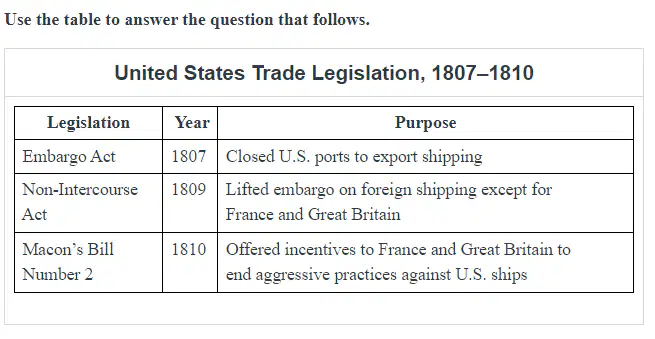
Why did United States legislators believe these measures were necessary?
a)
The war between France and Great Britain was disrupting the U.S. economy.
b)
An alliance treaty required the U.S. to support France against Great Britain.
c)
U.S. manufacturers exported most of their goods to France and Great Britain.
d)
The U.S. wanted to improve its trade relations with France and Great Britain.
64.
This Virginian was the Secretary of State under President John Adams. Chosen as Chief Justice of the Supreme Court in 1801, he established the idea that the courts have the ability to overturn laws that go against the Constitution. His decisions also helped define checks and balances in the government of the United States.
Which man is described in the passage?
a)
Thomas Jefferson
b)
James Madison
c)
John Marshall
d)
James Monroe
65.
Use the information below to answer the question.
The Life of Thomas Jefferson
• 1779 - Elected Governor of Virginia
• 1789 - Chosen Secretary of State of the United States
• 1796 - Elected Vice President of the United States
• 1803 - Arranged the Louisiana Purchase
• 1803 - Sent the Lewis and Clark Expedition
When did Thomas Jefferson become president of the United States?
a)
after being governor of Virginia but before being secretary of state
b)
after being secretary of state but before being vice president
c)
after being vice president but before the Louisiana Purchase
d)
after the Louisiana Purchase but before sending the Lewis and Clark Expedition
66.
Use the information below to answer the question.
• Author of the Declaration of Independence
• Third President of the United States
• Author of the Virginia Statue for Religious Freedom
• Purchased Louisiana Territory
Who is described in the list?
Responses
a)
John Adams
b)
Thomas Jefferson
c)
James Monroe
d)
George Washington
67.
Which early 19th century land acquisition doubled the territory of the United States?
a)
Alaska
b)
Florida
c)
Oregon Territory
d)
Louisiana Territory
68.
Sacagawea was a woman from the Shoshone tribe who was married to a French Canadian fur trapper. During the early 1800s, her assistance was important for the completion of what journey?
a)
the Trail of Tears
b)
the California Gold Rush
c)
the Underground Railroad
d)
the Lewis and Clark expedition
69.
Which U.S. president was the primary author of the Declaration of Independence?
a)
Thomas Jefferson
b)
George Washington
c)
John Adams
d)
Andrew Jackson
70.
Why did many manufacturers in the northeastern United States favor high tariff rates after the War of 1812?
a)
to promote competition among producers that would benefit American consumers
b)
to raise revenue to pay for rebuilding parts of the country destroyed during the war
c)
to protect domestic markets that had grown due to lack of competition from British imports
d)
to ensure that goods produced in the country would be sold domestically rather than overseas
71.
How did the War of 1812 affect the relationship between the United States and Britain?
a)
It brought about an end to the slave trade between the two countries.
b)
It resulted in a military alliance between the two countries.
c)
It ended the presence of British troops on U.S. soil.
d)
It gave Britain the status of a “most favored” trade partner.
72.
What was the primary foreign policy goal of the United States during the War of 1812?
a)
to remove British influence in North America
b)
to terminate a military alliance with France
c)
to increase trans-Atlantic trade with Spain
d)
to gain access to ports in South America
73.
What was one result of the American victory in the War of 1812?
a)
Many Americans began moving westward toward the Mississippi River.
b)
American Indian tribes gained citizenship rights due to their assistance in the war.
c)
The British agreed to leave the Northwest Territory.
d)
France sold land west of the Mississippi River to the United States.
74.
How did the War of 1812 help establish the reputation of the United States in international affairs?
a)
It proved that the United States could protect the interests of South American countries.
b)
It showed that the United States could negotiate treaties between warring countries.
c)
It proved that the United States Navy was superior to European navies.
d)
It showed that the United States could defend itself against the British.
75.
What argument was used by those in the United States who opposed the use of protective tariffs in the 1800s?
a)
The use of protective tariffs was unconstitutional.
b)
Tariffs made it more expensive to use slave labor.
c)
Tariffs benefitted manufacturers but not farmers.
d)
The use of tariffs reduced the price of manufactured goods.
76.
Use the excerpt to answer the question.
Brother . . . after we agreed to bury the Tomahawk at Greenville . . . the Americans . . . told us they would treat us well. . . . Since the peace was made you have . . . taken our lands from us and I do not see how we can remain at peace with you if you continue to do so. . . . I want the present boundary line to continue. Should you cross it, I assure you it will be productive of bad consequences.
—Tecumseh to William Henry Harrison, August 1810
This excerpt shows Tecumseh’s reaction to which treaty?
a)
the Treaty of Ghent
b)
the Adams-Onis Treaty
c)
the Canandaigua Treaty
d)
the Treaty of Fort Wayne
77.
Use the excerpt below to answer the question.
But every difference of opinion is not a difference of principle. We have called by different names [fellow believers in] the same principle. We are all Republicans, we are all Federalists. If there be any among us who would wish to dissolve this Union or to change its republican form, let them stand undisturbed as monuments of the safety with which error of opinion may be tolerated where reason is left free to combat it.
—President Jefferson’s First Inaugural Address, March 4, 1801
Which change in the U.S. government led Thomas Jefferson to make these remarks in his address?
a)
the revision of the Articles of Confederation
b)
the extension of voting rights to women
c)
the purchase of the Louisiana Territory
d)
the growth of political parties
78.
Use the list to answer the question that follows.
United States Treaties & Agreements
• Louisiana Purchase (1803)
• Adams-Onis Treaty (1819)
• Treaty of Guadalupe Hidalgo (1848)
• Gadsden Purchase (1853–54)
What was a consequence of each of these treaties and agreements?
a)
The United States joined a free-trade zone.
b)
The United States gained additional territory.
c)
The United States ended a war with a neighbor.
d)
The United States became part of a military alliance.
79.
Use the excerpt to answer the question that follows.
At length the business of New Orleans has terminated favorably to this country. Instead of being obliged to rely any longer on the force of treaties for a place of deposit, the jurisdiction of the territory is now transferred to our hands and in future the navigation of the Mississippi will be ours unmolested. This, it will be allowed, is an important acquisition, not, indeed, as territory, but as being essential to the peace and prosperity of our Western country, and as opening a free and valuable market to our commercial states.
—Alexander Hamilton, New York Evening Post, July 5, 1803
This excerpt refers to what development in United States history?
a)
the Embargo Act
b)
the Treaty of Ghent
c)
the Monroe Doctrine
d)
the Louisiana Purchase
100 %

