
 Worksheets
B cell activation stopp @ slide 16
Total questions: 52
Worksheet time: 31mins
Each B cell has Ig receptors of a single antigen specificity.
True
False
Mature B cells circulate in the blood, lymph, and lymphoid organs until they encounter antigen.
True
False
When a B cell is stimulated by an antigen, it will ____
phagocytize the antigen and die
create many clones bearing the same Ag receptor
Selected B cell clones will become ____
plasma cells
memory B cells
Which cell takes antigen to draining lymph nodes and activate antigen-specific naive Tcells?
macrophages
DCs
T cells proliferate and differentiate into ___
plasma cells
effector T cells
stay in the LN and interact with activated B cells
TH1
TFH
cytotoxic T cells
Which antibody is made first?
high affinity IgM
low affinity IgM
Memory B cells are generated to provide long term protection
True
False
The part of antigen that an antibody/BCR binds
epitope
TCR
Usually an epitope is a/an
protein
carbohydrate
lipid
any of these
Pathogens typically have one epitope that can be bound by antibody.
True
False
antigen that contains more than 1 epitope or multiple copies of the same epitope
multivalent antigen
T cell
B cells can bond to which of the following epitopes?
protein
carbohydrates
lipids
T cells can bond to which type of epitope?
protein
carbohydrate
lipid
Epitopes are composed of 2 groups:
Linear epitopes
Discontinuous epitopes
Composed of several successive amino acid residues.
Linear epitopes
Discontinuous epitopes
Formed from 2 or more parts of the protein antigen that are separated in the amino acid sequence but are brought together in the tertiary structure of the folded protein.
Linear epitope
discontinuous epitope
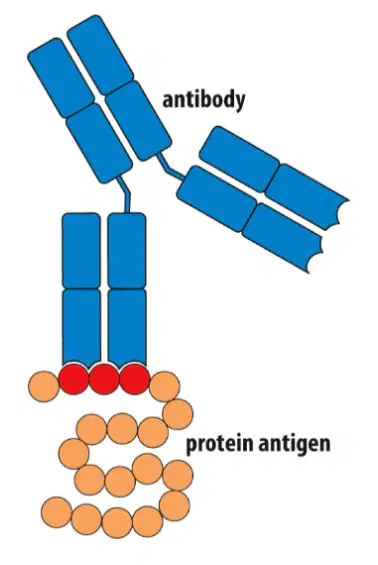
Which one?
linear epitope
discontinuous epitope
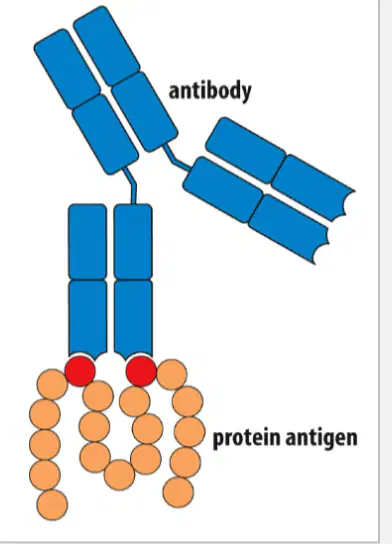
Which one?
linear epitope
discontinuous epitope
What is required for B cell activation?
cell-cell contact with MHC
crossllinking of surface Ig
B cell activation
surface IgM on naive B cells binds to epitope
multivalent antigens bind to multiple IgM causing cross linking
cross-linking leads to signals to inside of B cell through Iga and IgB of BCR
signaling leads to gene expression-> B cell activation
additional signals required
After cross linking causes clustering, signals are sent inside of B cell through ___ and ___ of the BCR
Iga
IgB
IgM
IgG
B cell co-receptor is composed of ...
CR2
CD19
CD81
Part of the b cell co-receptor that can bind complement components fixed on pathogen.
CR2
CD19
CD81
acts as the signaling chain in interactions with Iga and IgB of BCR
CR1
CD19
CD81
Brings CD19 to the surface and organizes the coreceptor on the membrane
CR2
CD19
CD81
The B cell co receptor increases signal by 1000 to 10,000 fold and incrases B cells sensitivity to antigen.
True
False
B cell response that requires help from T cells (CD4+ helper T cells)
T-dependent
T-independent
Which T cells help during B cell T-dependent responses?
CD4 + helper T cells
CD8 + cytoxic T cells
B cell respose that makes TI-1 and TI-2 antigens and do NOT require T cell help.
T dependent
T independent
What two subclasses of B cells mediate response to T independent antigen?
B1-B cells
Marginal zone B cells
B cell that produces T independent antigen that produces IgM antibodies that bind to broad spectrum of Ag with low affinity.
B1-B
Marginal zone B cells
Specialized to respond to blood born Ag entering interacting with the immune cells in the spleen.
B1-B cells
Marginal zone B cells
B1-B cells produce....
high affinity IgM
low affinity IgM
Rank the following in order from Best to Worst with number 1 being the best and number 3 being the worst.
TD antigens
Type II TI antigens
Type I TI antigens
Why is type II T independent antigens better than Type I TI antigens?
there is no polyclonal activation in Type II TI
not this
TI-1 antigens are typically ___
bacterial cell wall components
polymeric protein antigens
capsule bacterial polysaccharides
Polymeric flagellin
TI-1 antigens bind to innate immunity PRR on all B cells
True
False
Which one results in polyclonal antibody response?
TI type I
TI type II
TI type II antigens:
bacterial cell wall componenets
polymeric protein antigens
capsular bacterial polysaccharides
polymeric flagellin
Bind to and cross link many IgM BCRs
TI-1
TI-2
Typically have bound complement fragments
TI-1
TI-2
Can crosslink BCR and CR2 of the B cell co receptor
TI-1
TI-2
Interaction with T cells can push TI-2 activated cells to produce isotypes of antibody other than ____
IgG
IgM
Polyclonal antibody response
TI-1
TI-2
Following B cell development, naive B cells migrate to the ____
lymphoid follicles
blood
In the lymphoid follicles,
B cell can interact with antigen and become activated
if not activated, can recirculate through the blood and lymph and back
If the B cell does not come in contact with antigen in the lymphoid follicle....
it will be activated
it will recirculate
Naive B cells migrate to the
lyphoid follicles
medullary cord
What are the 3 pathways of TD activation of B cells?
become an antibody producing plasma cell
become low affinity memory cells
enter germinal center to participate in the germinal center reaction
In the germinal center, B cells can undergo...
clonal expansion of B and TFH cells
somatic hypermutation
Isotype switching

