
 Worksheets
Bacterial envelope and murien synthesis - Hussein ID Exam 1
Total questions: 50
Worksheet time: 30mins
What are the major differences between gram-positive and gram-negative bacterial cells?
Gram-positive cells have a thick peptidoglycan layer, while gram-negative cells have a thin peptidoglycan layer and an outer membrane.
Gram-positive cells have a thin peptidoglycan layer, while gram-negative cells have a thick peptidoglycan layer and no outer membrane.
Gram-positive cells have an outer membrane, while gram-negative cells do not.
Gram-positive cells have a thin peptidoglycan layer and an outer membrane, while gram-negative cells have a thick peptidoglycan layer.
What is the function of the murein (peptidoglycan) cell wall in bacteria?
It provides energy for the cell.
It protects the cell from osmotic pressure and gives it shape.
It helps in the replication of DNA.
It is involved in protein synthesis.
What is the principal mechanism of action of beta-lactams such as penicillins and cephalosporins?
They inhibit protein synthesis.
They disrupt the cell membrane.
They inhibit cell wall synthesis.
They interfere with DNA replication.
How do bacteria develop resistance to beta-lactams?
By producing penicillinase and beta-lactamase.
By altering their ribosomes.
By changing their DNA sequence.
By increasing their cell wall thickness.
All of the following are common shapes of bacteria EXCEPT
Square shapes
Select all of the following characteristics associated with bacilli
Long
Thin
Oval shapped
Rounded or pointed ends
Loose spiral
What type of group associations can bacteria form?
Only in liquid medium
Only on solid medium
Both in liquid and on solid medium
Neither in liquid nor on solid medium
Which of the following is a type of bacterial group association?
Chains
Triads
Hexads
Non-clusters
Bacteria typically don't have group associations
What is the difference between Gram-positive and Gram-negative bacteria?
Gram-positive bacteria have a thicker peptidoglycan layer.
Gram-negative bacteria have a thicker peptidoglycan layer.
Both have the same peptidoglycan layer thickness.
Gram-positive bacteria have an outer membrane.
Place each of the steps into their proper staining techniques
Stain with crystal violet
Modifigy with potassium iodide
Decolorize with alcohol; only gram-positive remain
Counterstain with safranin
Stain with hot carbol-fuchsin
Decolorize with acid alcohol, some bacteria remain red
Counterstains with methylene blue
Which stain is used first in the Gram stain procedure?
Crystal violet
Safranin
Methylene blue
Carbol-fuchsin
In the Acid-Fast stain procedure, what is used to decolorize the sample?
Alcohol
Potassium iodide
Acid alcohol
Crystal violet
What color do Gram-negative bacteria become after counterstaining with safranin?
Purple
Red
Blue
Pink
What is the counterstain used in the Acid-Fast stain procedure?
Crystal violet
Safranin
Methylene blue
Potassium iodide
What is the primary stain used in the Acid-Fast stain procedure?
Crystal violet
Safranin
Methylene blue
Carbol-fuchsin
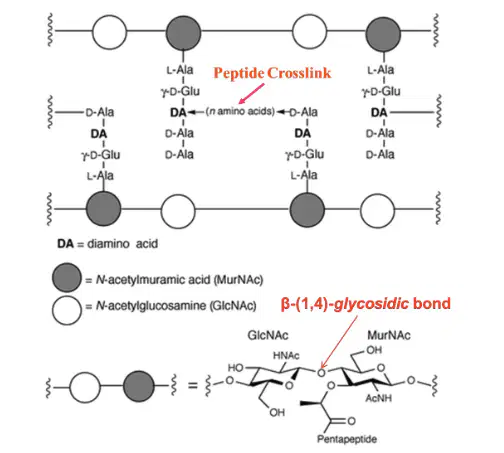
What is the structure shown in the diagram?
Lipopolysaccharide
Peptidoglycan
Teichoic acid
Phospholipid bilayer
What is the primary function of peptidoglycan in bacterial cells?
To facilitate binary fission
To prevent osmotic lysis
To transport nutrients
To inhibit antibiotic synthesis
The cytoplasm of bacteria is hypotonic when compared to the surrounding environment; therefore, net flow of water is into the cell
True
False
What happens to bacteria when peptidoglycan is exposed to β-Lactam antibiotics?
They reproduce more rapidly
They become resistant to antibiotics
It prevents patching of peptidoglycan
They increase in size
Match the following enzymes bacteria use to increase their size to their descriptions
Break the peptide cross links in peptidoglycan
Autolysins
Insert and link new peptidoglycan monomers into peptidoglycan breaks
Transglucosidase
Rebuild the peptide cross-links between the rows and layers of peptidoglycan to make the wall stronger
Transpeptidase
Which of the following enzymes is the target for B-Lactam antibiotics
Transglucosidase
Transpeptidase
Autolysins
Penicillinase
What is the result of blocking the transpeptidases from cross-linking the sugar chains in bacterial cell walls?
Stronger cell wall
Weak cell wall and osmotic lysis
Increased bacterial growth
Enhanced peptidoglycan synthesis
What is the mechanism of action of Vancomycin?
Binds to transpeptidases
Forms hydrogen bond interactions with the terminal D-alanyl-D-alanine moieties
Prevents resealing of the cell wall
Attacks only growing bacteria
Improper antibiotic use can lead to antibiotic resistant pathogens
True
False
Which of the following is a common Gram-negative bacterium
Streptococcus pneumoniae
Enterococcus faecalis
Neisseria gonorrhoeae
Staphylococcus aureus
What characteristic allows acid-fast bacteria to resist decolorization with an acid-alcohol mixture during the acid-fast stain procedure?
Presence of a thick peptidoglycan layer
Retention of the initial dye carbolfuchsin
High lipid content in the cell wall
Presence of teichoic acids
Which of the following bacteria is NOT considered an acid-fast bacterium
Mycobacterium tuberculosis
Mycobacterium leprae
Mycobacterium avium-intracellulare complex
Escherichia coli
What are the alternating aminoglycans in the glycan strand of murein?
N-acetylmuramic acid (NAM) and N-acetylglucosamine (NAG)
N-acetylmuramic acid (NAM) and N-acetylgalactosamine (NAG)
N-acetylglucosamine (NAG) and N-acetylgalactosamine (NAL)
N-acetylmuramic acid (NAM) and N-acetylneuraminic acid (NAN)
What are the two joined amino sugars in a peptidoglycan monomer?
L-alanine and D-alanine
N-acetylglucosamine (NAG) and N-acetylmuramic acid (NAM)
D-glutamic acid and meso diaminopimelic acid
L-alanine and D-glutamic acid
Which amino acids are part of the pentapeptide coming off of the NAM in E. coli?
L-alanine, D-glutamic acid, meso diaminopimelic acid, and two D-alanine
N-acetylglucosamine, N-acetylmuramic acid, L-alanine, and D-glutamic acid
L-alanine, D-glutamic acid, meso diaminopimelic acid, and L-lysine
N-acetylglucosamine, N-acetylmuramic acid, D-glutamic acid, and two D-alanine
What is the composition of the pentapeptide in the peptidoglycan monomer of S. aureus?
L-alanine, D-glutamine, L-lysine, D-alanine, D-alanine
L-alanine, D-glutamine, L-lysine, D-glutamine, D-alanine
L-alanine, D-glutamine, L-lysine, D-alanine, L-alanine
L-alanine, D-glutamine, L-lysine, L-alanine, D-alanine
Match the following antibiotics to their sites of action
Inhibits transglycosylation by binding D-Ala-D-Ala
Vancomycin
Inhibits the formation of N-acetylmuramic acid (NAM)
Fosfomycin
Blocks the incorporation of D-ala into pentapetidase side chain of the peptidoglycan
Cycloserine
Block the assembly of peptide cross-links in peptidoglycan by binding to transpeptidase
Vancomycin
In Gram-positive bacteria, what does the peptide bridge cross-link?
Lys to D-Ala
DAP to D-Ala
NAM to NAG
Glycine to Alanine
In Gram-negative bacteria, what does DAP cross-link directly to?
Lys
D-Ala
NAM
NAG
What is the role of autolysins in peptidoglycan synthesis?
Break glycosidic bonds and peptide cross-bridges
Insert new peptidoglycan monomers
Catalyze the formation of glycosidic bonds
Reform peptide cross-links
What is the function of transpeptidases in peptidoglycan synthesis?
Insert new peptidoglycan monomers
Reform peptide cross-links
Break glycosidic bonds
Catalyze the formation of glycosidic bonds
Which of the following extends through the cell wall (CW) in gram-positive bacteria?
Lipopolysaccharides
Teichoic acids
Peptidoglycan
Phospholipids
What are lipoteichoic acids attached to in the cell membrane (CM) of gram-positive bacteria?
Proteins
Lipids
Carbohydrates
Nucleic acids
Which component of the gram-positive cell wall can induce septic shock?
Peptidoglycan
Teichoic acids
Lipoteichoic acids
Phosphates
Which of the following is a component of the cytoplasmic membrane in Gram-positive bacteria?
Teichoic acid
Phospholipid bilayer
Peptidoglycan
Capsule
What is the function of the capsule in some Gram-positive bacteria?
Triggering innate immune response
Protection against phagocytosis
Binding pattern-recognition receptors
Activating alternative complement pathway
What is one of the functions of peptidoglycan and teichoic acid in Gram-positive bacteria?
Protection against phagocytosis
Triggering innate immune response
Forming the phospholipid bilayer
Exposing surface antigens
Which of the following is NOT a function of the peptidoglycan in Gram-negative cell walls?
Preventing osmotic lysis
Adhering to host cells
Providing structural support
Being part of the cell envelope
What is the role of the periplasm in Gram-negative cell walls?
Adhering to host cells
Preventing osmotic lysis
Containing enzymes and binding proteins
Forming a thick peptidoglycan wall
Which component anchors the outer membrane in murein in Gram-negative cell envelopes?
Lipopolysaccharide
Phospholipid bilayer
Lipoprotein
Peripheral proteins
Which of the following parts of the lipopolysaccharide is toxic
Lipid A
Core polysaccharid
Repeating O-antigen
Polymyxins disrupt bacterial membranes and are more useful in which of the following bacteria
Gram-negative bacteria
Gram-positive bacteria
Both gram negative and positive bacteria
Neither gram negative or positive bacteria
What is the main component of acid-fast cell walls
Which of the following inhibits mycolic acid synthesis and is a first line treatment for tuberculosis when dealing with acid fast bacteria
Vancomycin
Penicillin
Cyclosporine
The outer membrane of gram negative bacteria is responsible for the generation of membrane potential allowing for ATP generation by oxidative phosphorylation in gram negative bacteria
True
False

