
 Worksheets
Chemistry Paper 1 AQA Trilogy Foundation
Total questions: 118
Worksheet time: 2hrs 33mins
What is the charge of a Proton?
Positive Charge
Negative Charge
Neutral Charge
What is the Charge of an Electron?
Positive Charge
Negative Charge
Neutral Charge
What is the Charge of a Neutron?
Positive Charge
Negative Charge
Neutral Charge
What does the Nucleus of an atom contain?
Protons
Electrons
Neutrons
Which number tells you the amount of protons in an element?
Atomic Number
Mass Number
Which number tells you the amount of protons and neutrons in an element?
Atomic Number
Mass Number
What is an Isotope of a element?
Element with same number of Protons but a different number of Neutrons.
Element with same number of Neutrons but a different number of Protons.
What is a compound?
A substance formed from a two or more elements held by chemical bonds
A mixture of two or more chemicals which provides a useful outcome
What is a Mixture?
A substance formed from a two or more elements held by chemical bonds
A mixture of elements or compounds which can be physically separated
Which one is Filtration?
Used if the product is an insoluble solid and needs to be separated from a liquid. Uses filter paper
Used if the product is a soluble solid. Its placed in an evaporating basin and heated until crystals form
Used if the product is a soluble solid. Its placed in an evaporating basin and heated until start crystals forming then the heat is removed letting the crystals form while cool. Its then Filtered out
Which one is Evaporation?
Used if the product is an insoluble solid and needs to be separated from a liquid. Uses filter paper
Used if the product is a soluble solid. Its placed in an evaporating basin and heated until crystals form
Used if the product is a soluble solid. Its placed in an evaporating basin and heated until start crystals forming then the heat is removed letting the crystals form while cool. Its then Filtered out
Which one is Crystalisation?
Used if the product is an insoluble solid and needs to be separated from a liquid. Uses filter paper
Used if the product is a soluble solid. Its placed in an evaporating basin and heated until crystals form
Used if the product is a soluble solid. Its placed in an evaporating basin and heated until start crystals forming then the heat is removed letting the crystals form while cool. Its then Filtered out
What is Simple Distillation used for?
Separating out Solutions
Separating out a Mixture of Liquids
What is the first step in developing the modern day model of an atom?
John Dalton published his ideas about atoms. He thought that all matter was made of tiny particles called atoms, which he imagined as tiny spheres that could not be divided.
J J Thomson carried out experiments and discovered the electron. He made the plum pudding model of the atom. In this model, the atom is a ball of positive charge with negative electrons embedded in it.
Ernest Rutherford did the alpha scattering experiment through which he discovered that the mass of an atom is concentrated at its centre and the nucleus is positively charged. He called it the nuclear model.
Niels Bohr did calculations that led him to suggest that electrons orbit the nucleus in shells. The shells are at certain distances from the nucleus.
James Chadwick found evidence for the existence of particles in the nucleus with mass but no charge. These particles are called neutrons.


What is 5?
cooling tube
condenser
distillate
water pump
The part of the mixture that passes through the filter paper is called the
residue
filtrate
suspension

Identify the Reactants in this equation.
A
B
4Ca(OH)2
2KI + ____Cl2 → 2KCl + I2
What number should go in the blank space to balance the chemical equation?
2Al +____ HCl → 2AlCl3 + 3H2
2
4
3
6
Which of the following represent chemical equations? Check all that apply.
2Na + H2O → 2NaOH + H2
2KClO3 → 2KCl + 3O2
2Fe + 3O2 → 2Fe2O3
2H2O
3O3 , H2O
How are elements organized in the periodic table ?
Alphabetically
Based on physical and chemical properties
Increasing number of electrons
Most reactive to least reactive
Most elements on the periodic table are classified as ____________.
Gases
Metalloids
Metals
Nonmetals
Groups on the periodic table are arranged...
Vertically
Horizontally
Diagonally from bottom right corner
Diagonally from top right corner

Which accurately describes nonmetals?
Poor conductors of electricity
Often used in computer parts
Both malleable and ductile
Both dull and brittle

Which group on the periodic table is the most reactive?
Group 1
Group 2
Group 13
Group 18

What is the chemical symbol for Sodium?
S
So
Na
Ca

A neutral atom of _____________ has 52 electrons.
Chromium
Tellurium
Manganese
Antimony

Each horizontal row on the periodic table is called a what?
Group
Row
Period
Family

Who arranged the periodic table of elements by the atomic mass (or mass number)?
Democritus
John Dalton
Henry Moseley
Dmitri Mendeleev

Identify the unknown atom.
Flourine
Beryllium
Boron
Helium

Choose ALL of the alkali metals (group 1) from the list below:
lithium
copper
mercury
potassium
sodium
What ions do Metals form when they react?
Positive Ions
Negative Ions
Select all the properties of a Metal:
Strong
Malleable
Conductive
Brittle
Select the 3 things that describe Group 1 Elements as you go DOWN the group:
More Reactive
Lower Melting/Boiling Point
Higher relative atomic mass
Less Reactive
Higher Melting/Boiling Point
Select the 3 things that describe Group 7 Elements as you go DOWN the group:
More Reactive
Lower Melting/Boiling Point
Higher relative atomic mass
Less Reactive
Higher Melting/Boiling Point
Which one describes a reaction between a Group 1 metal and Water?
Vigorous Reaction to produce Hydrogen Gas and a Metal Hydroxide
Vigorous Reaction when Heated to form Metal Chloride Salts
Reacts to form a Metal Oxide
Which one describes a reaction between a Group 1 metal and Oxygen?
Vigorous Reaction to produce Hydrogen Gas and a Metal Hydroxide
Vigorous Reaction when Heated to form Metal Chloride Salts
Reacts to form a Metal Oxide
What happens to the Boiling point of Nobel Gases as you go Down the Group?
Increases
Decreases
As you move down the group, halogens' reactivity...
increases
decreases
doesn't change
shows no trend.
Which halogens can displace bromide ions to make bromine?
Fluorine and iodine.
Fluorine and bromine.
Fluorine and chlorine
Chlorine and iodine.

A displacement reaction involves...
a solution turning brown or yellow.
a less reactive element taking the place of a more reactive element.
a dislocated hip.
a more reactive element taking the place of a less reactive element.
Would a displacement reaction occur for Bromine + Potassium Iodide?
Yes
No
Maybe
How many electrons do the halogens all have in their outer shells?
1
2
7
8
Would a displacement reaction occur for Iodine + Potassium Bromide?
Yes
No
Maybe
As you go down the group, how does the boiling point of the halogen elements change?
Increases
Decreases
They're all about the same
6.15: Which of these is not a property of noble gases?
Colourless
Odourless
Flammable
Gas at room temperature


In the reactivity series which of the following is the most reactive element?
Copper
Zinc
Calcium
Potassium
In the following chemical reaction what will the products be?
Copper Sulfate + Iron -->
Copper Sulfide + Iron
Iron Sulfide + Copper
Iron Sulfate + Copper
Copper Sulfate + Iron
What is the correct charge on a Magnesium ion
Mg2+
Mg2-
Mg+
Mg-
Which of the following ions is produced when acids dissolve in water?
H+
H-
OH+
OH-
Which of the following ions is produced when alkalis dissolve in water?
H+
H-
OH-
OH+

Which of the following is the best definition of a strong acid?
An acid that fully dissociates into its ions.
An acid the partially dissociates into its ions.
An acid that does not dissociate into ions.

Which of the following is the best definition for a weak acid?
An acid that fully dissociates into its ions.
An acid that partially dissociates into its ions.
An acid that does not dissociate into its ions.
What is the best way to extract metals that are less reactive than Carbon?
Reduction reaction
Electrolysis
Phytomining
Bioleaching
How can we extract metals that are higher than Carbon in the reactivity series?
Reduction reaction
Electrolysis
Phytomining
Bioleaching

In the diagram, which electrode is the anode?
Left
Right
What is the charge on a Cation?
Positive
Negative
What is the charge on an anion?
Positive
Negative
Which of the following is the best statement to describe what happens to ions during electrolysis?
Positive Cations will move to the Negative Cathode.
Positive Cations will move to the Positive Cathode.
Negative Cations will move to the positive Cathode
Negative Cations will move the negative Cathode
When an acid and alkali react together this is known as a ___________ reactiion.
Combustion
Displacement
Neutralisation
Endothermic
What are the products of a neutralisation reaction?
Salt and Hydrogen
Salt and Water
Excess acid and Hydrogen
Excess alkali and Oxygen
What is the correct formula for Hydrochloric Acid?
HC
HCl
HCL
CLH
During the electrolysis of Molten Aluminium Oxide (Al2O3(L)) what is added to the electrolyte to lower its melting point?
Salt
Cryolite
Water
Sulphuric Acid
What is produced when an acid reacts with a metal carbonate e.g. MgCO3?
Salt + Water + Carbon Dioxide
Salt + Carbon Dioxide
Water + Carbon Dioxide
Salt + Water
During electrolysis the substance being separated is called
Compound
Mixture
Electrolyte
Cryolite
Hydrochloric Acid + Calcium Hydroxide >
Calcium Chloride + Water + Carbon-Dioxide
Calcium Nitrate + Water + Carbon-Dioxide
Calcium Phosphate + Water + Carbon-Dioxide
Calcium Chloride + Carbon-Dioxide
What is reduction in terms of oxygen?
Gain of oxygen
Loss of oxygen
Zinc can be extracted from zinc oxide by heating it with carbon in the blast furnace. Carbon monoxide is also produced. Which reactant is oxidised?
Zinc Oxide
Carbon


The required energy to start a reaction is called...
initiation energy
starting energy
activation energy
key energy


What is represented by letter A?
Products
Activation Energy
Reactants
Overall Energy Change
What is represented by letter B?
Products
Activation Energy
Reactants
Overall Energy Change
What is represented by letter D?
Products
Activation Energy
Reactants
Overall Energy Change
What is represented by letter C?
Products
Activation Energy
Reactants
Overall Energy Change
Which process is exothermic?
Bond Breaking
Bond Making
What is an element?
A substance you can separate
Two or more substances joined together
Made up of only one type of atom
The smallest part of a substance

Which structure is a fullerene?
A
B
C
D

What type of forces act between the ions in an ionic compound?
Electrostatic
Frictional
Gravitational
Magnetic

What are TWO properties of ionic compounds?
Conducts electricity when molten
High melting point
Low melting point
Small molecules
Weak bonds between particles
Each carbon atom in graphite is joined to _______ other carbon atoms
One
Two
Three
Four

What type of bonding holds together the atoms in graphite?
ionic
covalent
metallic

Why is graphite so soft and slippery?
It is made of layers of atoms
It is made of small molecules
It is an ionic compound

Which structure has a very low boiling point?
A
B
C
D
E

What type of structure does this diagram represent?
Ionic
Metallic
Alloy
Covalent
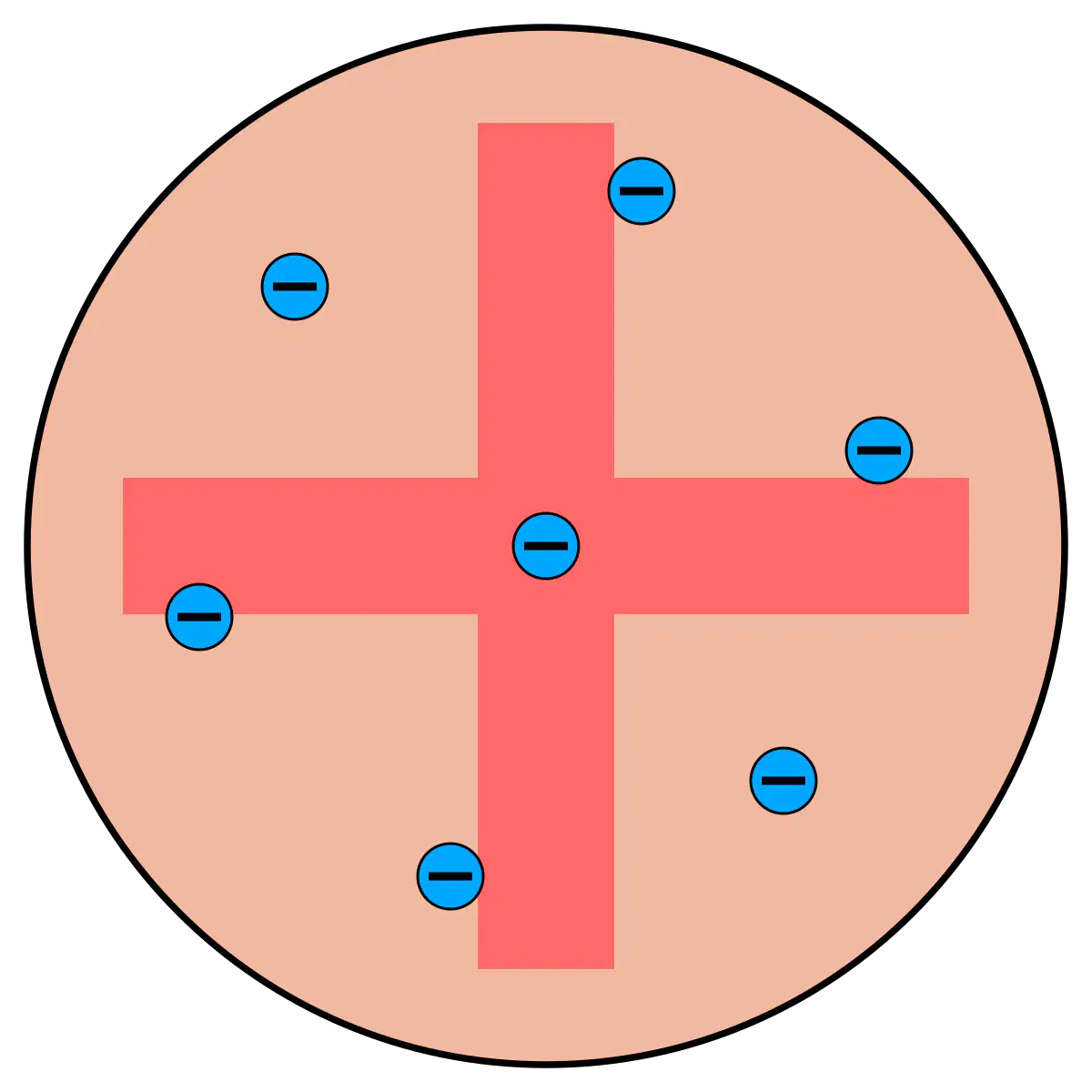
Which scientist proposed the 'plum pudding' model of the atom.
Neils Bohr
James Chadwick
Ernest Rutherford
JJ Thomson
Type of bond found between a metal and a non-metal element.
Ionic
Covalent
Metallic
Elements which are unreactive have a FULL outer shell of electrons. Which group on the periodic table does this apply to?
Group 1 (Alkali metals)
Group 7 (Halogens)
Transition metals
Group 0 (Noble gases)

