
NEW
Font size
 Worksheets
Genetics Unit Practice
Total questions: 33
Worksheet time: 39mins
The basic physical and functional unity of heredity
Gene
DNA
chromosome
allele
A single, highly organized and structured piece of DNA
Chromosome
DNA
Gene
Allele
A molecule containing information that forms the hereditary material of all cells
DNA
Gene
Allele
Chromosome
The science of how genetic information is transferred from parent to offspring
Genetics
Heredity
Gene
Purebred
The exact genetic information
Genotype
Phenotype
Heredity
The transfer of genetic information from parent to offspring
The exact genetic information carried by an individual
The science of how genetic information is transferred from parent to offspring
The physical expression of a gene or set of genes;
Genotype
Phenotype
Asexual reproduction and sexual reproduction both involve one parent
Sexual reproduction involves making clones and asexual reproduction creates diverse/different offspring
Asexual reproduction creates clones and sexual reproduction creates diverse/different offspring
True or False:
We get 1/2 of our genes from our mother and 1/2 of our genes from our father
True
False
According to natural selection, organisms more suited to their environment are better able to
Sleep
Survive
Perish
Migrate
The process of passing down favorable traits to one's offspring is called
Artificial Selection
Mutations
Evolution
Inheritance
Changes in genetic material are called _____________
Mutations
RNA
Genes
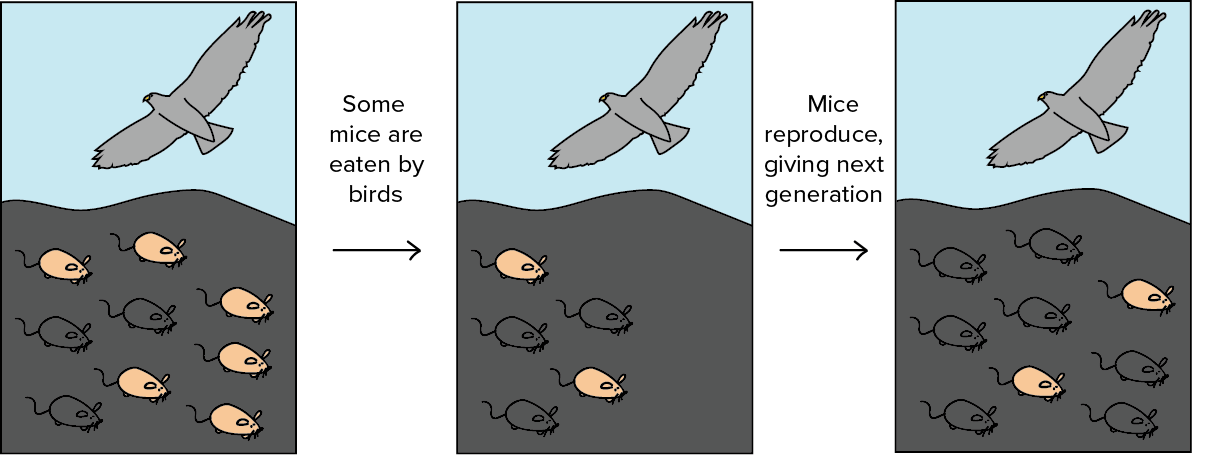
The light mice can reproduce more successfully than the dark mice
The hawks eat more dark mice than light mice because the dark mice taste better
The hawks eat more light mice than dark mice because they can see the light mice more easily
The hawks eat more dark mice than light mice because they can see the dark mice more easily
Which of the following are factors that affect the survival of species?
Overproduction
Variation
Competition
All of the above
Animals compete for resources in the environment. This will affect an organism's survival.
True
False
Selective breeding
organisms better adapted to their environment tend to survive and produce more offspring
process used by humans to develop new organisms with desirable characteristics

Which is an example of selective breeding?
A giraffe's long neck.
Clipping a horse's tail so it's not too long.
Training a horse to run faster.
Cross breeding a labrador retriever with a poodle .
Which statement best describes natural selection?
A lion eating another animal.
A farmer selecting the cows that will breed.
A dog breeder.
A botanist creating a new colored flower.
Which of the following genotypes is homozygous dominant?
A
Aa
AA
aa
Hair color, height, eye color and freckles are examples of human traits. What do we call the physical expression of the genetic material of an organism?
genetics
heredity
genotype
phenotype
The actual or hypothetical form or stock from which an organism has descended is the
ancestor
descendant
A person or animal that is descended from a specific ancestor is the
ancestor
descendant
Organisms of the same species that are at the same level of descent from a common ancestor are part of a
generation
gene pool
genotype
gene
A version or variation of a gene
trait
gene
allele
DNA
Which of the following is the best example of heredity?
A father and child are both very tall
Two friends have very similar freckles
Two brothers practice constantly to be good at basketball
A mother and her child both have the same favorite movie

