
 Worksheets
Histotechnology HML2153 Midterm Review
Total questions: 31
Worksheet time: 2hrs 43mins
The type of microscopy method that allows you to visualize phase objects is called
polarizing microscopy
darkfield microscopy
fluorescent microscopy
phase constrast
The type of aberration where straight lines appeared curved is called
chromatic
lateral chromatic
coma
distortion
Fluorescence Microscopy uses which of the following
fluorescein
polarizer
analyzer
darkfield
The ability to see two objects as distinct is called
resolution
light gathering
power
magnification
Compare darkfield microscopy and bright field microscopy.
The quality of transmitting light unequally in different directions is called
anisotropism
bilateral
birefringence
refraction
In darkfield microscopy, light reflected by the specimen enters the lens.
true
false
Using this dye ____________ , amyloid appears apple green under polarizing microscopy.
fluorescin
gram stain
H&E stain
congo red
Amyloid naturally exhibit this property
birefringence
resolution
aberration
phase objects
Which type of microscopy uses fluorochromes to stain the cells?
polarizing
bright field
dark field
fluorescent
Collagen has the following property.
autofluorescence
crystal structure
double refraction
anisotropism
Which immunofluorescence technique labels the primary antibody?
indirect method
FITC
direct method
fluorochromes
Explain the concept of fluorescence and how it used in fluorescence microscopy works.
Which of the following dyes can be used to label acid fast bacteria?
fluorochromes
gram stain
Auramine-rhodamine
thioflavin
For electron microscopes, the specimen is bombarded with
light
UV light
neutrons
electrons
A surface view with high level of detail is provided by which of the following microscopes?
transmission EM
scanning EM
polarizing microscope
darkfield microscopy

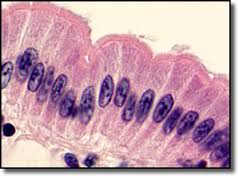


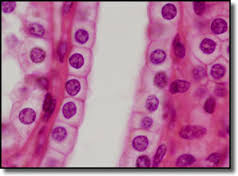


According to the picture, where is the basement membrane?
Apical Side
Columnar Cells
Avascular tissue
Basal Side
Epithelial tissue regenerate really quickly
True
False

