
 Worksheets
Cladograms and Evidence of Evolution
Total questions: 88
Worksheet time: 2hrs 22mins
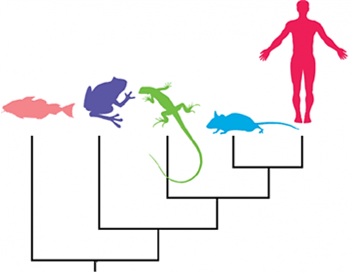
What is the human most closely related to?
Fish
mouse
Salamander
Human

Where is the alligator and T. rex's common ancestor?
Point A
Point B
Point C
Point D
What is the human most closely related to?
Fish
mouse
Salamander
Human
Where is the alligator and T. rex's common ancestor?
Point A
Point B
Point C
Point D
What is the purpose of a cladogram?
To map the ancestral relationships and shared traits of different organisms.
To trace the inherited traits of a single species over time.
To check the likelihood of an offspring having a particular trait.
To monitor mutations that arise among different populations.

What do both the squirrel and lion have in common that the other animals do not?
They are both vertebrates
They both have lungs
They are both mammals
They both lose their canine teeth.

What do amphibians, birds, prosimians and humans all have in common? Check all that apply.
Hair
Endothermic
Eukaryotic
Tetrapod
Vertebrate

Which letter represents the most recent common ancestor of sponges and mushrooms?
A
B
C
D
E

Which trait should go where A is on the cladogram?
eyes
feet
lips
hat

Which organism goes in the B position?


According to the diagram, what is the common ancestor of ALL organisms on the phylogenetic tree?
B
C
D
E

What is the common ancestor of Letters A, B, C, D, E?
1
2
3
4

Using the cladogram, which two organisms are more closely related Lizards and Newts OR Lamreys and Sharks
Newts and Lizards
Lampreys and Sharks

Which trait(s) do conifers have?
vascular tissue only
vascular tissue and seeds
vascular tissue, seeds and flowers
seeds only
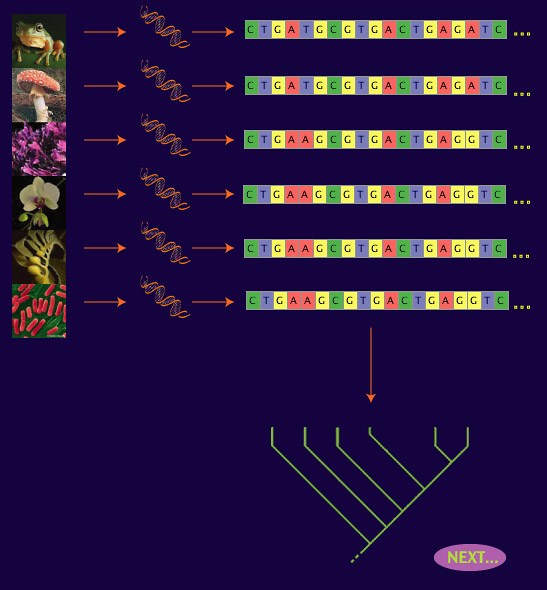
How has technology helped us in understanding evolutionary relationships?
We can travel back in time to observe different organisms in their habitats.
We clone different organisms using DNA from fossils so we can bring them back and observe.
We can now compare the DNA of different organisms to help determine the relationships between them.
We can follow different organisms on Twitter to look for similar traits and characteristics.
How can a cladogram be used to show how closely related two organisms are?
The further apart two organisms are on a cladogram the more they have in common.
If two organisms are next to each other on a cladogram then they must be the same species.
All organisms share a common ancestor.
You can use a cladogram to see how many traits two organisms have in common. The more in common, the more closely related they are.
Which of the following pictures is an example of a cladogram?


According to the tree, who is the closest relative to the human?
Yeast
Pine
Giardia
Fern

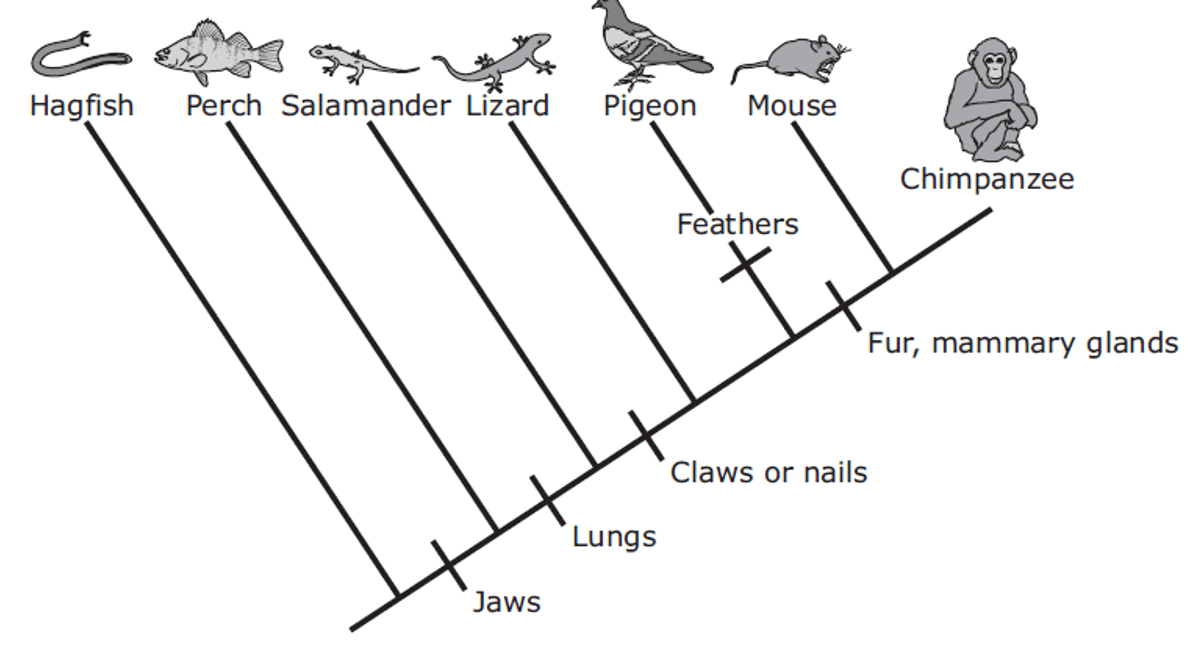
Based on the cladogram, what trait was last developed?
Opposable thumbs
lungs
claws / nails
fur / mammory glands

Which organisms lack tissues?
Roundworms
Flatworms
Cnidarians
Sponges

What is the closest relative of humans shown in this diagram?
horse
turtle
monkey
dog

According to this diagram, is the pig more closely related to the dog or kangaroo?
(a)

What organism on this diagram would have DNA most similar to the penguin?
(a)

Are humans related to tuna?
yes
no

Which species are extinct? (Check all that apply.)
A
D
E
H
J

Which species is a common ancestor for species B and D?
C
F
G
H
K

Which two living organisms are most closely related?
A and B
B and C
C and D
B and D
A and D

Which species are extinct? (Check all that apply)
Asian elephant
Mammoth
Mastadon
Stellar's sea cow
Dugong
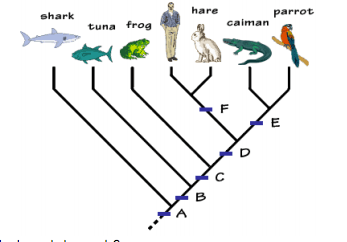
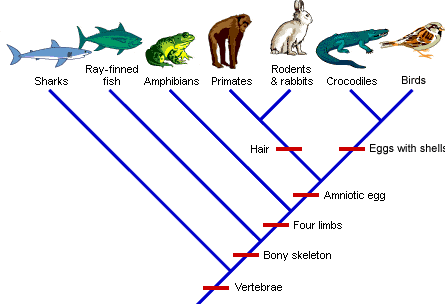
On the cladogram, which organism is the closest relative of the parrot?
Frog
Hare
Caiman
Parrot
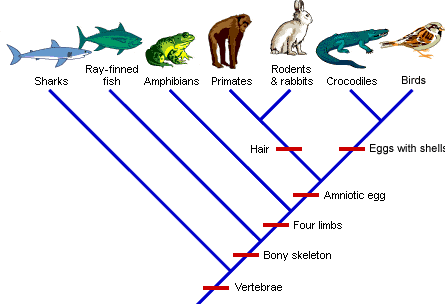
According to this cladogram, primates are most closely related to....
Amphibians
Rodents & rabbits
Crocodiles
Birds

Kangaroos and opossums both carry their immature offspring in pouches. This is evidence of
a common ancestor
living in the same habitat
similar skeletal structures
analogous structures

The system of classification for organisms is called -
taxonomy
evolution
terraformy
cladogram
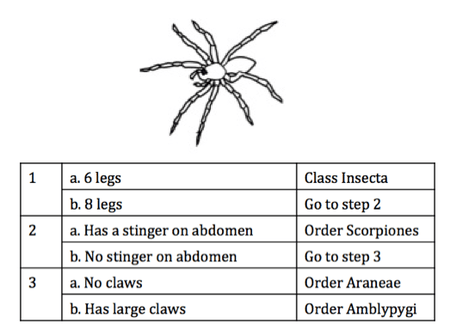


According to the cladogram, which of the following is NOT a derived characteristic?
light bones
Allosaurus
down feathers
3-toed foot; wishbone
According to this phylogenetic tree, which creature is the least related out of all pictured?
Fish
Frog
Salamander
Human

Which two groups of organisms have the MOST genetic DIFFERENCES?
rotifers and nematodes
mollusks and annelids
mollusks and arthropods
echinoderms and chordates

The diagram shows a cladogram of six species based on amino acid similarities. Which two species are MOST CLOSELY related.
I and II
II and IV
I and V
V and VI
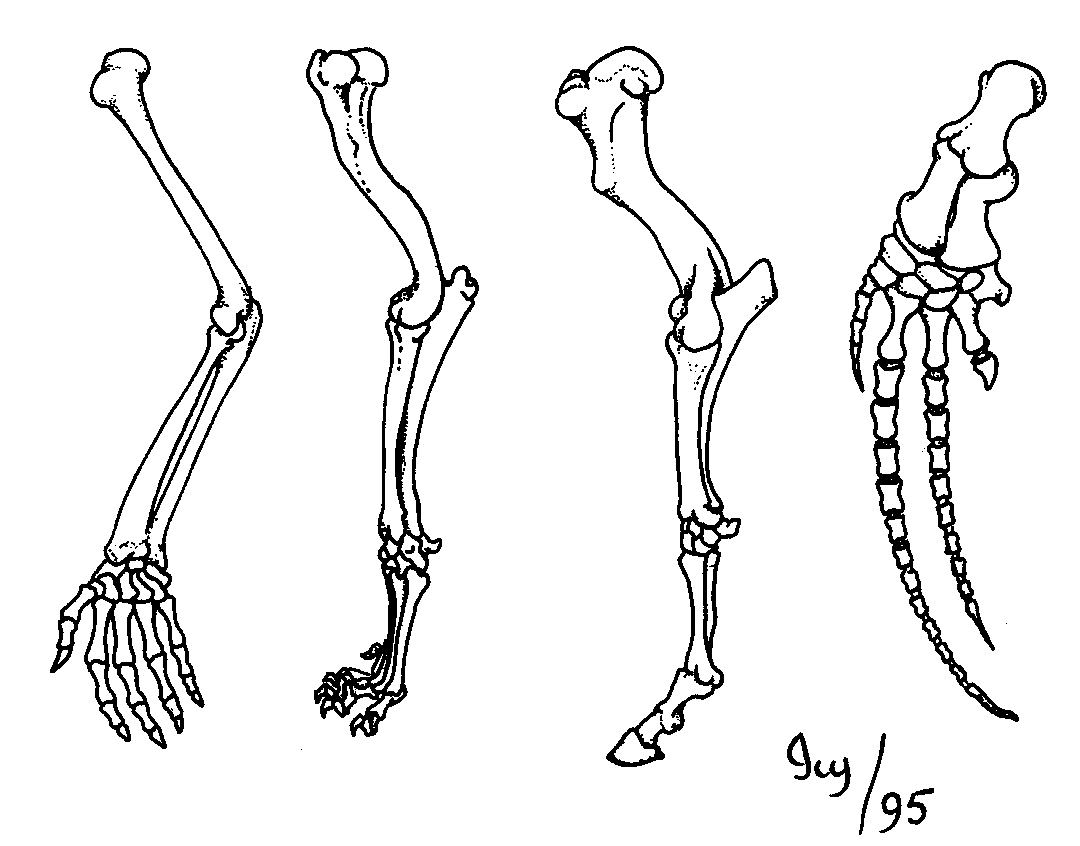


Which of the following can be determined by observing the embryos shown in the diagram

Vestigial structures
structures that perform a similar function but are not similar in origin
remnants of once-important structures that have slowly lost all or most of their function
features found in different organisms that share structural similarities but may have very different functions
preserved remains of an organism


The picture shows a/an ___________
homologous structure
vestigial structure
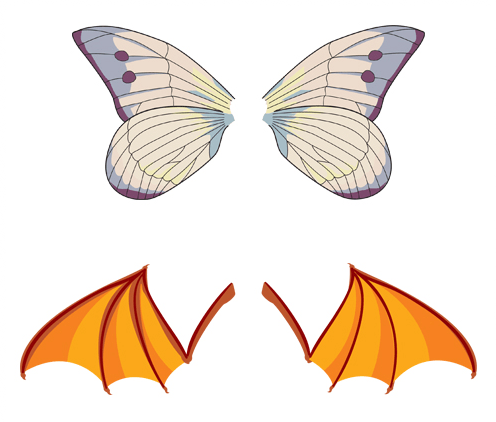
What is this an example of?
Homologous structure
Analogous structure
Vestigial organs
Functional adaption
Which of the following can be determined by observing the embryos shown in the diagram

What best describes the hind leg bones seen in the whale?
The bones are analogous structures to the fins of living fish.
The bones are vestigial structures that had a function in an ancestor.
The bones are homologous structures to the wings of butterflies.
The bones are fossil structures from an extinct ancestor.
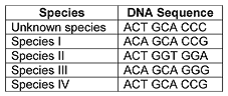




The fossil record help scientists
better understand the kinds of organisms that lived in the past
better understand how the environment has changed over time
better understand how organisms have evolved over time
all of the above
What is common ancestry?
When a species no longer exists
When organisms are descended from a single ancestor

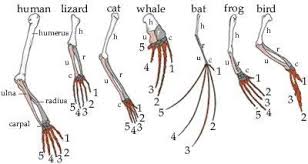
The forelimbs of humans, cats, whales, and bats are similar in structure due to having a common ancestor hundreds of millions of years ago. Is this considered homolgy or analogy?
Homology
Analogy
Which of the following are homologous structures?
whale flipper and bat wing
legs on a beetle and legs on a cat

The cave fish and minnow are related to each other but the cave fish is blind and only has the remnants of an eye. What type of structure is this?
vestigial
analogous
What is an example of a vestigial structure in a human?
liver
appendix
_______________, or selective breeding, is one way that humans impact evolution. One example is how the Belgian Blue cow has been bred to have greater muscle mass.
Artificial selection
Homologous

What can the arm bones of humans and bats show us? That they...
.. shared an ancestor whom had that arm structure
... will eventually evolve into similar creatures
... share a gene pool
Scientists are studying a particular protein found in blood cells. Based on this, which animals are most closely related?
Dog: ARG - LYS - HIS - TYR
Rabbit: ARG - LYS - TYR - TYR
Elk: ARG - PRO - TYR - ARG
Dog & Rabbit
Rabbit & Elk
Dog & Elk

The fossils found closer to the surface of the ground are generally -
(a)
A bat wing and a butterfly wing are both used for flying but they are made differently. What type of structure is this?
Homologous structure
Analogous structure
Vestigial structure
Fossil structure
A human arm and a whale fin have similar bone structure but the whale fin is used for swimming and the arm is used for reaching and grabbing. What type of structures are these?
Homologous structures
Analogous structures
Vestigial structures
Fossil structures
When comparing the DNA of two different organisms, the more differences in the DNA base pairs the more-
Closely related they are.
Distantly related they are.
It doesn't prove anything.
They look alike.

The moth wing and the bat wing are example of structures.
(a)

Which of the pictures above would be examples of homologous structures? (pick 2)
1
2
3

What type of evidence is shown with the diagram above?
Molecular
Anatomical
Embryological
Fossil
The similarities of bone structure in the diagram provide evidence of what?
The organisms probably use there forelimbs for the same thing.
The organisms evolved from a common ancestor.
The organisms have the same DNA.
All vertebrate species have identical forelimbs.
Analogous Structure
Same function different structure
Homologous Structure
Same structure different function
Comparative Embryology
Comparing embryological development of different species
Biochemical Evidence
Comparing DNA and amino acid sequences of different species
Vestigial Structures
Structures in the body of an organism that no longer work.

