
 Worksheets
Economics Practice Quiz (Chapter 1)
Total questions: 60
Worksheet time: 31mins
Scarcity exists because
some people make bad economic decisions.
people take too much leisure time.
the costs of production are high.
some individuals have low income.
human wants exceed the resources available to satisfy them.
Scarcity requires that we
produce efficiently.
learn to limit our wants.
make choices about what goods and services to produce.
have the most rapid economic growth possible.
have unlimited resources.
Which of the following statements BEST describes the study of economics? Economics studies how
firms make profits.
businesses reach decisions.
to organize production so that scarcity does not occur.
to create incentives so that scarcity does not exist.
we make choices in the face of scarcity.
Microeconomics includes the study of the
recessions and inflation in the global economy.
choices made by individuals and businesses.
reasons why the government changes interest rates.
aggregate effects on the national economy.
nationwide unemployment rate.
Which of the following is a microeconomic issue?
The price of gasoline increases in the United States this year.
The U.S. government cuts taxes to combat a recession.
The unemployment rate soars in Spain.
Inflation skyrockets in Russia.
The Brazilian economy experiences rapid economic growth.
Which of the following is a microeconomic topic?
K-Mart's decision to close stores that are not making a profit
Home Depot's choice to hire more full-time employees because its sales increased
Delta Airlines changes its fares.
Which of the following is a microeconomic issue?
Why is the average income lower in Africa than in Latin America?
Why has unemployment risen nationwide?
What is the impact on the quantity of Pepsi purchased if consumers' tastes change in favor of non-carbonated drinks?
Why has economic growth been rapid in China?
Why did overall production increase within the United States last year?
Macroeconomics is the study of
national or global economies.
the actions of individual consumers.
the actions of individual businesses.
how ceteris paribus affects causation.
the government.
Which of the following BEST describes macroeconomics?
It examines how the choices that individuals affect governments.
It analyzes the aggregate effects on the national economy of the choices made by individuals, firms, and governments.
It studies the choices that individuals and businesses make when coping with scarcity.
Proving causation is never a problem for macroeconomics.
It is not a social science because its predictions cannot be tested.
Which of the following is a macroeconomic topic?
China increases interest rates to slow its economic growth.
Congress lowers tax rates to try and lower the unemployment rate.
Nissan decides to produce more electric Leaf models and fewer Altima sedans.
Of the three major economic questions, which of the following is the BEST example of a "What?"
Should automobiles be produced using workers or robots?
What should doctors be paid?
Should we make faster microprocessors or pest-resistant corn?
Should migrant workers or domestic workers be used to pick grapes?
Should higher-income or lower-income people buy SUVs?
When Delta decides to quit flying to Lithuania, it directly answers the ______ question.
what
when
how
why
for whom
When Fresh Express Salads decides to mechanically pick all of its lettuce, it directly answers the ______ question.
when
for whom
how
where
what
The question of "How are goods and services produced?" most closely addresses which of the following issues?
Is income distributed fairly in the United States?
Should Ford build SUVs or luxury cars?
Should Ford use expensive industrial robots or inexpensive Mexican autoworkers to produce SUVs?
Why are Christmas trees popular only in December?
Should contractors build residential housing or shopping malls?
Which economic question depends on the incomes that people earn and the prices they pay for goods and services?
For whom?
Why?
Where?
What?
How?
When a third string NFL quarterback earns more than a police officer, society answers the ______ question.
how
what
why
for whom
social interest vs. self-interest
Canada has nationalized health care, so that everyone, regardless of their ability to pay, has some access to health care. Based on this observation, Canada has decided that "everyone, regardless of their ability to pay" is the answer to what microeconomic question?
For whom will health care be produced?
Why will we offer health care?
Must we offer health care?
How will health care be produced?
What type of health care will be produced and in what quantity?
Self interest reflects choices that are best for the individual who makes them, but cannot be used to determine how goods are produced, has nothing to do with determining what goods are produced, only occurs when wants exceed available resources, or reflects choices that are best for society as a whole?
cannot be used to determine how goods are produced.
has nothing to do with determining what goods are produced.
reflects choices that are best for society as a whole.
reflects choices that are best for the individual who makes them.
occurs only when wants exceed available resources.
If a decision is made and it is the best choice for society, the decision is said to be made in social interest, made in self-interest, consistent with scarcity, a valid economic choice, or a want-maximizing choice?
made in social interest.
made in self-interest.
consistent with scarcity.
a valid economic choice.
a want-maximizing choice.
A rational choice is one that must be made with perfect information, uses the available resources to most effectively satisfy the wants of the person making the choice, always turns out for the best for the decision maker, is made in the social interest rather than the self-interest, or creates no costs for the decision maker?
must be made with perfect information.
uses the available resources to most effectively satisfy the wants of the person making the choice.
always turns out for the best for the decision maker.
is made in the social interest rather than the self-interest.
creates no costs for the decision maker.
Which statement is NOT true about rational choice? It is a choice that uses the available resources to best achieve the objective of the person making the choice, it is the same for all individuals, it involves comparing costs and benefits, it can result in different decisions for different individuals, or it might turn out not to have been the best choice after the event?
It is a choice that uses the available resources to best achieve the objective of the person making the choice.
It is the same for all individuals.
It involves comparing costs and benefits.
It can result in different decisions for different individuals.
It might turn out not to have been the best choice after the event.
In economics, cost is measured as ________, and benefit is measured as ________.
what you are willing to pay on the margin; what the government pays you when you are unemployed or retired
the amount of money that you pay for something; the amount of money that someone else is willing to pay you
what you must give up to get something; what you are willing to give up to get it
what you are willing to give up to get it; what you must give up to get something
the amount of money that you pay on the margin; the amount of money that you receive on the margin
An opportunity cost is
whatever is paid out and cannot be reduced or reversed.
the dollar amount that is paid.
anything the decision maker believes costs to be.
another term for all the sunk costs.
the benefits of the highest-valued alternative forgone.
If Jessie studies economics for two hours instead of going to the movies with her friends, then
Jessie definitely is making a rational choice.
the opportunity cost of studying is the missed movie.
Jessie is not responding to any incentives.
the benefit of studying is the missed movie.
Jessie is ignoring a sunk cost.
Ali decides to attend the one-hour review session for microeconomics instead of working at his job. His job pays him $10 per hour. Ali's opportunity cost of attending the review session is
nothing, because the review session does not cost anything.
the value of the session minus the $10 he could have earned at his job.
the one-hour review session.
equal to the benefit he gets from the review session.
the $10 he could have earned at his job.
The benefit from a good or service that you purchase is measured by
how strong the incentives were that lead to buying the good or service.
what you are willing to give up to obtain the good or service.
the dollar amount that is paid for the good or service.
the dollar amount you can get by selling the good or service.
None of the above answers is correct because there is no way to measure the benefit you receive from purchasing a good or service.
The cost of a one-unit increase in an activity is called the
marginal benefit.
rational cost.
marginal cost.
margin.
opportunity benefit.
The marginal cost of an activity ______ as you do more of it.
changes ONLY IF the marginal benefit of the activity changes
decreases
doesn't change
increases
changes ONLY IF the marginal benefit of the activity does not change
A professor changes the penalty for cheating on exams from getting a 0 on the exam to getting an F in the course. The professor has
increased the marginal cost of cheating.
recognized that students don't make rational choices.
made all the students act in the social interest.
recognized that students don't respond to incentives.
decreased the marginal benefit of cheating.
The benefit of a one-unit increase in an activity
is always greater than the opportunity cost of that activity.
is called rational-choice benefit.
is called marginal cost.
is measured by what you must give up.
decreases as you do more of it.
Suppose you eat two hamburgers for lunch. The marginal benefit of the first burger is _______ of the second burger.
equal to the marginal cost AND the marginal benefit
equal to the marginal benefit
not related to the marginal benefit
larger than the marginal benefit
smaller than the marginal benefit
Decision making on the margin involves
comparing the marginal cost and marginal benefits when making a decision.
determining the total benefits of a decision.
comparing the total cost and the total benefit when making a decision.
comparing the benefits from the social interest to the benefits from the person's self-interest.
eliminating the additional cost when making a decision.
Instead of studying for an additional two hours for the economics final, Leann decides to watch a movie. Leann is making
an irrational decision because studying is more important than watching a movie.
a rational decision if her marginal cost from the movie is greater than her marginal benefit.
a rational decision if her marginal benefit from the movie is greater than her marginal cost.
a decision that does not involve an opportunity cost.
a decision that is not on the margin because she will see the entire movie.
Your economics professor offers 10 points extra credit if you attend a review session before your next exam. This extra credit is an example of
an increase in marginal cost to attend the review session.
an incentive to attend the review session.
a decrease in marginal benefit to attend the review session.
a rational choice.
None of the above answers is correct.
In examining two variables, we find that as one variable changes, the other changes. These variables are said to be
independent
causally related
correlated
significantly related
statistics
A positive statement
makes a statement about how the world operates.
is a true statement.
can be tested against the facts.
"Lower ticket prices would lead to more people attending ballgames." This statement is a
macroeconomic statement
statement that confuses marginal cost and sunk cost
statement assessing the social interest versus the private interest
normative statement
positive statement
Normative statements
describe how the world is.
describe how the world ought to be.
depend on people's values and cannot be tested.
A statement that "All children should receive free health care" is an example of what kind of statement?
a natural experiment statement
a fair statement
a positive statement
a statement on the margin
a normative statement
A scatter diagram can be used to see
if a relationship exists between two variables
if the value of a variable is rising or falling
whether a variable is positively or negatively related to itself
the value of a variable for different groups in a population
how a variable behaves over time
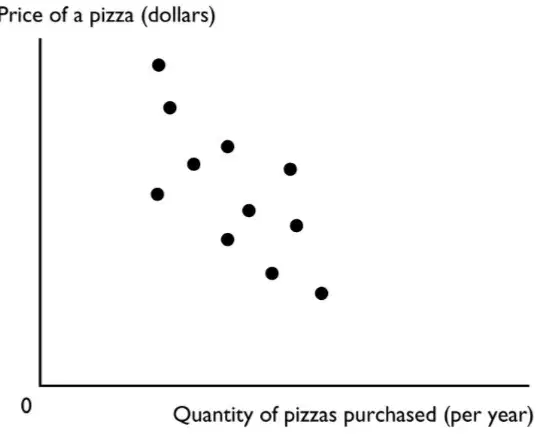
The figure above shows a .
cross-section graph.
time-series graph.
slope.
trend diagram.
scatter diagram.
A time series graph .
uses bars rather than lines.
is in the shape of a pie.
shows how a variable changes over time.
is similar to a cross-section graph because both can show trends over time.
shows points in a scatter diagram.
A steep slope in a time series graph means the variable is .
rising or falling quickly.
rising or falling slowly.
very close to its trend point.
high.
falling.
A time series graph reveals whether there is a , which represents .
trends in two variables; unrelated variables
cross-section relationship; a general tendency for the variables to rise or fall
trend in a variable; a general tendency for the variable to rise or fall
relationship between two variables; a trend in a variable
relationship between two variables; a cross-section relationship
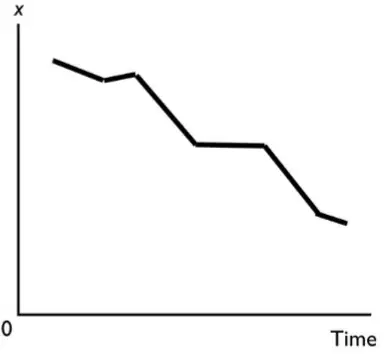
In the above figure, the diagram shows
an upward trend in x.
a two-variable scatter diagram.
a downward trend in x.
a scatter diagram.
a cross-section graph between x and time.
A cross-section graph
is divided into different sections.
measures time on the x-axis and the variable in which we are interested on the y-axis.
shows the values of an economic variable for different groups in a population at a point in time.
Both answers A and C are correct.
Both answers A and B are correct.
A graph shows the average wage of various demographic groups in 2012. The kind of graph used to show these data would be a
Venn diagram.
fixed-year figure.
time-series graph.
scatter diagram.
cross-section graph.
If two variables are positively related, then
an increase in one variable is accompanied by a decrease in the other.
one variable causes the other.
neither variable can be positively related to any other variable.
they change together, but not necessarily in the same direction.
an increase in one variable is accompanied by an increase in the other.
If x increases and as a result y decreases, then x and y are
not related because the relationship is a causal one.
trend-line related.
directly related.
negatively related.
positively related.
If the change in y = -4 and the change in x = 2, there is
a positive relationship between y and x.
an independent relationship between y and x.
no relationship between y and x.
a negative relationship between y and x.
a relationship between x and y but more information is needed to determine if it is a negative or positive relationship.
If two variables are unrelated, their graph is
either a horizontal or a vertical line.
a curved line.
an upward-sloping line.
a downward-sloping line.
None of the above answers is correct because it is not possible to graph unrelated variables.
A graph shows the price of a pound of cucumbers on the vertical axis and the quantity of new cars sold by Honda on the horizontal axis. The price of a pound of cucumbers remains constant as the quantity of new cars sold increases. The graph of these data is a
horizontal line.
vertical line.
negatively sloped line.
curve with a maximum.
positively sloped line.
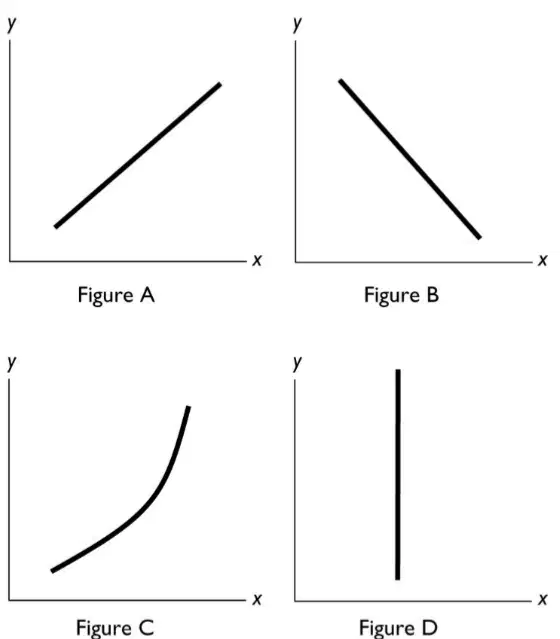
In the diagram above, which figure(s) show(s) an inverse relationship between the variables?
only B
only D
both B and C
both A and C
only C
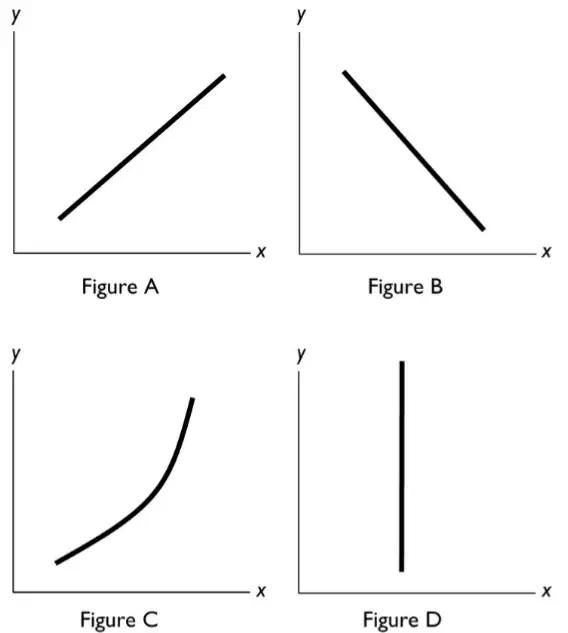
In the diagram above, which figure(s) show(s) no relationship between the variables?
only D
both A and C
both A and B
both B and C
only B
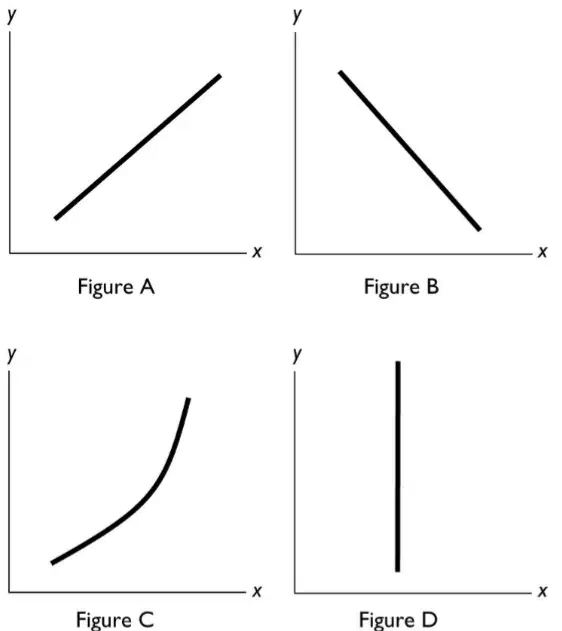
In the diagram above, which figure(s) show(s) a direct relationship between the variables?
only A
both A and C
only B
both B and C
only D
As a curve approaches a maximum point, the slope will
remain constant on either side of the maximum point.
decrease before and after the maximum point.
be negative and then positive after the maximum point.
be positive and then negative after the maximum point.
increase before and after the maximum point.
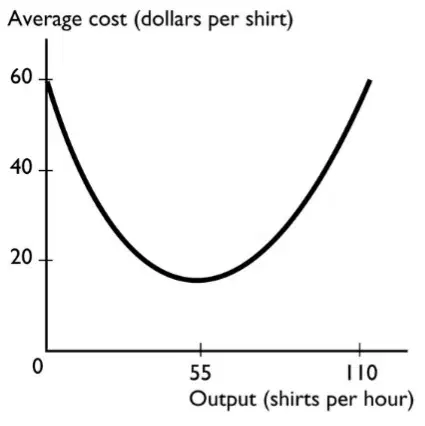
The graph shows
a cross-section relationship.
a relationship with a minimum.
a relationship with a maximum.
no relationship.
a relationship that becomes less steep.
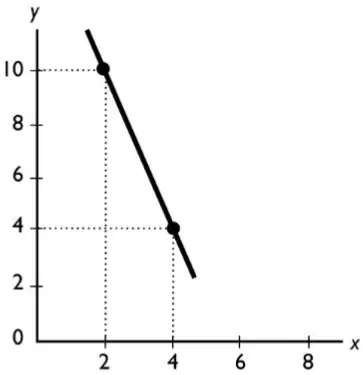
The slope of the line shown in the above figure is
-3
-5
-1
-1/3
-10
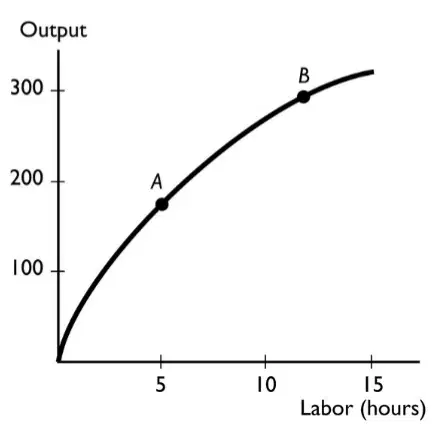
The slope of the curve at point B
is equal to the slope at point A.
is greater than the slope at point A.
is less than the slope at point A.
cannot be compared with the slope at point A.
can be compared with the slope at point A, but more information is needed to determine if the slope is greater than, less than, or equal to the slope at point A.
Which of the following statements is the best example of the term ceteris paribus?
An economist holds other factors constant when he examines the relationship between tax rates and tax revenues.
More money should be spent on cleaning up the environment.
An increase in the budget surplus after an increase in tax rates implies that tax rate increases cause budget surpluses.
When studying the effects of a budget deficit, an economist must take account of all the factors involved.
The government budget surplus was $200 billion in 2000 because the economy was growing.

