wayground logo

Free Printable Worksheets

Font size

S
M
L
XL
Worksheets

Genetics Test Prep

Total questions: 65

Worksheet time: 40mins

Name
Class
Date
1.

What are the 3 parts of a DNA nucleotide? (Check all that apply)

a)
phosphate group
b)
deoxyribose sugar
c)
nitrogen base
d)
mRNA
e)
amino acid
2.

Which of the following are ways that DNA differs from RNA? (mark three answers)

a)
the number of strands
b)
the type of sugar
c)
the bases used
d)
the number of bases
3.

Which of the following are possible bases found in DNA? (choose four)

a)
cytosine
b)
thymine
c)
adenine
d)
uracil
e)
guanine
4.

In the double helix shape of the DNA molecule, the rungs of the ladder are made of

a)
nitrogen bases.
b)
deoxyribose sugar.
c)
phosphate groups.
d)
amino acids.
5.

A set of three nitrogen bases on an mRNA strand is called a(n)

a)
codon
b)
anticodon
c)
nucleotide
d)
amino acid
6.

The process of forming an RNA strand from a DNA strand is called

a)
replication
b)
transcription
c)
translation
d)
mutation
7.

The type of RNA that carries / transfers an amino acid on one side is called

a)
tRNA
b)
mRNA
c)
cRNA
d)
rRNA
8.

Which of the following is a complementary DNA strand for this one: TACTGG

a)
TACTGG
b)
ATGACC
c)
UACUGG
d)
AUGACC
9.

What is the tRNA anticodon for this codon: AUG?

a)
UAC
b)
AUG
c)
TAC
d)
Met
10.

A long string of amino acids together is called a
a)
peptide bond.
b)
polypeptide chain.
c)
triploid.
d)
ribosome.
11.

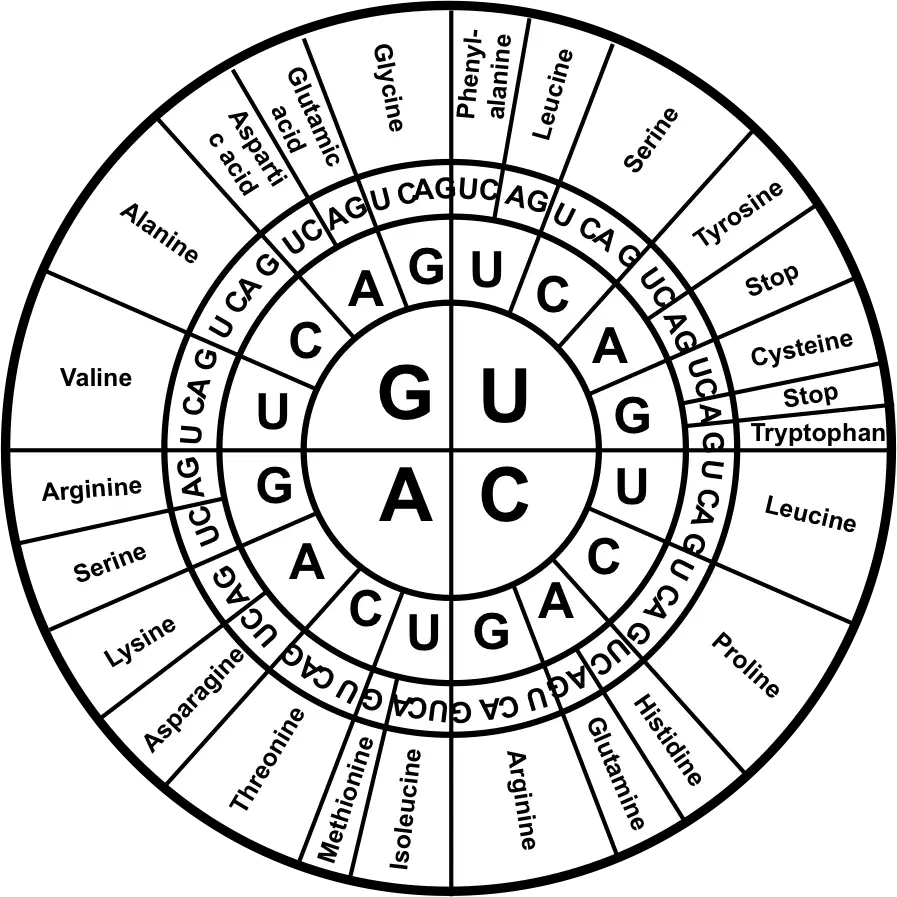
Use the following codon chart to determine the string of amino acids created from this mRNA strand: GGC AGA UUU CAG

a)
Gly-Arg-Phe-Glu
b)
Pro-Arg-Lys-Glu
c)
Gly-Ala-Phe-Leu
d)
Pro-Ala-Lys-Leu
12.
Which of the following scientists was NOT helpful in determining the shape and structure of a DNA molecule?
a)
Francis Crick
b)
James Watson
c)
Rosalind Franklin
d)
Erwin Schrödinger
13.
Which of the following is NOT a possible base in DNA?
a)
uracil
b)
cytosine
c)
guanine
d)
thymine
e)
adenine
14.
Which of the following is NOT part of a DNA nucleotide?
a)
nitrogen base
b)
deoxyribose sugar
c)
ribose sugar
d)
amino acids
e)
phosphate group
15.
In DNA, the base that is complementary to guanine is:
a)
uracil
b)
cytosine
c)
thymine
d)
adenine
16.
A segment of DNA that codes for a protein is called a
a)
chromosome
b)
gene
c)
nucleotide
d)
amino acid
17.
Which of the following is NOT found within a chromosome?
a)
histones
b)
genes
c)
nitrogen bases
d)
ribosomes
18.
Which enzyme is responsible for adding new bases to a DNA strand during replication?
a)
helicase
b)
ligase
c)
catalase
d)
DNA polymerase
19.
Which of the following is NOT a correct match for a type of RNA and its function?
a)
mRNA - is a copy of the DNA sequence
b)
tRNA - transfers the DNA sequence to the ribosome
c)
rRNA - makes up ribosomes
d)
All of the above are correct matches.
20.
All of the following can be found in a finished mRNA strand except:
a)
introns
b)
nitrogen bases
c)
codons
d)
exons
21.
In eukaryotic DNA, the strands are ______________ and have ____________ origin point(s).
a)
linear; multiple
b)
linear; one
c)
circular; multiple
d)
circular; one
22.
In eukaryotic DNA, the strands are ______________ and have ____________ origin point(s).
a)
linear; multiple
b)
linear; one
c)
circular; multiple
d)
circular; one
23.
The bonds used to hold nitrogen bases together on the two sides of a DNA strand are
a)
hydrogen bonds
b)
peptide bonds
c)
nuclear bonds
d)
ionic bonds
24.
What is a codon?
a)
A sequence of 3 nitrogen bases on an mRNA strand.
b)
A sequence of 3 nitrogen bases on a tRNA molecule.
c)
A sequence of 5 nitrogen bases on an mRNA strand.
d)
A sequence of 5 nitrogen bases on a tRNA molecule.
25.
Which of the following is NOT true of ribosomes?
a)
They are the site of transcription.
b)
They are found in the cytoplasm.
c)
They are made of rRNA.
d)
They assemble amino acids into polypeptide chains.
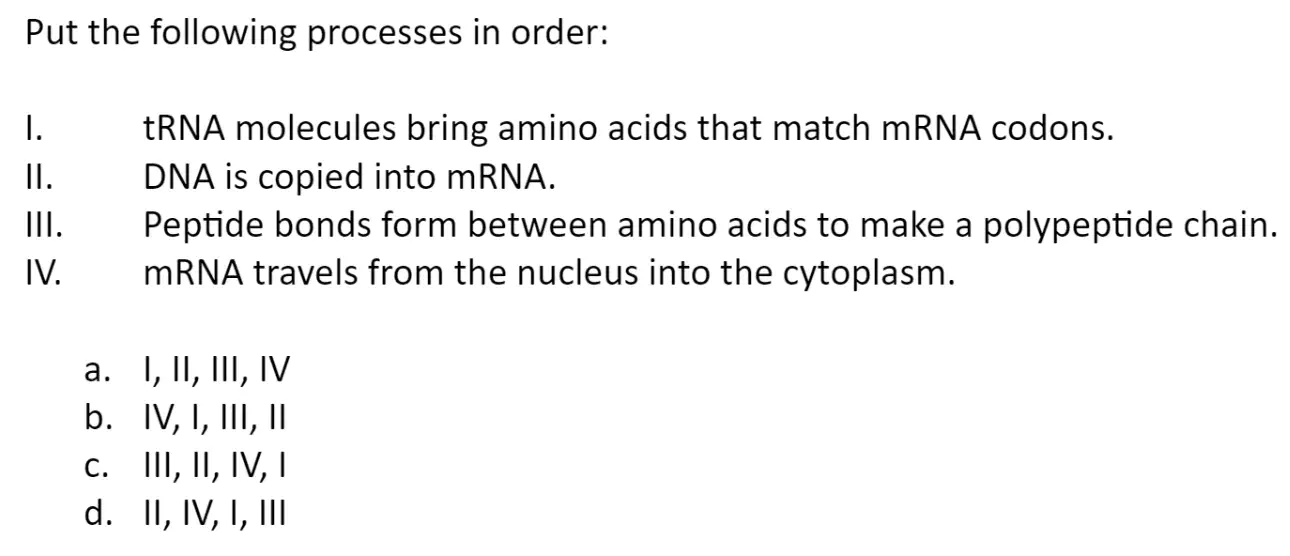
26.
a)
a. I, II, III, IV
b)
b. IV, I, III, II
c)
c. III, II, IV, I
d)
d. II, IV, I, III
27.
Gene regulation in eukaryotic cells
a)
is simpler than that of prokaryotic cells.
b)
involves transcription factors.
c)
uses an operator to switch genes on and off.
d)
is required to keep all cells identical.
28.
In this illustration, the promoter would be found in
a)
region A
b)
region B
c)
either could be the promoter
29.
A mutation that only involves one nucleotide is known as a
a)
point mutation
b)
frameshift mutation
c)
translocation
d)
nonsense mutation
30.
Which of the following would definitely NOT cause a frameshift mutation?
a)
substitution
b)
deletion
c)
insertion
d)
All of the above would cause frameshift mutations.
31.
When translation stops early because of a mutation, this is known as
a)
a silent mutation.
b)
a missense mutation.
c)
a nonsense mutation.
d)
an inverse mutation.
32.
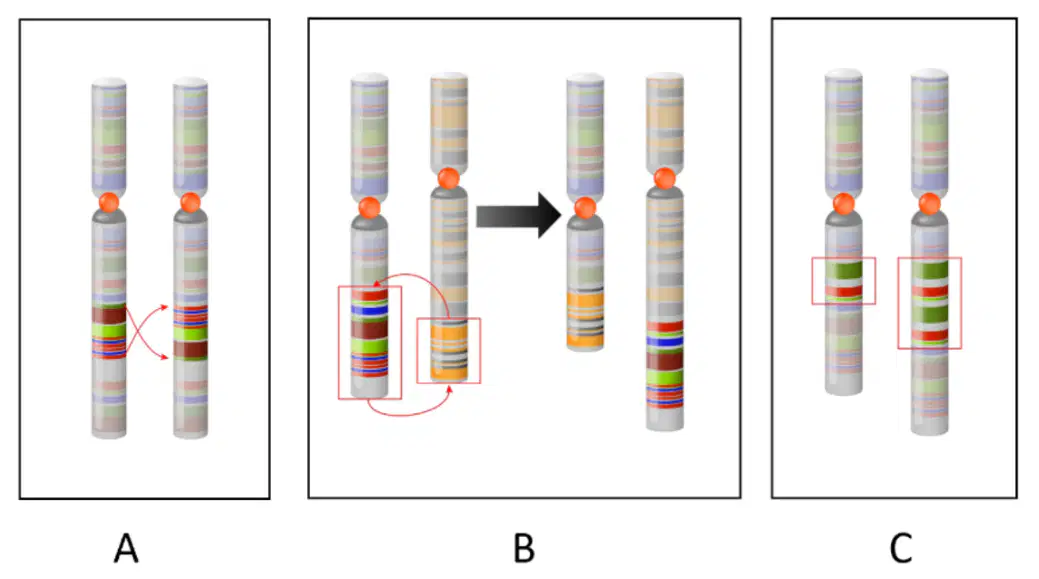
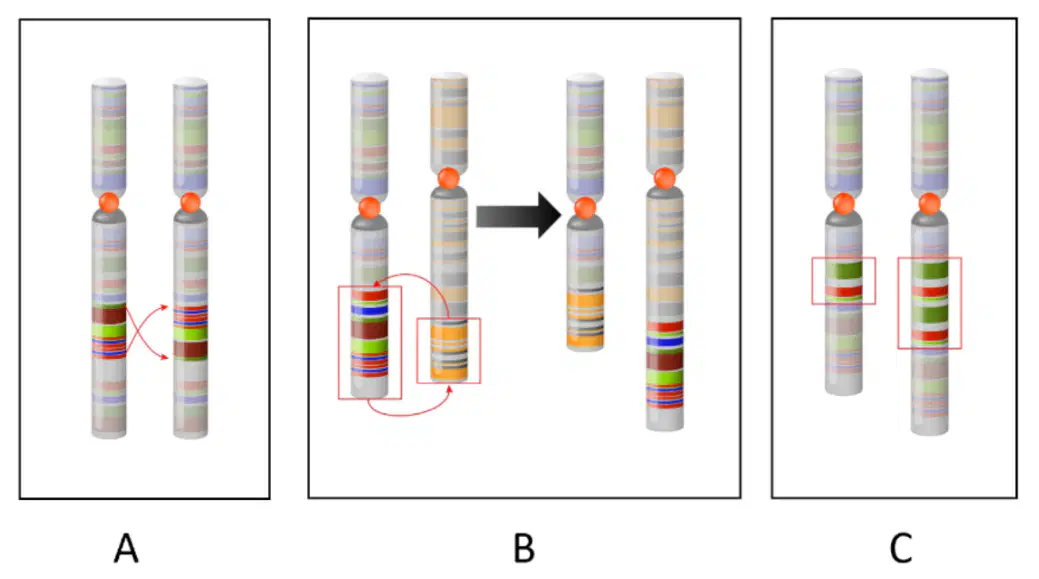
In this image, translocation is shown in box
a)
A
b)
B
c)
C
33.
In this image, duplication is shown in box
a)
A
b)
B
c)
C
34.
mRNA is needed as a go-between because DNA must remain protected in the _____, but proteins are made outside of the nucleus in the _____.
a)
nucleus; ribosomes
b)
cytoplasm; ribosomes
c)
nucleus; chloroplast
35.
If the percentage of guanine in an organism’s DNA was 20%, what would you expect the percentage of adenine to be?
a)
30%
b)
20%
c)
80%
36.
Gene regulation allows cells to ________ while using the same DNA and prevents wasteful production of unnecessary _________.
a)
specialize; proteins
b)
divide; oxygen
c)
generalize; hydrogen bonds
37.
True or False: Rosalind Franklin's x-ray crystallography image, called Photo 51, was viewed by Watson and Crick without her permission.
a)
true
b)
false
38.

What does DNA determine?

a)

traits of living things

b)

traits of nonliving things

c)

organization of living things

d)

Did Not Attempt

39.

What did Avery (The Scientist) discover about DNA?

a)

DNA stores and transmits the genetic information from one generation of an organism to the next.

b)

DNA has a look of a double Helix

40.

Where is Eukaryotic DNA generally located?

a)

In the cytoplasm

b)

In the nucleus

c)

In space

41.
If we think of DNA as a ladder, which parts are the steps of the ladder?
a)
the nitrogenous base pairs
b)
the phosphate-sugar backbone
c)
the genes
d)
the phospholipid bilayer
42.
If we think of DNA as a ladder, which parts are the sides of the ladder?
a)
the nitrogenous base pairs
b)
the phosphate-sugar backbone
c)
the genes
d)
the phospholipid bilayer
43.
Which of the following best describes a DNA molecule?
a)
double helix
b)
contains ribose
c)
made of amino acids
d)
contains uracil
44.
What determines the code, or information, of a DNA molecule?
a)
the shape (structure) of the nitrogen bases
b)
the order (sequence) of the nitrogen bases
c)
the color of the nitrogen bases
d)
the frequency (number) of nitrogen bases
45.
The two strands of nitrogenous bases in DNA are joined by which type of bond?
a)
polar bonds
b)
ionic bonds
c)
covalent bonds
d)
hydrogen bonds
46.

A process in which DNA has the unique ability to make an exact copy of itself.

a)

Replication

b)

Translation

c)

Transcription

d)

Protein Synthesis

47.
Who was given credit for determining the shape of DNA? 
a)
Avery
b)
Watson and Darwin
c)
Watson and Crick
d)
Franklin and Crick
48.
X outlines a(n) ___________.
a)
amino acid
b)
nitrogen base 
c)
nucleotide
d)
nitrogen base pair
49.
The molecule pictured is a monomer of _______.
a)
RNA
b)
DNA
c)
a carbohydrate
d)
a protein
50.
Genetic info flows in one direction. Which best represents this flow?
a)
DNA-protein-RNA
b)
Protein-RNA-DNA
c)
RNA-protein-DNA
d)
DNA-RNA-protein
51.
Where does transcription take place?
a)
nucleus
b)
ribosome
c)
cytoplasm
d)
smooth ER
52.
The anticodon is located on 
a)
DNA
b)
mRNA
c)
tRNA
d)
rRNA
53.

In RNA, Uracil pairs with ______.

a)

cytosine

b)

adenine

c)

guanine

d)

thymine

54.
The process to go from DNA to mRNA is _______
a)
translation
b)
transcription
c)
replication
55.

DNA holds the code for

a)

lipids

b)

carbohydrates

c)

proteins

d)

sugars

56.
The main function of tRNA is to...
a)
carry a message that, when translated, forms proteins
b)
form a portion of ribosomes
c)
string together complementary RNA and DNA strands
d)
bring amino acids from the cytoplasm to the ribosomes
57.

What process is going on in this photo?

a)

Transcription

b)

Translation

c)

Replication

d)

All the above

58.
The DNA sequence ATCAGCGCTGGC is part of a gene. How many amino acids are coded for by this message?
a)
4
b)
8
c)
12
d)
20
59.
DNA sequence is ACAGTGC. How would this be coded on mRNA?
a)
TGTCACG
b)
UGUCACG
c)
GUGACAU
d)
CACUGUA
60.
Carries the genetic code to the ribosome
a)
mRNA
b)
tRNA
c)
rRNA
d)
DNA
61.
The process of making changes in the DNA code of a living organism is called
a)
selective breeding 
b)
genetic engineering
c)
inbreeding
d)
hybridization
62.

What was the name of the movie we watched about DNA and genetic engineering?

a)

GATTACA

b)

Jurassic Park

c)

The Bourne Identity

d)

Vincent's Fire

63.

What branch of biology is concerned with collecting genome sequences of endangered animals, like the koala?

a)

conservation biology

b)

historical biology

c)

genetic engineers

d)

biochemistry

64.

Koalas can survive eating toxic eucalyptus leaves because their DNA codes for ________ that are enzymes which allow them to break down the toxins.

a)

proteins

b)

hydrogen bonds

c)

nucleic acids

d)

ribosomes

65.

Traits are coded for in ___.

a)

DNA

b)

text

c)

ribosomes

d)

rRNA