
Font size
 Worksheets
Module 1 Review ("Classification and States of Matter")
Total questions: 35
Worksheet time: 55mins
The measure of the average kinetic energy of the particles in a material is ___________.
temperature
kinetic energy
potential energy
thermal energy
The result of the motion of all the particles, and the distance and attractions between those particles in the system is ___________.
temperature
kinetic energy
potential energy
thermal energy
Put each state in order from particles closest together to particles farthest apart.
Solid
Liquid
Gas
Which state of matter does not have a definite shape but does have a definite volume?
Solid
Liquid
Gas
In which state of matter are there very weak attractions between particles?
Solid
Liquid
Gas
The forces of attraction between the particles of a matter sample are strong and draw particles together, keeping them in their place. This is an example _____.
of the liquid state of matter
of the solid state of matter
of the gaseous state of matter
of matter not existing
The sum of all the potential energy and kinetic energy of an object equals its _____.
thermal energy
potential energy
kinetic energy
force
When a liquid boils, its particles get ____. This may be due to the ____ in pressure.
further apart; decrease
closer together; decrease
further apart; increase
closer together; increase
Of the 3 types of temperature scales, which is most used by scientists:
Fahrenheit
Celsius
Kelvin
all are used equally
What is the periodic table of elements?
A system that shows the elements and abbreviations and is organized in columns and rows.
A list of chemical reactions.
A manual for laboratory equipment.
A textbook for chemistry.
Which of these is not an element?
Water (H2O)
Copper (Cu)
Carbon (C)
Iron (Fe)
In a chemical formula, the number of each type of atom in the compound is shown with numbers that are ____.
subscripts
chemical symbols
superscripts
oxidation numbers
What does Charles's Law state about the relationship between the volume of a gas and its temperature, assuming constant pressure?
The volume of a gas decreases with increasing temperature.
The volume of a gas increases with increasing temperature.
The volume of a gas is not affected by changes in temperature.
The volume of a gas decreases as the pressure increases.
In a gas, which quantities relate in such a way that when one increases, the other one decreases?
temperature, pressure
temperature, volume
number of particles, pressure
volume, pressure
Explain why heat transfer between a mug of hot cocoa and your hands is an open system.
Because energy is not exchanged with the environment.
Because energy is released into the environment.
Because the system is completely isolated from its surroundings.
Because only matter is exchanged with the environment.
What is the process that turns a gas into a liquid?
melting
freezing
vaporization
condensation
What is the process that turns a solid into a liquid?
melting
freezing
vaporization
condensation
What is the process that turns a liquid into a solid?
melting
freezing
vaporization
condensation
What is the process that turns a liquid into a gas?
melting
freezing
vaporization
condensation
What is the unit of measurement for gas pressure?
atm (atmosphere)
degree
Boyle
Newton
What does Boyle’s Law state, when temperature is constant?
The pressure of a gas increases if the volume increases
The pressure of a gas increases if the volume decreases
The volume of a gas decreases if the pressure decreases
The amount of gas and its volume at constant temperature
Why does the pressure of an air mattress increase when you pump air into it?
Because the volume of the mattress decreases
Because the temperature of the air increases
Because more air molecules are forced into the same volume
Because the air molecules move slower
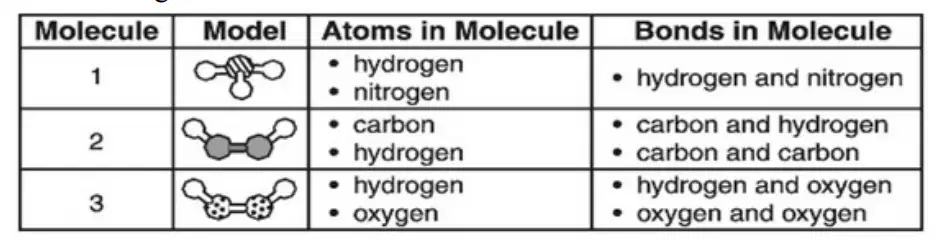
The table shows three models that represent a different molecule each. Information on each molecule is given in the table.
Match each element to the atom model used to represent it.
hydrogen
white sphere
nitrogen
striped sphere
carbon
gray sphere
oxygen
dotted sphere
In general, metals are ____ since they are composed of individual atoms or small molecules.
brittle
good conductors of heat
poor conductors of heat
poor conductors of electricity
In general, nonmetals are ____ since they are composed of individual atoms or small molecules.
good conductors of electricity
malleable and ductile
gases at room temperature
good conductors of heat
A tendency to break rather than flex or bend.
Brittle
Luster
Metals
Matter
The ability of something to be reshaped without breaking; ability of a substance to be hammered or flattened into thin sheets.
Luster
Matte
Brittle
Malleability
Is the following compound ionic or covalent?
A material that has a low melting point
Ionic
Covalent
Is the following compound ionic or covalent?
A material with a high melting point
Ionic
Covalent
Is the following compound ionic or covalent?
A material that is hard and brittle
Ionic
Covalent
When dissolved in water, the solution is a poor conductor of electricity.

The following properties are all characteristics of ionic compounds EXCEPT
high melting and boiling points
soft
crystal lattice structure
conduct electricity when dissolved in water
True or False: Ionic compounds are usually liquids at room temperature.
True
False

