
 Worksheets
Biology Evil Review
Total questions: 64
Worksheet time: 2hrs 3mins
Reorder the following from least to greatest (from left to right).
organism
population
community
ecosystem
biome

What level of ecological organization does the bird represent?
Organism
Population
Community
Ecosystem
(a) - Organisms that have similar features and can reproduce.
(b) - A group of the same species that live in a certain area.
(c) - A combination of all the different populations that live and interact in the same environment
(d) - All the living and non-living things that interact in one specific part of the environment.
Label the following prokaryotic cell.

The DNA of these cells is found in the Nucleus
Prokaryotic
Eukaryotic
Both
These cells have no nucleus
Prokaryotic
Eukaryotic
Both
A virus is
living
non living
dead
Viruses need a ____________ in order to make copies of themselves.
bacterial cell
host cell
capsid
vaccine
Which cycle kills the host cell immediately?
Lytic
Lysogenic
During which cycle does a virus's genetic information become a part of the host cell's genetic information?
Lytic
Lysogenic
Which biomolecule has amino acids as their monomer?
Carbohydrate
Nucleic acid
lipid
protein
Match the following functions to the biomolecule
Act as hormones
Lipid
Build muscle
Protein
Carry genetic information
Nucleic acid
Energy source (cellular respiration)
Carbohydrate
Which biomolecules provide quick energy for the cell and also provide materials to build the cell membrane/wall?
Carbohydrates
Proteins
Lipids
Nucleic Acids
Which biomolecules contains your genetic information?
Proteins
Lipids
Carbohydrates
Nucleic Acids
Which biomolecules act as Long Term Energy Storage for the cell and also cushions and insulates organs?
Carbohyrdates
Lipids
Proteins
Nucleic Acids
Cells of organisms must go through cell division for?
growth
repair of damaged cells
replacement of dying cells.
All of these
DNA is replicated during ______ of the cell cycle.
Gap 1
Synthesis (S phase)
Gap 2
Gap 0
Label the parts of the Cell Cycle
G1
S phase
G2
Mitosis
Match the image to the correct answer

Prophase

Metaphase

Anaphase

Telophase

Cytokinesis


The D in DNA stands for
double stranded
deoxyribo
denature
dicarbo
Which of the following is NOT part of a nucleotide
sugar
phosphate
nitrogen base
amino acid
The backbone of DNA is made of
base pairs
sugars and phosphates
only sugars
only phosphates
The two strands of DNA are held together with
covalent bonds
hydrogen bonds
nothing
CAT TCA CTG

In the punnett square below, what belongs in the missing square

What goes in box 15
aabb
AABB
aaBB
AAbb

Based off this punnett square, what fraction of the offspring will have wrinkled, yellow seeds?
9/16
3/16
1/16
16/16


The study of organisms at their earliest stage of life
embryology
the fossil record
DNA
vestigial structures

Polar bears live in the Arctic. Ice in the Arctic in melting rapidly, reducing the range in which the polar bear can live. If polar bears do not have adaptation that allow them to survive these changes, what might happen to them?
become another speices
overpopulation
change the enviornment
become extinct
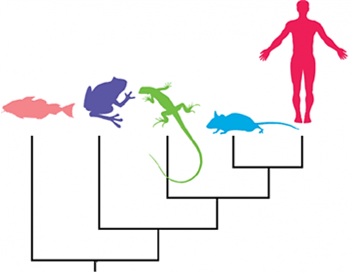
What is the human most closely related to?
Fish
mouse
Salamander
Human

Where is the alligator and T. rex's common ancestor?
Point A
Point B
Point C
Point D

The science of describing, classifying, and naming living things is called:
Geology
Biology
Taxonomy
Chemistry

The scientific name for an organism is made from the:
class and family name
genus and species name
domain and kingdom name
kingdom and phylum name

What is the correct order of taxonomy?
Kingdom, pylum, class, species, genus, family, class
Species, genus, family, order, class, phylum, kingdom
Kingdom, phylum, class, order, family, genus, species
species, phylum, order, class, kingdom, family, genus
What kingdom is a mushroom in?
PLANT
FUNGI
PROTIST
MUSHROOM

Organisms in this smallest taxonomic group share many characteristics and are so closely related that they can even reproduce with each other.
domain
kingdom
species
class

What helps pollen move form one plant to another?
hummingbirds
bees
butterflies
all of the above
After being pollinated, a flower will produce a _______.
seed
another flower
magic spell
bird
the transfer of pollen from flower to flower to make a new seed
seed dispersal
pollination

Animals disperse seeds by
eating food with seeds and pooping them out
burying them
seeds sticking to them
all of the above

