
Font size
 Worksheets
waves revision
Total questions: 128
Worksheet time: 3hrs 12mins





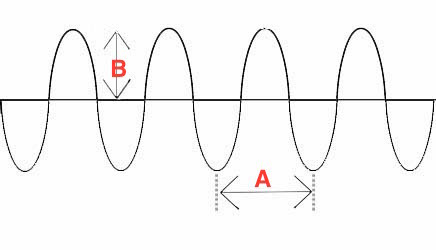
The speed of propagation of a transverse wave on a 2.0-m long string fixed at both ends is 200 m/s. Which one of the following is the frequency of this string?
25 Hz
50 Hz
100 Hz
200 Hz

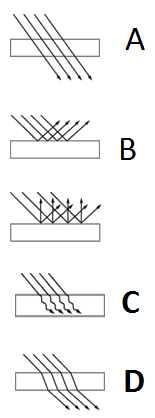


What does pitch depend on?
amplitude
frequency
intensity
volume of sound

What is the speed (velocity) of a sound wave with frequency 2000 Hz and wavelength 0.4 m?
5×10³ m/s
3.2×10² m/s
2×10⁻⁴ m/s
8×10² m/s
Criteria A: Explain with your owns words what is a wave

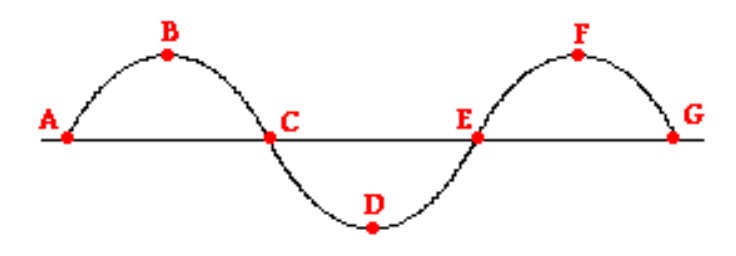
Write the parts of the wave.
A.
B.
C.
D.

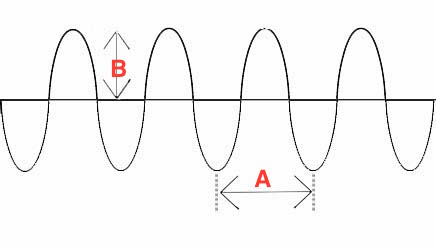
Which wave has a higher amplitude
The wave on top
The wave on bottom
They both have the same amplitude
Anyone
Electromagnetic waves are different from mechanical waves because:
Electromagnetic waves does not requieres a medium to travel
Electromagnetic waves only travel through a medium
Electromagnetic waves travel slower than mechanical waves
Eectromagnetic waves are not emitted from the Sun
Longitudinal waves are...
Move up and down and perpendicular
Move back and forth and parallel
Use both transfering the energy
Frequency of a wave is measured in units called
Joules (J)
Newtons (N)
Hertz (Hz)
Seconds
Write 3 differences between Transversal waves and Longitudinal waves.
Criteria D: Write about how do you think waves can help us to communicate with each others in this moments with the Covid - 19.
What is the difference between Period and frequency? Explain it with an example.

Which type of wave causes the medium to vibrate in a direction parallel to the waves motion?
transverse
longitudinal
surface
mechanical

Which type of waves causes the medium to vibrate perpendicular to the direction of the wave?
transverse
longitudinal
surface
mechanical
Which object would be best to model a longitudinal wave?
rope
bridge
slinky
water bottles
Amplitude is a measurement of the
speed of the wave
pitch
distance of wavelength
amount of energy the wave has
Sound is what kind of wave?
transverse
longitudinal
surface
electromagnetic

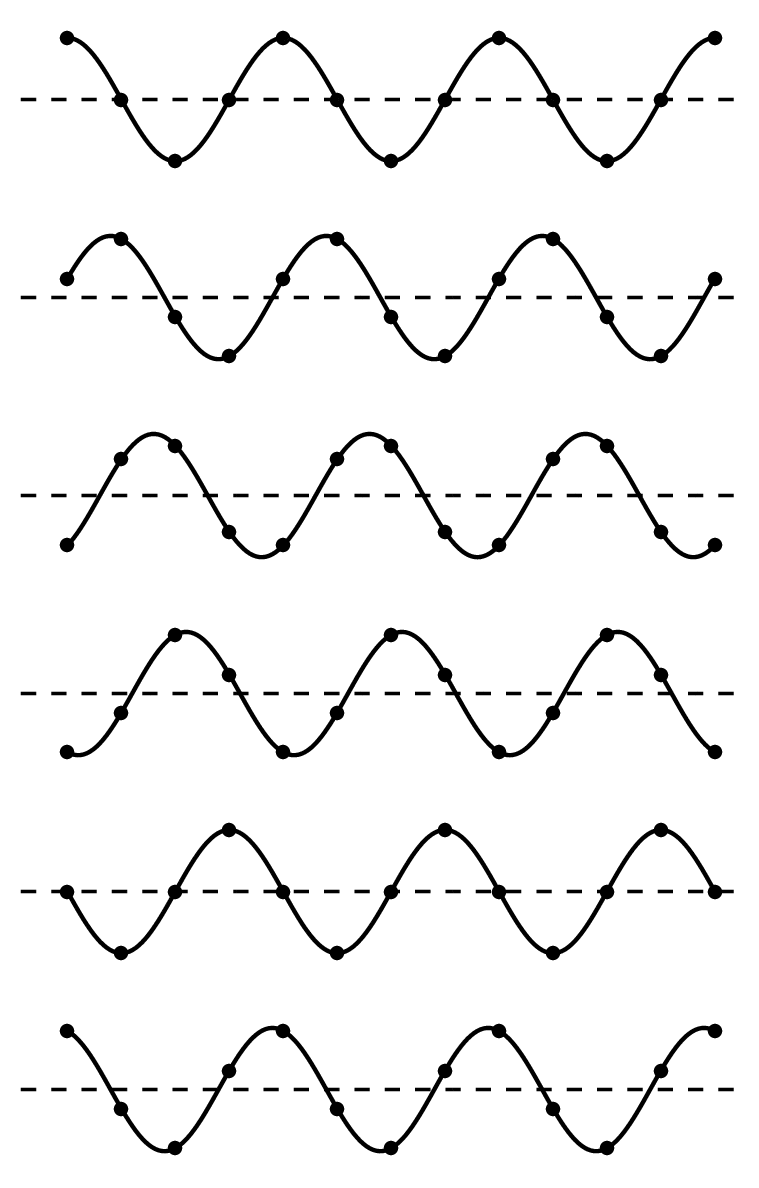
What kind of wave is pictured?
transverse
longitudinal
surface
sound
The maximum distance from the rest position is called
wavelength
amplitude
frequency
speed
What is the standard unit of frequency?
m/s
Hz
m
lambda
The material through which a wave travels is called the
medium
vacuum
stuff
contingent
The number of waves that pass a given point in a certain amount of time
amplitude
wavelength
frequency
period
The densest part of a longitudinal wave is called a
compression
rarefaction
amplitude
transform
The smaller the wavelength the __________ the energy
lower
higher
Which of the following types of waves require a medium?
light
sound
x ray
radio
What kind of wave does not require a medium to travel?
mechanical
electromagnetic
longitudinal
seismic
What part of a longitudinal wave is "spread apart"
compression
rarefaction
amplitude
frequency
What color light is 5 x 10^-7
orange
yellow
green
blue
Which wave has the highest energy of those listed?
radio
uv
infrared
visible light
Which wave has the largest wavelength?
x ray
visible light
radio
gamma ray
The color of light is determined by the
wavelength
speed
amplitude
crest
The color of an object is due to
the wavelength it absorbs
the wavelength it reflects
the speed it absorbs
the medium of the frequency
The frequency of a sound wave determines its
volume
pitch
speed
refraction
Electromagnetic waves travel
at the speed of light
only in air
fastest in solids
only if they have a medium

Name the missing part of the wave
Amplitude
Wavelength

Name the missing part of the wave ....?
Wavelength
Amplitude

This type of wave is called a...
Longitudinal wave, because it's particle motion is parallel to direction of wave travel
Transverse wave, because it's particle motion is perpendicular to the direction of wave travel

This type of wave is called a...
Longitudinal wave, because it's particle motion is parallel to direction of wave travel
Transverse wave, because it's particle motion is perpendicular to the direction of wave travel

Which of the following travelling waves has a higher frequency?
A
B
C

What can you conclude about the relationship between wavelength and frequency by observing them?
Wavelength and frequency are unrelated
When wavelength increases, the frequency decreases.
When wavelength increases, the frequency also increases.

How could we represent the wave speed using wavelength λ and period T?
v=Tλ
v=λT
v=λ⋅T

Say that you observe 4 ripples per second reaching the edge of the pond and that the distance between the crest of the ripples are 7cm.
Can you calculate the speed of the ripples caused by the acorn? Remember v=λ⋅f
28 cm/sec
1.75 cm/sec
40 cm/sec

Human ears can hear between 20 Hz and 20,000 Hz. But animals can hear frequencies higher and lower than these. If a baby mouse makes sound wave travelling at 343 m/s and with a wavelength of 0.00858 m, can you hear it?
Yes
No
Which of the following statements about waves is correct?
Waves can be produced on ropes.
Waves are a way of transferring energy from place to place.
There are two types of wave: longitudinal and transverse.
All of the above.
Which of the following is not a property of all waves?
echoes
refraction
the Doppler effect
polarisation
Complete the sentence: The amplitude of a wave is
the time it takes for one complete oscillation of the wave.
the number of waves per second.
the maximum displacement from the rest position.
the distance between two successive points on a wave.
Complete the sentence: The wavelength of a wave is
the time it takes for one complete oscillation of the wave.
the number of waves per second.
the maximum displacement from the rest position.
the distance between two successive points on a wave.
Which of the following statements best describes a transverse wave?
a wave that vibrates at right angles to the direction of energy transfer
a wave that vibrates parallel to the direction of energy transfer
a sound wave
a wave that crosses other wavefronts
Which of the following statements best describes a longitudinal wave?
a wave that vibrates at right angles to the direction of energy transfer
a wave that vibrates parallel to the direction of energy transfer
a light wave
a wave that crosses other wavefronts
Which of the following is a type of longitudinal wave?
microwave
radio wave
sound wave
Mexican wave
Which of the following is the unit of frequency?
m/s
s
Hz
m
A wave has a time period of 0.2 s. What is the frequency of the wave?
0.2 Hz
5 Hz
0.2 s
5 s
A cyclist rotates the pedals of his bike twice in 1 second. What is the frequency at which he is turning?
2 Hz
1 Hz
0.5 Hz
20 Hz
The wave machine at a swimming pool oscillates at a frequency of 0.25 Hz. What is the time period of the wave?
25 seconds
0.25 seconds
4 seconds
40 seconds
Which equation correctly links wave speed, frequency and wavelength?
v = f × λ
v = λ/f
v = f × T
v × λ = f
Wave speed is measured in which unit?
m
Hz
m/s
s
A tuning fork creates a sound wave with a frequency of 250 Hz. The wavelength of the wave is 1.36 m. What is the speed of sound?
0.005 m/s
340 m/s
184 m/s
184 s
A dolphin sends out a call to another dolphin at a frequency of 130 Hz. The speed of sound in water is 1400 m/s. What is the wavelength of the wave?
11 m
0.1 m
182 m
101 m
A sailor measures 5 waves passing her boat in 10 seconds. Each wave has a wavelength of 2 m. What is the speed of the wave?
1 m/s
10 m/s
4 m/s
0.5 m/s
Which of the following statements best describes the law of reflection?
The angle of incidence is greater than the angle of reflection.
The angle of reflection is greater than the angle of incidence.
The angle of incidence is equal to the angle of reflection.
None of the above.
Complete the statement: The refraction of light occurs because
The light rebounds off the boundary surface.
The light changes speed as it enters another medium.
The light is reflected by the surface of the water.
None of the above.
An ambulance is driving quickly towards Jack with its siren on. How will the siren sound to Jack compared to if the ambulance was stationary?
The siren has a lower pitch.
The siren has a higher pitch.
The siren sounds the same.
The siren will sound the same, just louder.
What is the name given to the apparent shift in frequency when a source of waves is moving?
refraction
diffraction
reflection
the Doppler effect
Do waves carry energy or matter?
Energy
Matter
I'm not sure
What is a "medium" in terms of waves ??
A size between small and large
The material or object a wave travels through
How tall the wave is
How fast the wave is
In an ocean wave, what is the medium?
The boats as the move across the water
the currents underneath the ocean surface
the ocean water is the medium
Sunlight reflecting off the ocean surface

If you shake a rope to make a wave, what would be the medium of this wave?
Your hand moving up and down
The air surrounding the rope
the rope itself
there is no medium in this wave
Which of the following can act as a medium?
Solids
Liquids
Gases
All of the above

What is #2 pointing at on the diagram?
Wavelength
Amplitude
Trough
Crest

What is #3 pointing at on the diagram?
Interference
Trough
Wavelength
Amplitude
Do all waves always have the same wavelength?
Yes
No

As frequency increases from low to high, does energy increase with it?
YES - high frequency = high energy
NO - frequency and energy are not related

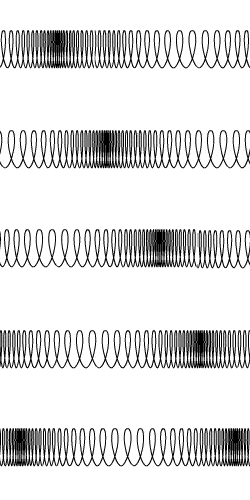
Does this wave demonstrate a TRANSVERSE WAVE or a COMPRESSIONAL/LONGITUDINAL WAVE?
(Look at particle motion compared to energy motion!)
Transverse Wave
Compressional/Longitudinal Wave

Does this wave demonstrate a TRANSVERSE WAVE or a COMPRESSIONAL/LONGITUDINAL WAVE?
(Look at particle motion compared to energy motion!)
Transverse Wave
Compressional/Longitudinal Wave
Which wave type does the medium move perpendicular (up/down) as the wave moves through it from left to right?
Compressional wave
Transverse wave
Electromagnetic wave
Which wave type ALWAYS needs a medium?
Mechanical wave
Electromagnetic wave
Neither wave type needs a medium

Does a short wavelength correlate to low or high frequency?
shorter wavelength = higher frequency
shorter wavelength = lower frequency
wavelength and frequency are NOT related
Do light waves need a medium to travel through?
NO
YES

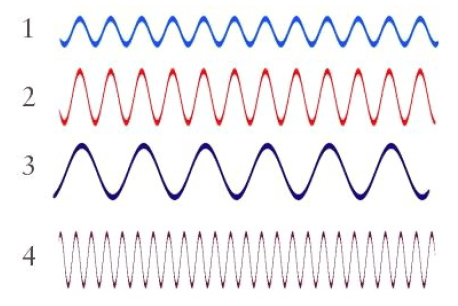
Which wave # has the LOWEST frequency??
Wave #1
Wave #2
Wave #3
Wave #4
Are sound waves transverse waves or longitudinal/compressional waves?
Transverse waves
Longitudinal/Compressional waves

What kind of wave is pictured below?
compressional wave
transverse wave
sound wave
Longitudinal wave

Which are properties of a mechanical wave? (select all that apply!)
can be longitudinal or transverse
can move through outer space
must have matter to move
carries energy

