
Font size
 Worksheets
Waves Quiz (Edexcel)
Total questions: 90
Worksheet time: 50mins
What do waves transfer?
Matter
Energy and information
Heat only
Sound only
How are waves described in terms of their motion?
As a straight line movement
As oscillations or vibrations about a fixed point
As a circular motion
As a random motion
What is an example of a wave causing particles to oscillate up and down?
Sound in air
Ripples in water
Light in a vacuum
Heat in a metal rod
What do sound waves cause particles of air to do?
Move in a straight line
Vibrate back and forth
Rotate around a fixed point
Expand and contract
Do waves transfer matter along with energy and information?
What type of wave is present on the surface of a body of water?
Longitudinal wave
Transverse wave
Surface wave
Sound wave
Why does the toy duck not travel with the wave?
Because the duck is anchored to the bottom of the water body
Because the duck is too heavy to move with the wave
Because the wave transfers energy, not the particles of the medium
Because the duck is not a part of the water
What demonstrates that waves do not transfer matter?
The duck moves in a circular motion
The duck moves along with the wave horizontally
The duck bobs up and down without moving horizontally with the wave
The duck sinks when the wave passes
What happens to the points on the wave as it passes?
They move along with the wave
They vibrate back and forth about fixed positions
They travel to the shore
They sink and rise with the wave
What is transferred by both transverse and longitudinal waves?
Matter
Particles
Energy
Heat
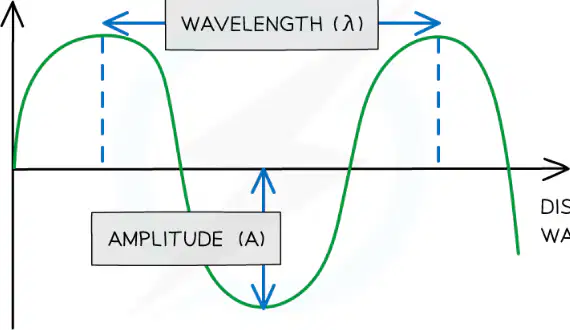
What is amplitude defined as in wave motion?
The distance from one point on the wave to the same point on the next wave
The distance from the undisturbed position to the peak or trough of a wave
The maximum velocity of the wave
The time it takes for one complete wave to pass a point
What symbol is used to represent wavelength in wave motion?
A
T
λ (lambda)
v
How is wavelength measured in a transverse wave?
From the centre of one compression to the centre of the next
From the peak to the undisturbed position
From one peak to the next peak
From the trough to the undisturbed position
How is wavelength measured in a longitudinal wave?
From the peak to the undisturbed position
From one peak to the next peak
From the centre of one compression to the centre of the next
From the trough to the undisturbed position
In a wave diagram, where is the distance along a wave typically put?
On the y-axis
On the z-axis
On the x-axis
On the wavefront
What is the definition of frequency in the context of waves?
The distance a wave travels in one second
The number of waves passing a point in one second
The time taken for a wave to complete one cycle
The height of the wave from the equilibrium position
What symbol is used to represent frequency?
λ
T
f
v
How is frequency measured?
Meters (m)
Seconds (s)
Hertz (Hz)
Meters per second (m/s)
What does the time period of a wave represent?
The number of waves passing a point in one second
The distance a wave travels in one second
The time taken for a single wave to pass a point
The speed of the wave
What symbol is used to represent the time period of a wave?
λ
T
f
v
How is the time period measured?
Meters (m)
Seconds (s)
Hertz (Hz)
Meters per second (m/s)
What is the relationship between frequency (f) and time period (T) of a wave?
How is wave velocity (or wave speed) defined?
The number of waves passing a point in one second
The time taken for a single wave to pass a point
The distance a wave travels in one second
The height of the wave from the equilibrium position
What is a wavefront a useful way of picturing?
The amplitude of a wave
Waves from above, where each wavefront represents a single wave
The frequency of a wave
The period of a wave
What does the space between each wavefront represent?
The amplitude of the wave
The frequency of the wave
The wavelength
The energy of the wave
What does it represent when wavefronts are close together?
A wave with a long wavelength
A wave with a high amplitude
A wave with a short wavelength
A wave with a low frequency
What does it represent when wavefronts are far apart?
A wave with a high frequency
A wave with a short wavelength
A wave with a low amplitude
A wave with a long wavelength
What is sometimes called a ray in the context of wavefronts?
The direction the wave is moving
The space between wavefronts
The wavefronts that are close together
The wavefronts that are far apart
What are waves described as in the context of transferring energy?
Repeated vibrations that transfer energy
Single occurrences that transfer energy
Continuous motion that does not transfer energy
Random movements that occasionally transfer energy
Which of the following is NOT a type of wave mentioned in the text?
Transverse
Longitudinal
Circular
Electromagnetic
How are transverse waves defined?
Waves where the points along its length vibrate parallel to the direction of energy transfer
Waves where the points along its length vibrate at 90 degrees to the direction of energy transfer
Waves where the points along its length do not vibrate
Waves where the points along its length vibrate in random directions
In a transverse wave, the energy transfer is:
Parallel to wave motion
Perpendicular to wave motion
In the same direction as the particle motion
Not related to the wave motion
Which of the following environments can transverse waves move in?
Solids only
Liquids only
Gases only
Solids, liquids, gases, and in a vacuum
What is the highest point above the rest position on a wave called?
Trough
Crest
Peak
Summit
What is the lowest point below the rest position on a wave called?
Trough
Crest
Valley
Dip
Which of the following is NOT an example of a transverse wave?
Ripples on the surface of water
Vibrations in a guitar string
S-waves (a type of seismic wave)
Sound waves in air
In transverse waves, how are the vibrations of the particles in the medium oriented relative to the direction of energy transfer?
Parallel
At a 45-degree angle
Perpendicular
In the same direction
What do the curves above and below the central line in the representation of transverse waves indicate?
The direction of energy transfer
The amplitude of the wave
The peaks and troughs of the wave
The frequency of the wave
How are transverse waves represented in diagrams?
As a dotted line
As a continuous solid line
With arrows only
Not represented at all
In longitudinal waves, how do the points along its length vibrate?
Perpendicular to the direction of energy transfer
Parallel to the direction of energy transfer
In a circular motion
They do not vibrate
For a longitudinal wave, which of the following statements is true?
They transfer energy and the particles of the medium
They can move in a vacuum
They cannot move in solids, liquids, and gases
The energy transfer is in the same direction as the wave motion
What are the key features of a longitudinal wave called where the points are close together?
Troughs
Rarefactions
Compressions
Crests
What are the key features of a longitudinal wave called where the points are spaced apart?
Troughs
Rarefactions
Compressions
Crests
Which of the following is an example of a longitudinal wave?
Light wave
Sound wave
Water wave
Radio wave
What does drawing the lines closer together in the representation of a longitudinal wave indicate?
Rarefaction
Compression
Wavelength
Amplitude
Longitudinal waves can be seen in a slinky spring when it is:
Held at one end and shaken up and down
Moved quickly backwards and forwards
Placed on a surface and stretched out
Twisted in a circular motion
In a longitudinal wave, the direction of energy transfer is:
Perpendicular to the wave movement
In a circular pattern
Parallel to the wave movement
In an oscillating motion
In a longitudinal wave, what is the direction of energy transfer relative to the direction of vibration?
Perpendicular to the direction of vibration
The same as the direction of vibration
Opposite to the direction of vibration
There is no energy transfer in longitudinal waves
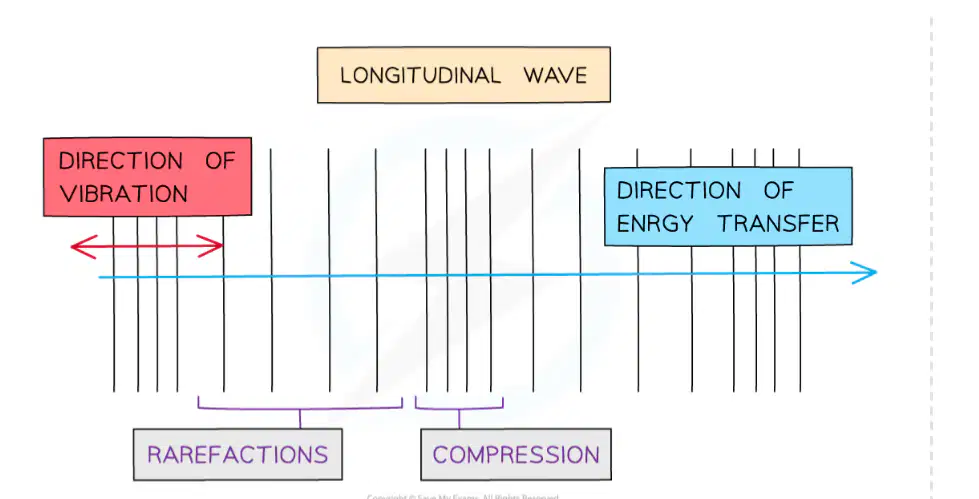
What are the two main features of a longitudinal wave as shown in the diagram?
Troughs and crests
Rarefactions and compressions
Peaks and valleys
Nodes and antinodes
Which of the following can be used to demonstrate longitudinal waves according to the text?
Water surface
Ropes
Springs
Light beams
In which direction does the wave travel in a rope compared to the vibration of the rope?
Parallel
Perpendicular
At a 45-degree angle
In the same direction as the hand movement
How does the wave travel in a spring relative to the vibration of the coils?
Perpendicular
At a 45-degree angle
Parallel
In a zigzag pattern
What is depicted by the arrows in the diagrams for both ropes and springs?
Direction of the wave only
Direction of the vibration only
Movement of energy
Direction of the external force applied
What is the structure of transverse waves?
Compressions and Rarefactions
Peaks and Troughs
Constant density
Changes in pressure
In which medium can longitudinal waves not travel?
Vacuum
Solids
Liquids
Gases
How does the vibration direction of transverse waves relate to the direction of energy transfer?
Parallel to direction of energy transfer
90 degrees to direction of energy transfer
Dependent on material it is traveling in
Changes in pressure
What happens to the density of longitudinal waves as they travel?
Constant density
Changes in density
Pressure is constant
Dependent on material it is traveling in
What is the speed of wave dependent on for transverse waves?
Changes in pressure
Constant density
Dependent on material it is traveling in
Cannot travel in a vacuum
What type of waves are P-waves?
Transverse waves
Longitudinal waves
Surface waves
Mechanical waves
In longitudinal waves, how do points along the wave vibrate relative to the direction of energy transfer?
Perpendicular to the direction of energy transfer
In a circular motion
Parallel to the direction of energy transfer
In an elliptical motion
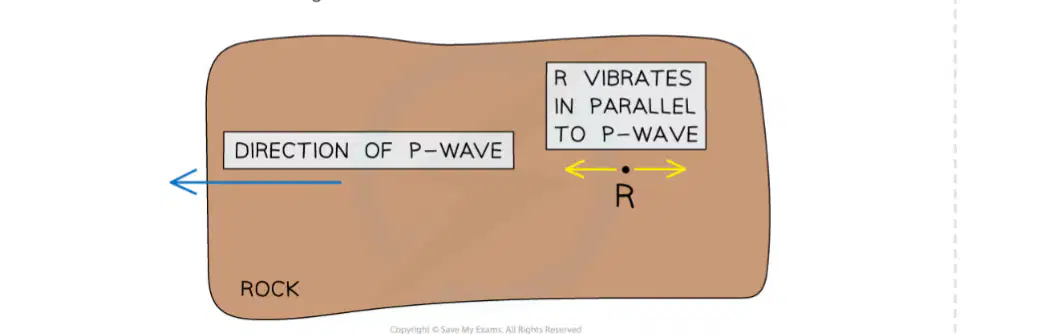
What is indicated by the arrows at point R in the diagram?
The point R is stationary
The point R vibrates in a direction that is perpendicular to the P-wave
The point R vibrates in parallel to the direction of the P-wave
The point R represents the amplitude of the P-wave
How is wave speed defined according to the wave equation?
The distance a wave travels in a given amount of time
The frequency of the wave divided by the wavelength
The time it takes for a wave to travel one meter
The product of the wave's frequency and wavelength
What is the formula for calculating wave speed?
v = d / t
v = f × λ
v = λ / f
v = t / d
What does the symbol 'v' represent in the wave speed equation?
Velocity
Volume
Voltage
Wave speed in metres per second (m/s)
What does the wave equation v = f × λ relate?
Wave speed to distance and time
Wave speed to frequency and wavelength
Frequency to time and wavelength
Wavelength to distance and time
What does the symbol 'λ' stand for in the wave equation?
Frequency in Hertz (Hz)
Time in seconds (s)
Wavelength in metres (m)
Distance travelled by the wave
If a wave's frequency is 10 Hz and its wavelength is 2 meters, what is the wave speed?
5 m/s
10 m/s
20 m/s
200 m/s
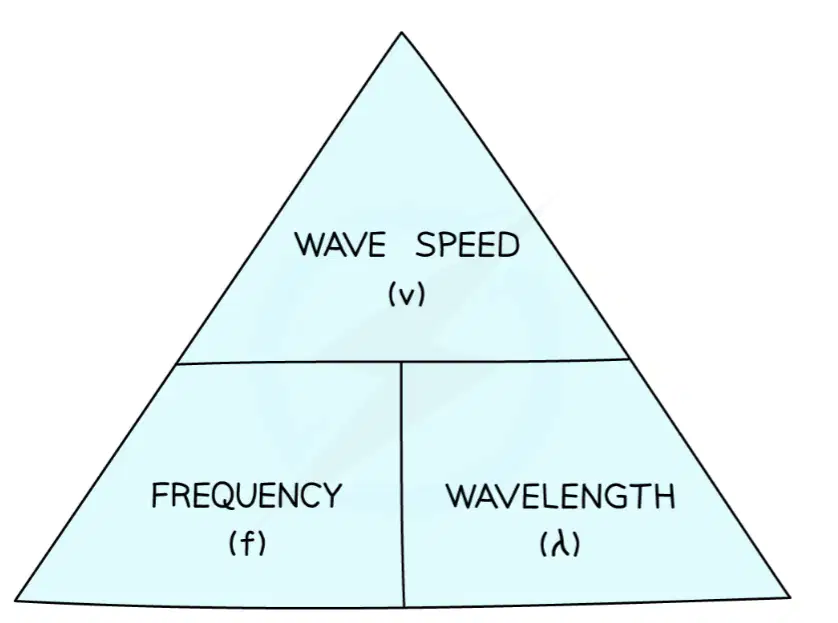
What is the relationship between wave speed (v), frequency (f), and wavelength (λ) as shown in the diagram?
v = f + λ
v = f / λ
v = f × λ
v = f - λ
Given a wave in a pond has a speed of 0.15 m/s and a time period of 2 seconds, what is the frequency of the wave?
0.075 Hz
0.3 Hz
0.5 Hz
2 Hz
Using the same wave with a speed of 0.15 m/s and a time period of 2 seconds, what is the wavelength of the wave?
0.075 m
0.3 m
0.15 m
0.6 m
What is the formula to calculate frequency (f) if the period (T) is known?
f = T
f = 1/T
f = T^2
f = 2T
Given the wave speed (v) as 0.15 m/s and the frequency (f) as 0.5 Hz, what is the wavelength (λ)?
λ = 0.075 m
λ = 0.30 m
λ = 0.60 m
λ = 1.50 m
How can frequency be calculated from the period?
Multiply the period by 2
Divide 1 by the period
Square the period
Take the square root of the period
What should you be careful about when converting frequency units from kHz to Hz?
1 kHz = 10 Hz
1 kHz = 100 Hz
1 kHz = 1000 Hz
1 kHz = 10000 Hz
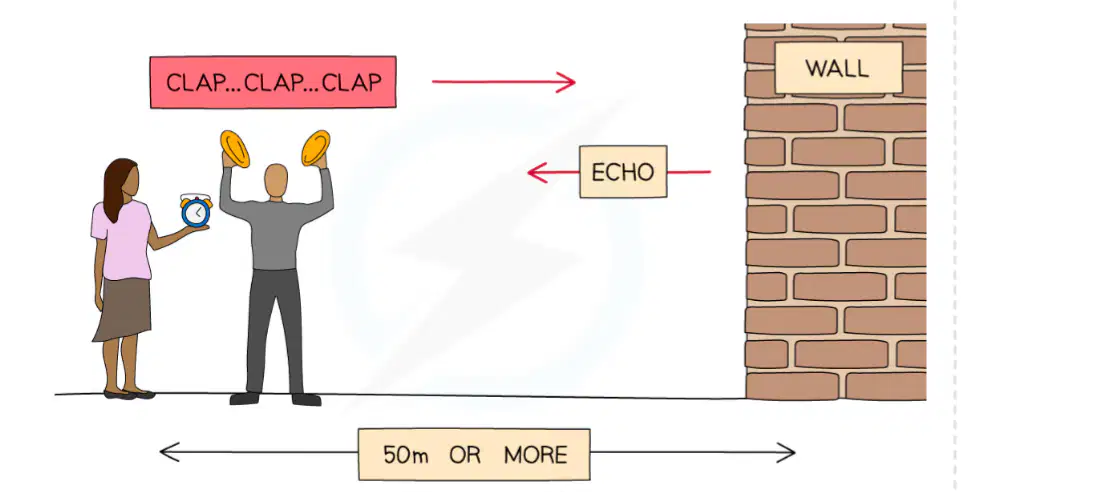
What is the purpose of the experiment described in the method for measuring wave speed?
To determine the speed of light in air
To determine the speed of sound in air
To measure the distance between two points using sound
To test the hearing ability of individuals
What equipment is used to measure the distance between the two people in the experiment?
A ruler
A measuring tape
A trundle wheel
A stopwatch
What do the two people use to create a sound in the experiment?
A whistle
Two wooden blocks
A bell
Clapping hands
What is the minimum distance recommended between the two people in the experiment?
50m
100m
150m
200m
How is the speed of sound calculated in this experiment?
By measuring the time it takes for the sound to travel between the two people
By counting the number of claps heard in a minute
By using the frequency of the sound waves produced
By measuring the loudness of the sound at the second point
What instrument is used by a person to measure the distance from a wall when measuring the speed of sound using echoes?
Stopwatch
Trundle wheel
Wooden blocks
Tape measure
What must be the minimum distance between a person and a wall to effectively measure the speed of sound using echoes according to the method described?
10m
20m
50m
100m
How many times should the claps be repeated to calculate an average time for the echoes when measuring the speed of sound?
10
20
30
40
What is the purpose of the second person with a stopwatch in the method described for measuring the speed of sound using echoes?
To measure the distance to the wall
To listen for the echo
To start timing when they hear one of the claps and stop timing 20 claps later
To clap the wooden blocks
What is the total distance travelled by sound during the 20 claps if the person is standing 50m away from the wall?
500m
1000m
2000m
2500m
Which equation is used to calculate the speed of sound based on the method described in the image?
SPEED OF SOUND = DISTANCE TRAVELED BY SOUND / TIME TAKEN
SPEED OF SOUND = TIME TAKEN / DISTANCE TRAVELED BY SOUND
SPEED OF SOUND = DISTANCE TRAVELED BY SOUND * TIME TAKEN
SPEED OF SOUND = TIME TAKEN * DISTANCE TRAVELED BY SOUND
What is the purpose of using two microphones in the method of measuring the speed of sound using an oscilloscope?
To measure the distance between the microphones
To detect the sound at two different locations and measure the time difference
To amplify the sound of the clap
To record the sound for analysis at a later time
What triggers the oscilloscope to display the sound waves in this experiment?
The sound of the clap reaching the second microphone
The sound of the clap reaching the first microphone
The sound of the clap reaching both microphones simultaneously
The sound of the clap echoing off the wall
How is the speed of sound calculated using this method?
Speed of sound = Distance to the wall / Time taken
Speed of sound = 2 * Distance to the wall / Time taken
Speed of sound = Time taken / Distance to the wall
Speed of sound = Distance to the wall / 2 * Time taken
What is the role of the two wooden blocks in this experiment?
To hold the microphones in place
To reflect the sound waves
To make a large clap next to the first microphone
To adjust the distance between the microphones
What is done after measuring the time difference between the claps reaching each microphone?
The experiment is concluded
The oscilloscope settings are adjusted
The distance between the microphones is measured again
The time difference is used to calculate the speed of sound

