
Font size
 Worksheets
#10 Food Webs, Adaptations
Total questions: 58
Worksheet time: 2hrs 34mins

What is a fitting description for this diagram?

The Mayfly is a food source for which 3 organisms?

The trout is a source of food for the human and the eagle. When there are more than one organism vying for the same source we call this____?


An animal that gets energy from eating both plants and animals is a(n)
herbivore
carnivore
omnivore

Which of the following is NOT a consumer
grass
dog
shark
fish

Which of the following is a living part of the ecosystem?
Air
Sunlight
Mushroom
Soil

Decomposers get energy from...
the sun
eating plants
eating animals
dead things and waste

Arrows in a food web represent...
eating
sunlight
energy
matter
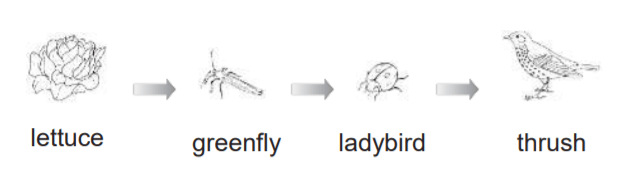
Who is the producer?
lettuce
greenfly
ladybird
thrush

What is a producer?
an organism that gets energy from eating other organisms
an organisms that uses sunlight to make its own food
an organism that gets energy from eating dead organisms, non-living material or waste

An animal that hunts other animals for food is a ___________
herbivore
predator
prey
omnivore

What is a herbivore?
an animal that gets energy from eating other animals
an organism that gets energy from eating only plants
an animal that gets energy by eating both plants and other animals

ow many types of organisms in this food web obtain energy directly from producers?
two
three
four
five

Which type of organism should replace the X in the food web?
an omnivore
an herbivore
a carnivore
a producer
The deer population has significantly increased in an ecosystem, the best hypothesis is


Finding the fossils of trees in an area that is currently a desert without much life might tell us that the area, millions of years ago –
was heavily eroded by strong winds
received enough rain to support a forest
suffered very powerful earthquakes
was destroyed by the impact of meteorites

This table gives information for different kinds of fossils. Finding which kind of fossil would lead to the conclusion that the area where it was found was, long ago, under hundreds of meters of salt water?


An area is currently a forest. What evidence would best indicate that this area was covered by water millions of years ago?
An increase in rainfall in the forest over time
Presence of plants in the forest that need water to live
Fossils of fish discovered in rocks below the forest
Insects living in the forest that lay their eggs in water

This table gives information on different fossils. According to the information on the table, finding which fossil in a region would lead to the conclusion that the area was, long ago, covered with trees?


Fossil ferns, like the ferns found in modern swamps, were discovered in a layer of rock. In a rock layer below were found the fossils of cactus, like those that live in hot, arid deserts today. Based on this evidence, we could conclude that the area where the fossils were discovered had what sequence of climates in the past?
Forest, followed by deep ocean
Cold climate that got warmer over time
Rushing river, then a dark cave
Very dry and then, much more damp

What does it mean to CAMOUFLAGE?
when a weak animal copies a stronger animal to warn of predators
when an animal is able to change colors to survive in an enviornment
when an animal hibernates during the winter.

What is HIBERNATION?
when a weak animal copies stronger animal to warn off predators.
when an animal hides in the cold winter and sleeps until the spring
when a larger animal eats its prey


Some animals, such as lions, have pointed teeth, while other animals, such as cattle, have flat teeth. The difference in the shape of these animals' teeth is most closely related to--- (5.10A)
the type of organisms the animals consume
the sounds the animals make
the habitat the animals live in
the type of predators the animals have

A chameleon lies next to a large blue flower so predators can NOT find it. This is an example of
camouflage
mimicry
migration

The teeth in this picture are from an animal that would most likely eat
grass
insects
fruit
fish

Sea turtles are also different from land turtles because sea turtles cannot pull their head or limbs into their shell to protect themselves from predators. how does the head, shell shape, and flippers of sea turtles help the turtles escape their predators?
Dig deep holes for their eggs
Swim and dive easily
Blend into their surroundings
Hold their breath for several minutes

Which structural adaptation allows the penguin to stay warm when diving in icy water?
The beak
The feathers
The flippers
The webbed feet

Skunks have a structural adaptation that releases a liquid spray with a bad odor when in close contact with predators. How is the adaptation helpful to the skunk?
Avoid predators
Obtain food
Make shelter
Increase body temperature


What is the function on large padded paws on a snow leopard?
camouflage
protection from predators
keep it warm
walking in snow

What is the structure that helps the duck swim in water?
beak
feathers
fin
webbed feet

Adaptations help animals ___________.
survive
get food
protect themselves
all of the above

All of the living things in an environment.
Biotic
Abiotic

Non-living physical and chemical elements of an environment.
Biotic
Abiotic
Frogs in a pond interact with both living and nonliving elements in their ecosystem. Frogs interact with nonliving elements when they _________.
eat swimming insects for energy
lay their eggs in bodies of water
become food for another animal
hide beneath plants in the pond

This organism, usually a bacteria or fungus, breaks down dead plants and animals.
Producer
Consumer
Decomposer
A plant uses which nonliving components to produce food and oxygen?
sunlight, water, and carbon dioxide
sunlight and carbon dioxide
water, and carbon dioxide
Soil, ice, and oil


Using the food web, choose the organisms in the correct order.
microscopic plants > water fleas > small fish > perch
microscope plants > perch > water flease > small fish
perch > waterboatmen > small fish > tadpoles
microscopic plants > tadpoles > water boatman > perch

producer
consumer
decomposer
What is the primary role of decomposers in an ecosystem?
To break down dead organisms and recycle nutrients
To produce energy from sunlight
To provide shelter for small animals
To compete with herbivores for food
Which of the following adaptations would help an animal survive in a desert environment?
Thick fur
Large ears
Webbed feet
Bright feathers
What would likely happen to a food web if a top predator is removed?
The population of prey species would decrease
The ecosystem would become more stable
The population of prey species would increase
Producers would become extinct

