
Font size
 Worksheets
Fondren Circular Motion Review
Total questions: 48
Worksheet time: 1hrs 3mins
Which of the following factors is the period of an oscillating spring dependent on? Select all that apply.
gravity
mass
spring constant
amplitude of the oscillation
length of spring
Which of the following factors is the period of a simple pendulum on? Select all that apply.
gravity
mass
spring constant
amplitude of the oscillation
length of string
Which of the following correctly describes the relationship between period and frequency?
Period is twice frequency
Frequency and period are the same
Period is equal to 1/f
Frequency is period multiplied by the number of oscillations.
What is the unit of period?
(a)
What is the unit of frequency?
(a)
Which of the following is the correct equation for the period of a simple pendulum?
T=2πmk
T=2πkm
T=2πlg
T=2πgl
Simple Pendulum
As the mass attached to the pendulum increases, what happens to the period of the pendulum?
It increases
It decreases
It stays the same
Simple Pendulum
As the length of the pendulum increases, what happens to the period of the pendulum?
It increases
It decreases
It stays the same
Simple Pendulum
As the acceleration due to gravity increases, what happens to the period of the pendulum?
It increases
It decreases
It stays the same
Oscillating Spring
As the mass attached to the spring increases, what happens to the period of the spring?
It increases
It decreases
It stays the same
Oscillating Spring
As the spring constant (k) of the spring increases, what happens to the period of the spring?
It increases
It decreases
It stays the same
As the amplitude (size of oscillation) increases, what happens to the period of an object in simple harmonic motion?
It increases
It decreases
It stays the same
As period increases, frequency:
decreases
increases
stays the same
As frequency increases, period:
decreases
increases
stays the same
For a system in simple harmonic motion, which of the following is the number of cycles or oscillations per unit of time?
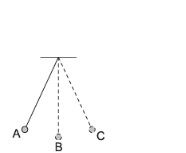
A pendulum oscillates as shown. At which of the following positions is the kinetic energy equal to the total energy?
A
B
C
Not enough information given.
A pendulum swings back and forth 10 times in 12.1 s. What is the period?
12.1 s
1..21 s
0.121 s
0.826 s
8.26 s
A pendulum swings back and forth 10 times in 12.1 s. What is the frequency?
12.1 Hz
1..21 Hz
0.121 Hz
0.826 Hz
8.26 Hz

The maximum velocity occurs where the ____.
potential energy is a maximum
kinetic energy is a minimum
displacement from equilibrium is equal to
the amplitude of 0.4 𝑚
displacement from equilibrium is equal to
zero
Increasing which of the following will increase the frequency of a spring-mass oscillator? (SELECT ALL THAT APPLY.)
Spring constant
Mass
Amplitude
Gravitational field strength
Period
When is the pendulum at 0 velocity
At its lowest point
At its highest point
It moves at a constant velocity
It is at rest
A pendulum swings back and forth 10 times in 12.1 s. What is the frequency?
12.1 Hz
1..21 Hz
0.121 Hz
0.826 Hz
8.26 Hz
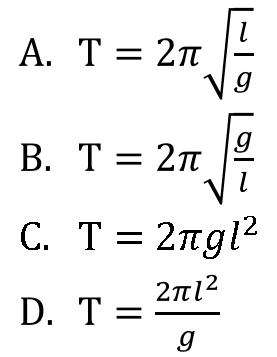
Based on your findings, which equation could best describe the pendulum’s period?
A
B
C
D
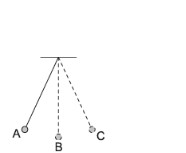
A pendulum oscillates as shown. At which of the following positions is the potential energy equal to the total energy?
A
B
C
Not enough information
A pendulum oscillates as shown. At which of the following positions is the kinetic energy equal to the total energy?
A
B
C
Not enough information given.
What shape is Earth's orbit?
circle
ellipse
square
spiral
What is Kepler's 1st law?
The planets orbit in an ellipse
The plants move faster when they are closer to the sun and slower when they are further from the sun
The farther a planet is from the sun the slower the orbit
(P2 = a3)
What is Kepler's 2nd law?
The planets orbit in an ellipse
The plants move faster when they are closer to the sun and slower when they are further from the sun
The farther a planet is from the sun the slower the orbit
(P2 = a3)
What is Kepler's 3rd law?
The planets orbit in an ellipse
The plants move faster when they are closer to the sun and slower when they are further from the sun
The farther a planet is from the sun the slower the orbit
(P2 = a3)
The point in the earth's orbit where it is closest to the sun and moves the fastest.
aphelion/apogee
perihelion/perigee
The point in the earth's orbit where it is farthest to the sun and moves the slowest.
aphelion/apogee
perihelion/perigee
What planet is closest to the sun?
Mars
Earth
Venus
Mercury
What are the four inner planets?
Earth, Uranus, Mercury, Venus
Mercury Venus Earth Saturn
Mars, Earth , Mercury, Venus
Mars, Earth, Neptune, Mercury
Which planet is farthest from the sun?
Neptune
Jupiter
Mercury
Uranus
Which planets are made of solid surfaces and rocky cores?
terrestrial
gas giants
outer planets
Which planets are mostly made of gases?
terrestrial
gas giants
inner planets

